
Autonomous Underwater Vehicle Market Outlook: Size, Share, Trends, Growth Analysis, Competitive Landscape & Forecast, 2022-2033

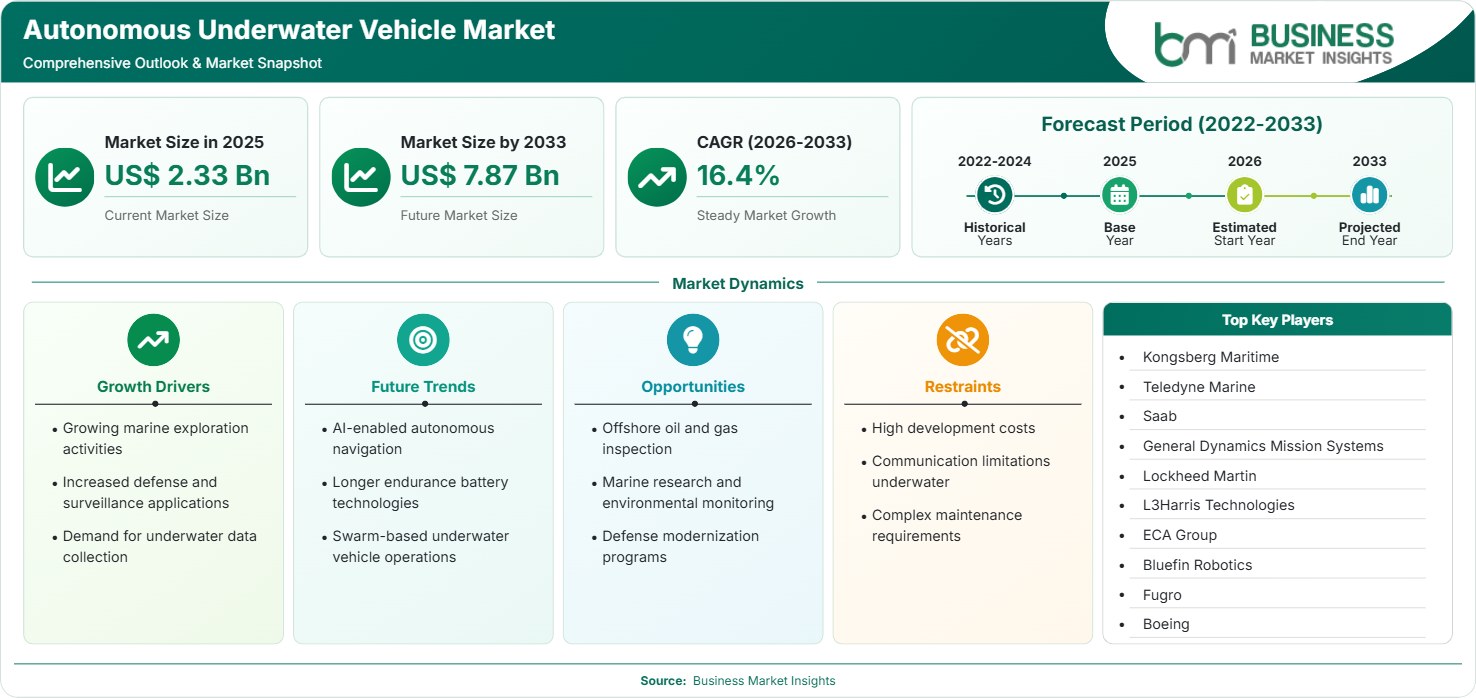
The Autonomous Underwater Vehicle Market was valued at US$ 2.33 Billion in 2025 and is projected to reach US$ 7.87 Billion by 2033, growing at a CAGR of 16.4% during 2026–2033. Market growth is driven by expanding marine exploration, rising defense and surveillance applications, and increasing demand for underwater data collection. Additional opportunities are emerging from offshore oil and gas inspection, marine research, environmental monitoring, and defense modernization.

Report Coverage
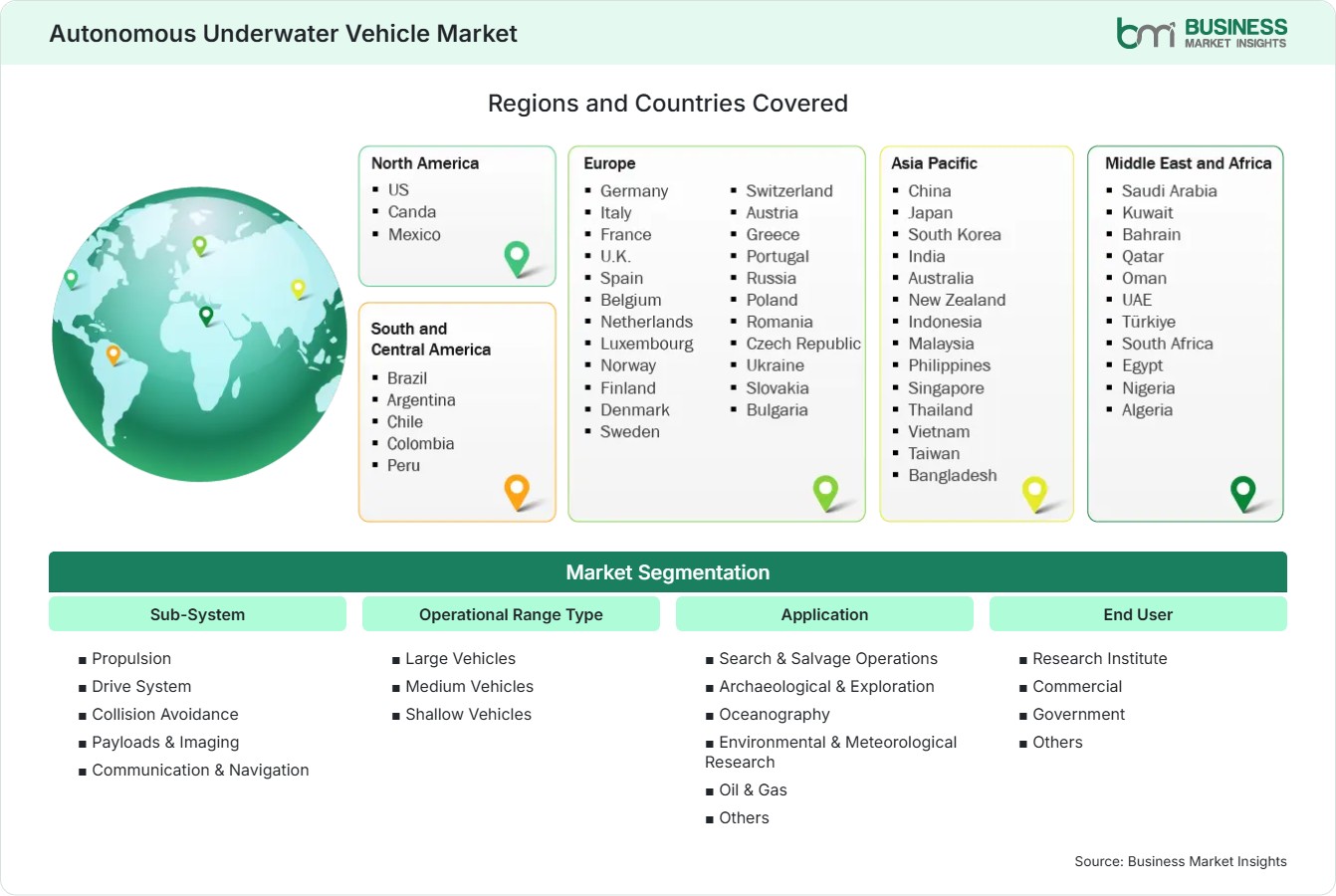
  • Sub-System: Propulsion, Drive System, Collision Avoidance, Payloads & Imaging, Communication & Navigation
  • Operational Range Type: Large Vehicles, Medium Vehicles, Shallow Vehicles
  • Application: Search & Salvage Operations, Archaeological & Exploration, Oceanography, Environmental & Meteorological Research, Oil & Gas, Others
  • End User: Research Institute, Commercial, Government, Others
US$ 2.33 Bn Market size in 2025
US$ 7.87 Bn Market Size by 2033
16.4% CAGR, 2026 - 2033
2026-2033 Forecast Period

AI Overview

Autonomous Underwater Vehicle Market Summary

  • North America Region: North America accounted for 34%–37% of the market in 2025 and is projected to grow at a CAGR of 15.8%–16.3% during 2026–2033. Strong naval investments, ocean research, offshore energy activities, and underwater technology development continue supporting growth. The United States remains the leading contributor with a projected CAGR of 16.0%–16.5%.
  • Fastest Growing Region: Asia Pacific represented 28%–31% market share in 2025 and is expected to register the fastest CAGR of 17.2%–17.8% through 2033, supported by increasing maritime security, offshore exploration, oceanographic research, and government investments.
  • Leading Segment: Payloads & Imaging accounted for 32%–35% market share in 2025 and is forecast to grow at a CAGR of 16.5%–17.0%, driven by demand for underwater mapping, inspection, imaging, and scientific data collection.
  • High Growth Segment: Communication & Navigation represented 18%–21% market share in 2025 and is projected to expand at a CAGR of 17.5%–18.0% due to advances in underwater communication, navigation accuracy, and autonomous mission capabilities.
  • Key Market Opportunity: Growing offshore inspection, environmental monitoring, and defense modernization programs are creating opportunities for manufacturers developing advanced navigation, sensing, and long-endurance technologies.
  • Major Market Players: Kongsberg Maritime, Teledyne Marine, Saab AB, General Dynamics Mission Systems, Lockheed Martin Corporation, L3Harris Technologies, Inc., ECA Group, Bluefin Robotics, Fugro N.V., The Boeing Company.
Strategic Insights

Autonomous Underwater Vehicle Market: Strategic Insights

Autonomous Underwater Vehicle Market Strategic Framework
FREE PDF
Request your free sample
Request free sample
Stakeholder View

Key Takeaways

  • The market ecosystem is expanding through collaboration among marine technology developers, defense contractors, research institutions, offshore operators, and sensor manufacturers. Integrated navigation, propulsion, and data-processing capabilities strengthen competitive positioning.
  • Defense surveillance, offshore energy inspection, and oceanographic research offer the strongest growth opportunities as organizations seek efficient and reliable underwater systems.
  • Innovation focuses on AI-based navigation, advanced imaging, energy-efficient propulsion, autonomous mission planning, and improved underwater communication.
  • Asia Pacific presents strong investment opportunities due to growing maritime security needs, offshore exploration, ocean research, and government support for underwater technologies.
  • Strategic collaborations, defense contracts, acquisitions, and technology partnerships continue shaping competition across commercial, scientific, and military applications.
  • Rising environmental monitoring and climate research initiatives are increasing demand for autonomous platforms capable of long-duration oceanographic and ecological data collection.
Geographic Outlook

Autonomous Underwater Vehicle Market Regional Highlights

North America Autonomous Underwater Vehicle Market

North America accounted for 34%–37% of global revenue in 2025 and is projected to grow at a CAGR of 15.8%–16.3% during 2026–2033. Growth is supported by naval modernization, marine research, offshore energy activities, and investments in autonomous maritime technologies. Defense applications, oceanographic studies, and commercial underwater inspection continue driving regional demand.

  • The United States dominates regional demand through defense investments, naval surveillance, marine research, and offshore infrastructure inspection, with a projected CAGR of 16.0%–16.5%.
  • Defense agencies are expanding the use of autonomous underwater vehicles for intelligence gathering, mine detection, maritime surveillance, and operational support.
  • Research institutions deploy advanced underwater systems for ocean mapping, climate studies, marine biodiversity analysis, and long-term environmental monitoring.
  • Offshore energy operators use autonomous vehicles for subsea inspection, pipeline monitoring, and infrastructure assessment to improve safety and reduce costs.
  • Technology companies continue investing in autonomous navigation, artificial intelligence, and sensor integration to improve mission efficiency and reliability.

US Autonomous Underwater Vehicle Market

The United States represented 29%–32% of the global Autonomous Underwater Vehicle market share in 2025 and is projected to grow at a CAGR of 16.0%–16.5% through 2033. Strong defense spending, naval modernization, offshore energy activities, and marine research investments continue driving adoption. The country remains a leading center for underwater robotics and autonomous sensing technologies.

  • Naval modernization programs continue increasing demand for autonomous underwater vehicles equipped with advanced sensors, navigation systems, and surveillance capabilities.
  • Government-funded ocean research programs support marine mapping, environmental studies, and scientific data collection.
  • Offshore oil and gas operators deploy autonomous systems for subsea inspection, asset monitoring, and maintenance planning.
  • Technology developers continue advancing autonomous capabilities through artificial intelligence, improved batteries, and enhanced underwater communication.

Europe Autonomous Underwater Vehicle Market

Europe accounted for 24%–27% of global revenue in 2025 and is projected to grow at a CAGR of 15.5%–16.0% during the forecast period. Maritime security initiatives, offshore renewable energy projects, marine research, and defense modernization continue supporting demand. Norway leads the regional Autonomous Underwater Vehicle Market, while the United Kingdom is emerging as a high-growth country.

  • Norway leads regional adoption through offshore energy operations, maritime technology expertise, and subsea inspection demand, with a projected CAGR of 15.7%–16.2%.
  • The United Kingdom is expected to register a CAGR of 16.3%–16.8%, supported by defense modernization, marine research, and autonomous technology investments.
  • European defense organizations continue strengthening underwater surveillance capabilities to improve maritime security and protect critical infrastructure.
  • Offshore renewable energy projects are increasing demand for autonomous inspection solutions across offshore wind and subsea installations.
  • Marine research institutions continue adopting autonomous vehicles for oceanographic studies, ecosystem monitoring, and underwater mapping.

Asia Pacific Autonomous Underwater Vehicle Market

Asia Pacific represented 28%–31% of global revenue in 2025 and is expected to record the fastest CAGR of 17.2%–17.8% during 2026–2033. Increasing maritime security, offshore exploration, ocean research, and government investments continue accelerating adoption. China remains the largest regional market, while India is expected to witness rapid growth.

  • China leads regional demand through naval technology development, maritime surveillance, offshore exploration, and underwater research, with a projected CAGR of 17.0%–17.5%.
  • India is expected to register a CAGR of 18.0%–18.5%, supported by naval modernization, ocean exploration, and marine research.
  • Japan and South Korea continue expanding adoption through marine technology development, defense applications, and offshore infrastructure monitoring.
  • Southeast Asian countries are increasing investments in maritime security and ocean resource exploration.
  • Government-supported ocean research programs continue creating opportunities for underwater robotics manufacturers and technology providers.

Rest of World Autonomous Underwater Vehicle Market

The Rest of World accounted for 8%–11% of global revenue in 2025 and is projected to expand at a CAGR of 16.0%–16.6% through 2033. Latin America, the Middle East, and Africa continue investing in offshore exploration, maritime security, and environmental monitoring, supporting wider Autonomous Underwater Vehicle Market adoption.

Brazil remains the leading South & Central American market, while the United Arab Emirates is emerging as a high-growth market through offshore energy and marine technology investments.

  • Brazil continues expanding autonomous underwater vehicle adoption through offshore energy operations, marine research, and environmental monitoring, with a projected CAGR of 15.8%–16.3%.
  • The United Arab Emirates is expected to grow at a CAGR of 16.5%–17.0%, supported by offshore infrastructure development and maritime security investments.
  • Oil and gas operators across emerging regions continue deploying autonomous systems for subsea inspection, pipeline monitoring, and offshore asset management.
  • Coastal nations are investing in marine research and environmental monitoring to strengthen understanding of ocean ecosystems and climate impacts.
  • Defense organizations continue adopting autonomous underwater technologies to improve maritime surveillance and protect strategic marine assets.
Global Market Geography
FREE PDF
Request your free sample
Request free sample
Segment Analysis

Autonomous Underwater Vehicle Market Segmentation

Sub-System

The sub-system segment represents the technological foundation of autonomous underwater vehicles, including propulsion, navigation, sensing, communication, and mission-specific components. The segment accounted for approximately 58%–61% Autonomous Underwater Vehicle Market share in 2025 and is projected to grow at a CAGR of 16.2%–16.7% during 2026–2033. Increasing demand for longer operational endurance, improved underwater navigation, advanced imaging capabilities, and autonomous mission execution is accelerating innovation across vehicle subsystems.

  • Propulsion: Propulsion systems are advancing through energy-efficient designs, improved underwater mobility, and enhanced endurance capabilities required for extended ocean exploration and defense missions.
  • Drive System: Drive systems are evolving with improved motor efficiency, precision control technologies, and advanced power management solutions supporting reliable autonomous underwater operations.
  • Collision Avoidance: Collision avoidance technologies are gaining importance as autonomous vehicles require enhanced navigation safety, obstacle detection, and intelligent route planning in complex underwater environments.
  • Payloads & Imaging: Payload and imaging systems represent a major growth area due to increasing demand for underwater mapping, seabed analysis, surveillance, inspection, and scientific data collection.
  • Communication & Navigation: Communication and navigation systems are expanding through advancements in acoustic communication, GPS alternatives, sensor fusion, and autonomous positioning technologies for deep-water operations.

Operational Range Type

The operational range type segment is expanding as end users require autonomous underwater vehicles capable of performing missions across different depths and environments. The segment accounted for approximately 46%–49% market share in 2025 and is expected to grow at a CAGR of 16.0%–16.5% during the forecast period. Increasing defense operations, offshore exploration, and scientific missions are driving demand for vehicles with specialized depth capabilities.

  • Large Vehicles (Depth More Than 1000M): Large autonomous underwater vehicles are increasingly adopted for deep-sea exploration, defense surveillance, oceanographic research, and offshore infrastructure inspection requiring extended operational depth.
  • Medium Vehicles (100M to 1000M): Medium-range vehicles are widely used for commercial inspection, marine research, environmental monitoring, and defense applications requiring balanced endurance and operational flexibility.
  • Shallow Vehicles (Depth Upto 100M): Shallow underwater vehicles are gaining adoption for coastal monitoring, port security, marine surveys, and research activities requiring cost-effective autonomous operations.

Application

The application segment continues expanding as autonomous underwater vehicles support diverse missions across defense, commercial, scientific, and environmental sectors. The segment accounted for approximately 52%–55% market share in 2025 and is projected to grow at a CAGR of 16.4%–16.9% during 2026–2033. Increasing ocean exploration, offshore activities, and demand for accurate underwater data collection are strengthening adoption across industries.

  • Search & Salvage Operations: Autonomous vehicles are increasingly used for locating underwater objects, disaster response, wreck identification, and recovery operations due to improved sensing and navigation capabilities.
  • Archaeological & Exploration: Adoption is increasing for underwater archaeology, historical site mapping, and deep-sea exploration projects requiring detailed imaging and non-invasive investigation methods.
  • Oceanography: Research organizations utilize autonomous vehicles for ocean mapping, current monitoring, marine ecosystem studies, and long-duration scientific data collection missions.
  • Environmental & Meteorological Research: Demand is growing for climate studies, pollution monitoring, marine habitat assessment, and environmental data collection supporting sustainability and conservation initiatives.
  • Oil & Gas: Offshore operators deploy autonomous underwater vehicles for subsea inspection, pipeline monitoring, infrastructure assessment, and operational safety improvement across marine energy assets.

End User

The end-user segment is expanding as research organizations, commercial operators, and government agencies increase adoption of autonomous underwater technologies. The segment accounted for approximately 54%–57% market share in 2025 and is forecast to grow at a CAGR of 16.1%–16.6% through 2033. Growing requirements for underwater intelligence, exploration, inspection, and environmental monitoring are driving deployment.

  • Research Institute: Research institutions are adopting autonomous underwater vehicles for oceanographic studies, climate monitoring, marine biology research, and scientific exploration requiring reliable underwater data collection.
  • Commercial: Commercial users are increasing adoption for offshore energy inspection, marine surveying, infrastructure monitoring, and underwater asset management applications requiring improved efficiency and reduced operational risks.
  • Government: Government agencies utilize autonomous underwater vehicles for defense surveillance, maritime security, environmental monitoring, and strategic ocean research programs.
  • Others: Other users include educational organizations, technology developers, and specialized marine operators adopting autonomous platforms for testing, innovation, and customized underwater missions.
Market Forces

Autonomous Underwater Vehicle Market Dynamics

Key Market Drivers

Growing marine exploration activities

With the increase in the number of marine exploration projects, there is an increased need for self-propelled vehicles that can be used to collect information from the seabed. Such research institutions and offshore firms are using self-propelled systems to explore the sea without necessarily depending on manned systems. The Autonomous Underwater Vehicle Market growth is supported by rising investments in oceanographic research, marine biodiversity studies, and seabed resource assessment.

Increased defense and surveillance applications

Growing maritime security concerns are accelerating adoption of autonomous underwater vehicles for defense and surveillance operations. Naval organizations are deploying these systems for intelligence gathering, underwater reconnaissance, mine detection, and monitoring of strategic maritime areas. Autonomous vessels offer benefits through decreased human involvement and prolonged observations underwater. Modernization efforts of defense within key economies are investing in unmanned marine systems that have sophisticated sensors and communication as well as autonomous missions.

Demand for underwater data collection

Increasing demand for accurate underwater data is driving adoption of autonomous underwater vehicles across scientific, environmental, and commercial sectors. Organizations require detailed information about ocean conditions, underwater ecosystems, marine infrastructure, and seabed environments for research and operational decision-making. Through the use of autonomous vehicles equipped with advanced imaging sensors, sonar equipment, and environmental monitoring sensors, effective data acquisition can be achieved. The need for data about climate change, marine environment protection, and offshore management facilities is increasing due to the rising importance of these fields, and therefore, increasing demand for underwater systems. Effective data processing and autonomous navigation are making it easier to acquire quality data through cost-efficient means.

Key Market Opportunities

Offshore oil and gas inspection

The offshore oil and gas industry represents a significant opportunity for autonomous underwater vehicle adoption due to increasing requirements for subsea inspection, pipeline monitoring, and infrastructure maintenance. Operators are using autonomous systems to assess underwater assets, identify potential issues, and improve operational safety while reducing inspection costs. Growing offshore exploration activities and aging subsea infrastructure are creating demand for advanced inspection technologies capable of operating in difficult environments. Autonomous underwater vehicles equipped with imaging systems, sonar technology, and navigation capabilities provide valuable data for asset management and maintenance planning. Continued investment in offshore energy projects is expected to support adoption among commercial operators seeking efficient inspection solutions, reinforcing the Autonomous Underwater Vehicle market forecast over the coming years.

Marine research and environmental monitoring

Increasing focus on ocean conservation, climate change analysis, and environmental monitoring is creating opportunities for autonomous underwater vehicle manufacturers. Research organizations and environmental agencies are deploying autonomous platforms to monitor marine ecosystems, measure ocean conditions, and collect long-duration environmental data. These systems enable researchers to access remote underwater regions and improve understanding of marine biodiversity, pollution patterns, and climate impacts. Growing sustainability initiatives and investments in ocean science programs are encouraging adoption of autonomous technologies, reflecting evolving Autonomous Underwater Vehicle market trends across environmental applications.

Defense modernization programs

Defense modernization initiatives worldwide are creating strong opportunities for autonomous underwater vehicle providers as naval forces invest in advanced unmanned maritime technologies. Governments are increasing spending on underwater surveillance, intelligence gathering, and maritime security capabilities to address evolving geopolitical challenges. Autonomous underwater systems offer advantages through extended operational endurance, reduced mission risks, and improved underwater situational awareness.

Market Restraints and Challenges

High development costs

Factor: Autonomous underwater vehicles require significant investment in advanced engineering, specialized materials, propulsion systems, navigation technologies, underwater sensors, communication equipment, and software development.

Impact: High development and production costs can restrict adoption among smaller commercial operators and research organizations with limited budgets. Expensive testing procedures, maintenance requirements, and technology upgrades can also extend project timelines and increase lifecycle costs.

Communication limitations underwater

Factor: Underwater communication remains challenging because radio frequency signals experience significant limitations when transmitted through water, requiring specialized acoustic communication technologies with lower data transfer speeds and higher latency.

Impact: Communication limitations can reduce operational efficiency, restrict mission complexity, and create challenges for applications requiring continuous connectivity. Operators often rely on pre-programmed missions and onboard decision-making systems, which may limit flexibility in dynamic environments.

Company Analysis

Competitive Landscape

The competitive landscape of the Autonomous Underwater Vehicle Market analysis includes marine technology providers, defense contractors, and autonomous systems developers focusing on underwater robotics, navigation, sensing, and mission-specific solutions. Competition is increasing around artificial intelligence, long-endurance platforms, advanced propulsion, and specialized systems for defense, research, and offshore applications.

Company Name

Overview

Products and Services Relevant to this Market

Kongsberg Maritime

Global marine technology company providing autonomous systems and underwater solutions for commercial and defense applications.

Autonomous underwater vehicles, navigation systems, sonar technology, marine sensors, and underwater inspection solutions.

Teledyne Marine

Marine technology provider specializing in underwater imaging, sensors, robotics, and exploration systems.

Autonomous vehicles, sonar systems, imaging technologies, navigation equipment, and underwater data collection solutions.

Saab AB

Defense and security company developing advanced maritime technologies and autonomous underwater systems.

Underwater vehicles, naval systems, surveillance technologies, sensors, and defense-focused autonomous solutions.

General Dynamics Mission Systems

Defense technology provider delivering advanced mission systems and maritime capabilities.

Underwater vehicles, navigation systems, sonar solutions, communication technologies, and defense applications.

Lockheed Martin Corporation

Aerospace and defense company developing advanced unmanned maritime technologies.

Autonomous underwater vehicles, maritime systems, surveillance technologies, and defense solutions.

L3Harris Technologies, Inc.

Technology company providing communication, sensing, and defense solutions.

Underwater systems, sensors, communication technologies, navigation solutions, and autonomous platforms.

ECA Group

Marine robotics company specializing in autonomous systems and underwater mission technologies.

Autonomous underwater vehicles, mine detection systems, naval robotics, and underwater inspection solutions.

Bluefin Robotics

Underwater robotics company focused on autonomous underwater vehicle development.

Autonomous vehicles, underwater mapping systems, navigation technology, and research platforms.

Fugro N.V.

Geo-data specialist providing marine surveying and offshore inspection services.

Autonomous underwater vehicles, marine surveys, seabed mapping, inspection services, and environmental monitoring solutions.

The Boeing Company

Aerospace and defense company developing advanced unmanned underwater technologies.

Autonomous underwater vehicles, defense systems, underwater robotics, and advanced mission platforms.

Industry Activity

Recent Developments

May 2025

Saab AB continued advancement of autonomous underwater systems through its naval technology portfolio, including developments supporting underwater surveillance, mine countermeasure operations, and maritime security applications.

February 2025

Fugro N.V. continued expansion of autonomous offshore survey capabilities using remote and autonomous technologies for seabed mapping, offshore inspection, and marine data acquisition applications.

September 2024

Teledyne Marine expanded its marine technology portfolio through continued development of underwater imaging, acoustic sensing, navigation, and autonomous solutions supporting ocean exploration, hydrographic surveys, and subsea operations.

June 2024

Kongsberg Maritime announced the launch of the HUGIN Endurance autonomous underwater vehicle (AUV), designed for long-duration subsea missions including ocean mapping, inspection, and data collection. The system expands autonomous underwater operations by enabling extended-range survey capabilities.

Trust & Transparency

Research Methodology

The market analysis combines proprietary research with secondary data from government agencies, company disclosures, regulatory filings, industry databases and expert interviews. Market estimates are validated through data triangulation, cross-market benchmarking and analyst review.

View Full Research Methodology

Questions Answered

Frequently Asked Questions

What does the Autonomous Underwater Vehicle Market Report provide?

The report provides insights into market size, technology trends, application opportunities, competitive developments, regional outlook, segmentation analysis, and factors influencing future industry growth.

How are technological advancements improving autonomous underwater vehicles?

Advancements in artificial intelligence, sensor technology, propulsion efficiency, imaging systems, and autonomous navigation are improving mission accuracy, operational endurance, and decision-making capabilities in complex underwater environments.

Which application areas are creating strong demand for autonomous underwater vehicles?

Defense surveillance, offshore oil and gas inspection, environmental monitoring, oceanography, and search and salvage operations are creating strong demand due to increasing requirements for efficient underwater operations.

Why are autonomous underwater vehicles important for ocean research?

Autonomous underwater vehicles enable researchers to collect long-duration oceanographic data, conduct seabed mapping, monitor marine ecosystems, and study underwater environments that are difficult to access using traditional methods.

What factors are driving growth in the autonomous underwater vehicle market?

Increasing marine exploration activities, defense modernization programs, offshore infrastructure inspection requirements, and demand for underwater data collection are driving adoption of autonomous underwater vehicles across commercial, government, and research applications.

Access the Full Autonomous Underwater Vehicle Market Report

Get segment-level forecasts, regional estimates, competitive benchmarking, company profiles and downloadable Excel datasets.

Access the full Autonomous Underwater Vehicle Market Report
350 pages PDF & Excel | 2026-08-03
Similar Research

Related Market Reports