
Autonomous Aircraft Market Outlook: Size, Share, Trends, Growth Analysis, Competitive Landscape & Forecast, 2026-2033

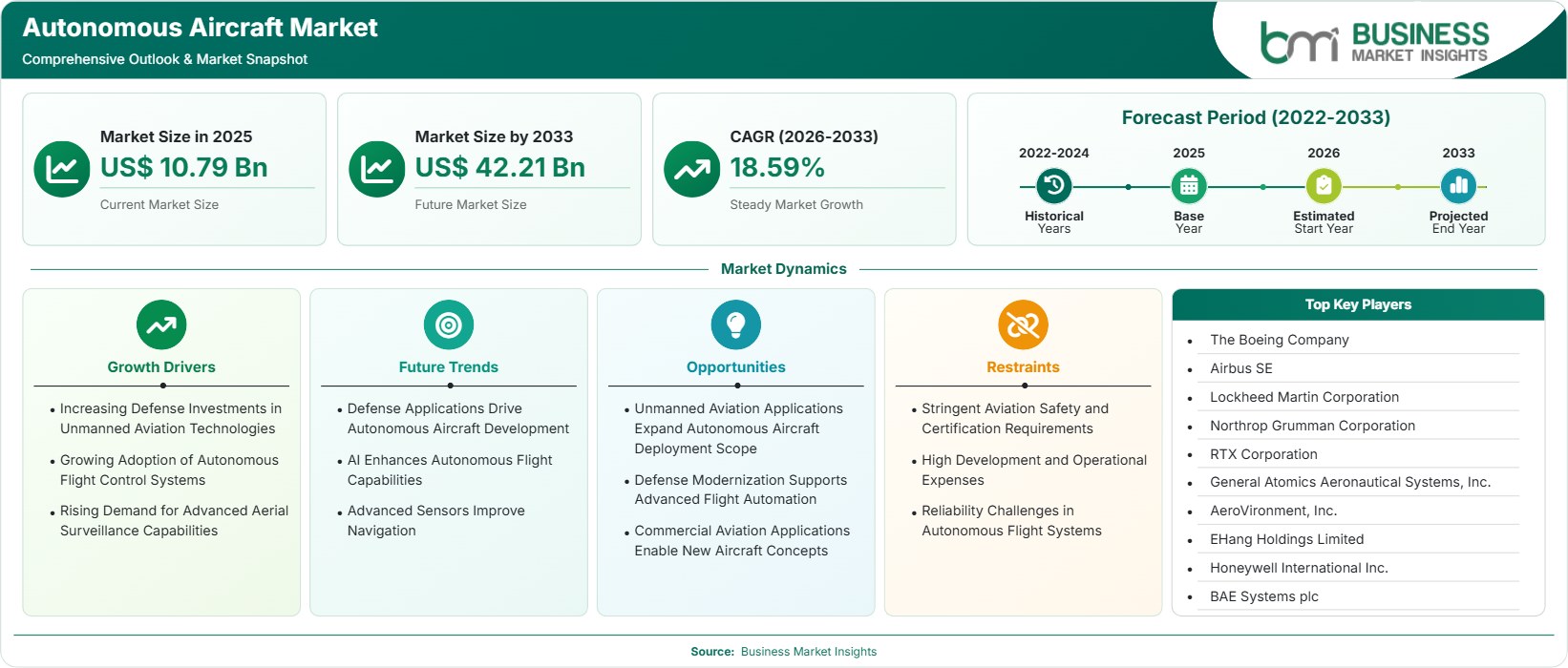
The Autonomous Aircraft Market size was valued at US$ 10.79 Billion in 2025 and is projected to reach US$ 42.21 Billion by 2033, growing at a CAGR of 18.59% during 2026–2033, driven by AI-enabled flight systems, defense modernization programs, autonomous cargo operations, urban air mobility development, and expanding regulatory support for beyond-visual-line-of-sight operations worldwide.

Report Coverage
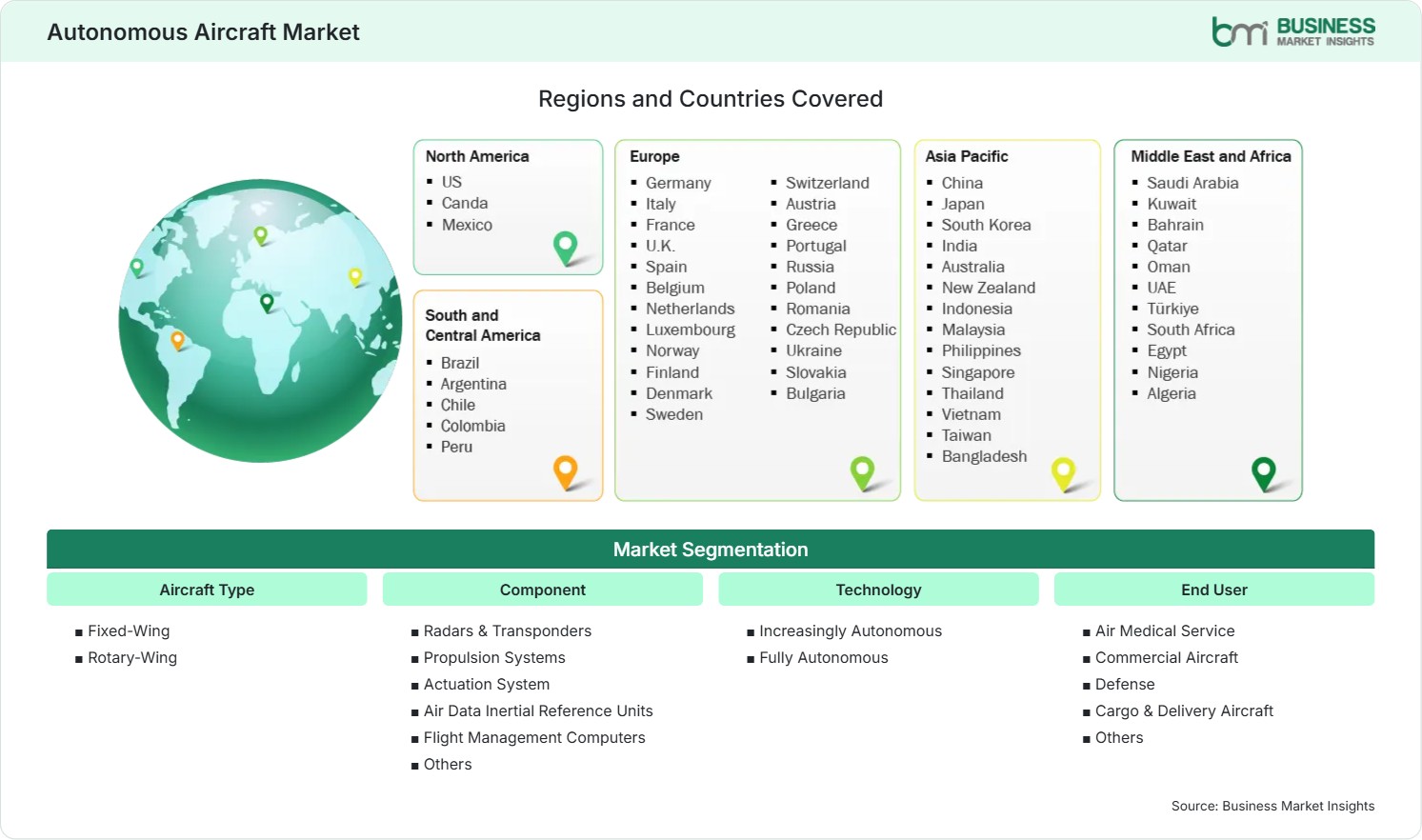
  • Aircraft Type: Fixed-Wing, Rotary-Wing
  • Component: Radars & Transponders, Propulsion Systems, Actuation System, Air Data Inertial Reference Units, Flight Management Computers, Others
  • Technology: Increasingly Autonomous, Fully Autonomous
  • End User: Air Medical Service, Commercial Aircraft, Defense, Cargo & Delivery Aircraft, Others
US$ 10.79 Bn Market size in 2025
US$ 42.21 Bn Market Size by 2033
18.59% CAGR, 2026 - 2033
2026-2033 Forecast Period

AI Overview

Autonomous Aircraft Market Summary

  • North America Region: Holds a market share of 38%–41% in 2025, growing at a CAGR of 17.5%–18.5% during 2026–2033. Growth is supported by defense procurement, autonomous cargo programs, AI flight control development, certification pathways, aerospace investment, unmanned traffic management initiatives, digital aviation infrastructure, military modernization, advanced sensors, and autonomous logistics deployments. The U.S. market remains the innovation center, supported by FAA initiatives and defense funding, advancing at 17.8%–18.8% CAGR.
  • Fastest Growing Region: Asia Pacific accounts for 24%–27% share in 2025 and is forecast to grow at 20.5%–21.5% CAGR during 2026–2033. Strong manufacturing capabilities, drone adoption, smart mobility projects, defense spending, domestic aerospace programs, supportive innovation policies, urban congestion challenges, logistics automation, and large-scale testing corridors accelerate commercialization.
  • Leading Segment: Increasingly Autonomous technology represents 64%–67% share in 2025 with 17.8%–18.8% CAGR during 2026–2033. Adoption benefits from pilot-assist systems, safety certification compatibility, airline operational confidence, lower transition risks, existing avionics integration, reduced crew workload, scalable deployment models, stronger regulatory acceptance, and operational efficiency improvements.
  • High Growth Segment: Cargo & Delivery Aircraft captures 18%–21% share in 2025 and advances at 22.0%–23.5% CAGR during 2026–2033. E-commerce logistics, remote delivery needs, autonomous fleet economics, last-mile optimization, warehouse integration, lower operating costs, growing medical supply transport requirements, and expanded BVLOS approvals support rapid adoption.
  • Key Market Opportunity: Autonomous cargo networks can transform regional logistics by reducing operating expenses, expanding access to underserved areas, enabling continuous operations, improving delivery speed, supporting e-commerce growth, and strengthening supply-chain resilience.
  • Major Market Players: The Boeing Company, Airbus SE, Lockheed Martin Corporation, Northrop Grumman Corporation, RTX Corporation, General Atomics Aeronautical Systems, Inc., AeroVironment, Inc., EHang Holdings Limited, Honeywell International Inc., BAE Systems plc.
Strategic Insights

Autonomous Aircraft Market: Strategic Insights

Autonomous Aircraft Market Strategic Framework
FREE PDF
Request your free sample
Request free sample
Stakeholder View

Key Takeaways

  • The value chain increasingly revolves around software, AI algorithms, autonomy stacks, navigation systems, sensors, and data processing capabilities rather than traditional airframe manufacturing alone.
  • Cargo, delivery, and air medical applications present some of the strongest commercial opportunities because autonomous operations can improve accessibility while reducing operating costs.
  • Innovation is shifting toward sensor fusion, edge AI, autonomous decision engines, and real-time detect-and-avoid systems capable of operating in complex airspace environments.
  • Asia Pacific offers one of the most compelling investment propositions due to rapid urbanization, government-backed aviation programs, and expanding domestic aerospace manufacturing capacity.
  • Venture capital activity, strategic partnerships, and aerospace acquisitions increasingly target autonomy software developers, avionics providers, and advanced mobility companies.
  • Regulatory readiness is becoming a critical differentiator, with operators focusing on certification pathways that enable scaling from pilot-assisted to fully autonomous operations.
Geographic Outlook

Autonomous Aircraft Market Regional Highlights

North America Autonomous Aircraft Market

North America accounts for 38%–41% Autonomous Aircraft Market share in 2025 and is expected to expand at 17.5%–18.5% CAGR through 2033. The region is characterized by mature infrastructure for aerospace manufacturing, high defense spending, innovation hubs for artificial intelligence, and commercialization activities. Major firms have continued investing in autonomous combat airplanes, freight carriers, and advanced air mobility products. There have been gradual moves to develop regulatory frameworks that will support greater autonomy.

  • Defense modernization programs continue investing in autonomous ISR, logistics support, and collaborative combat aircraft technologies.
  • FAA-led airspace integration initiatives improve deployment readiness for advanced autonomous operations.
  • Growing venture capital funding supports avionics, autonomy software, and sensor technology developers.
  • Autonomous freight and regional cargo pilots are expanding commercial validation opportunities.
  • Large aerospace primes increasingly partner with AI specialists to accelerate development cycles.

US Autonomous Aircraft Market

The U.S. represents 76%–80% of North American share and grows at 17.8%–18.8% CAGR. The federal defense programs, the amount of money spent on R&D in the aerospace industry, and the use of AI technology places the country in the lead when it comes to autonomous aircraft innovations. Government-sponsored testing facilities and growth in autonomous logistics projects enable commercialization.

  • Defense agencies remain major purchasers of increasingly autonomous aircraft systems.
  • Commercial cargo testing programs continue evaluating autonomous regional logistics solutions.
  • AI and digital engineering capabilities accelerate system development and validation.
  • Academic-industry collaborations contribute to autonomy, navigation, and safety research.

Europe Autonomous Aircraft Market

Europe captures 26%–29% Autonomous Aircraft Market share in 2025 and advances at 17.0%–18.0% CAGR. Regulatory harmonization efforts and sustainability objectives are shaping deployment strategies. Germany leads regional adoption while the United Kingdom demonstrates high-growth potential with approximately 18%–19% CAGR. Aerospace manufacturers continue investing in autonomous flight technologies directed toward defense, logistics, and urban mobility applications. Collaborative research programs support commercialization and certification progress.

  • Europe prioritizes autonomy integration alongside sustainable aviation initiatives.
  • Germany maintains technological leadership through established aerospace manufacturing ecosystems.
  • The United Kingdom records one of the fastest regional growth trajectories.
  • Defense cooperation programs support autonomous aviation development.
  • Advanced air mobility projects stimulate investment across multiple countries.

Asia Pacific Autonomous Aircraft Market

Asia Pacific holds 24%–27% market share in 2025 and records the fastest regional expansion at 20.5%–21.5% CAGR. China leads adoption while India demonstrates high-growth momentum at approximately 21%–22% CAGR. Government support, drone manufacturing capacity, smart city initiatives, and logistics modernization contribute to growth. The region is becoming a major center for autonomous vehicle production, testing, and commercialization.

  • Domestic manufacturers accelerate autonomous platform development.
  • Urban logistics requirements stimulate deployment of cargo-focused autonomous solutions.
  • Defense procurement increasingly emphasizes unmanned and autonomous capabilities.
  • Digital infrastructure investments strengthen autonomous operations.
  • Smart city programs encourage advanced mobility implementation.

Rest of World Autonomous Aircraft Market

The Rest of World region accounts for 8%–11% Autonomous Aircraft Market share in 2025 and expands at 18.0%–19.0% CAGR. In South and Central America, logistics challenges encourage interest in autonomous delivery networks. Middle East and Africa markets benefit from smart mobility investments and aviation diversification programs. Brazil leads Latin American adoption, while the United Arab Emirates demonstrates one of the strongest growth profiles with approximately 19%–20% CAGR.

  • Remote-area connectivity needs create demand for autonomous delivery operations.
  • Gulf countries continue investing in advanced mobility ecosystems.
  • Infrastructure modernization supports future autonomous deployment.
  • Resource-sector monitoring applications drive specialized adoption.
  • Air medical and emergency-response use cases gain traction.
Global Market Geography
FREE PDF
Request your free sample
Request free sample
Segment Analysis

Autonomous Aircraft Market Segmentation

Aircraft Type

This segment accounts for approximately 100% of market classification, with Fixed-Wing commanding 56%–59% share in 2025 and growing at 18%–19% CAGR. Adoption reflects long-range efficiency, defense utility, and cargo mission suitability. The Autonomous Aircraft Market scope continues expanding as operators deploy both conventional and vertical mobility platforms.

  • Fixed-Wing: Preferred for surveillance, cargo transport, and long-endurance missions due to extended range, operational efficiency, and compatibility with existing aviation infrastructure.
  • Rotary-Wing: Expands rapidly across urban mobility, medical response, and precision logistics applications requiring vertical takeoff, landing flexibility, and operation within space-constrained environments.

Component

Component innovation remains central, supporting performance, autonomy, navigation reliability, and safety. Integrated avionics ecosystems increasingly combine sensing, flight management, communications, and propulsion technologies to enable higher levels of autonomous operation. Component upgrades continue driving replacement and retrofit demand.

  • Radars & Transponders: Enable situational awareness, collision avoidance, tracking, and airspace integration essential for safe autonomous operations.
  • Propulsion Systems: Improve endurance, fuel efficiency, reliability, and environmental performance across commercial and defense platforms.
  • Actuation System: Supports precise automated control inputs and responsive aircraft maneuverability under autonomous flight conditions.
  • Air Data Inertial Reference Units: Deliver accurate navigation, positioning, and motion sensing for autonomous decision-making.
  • Flight Management Computers: Act as central mission-processing systems coordinating navigation, routing, and operational optimization.

Technology

Technology segmentation reflects varying autonomy maturity levels. Increasingly Autonomous systems dominate adoption due to certification compatibility, while Fully Autonomous platforms exhibit faster expansion potential as regulations evolve and technological confidence strengthens.

  • Increasingly Autonomous: Delivers pilot support, automation efficiency, and gradual transition toward higher operational autonomy.
  • Fully Autonomous: Advances through AI breakthroughs, autonomous navigation capabilities, and emerging regulatory approvals supporting minimal human intervention.

End User

End-user demand increasingly reflects operational efficiency gains, manpower optimization, and mission flexibility. Defense remains the largest segment with 42%–45% share in 2025, while Cargo & Delivery Aircraft is the fastest-growing category at 22.0%–23.5% CAGR.

  • Air Medical Service: Enhances rapid response capabilities and improves access to remote healthcare delivery.
  • Commercial Aircraft: Focuses on automation enhancement, operational efficiency, and future crew optimization strategies.
  • Defense: Supports ISR, surveillance, combat support, logistics, and force-multiplication missions.
  • Cargo & Delivery Aircraft: Benefits from e-commerce expansion, autonomous logistics networks, and last-mile delivery requirements.
Market Forces

Autonomous Aircraft Market Dynamics

Key Market Drivers

Expansion of Defense Autonomous Aviation Programs

Defense organizations globally are increasing investments in autonomous and collaborative aircraft technologies to improve mission effectiveness and reduce operational risks. Modernization efforts supported by NATO countries, U.S. Department of Defense funds, programs, and ISR purchases are hastening the process of adoption. The synergy between mission planning through AI, autonomous navigation, and sensors boosts efficiency without increasing reliance on limited aviation staff resources. Furthermore, defense demand is fostering technology spillovers into the commercial realm. Increasing geopolitical instability and commitments made by governments regarding future airpower solutions will keep driving the demand going.

Growth in Logistics and Cargo Automation

The rise of e-commerce, time-sensitive freight requirements, and remote-area delivery needs are driving the adoption of autonomous aviation. Autonomous cargo planes are becoming the norm due to the desire of operators to lower labor costs, increase dependability, and increase the reach of their services. There is a need for logistics companies to develop aerial networks that can effectively serve areas where traditional ground infrastructure is not effective. Moreover, autonomous flying is characterized by the ability to fly at odd hours and maximize the use of the available fleet.

Advances in AI, Sensor Fusion, and Flight Computing

Continuous improvements in machine learning algorithms, onboard computing power, computer vision, radar processing, and navigation systems are enhancing autonomous flight reliability. Modern systems can interpret complex operational environments and support dynamic decision-making. Current Autonomous Aircraft Market trends now favor software-defined solutions that can be updated and improved even post-deployment. Detect-and-avoid technology, predictive maintenance capabilities, and flight management solutions help ensure safe results while also enabling certification processes. The convergence of technology helps bring down the obstacles to adoption.

Key Market Opportunities

Commercialization of Autonomous Regional Cargo Networks

There is considerable potential for drone applications in regional logistics corridors, as most routes are underutilized due to geographical and economic challenges. There will be reduced operational costs and more regular flights through automation. Upon developing the regulatory framework, there will be an introduction of commercial freight services. Long-term Autonomous Aircraft Market Forecasts increasingly depend on scalable cargo operations capable of delivering measurable economic benefits. Investments in supporting infrastructure, digital air traffic systems, and fleet management platforms create attractive opportunities for manufacturers and technology providers.

Urban Air Mobility Ecosystem Development

Urban air mobility programs create opportunities for autonomous technologies across passenger transport, emergency services, and infrastructure monitoring. With increasing congestion in large metropolitan areas, there is an increased need for alternative modes of transportation. The ability to operate autonomously will enhance the economics and scalability of a vehicle fleet once the certification hurdles are overcome. There have been efforts by governments, investors, and aerospace companies to develop test corridors, vertiports, and digital traffic management systems.

Autonomous Air Medical Service Expansion

Healthcare delivery increasingly requires fast transportation across remote and underserved areas. An autonomous medical aircraft will facilitate the prompt transportation of medications, diagnostic equipment, blood components, and emergency items. Flexibility in operations is going to increase the resilience of the healthcare system, particularly during emergencies and disruptions to the infrastructure. Governments and public health agencies are still considering the use of autonomous aviation technologies for emergency response.

Market Restraints and Challenges

Certification Complexity and Regulatory Uncertainty

Factor: Regulatory agencies require extensive validation of autonomous decision-making, safety performance, and airspace integration capabilities. Impact: The lengthy certification process contributes to higher development costs, delays in productization, and uncertainty in planning for both developers and operators. The regulatory bodies responsible for aviation emphasize the need for safety and reliability, which makes the certification process very stringent. The varying nature of the national regulations adds to the difficulties in the process of market expansion.

Cybersecurity and Operational Risk Exposure

Factor: Autonomous systems depend on software, communications networks, and connected operational technologies vulnerable to cyber threats. Impact: The security issue may affect adoption, drive up compliance costs, and shape regulations. Possible threats include navigational interference, security breaches, data tampering, and communication failures. There is a need for a secure architecture and a redundant structure to monitor such systems. The need to maintain confidence from all stakeholders makes this an ongoing challenge.

Company Analysis

Competitive Landscape

The competitive environment reflects intensive investment in autonomous systems, avionics, AI, and defense programs. This Autonomous Aircraft Market analysis highlights leading participants across aerospace, defense, and advanced mobility segments.

Company Name

Overview

Products and Services relevant to this market

The Boeing Company

Global aerospace leader developing autonomous aviation technologies across defense and commercial platforms.

Autonomous flight systems, military aircraft, navigation technologies, advanced aerospace solutions.

Airbus SE

Leading aircraft manufacturer advancing autonomous operations and advanced air mobility initiatives.

Autonomous flight research, aircraft platforms, digital aviation technologies.

Lockheed Martin Corporation

Defense contractor focused on autonomous mission systems and advanced air capabilities.

Autonomous defense aircraft, ISR systems, AI-enabled aviation solutions.

Northrop Grumman Corporation

Major aerospace and defense supplier with extensive unmanned aviation expertise.

Autonomous aircraft, surveillance platforms, mission-management systems.

RTX Corporation

Aerospace and defense technology provider supporting autonomous aviation ecosystems.

Sensors, avionics, communications, navigation solutions.

General Atomics Aeronautical Systems, Inc.

Specialist in unmanned and autonomous aviation technologies for defense markets.

Autonomous aircraft, ISR capabilities, mission systems.

AeroVironment, Inc.

Developer of advanced autonomous aerial platforms and related technologies.

Autonomous aerial systems, intelligence solutions, analytics.

EHang Holdings Limited

Pioneer in autonomous aerial mobility and passenger aircraft innovation.

Autonomous air mobility vehicles, flight management systems.

Honeywell International Inc.

Provider of avionics, automation, and aerospace technologies.

Flight computers, navigation systems, autonomous aviation components.

BAE Systems plc

Defense technology company developing advanced autonomous aviation solutions.

Mission systems, aircraft electronics, autonomous technologies.

Trust & Transparency

Research Methodology

The market analysis combines proprietary research with secondary data from government agencies, company disclosures, regulatory filings, industry databases and expert interviews. Market estimates are validated through data triangulation, cross-market benchmarking and analyst review.

View Full Research Methodology

Questions Answered

Frequently Asked Questions

What does the Autonomous Aircraft Market Report indicate about future competition?

The Autonomous Aircraft Market Report indicates competition will increasingly center on autonomy software, AI capability, certification expertise, cybersecurity resilience, and integrated flight management platforms rather than airframe manufacturing alone.

How are regulations influencing commercialization?

Regulations shape certification timelines, safety validation requirements, and airspace integration standards. Progress in these areas directly affects deployment speed and investment activity.

Which end-user segment offers the highest growth potential?

Cargo and delivery applications demonstrate strong growth potential because operators can achieve lower operating costs, improved coverage, and faster logistics performance through autonomous operations.

Which region leads the industry today?

North America maintains the largest regional position due to strong aerospace infrastructure, defense investment, regulatory advancement, and the presence of major technology developers and manufacturers.

What is driving adoption of autonomous aircraft technologies?

AI-enabled navigation, defense modernization, logistics automation, advanced sensors, and the need for improved operational efficiency are among the primary adoption drivers. Regulatory progress is also expanding commercial deployment opportunities.

Access the Full Autonomous Aircraft Market Report

Get segment-level forecasts, regional estimates, competitive benchmarking, company profiles and downloadable Excel datasets.

Access the full Autonomous Aircraft Market Report
350 pages PDF & Excel | 2026-09-21
Similar Research

Related Market Reports