
Reusable Launch Vehicle Market Outlook: Size, Share, Trends, Growth Analysis, Competitive Landscape & Forecast, 2026-2033

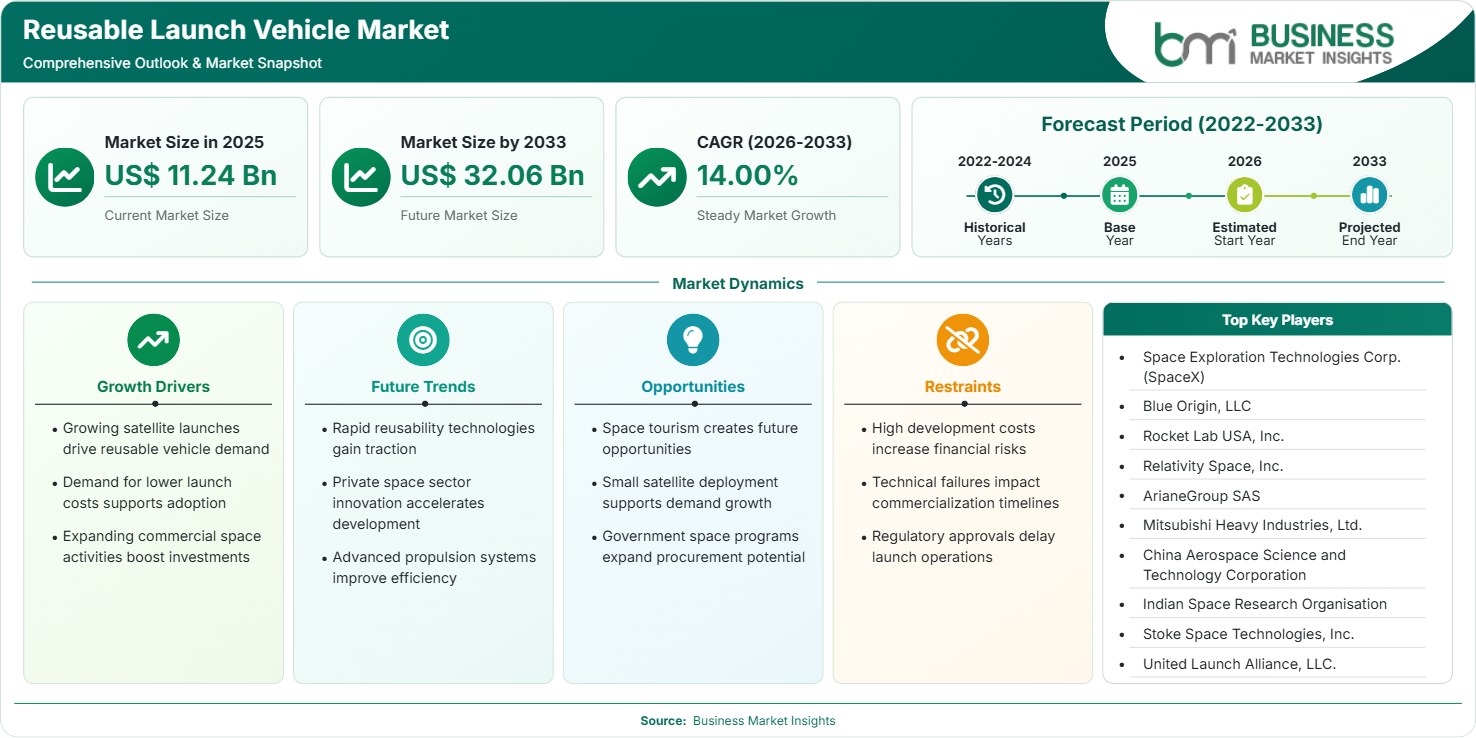
The Reusable Launch Vehicle Market size was valued at US$ 11.24 Billion in 2025 and is projected to reach US$ 32.06 Billion by 2033, growing at a CAGR of 14% during 2026–2033. Key growth drivers include rising satellite deployment, launch-cost reduction initiatives, commercial space expansion, defense modernization programs, and increasing investments in reusable propulsion and recovery technologies.

Report Coverage
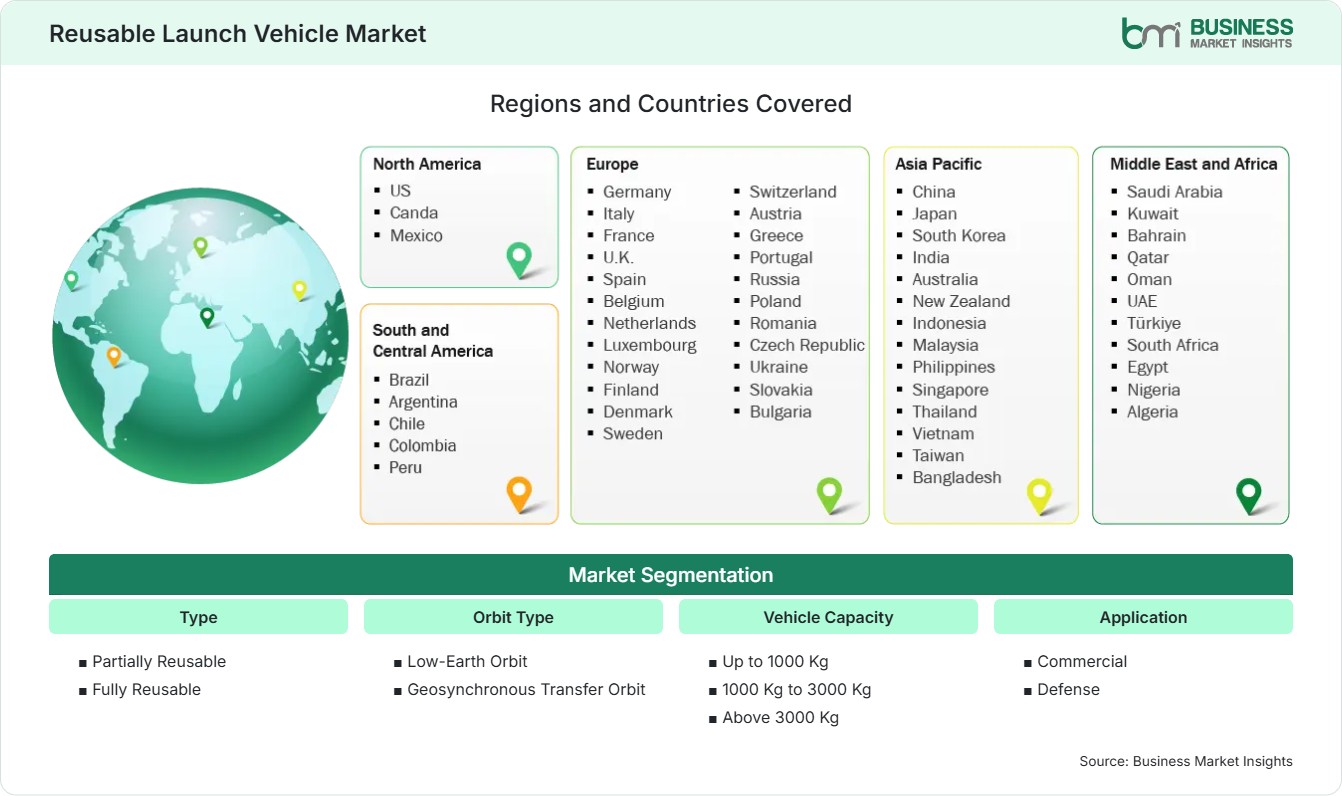
  • Type: Partially Reusable, Fully Reusable
  • Orbit Type: Low-Earth Orbit, Geosynchronous Transfer Orbit
  • Vehicle Capacity: Up to 1000 Kg, 1000 Kg to 3000 Kg, Above 3000 Kg
  • Application: Commercial, Defense
US$ 11.24 Bn Market size in 2025
US$ 32.06 Bn Market Size by 2033
14.00% CAGR, 2026 - 2033
2026-2033 Forecast Period

AI Overview

Reusable Launch Vehicle Market Summary

  • North America Region: North America holds a market share of 42%–45% in 2025, growing at a CAGR of 13%–15% during 2026–2033. Strong commercial launch activity, government contracts, reusable booster innovation, and defense missions continue creating opportunities for launch frequency expansion and operational cost optimization across orbital programs. U.S. market benefits from launch leadership, defense demand, and private sector investments, expanding at 13.5%–15.5% CAGR.
  • Fastest Growing Region: Asia Pacific accounts for 22%–25% share in 2025 and advances at 15%–17% CAGR during 2026–2033. National space programs, commercial launch startups, satellite manufacturing growth, and sovereign access initiatives strengthen long-term opportunities for reusable platform development and deployment.
  • Leading Segment: Commercial application represents 62%–66% share in 2025 and grows at 14%–16% CAGR through 2033. Broadband mega-constellations, Earth observation demand, reduced launch costs, and private investment flows continue supporting higher mission volumes and reusable platform utilization.
  • High Growth Segment: Fully Reusable systems hold 30%–34% share in 2025 and are projected to expand at 16%–18% CAGR during 2026–2033. Rapid improvements in turnaround capability, thermal protection technologies, and payload economics accelerate adoption across commercial and institutional operators.
  • Key Market Opportunity: Expanding low-cost access to space through high-frequency reusable launch operations enables new business models across communications, Earth observation, scientific missions, defense payloads, and in-orbit infrastructure development.
  • Major Market Players: Space Exploration Technologies Corp. (SpaceX), Blue Origin, LLC, Rocket Lab USA, Inc., Relativity Space, Inc., ArianeGroup SAS, Mitsubishi Heavy Industries, Ltd., China Aerospace Science and Technology Corporation, Indian Space Research Organisation, Stoke Space Technologies, Inc., United Launch Alliance, LLC.
Strategic Insights

Reusable Launch Vehicle Market: Strategic Insights

Reusable Launch Vehicle Market Strategic Framework
FREE PDF
Request your free sample
Request free sample
Stakeholder View

Key Takeaways

  • Reusability is reshaping the launch services value chain by reducing refurbishment costs, increasing launch cadence, and improving asset utilization across manufacturing, operations, and mission-management activities.
  • Small satellite constellation deployments and commercial communications programs offer the highest growth potential due to recurring launch requirements and growing demand for affordable orbital access.
  • Innovation is shifting toward fully reusable architectures, autonomous recovery systems, methane propulsion, and data-driven predictive maintenance to reduce turnaround times between missions.
  • Asia Pacific presents a compelling investment case as China, India, Japan, and emerging commercial operators expand launch infrastructure and domestic reusable launch capabilities.
  • Strategic investments, government contract awards, and private funding rounds continue accelerating commercialization, creating opportunities for partnerships, acquisitions, and technology licensing.
  • Defense applications are becoming increasingly important as military organizations prioritize responsive launch capabilities and sovereign access to critical space assets.
Geographic Outlook

Reusable Launch Vehicle Market Regional Highlights

North America Reusable Launch Vehicle Market

North America accounted for 42%–45% Reusable Launch Vehicle Market share in 2025 and is projected to register 13%–15% CAGR through 2033. The region benefits from established commercial launch operators, strong defense spending, extensive launch infrastructure, and continuous innovation in reusable propulsion systems. Government contracts and satellite constellation expansion remain major contributors. Private-sector investment continues supporting next-generation vehicle development and improved vehicle reuse rates, strengthening regional competitiveness in orbital launch economics and mission flexibility.

  • SpaceX continues setting operational benchmarks through frequent reusable missions and booster recovery programs supporting commercial and government customers.
  • U.S. defense agencies increasingly emphasize responsive launch capabilities, creating demand for rapid deployment and reusable platforms.
  • Venture capital and institutional funding support emerging launch providers developing reusable architectures and advanced propulsion technologies.
  • Satellite broadband and Earth observation programs create sustained launch demand across multiple orbital classes.
  • Launch-site modernization initiatives improve turnaround efficiency and support higher annual launch frequencies.

US Reusable Launch Vehicle Market

The United States represents approximately 82%–86% of the North American Reusable Launch Vehicle Market share and is expected to grow at 13.5%–15.5% CAGR. Strong participation from commercial launch providers, NASA programs, Space Force initiatives, and private investors sustains leadership. The country's integrated ecosystem combines launch infrastructure, advanced manufacturing, and space technology expertise. Ongoing investments in full reusability and heavy-lift systems support long-term competitiveness while improving launch efficiency and payload affordability across commercial and defense missions.

  • Federal procurement programs strengthen demand visibility for launch providers while supporting infrastructure expansion.
  • Reusable booster operations continue reducing launch costs and increasing mission frequency across commercial customers.
  • Strong R&D spending supports reusable engines, autonomous landing systems, and next-generation vehicle designs.
  • Public-private partnerships accelerate deployment of advanced launch platforms and associated technologies.

Europe Reusable Launch Vehicle Market

Europe holds 23%–26% Reusable Launch Vehicle Market share in 2025 and is forecast to grow at 12%–14% CAGR. Regional demand is supported by sovereign launch capability goals, satellite programs, and increased investment in reusable technologies. France leads market adoption, while Germany demonstrates the highest growth trajectory with estimated growth exceeding regional averages. Policy support from European institutions and growing private launch ventures contribute to technology development, infrastructure expansion, and broader commercialization opportunities across the regional space ecosystem.

  • ArianeGroup and emerging launch startups are accelerating reusable technology development programs.
  • Germany remains a high-growth market due to startup activity and increasing private investments.
  • Advanced satellite manufacturing capabilities drive demand for flexible and economical launch solutions.
  • Regional initiatives emphasize independent access to space and launch-security requirements.
  • Research collaborations continue supporting propulsion efficiency and reuse technologies.

Asia Pacific Reusable Launch Vehicle Market

Asia Pacific maintains 22%–25% Reusable Launch Vehicle Market share in 2025 and is expected to expand at 15%–17% CAGR. Strong government support, expanding commercial participation, and growing satellite deployment activity support regional expansion. China leads revenue generation, while India ranks among the fastest-growing markets. National space programs increasingly prioritize reusability to reduce launch costs and improve competitiveness. The region benefits from expanding manufacturing capabilities, infrastructure development, and growing demand for communications and Earth observation services.

  • China invests heavily in reusable launch technologies and commercial launch ecosystems.
  • India advances reusable launch initiatives while increasing private-sector participation.
  • Expanding broadband connectivity requirements support additional satellite launches and related services.
  • National security and strategic autonomy objectives strengthen investment momentum.
  • Regional partnerships support technology transfer and infrastructure development.

Rest of World Reusable Launch Vehicle Market

Rest of World accounts for 8%–10% share in 2025 and is projected to achieve 14%–16% CAGR through 2033. Middle Eastern governments continue investing in space capabilities and research programs. South and Central American countries increasingly participate in satellite and launch ecosystem development.

Growing institutional interest, international collaborations, and technology partnerships are supporting adoption. The United Arab Emirates leads regional investment activity, while Brazil demonstrates comparatively strong growth potential through expanding space initiatives and infrastructure modernization efforts.

  • UAE investments support advanced space technology programs and international partnerships.
  • Brazil benefits from increasing attention toward launch infrastructure and aerospace development.
  • Satellite services demand encourages broader participation in launch-related activities.
  • International collaborations improve technical capabilities and workforce development.
  • Government diversification strategies support long-term space-sector investments.
Global Market Geography
FREE PDF
Request your free sample
Request free sample
Segment Analysis

Reusable Launch Vehicle Market Segmentation

Type

Type segment dynamics reflect differing operational strategies. The segment represents a critical element of Reusable Launch Vehicle Market scope, with partially reusable systems holding 66%–70% share in 2025 and growing at 13%–15% CAGR, while fully reusable concepts attract increasing investment due to long-term cost efficiencies and mission scalability.

  • Partially Reusable: Widely adopted because of technological maturity, proven reliability, and reduced operational risks. Recovery of major propulsion elements supports launch cost reduction while maintaining performance consistency across missions.
  • Fully Reusable: Growing interest stems from potential for dramatically lower launch costs, rapid turnaround capability, and improved mission economics for high-frequency commercial and institutional deployments.

Orbit Type

Orbit selection remains closely aligned with satellite deployment strategies. Low-Earth Orbit dominates with 68%–72% share in 2025 and grows at 14%–16% CAGR, supported by broadband constellations, Earth observation demand, and commercial expansion into data-driven space services.

  • Low-Earth Orbit (LEO): Strong demand from communications, imaging, navigation augmentation, and scientific missions continues encouraging frequent launches and higher utilization of reusable systems.
  • Geosynchronous Transfer Orbit (GTO): Demand remains supported by communications satellites and strategic payloads requiring high-value orbital insertion capabilities and dependable launch performance.

Vehicle Capacity

Vehicle capacity segmentation reflects varying payload requirements. The 1000 Kg to 3000 Kg category accounts for 38%–42% share in 2025 and expands at 14%–16% CAGR, benefiting from balanced economics and compatibility with diversified satellite missions.

  • Up to 1000 Kg: Favored for small satellite deployments, technology demonstrations, and emerging commercial space applications requiring flexible launch schedules.
  • 1000 Kg to 3000 Kg: Supports medium-sized satellite missions and constellation deployments, providing attractive economics and operational flexibility across commercial operators.
  • Above 3000 Kg: Essential for heavy communications satellites, defense payloads, and multi-satellite missions requiring higher lift performance and advanced launch capabilities.

Application

Application analysis highlights commercialization as the dominant revenue contributor. Commercial applications capture 62%–66% share in 2025 and grow at 14%–16% CAGR, reflecting increasing private investment and satellite deployment activities aligned with Reusable Launch Vehicle Market trends.

  • Commercial: Driven by satellite broadband, Earth observation, IoT connectivity, scientific programs, and growing demand for affordable access to orbital environments.
  • Defense: Supported by national security priorities, rapid launch requirements, resilient space architectures, and increasing deployment of strategic space assets.
Market Forces

Reusable Launch Vehicle Market Dynamics

Key Market Drivers

Rising Satellite Constellation Deployments

The global demand for broadband connectivity, earth observation satellites, and Internet of Things (IoT) initiatives is also helping to drive up launch demand. Large constellations require many launches in a short time frame, making the use of reusable systems more favorable. Companies wish to reduce their launch costs and have quicker access to orbit, hence using systems that can launch repeatedly. Orders from satellite companies for commercial purposes are still strong. Industry investment in reusable architectures directly aligns with accelerating deployment schedules, reinforcing long-term demand and strengthening overall sector expansion prospects, supporting Reusable Launch Vehicle Market growth.

Government and Defense Space Investments

National governments increasingly view space infrastructure as strategically important. Defense agencies prioritize responsive launch capabilities, resilient architectures, and independent access to orbit. The procurement contracts, research grants, and technology development projects provide financial support for reusable vehicles. Space agencies in countries like the United States, Europe, India, China, and Japan keep on supporting innovations in launch technology and reusability initiatives. Geopolitical competition also fuels this trend. This spending pattern raises the profile of the market, boosts private sector involvement, and builds the pipeline of innovations within the launch industry.

Advancements in Recovery and Refurbishment Technologies

Improvements in autonomous landing guidance, propulsion reliability, materials engineering, and predictive maintenance are enhancing reuse economics. High recovery success rates lower lifecycle costs and increase mission availability. The launch service providers have begun using digital twins, big data analytics, and additive manufacturing technologies to make refurbishment more efficient. Learning through continuous operation from multiple launches helps improve performance and reliability. This allows for high commercial value and better customer trust, making sure there is lasting backing for growth in the industry.

Key Market Opportunities

Expansion of Fully Reusable Heavy-Lift Systems

The continued evolution of fully reusable launch platforms is an enormous opportunity. Rapid turnaround and high launch rates could help cut costs and increase the involvement of people in space-based business. Companies, scientific bodies, and the state will be able to use more facilities of space. Reusable Launch Vehicle Market Forecasts increasingly reflect the transformative potential of such systems. As recovery technologies mature and operational reliability improves, fully reusable vehicles could enable entirely new business models spanning manufacturing, transportation, space stations, and lunar missions.

Growing Demand from Emerging Space Economies

Countries seeking independent access to space are investing in launch infrastructure, satellite programs, and commercial partnerships. Space capabilities have become strategic resources for developing nations in Asia, the Middle East, and Latin America. Such investments present business possibilities for those providing technology, launch services, and infrastructure. This requirement is not limited to only launch services but also in areas like training, manufacturing, and mission planning. International collaboration may lead to additional business opportunities for reusable launch services.

Commercialization of In-Orbit Services

The development of servicing, maintenance, debris mitigation, and orbital logistics solutions creates new opportunities for reusable launch providers. Higher utilization of inexpensive orbital transportation will help facilitate greater demand for launches. With the development of commercial space stations and advanced research facilities, the ability to launch on a regular basis will become increasingly more critical. Vehicles that can be used again are in a position to benefit from these new services due to cost-effectiveness and flexibility.

Market Restraints and Challenges

High Development Costs and Technical Complexity

Factor: Developing reusable launch systems requires significant investment in propulsion, recovery, testing, and infrastructure.

Impact: Higher capital needs provide a deterrent for new entrants and a longer time to market. Complicated engineering issues can lead to project delays, higher costs, and performance risks. High testing and certification costs can raise the cost burden prior to generating any significant revenues. Smaller firms could have financing difficulties, which would hinder development and scaling-up efforts. These could act as a deterrent for adoption and provide a competitive advantage for larger firms.

Regulatory, Safety, and Mission Reliability Risks

Factor: Launch operations must comply with stringent safety, environmental, and airspace regulations.

Impact: Regulatory complexity can undermine mission success, increasing compliance costs. Moreover, the reusability of a system is subject to increased scrutiny in terms of reliability and recovery capabilities. Failure of missions can adversely impact the confidence levels of the customers as well as economic performance. The varying regulatory environment across the globe adds to the challenges of operations and technology transfer.

Company Analysis

Competitive Landscape

Reusable Launch Vehicle Market analysis indicates increasing competition among established aerospace firms and emerging commercial launch providers focused on reducing launch costs and improving flight cadence.

Company Name

Overview

Products and Services relevant to this market

Space Exploration Technologies Corp. (SpaceX)

Global leader in reusable orbital launch operations with extensive commercial and government launch portfolio.

Falcon 9, Falcon Heavy, Starship development, launch services, payload integration, recovery operations.

Blue Origin, LLC

Private aerospace company focused on reusable launch systems and advanced space infrastructure.

New Glenn, New Shepard, reusable propulsion systems, orbital launch services.

Rocket Lab USA, Inc.

Commercial launch provider expanding reusable capabilities and medium-lift launch offerings.

Electron recovery program, Neutron launch vehicle, satellite deployment services.

Relativity Space, Inc.

Aerospace innovator emphasizing advanced manufacturing and reusable launch concepts.

Terran R development, launch vehicle engineering, additive manufacturing technologies.

ArianeGroup SAS

European aerospace leader developing next-generation launch technologies.

Ariane launch systems, reusable technology research, propulsion solutions.

Mitsubishi Heavy Industries, Ltd.

Major aerospace contractor supporting Japanese launch activities.

Launch services, rocket systems, aerospace engineering solutions.

China Aerospace Science and Technology Corporation

State-backed aerospace organization with extensive launch capabilities.

Long March launch systems, reusable technology programs, orbital services.

Indian Space Research Organisation

National space agency advancing cost-efficient launch technologies.

Reusable launch demonstrators, satellite launch services, technology development.

Stoke Space Technologies, Inc.

Emerging company focused on fully reusable launch architecture.

Fully reusable launch vehicle development and propulsion technologies.

United Launch Alliance, LLC

Established launch provider serving government and defense customers.

Vulcan platform, advanced launch services, reusable technology initiatives.

Trust & Transparency

Research Methodology

The market analysis combines proprietary research with secondary data from government agencies, company disclosures, regulatory filings, industry databases and expert interviews. Market estimates are validated through data triangulation, cross-market benchmarking and analyst review.

View Full Research Methodology

Questions Answered

Frequently Asked Questions

What does this Reusable Launch Vehicle Market Report emphasize?

The report evaluates technology evolution, market structure, regional opportunities, competitive positioning, investment trends, regulatory influences, and growth potential across major segments.

What factors influence provider competitiveness?

Recovery success rates, turnaround speed, launch reliability, payload flexibility, infrastructure availability, and customer relationships are key competitive differentiators.

Which orbit category generates the highest demand?

Low-Earth Orbit generates the strongest demand because most communications constellations, imaging satellites, and emerging commercial space services operate within this orbital environment.

What is driving commercial demand for reusable launch systems?

Satellite broadband networks, Earth observation services, scientific missions, and private space initiatives require cost-effective and reliable launch solutions, increasing commercial demand.

How does reusability improve launch economics?

Reusable systems reduce the need to build new hardware for every mission, lowering costs, increasing launch frequency, and improving operational efficiency through repeated use of major vehicle components.

Access the Full Reusable Launch Vehicle Market Report

Get segment-level forecasts, regional estimates, competitive benchmarking, company profiles and downloadable Excel datasets.

Access the full Reusable Launch Vehicle Market Report
350 pages PDF & Excel | 2026-08-28