
Armored Vehicle Market Outlook: Size, Share, Trends, Growth Analysis, Competitive Landscape & Forecast, 2026-2033

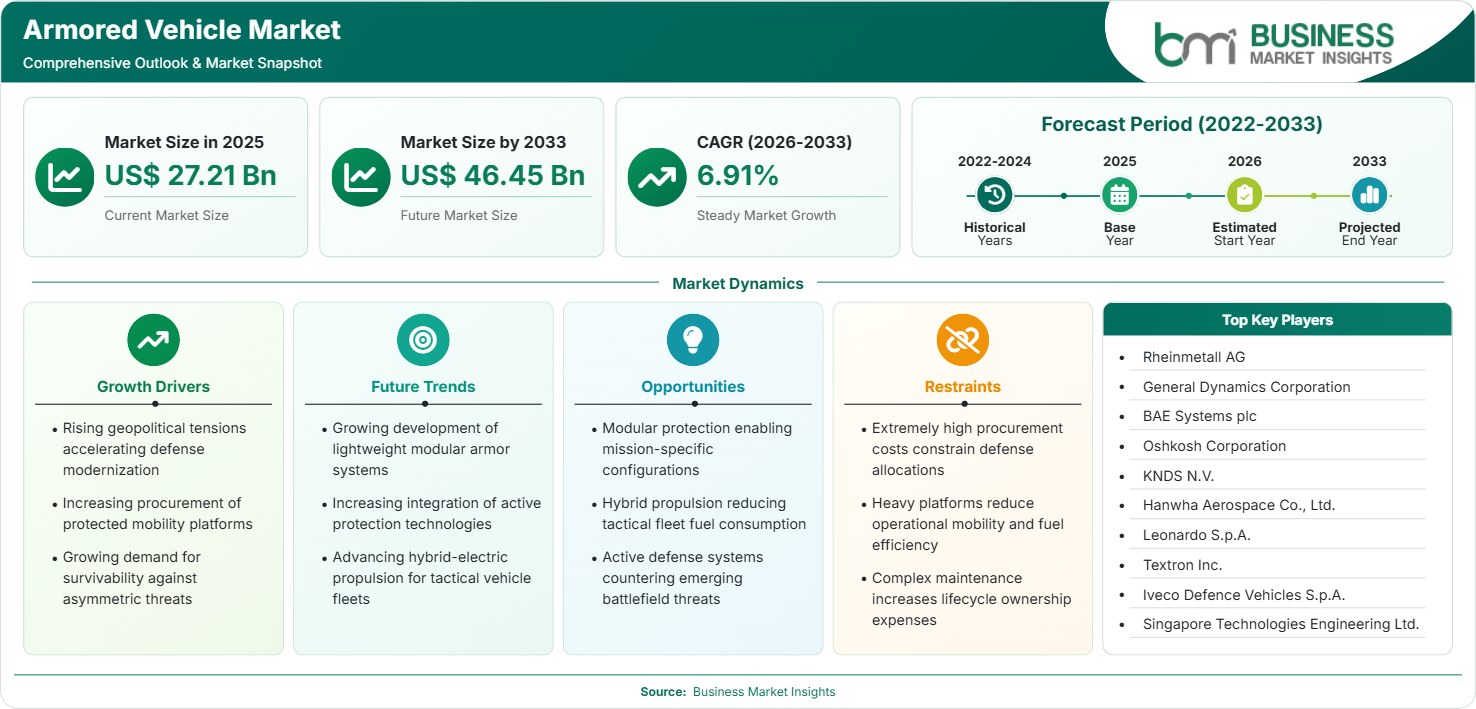
The Armored Vehicle Market size was valued at US$ 27.21 Billion in 2025 and is projected to reach US$ 46.45 Billion by 2033, growing at a CAGR of 6.91% during 2026–2033. Rising defense modernization programs, increased geopolitical tensions, battlefield digitization, active protection systems, and growing procurement of next-generation wheeled and unmanned platforms continue creating substantial long-term opportunities.

Report Coverage
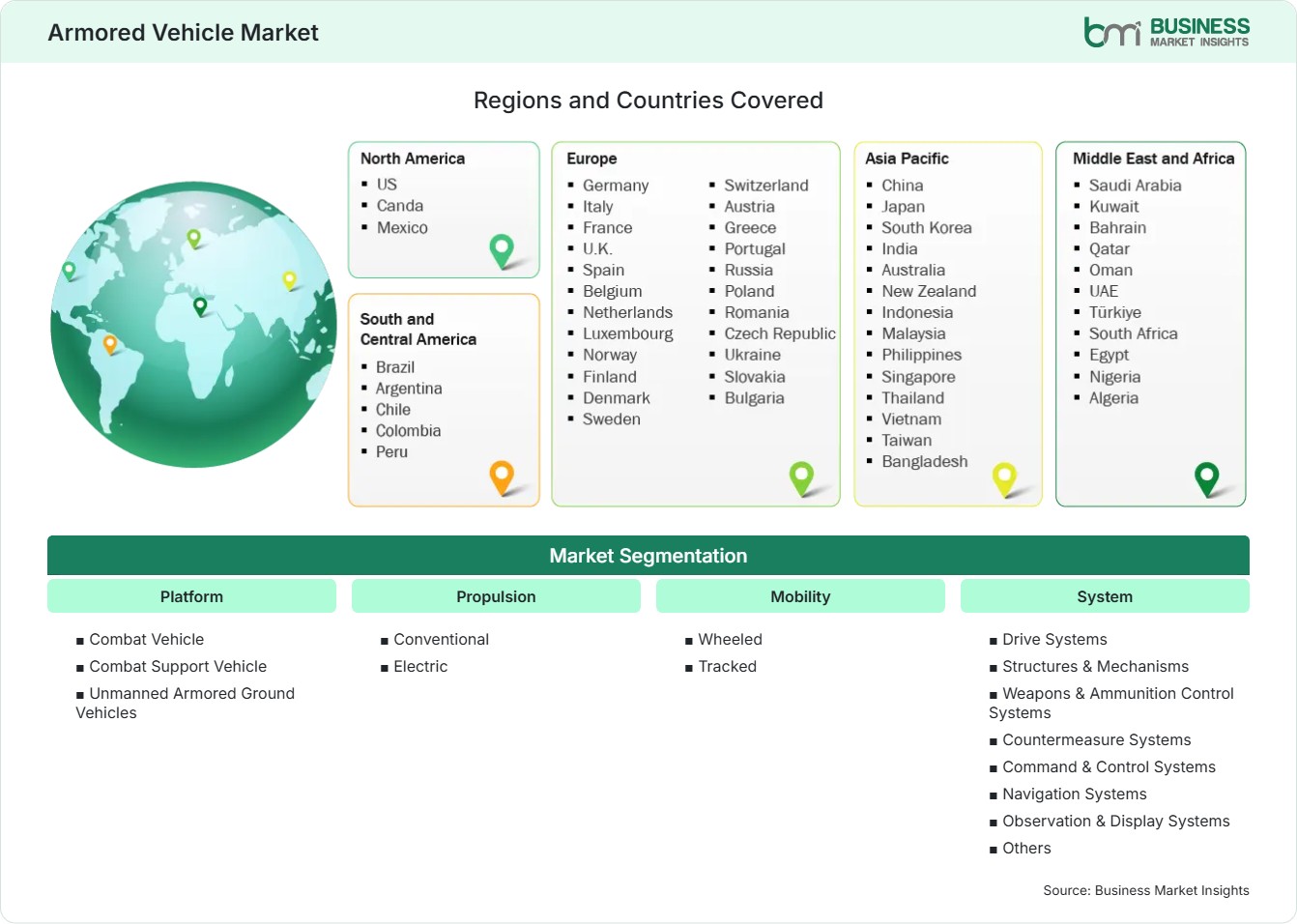
  • Platform: Combat Vehicle, Combat Support Vehicle, Unmanned Armored Ground Vehicles
  • Propulsion: Conventional, Electric
  • Mobility: Wheeled, Tracked
  • System: Drive Systems, Structures & Mechanisms, Weapons & Ammunition Control Systems, Countermeasure Systems, Command & Control Systems, Navigation Systems, Observation & Display Systems, Others
  • Solution: Line Fit, Retrofit
US$ 27.21 Bn Market size in 2025
US$ 46.45 Bn Market Size by 2033
6.91% CAGR, 2026 - 2033
2026-2033 Forecast Period

AI Overview

Armored Vehicle Market Summary

  • North America Region: North America holds a 34%–37% share in 2025, growing at a CAGR of 5.8%–6.3% during 2026–2033. Key drivers include military recapitalization, autonomous vehicle integration, defense funding growth, fleet upgrades, active protection systems adoption, digital battlefield networking expansion, NATO interoperability requirements, industrial base investments, survivability enhancements, logistics modernization, and advanced sensor deployment programs.
    US market benefits from sustained modernization funding and vehicle replacement initiatives, advancing at 5.9%–6.4% CAGR.
  • Fastest Growing Region: Asia Pacific holds a 24%–27% share in 2025 and expands at a CAGR of 8.2%–8.8% during 2026–2033. Growth is supported by border security requirements, indigenous manufacturing initiatives, military modernization, defense industrial expansion, mobility upgrades, strategic procurement programs, advanced combat vehicle development, technology transfer agreements, regional security priorities, export opportunities, and fleet diversification.
  • Leading Segment: Combat Vehicle accounts for 49%–53% share in 2025 and grows at 6.2%–6.8% CAGR. Demand stems from infantry fighting vehicle replacement, tank modernization, battlefield protection requirements, integrated firepower systems, network-centric warfare adoption, modular platform architecture, survivability enhancements, digital command integration, operational readiness priorities, expeditionary deployments, and tactical mobility upgrades.
  • High Growth Segment: Unmanned Armored Ground Vehicles represent 8%–11% share in 2025 and expand at 10.2%–11.4% CAGR. Growth drivers include autonomous navigation advancement, reduced personnel risk, enhanced reconnaissance missions, AI-enabled operations, remote weapon integration, multi-domain warfare requirements, border surveillance applications, military experimentation programs, sensor fusion technologies, and robotics investment acceleration.
  • Key Market Opportunity: Electrification, hybrid propulsion, autonomous mission systems, predictive maintenance technologies, open-architecture electronics, and retrofit modernization programs create scalable opportunities across military fleets while extending platform lifecycles and operational effectiveness.
  • Major Market Players: Rheinmetall AG, General Dynamics Corporation, BAE Systems plc, Oshkosh Corporation, KNDS N.V., Hanwha Aerospace Co., Ltd., Leonardo S.p.A., Textron Inc., Iveco Defence Vehicles S.p.A., and Singapore Technologies Engineering Ltd.
Strategic Insights

Armored Vehicle Market: Strategic Insights

Armored Vehicle Market Strategic Framework
FREE PDF
Request your free sample
Request free sample
Stakeholder View

Key Takeaways

  • The industry value chain increasingly integrates digital electronics, sensors, power systems, armor materials, weapons integration, and lifecycle support services into unified platform ecosystems.
  • Unmanned armored ground vehicles and retrofit modernization programs offer the strongest medium-term expansion opportunities due to cost-effective capability upgrades.
  • Innovation investment is shifting toward autonomous navigation, active protection systems, AI-supported mission management, and hybrid-electric mobility architectures.
  • Asia Pacific presents a compelling investment case due to indigenous manufacturing policies, expanding defense spending, and accelerated platform procurement initiatives.
  • Strategic partnerships, cross-border industrial collaborations, and defense-sector consolidation continue strengthening production capabilities and export competitiveness.
  • Long-term competitiveness increasingly depends on modular open-system architectures that simplify upgrades without requiring complete fleet replacement.
Geographic Outlook

Armored Vehicle Market Regional Highlights

North America Armored Vehicle Market

North America accounts for approximately 34%–37% of revenue in 2025 and advances at a CAGR of 5.8%–6.3% through 2033. The region benefits from sustained military expenditures, extensive vehicle replacement programs, and strong domestic manufacturing capabilities. Advanced battlefield networking, active protection systems, and autonomous technologies are increasingly incorporated into procurement programs. Armored Vehicle Market share remains supported by U.S. modernization priorities and NATO interoperability requirements.

  • Vehicle recapitalization initiatives continue creating demand for next-generation tracked and wheeled platforms.
  • Active protection systems and digital battlefield integration receive growing procurement emphasis.
  • Domestic industrial capacity supports rapid production scaling and lifecycle support services.
  • Defense research funding accelerates autonomous and hybrid mobility technology development.

US Armored Vehicle Market

The United States contributes roughly 78%–82% of regional demand and records a CAGR of 5.9%–6.4%. Fleet modernization programs, armored platform replacement, and combat support mobility upgrades remain primary demand drivers. Procurement strategies increasingly emphasize survivability, network connectivity, and operational flexibility.

  • Army modernization programs prioritize advanced protection, mobility, and command systems.
  • Autonomous ground vehicle experimentation supports future force transformation goals.
  • Industrial partnerships strengthen supply-chain resilience and manufacturing readiness.
  • Lifecycle extension contracts create substantial aftermarket opportunities.

Europe Armored Vehicle Market

Europe represents a 27%–30% share in 2025 and expands at 6.8%–7.4% CAGR. Regional demand is influenced by defense readiness initiatives, NATO commitments, and replenishment of military inventories. Germany leads regional revenues, while Poland ranks among the fastest-growing national markets with procurement-led expansion. Armored Vehicle Market growth remains supported by increased defense allocations across the continent.

  • Eastern European procurement activity continues accelerating modernization spending.
  • Local manufacturing partnerships strengthen regional defense industrial capabilities.
  • Digitalization and survivability requirements influence vehicle design priorities.
  • Germany leads demand, while Poland demonstrates high-growth procurement momentum.

Asia Pacific Armored Vehicle Market

Asia Pacific holds a 24%–27% share in 2025 and posts the fastest CAGR of 8.2%–8.8%. Rising security priorities, indigenous manufacturing initiatives, and fleet modernization investments support sustained expansion. China and India remain major procurement markets, while South Korea exhibits strong technology-driven growth.

  • Indigenous defense production programs stimulate domestic armored platform development.
  • Cross-border technology partnerships accelerate capability enhancement initiatives.
  • Border security and rapid deployment requirements drive vehicle procurement.
  • South Korea and India continue investing heavily in advanced land systems.

Rest of World Armored Vehicle Market

Rest of World holds a 10%-13% market share in 2025 and experiences growth at a 6.5%-7.1% CAGR. The Middle East market is driven by security modernization programs and the requirement for armored mobility solutions. Latin America purchases remain cautious but on the rise. Saudi Arabia is the leading market spender, while the UAE shows significant signs of modernization.

  • Security modernization programs sustain procurement activity across Gulf countries.
  • Fleet refurbishment projects create significant retrofit opportunities.
  • Local assembly agreements support regional industrial participation objectives.
  • Export-focused partnerships improve access to advanced technologies.
Global Market Geography
FREE PDF
Request your free sample
Request free sample
Segment Analysis

Armored Vehicle Market Segmentation

Platform

The platform segment is the largest, occupying around 49% - 53% market share in 2025 and growing at a CAGR of 6.8% - 7.4% throughout the forecast period. Increasing combat vehicle acquisition initiatives, modernization of mechanized forces, and rising adoption of autonomous platforms have been boosting demand. The scope of the Armored Vehicle Market is expanding owing to investment in versatile, network-enabled land platforms.

  • Combat Vehicle: Represents the dominant platform category due to extensive procurement of infantry fighting vehicles, main battle tanks, and armored personnel carriers supporting frontline combat operations and modernization initiatives.
  • Combat Support Vehicle: Demand is driven by engineering, recovery, command, medical evacuation, and logistics missions that require protected mobility and operational support capabilities across complex battlefield environments.
  • Unmanned Armored Ground Vehicles: Rapid adoption is supported by autonomous navigation technologies, remote operations, intelligence gathering, reconnaissance requirements, and reduced personnel exposure in high-risk operational settings.

Propulsion

Propulsion technology is advancing due to increased demand for operational efficiency and logistics optimization by defense departments. The market accounted for a significant portion of industry revenues in 2025, with electrification efforts making some headway. The market is expected to grow at a CAGR of 6.9%-7.7%, supported by hybrid powertrain development and military sustainability objectives.

  • Conventional: Continues to dominate deployments owing to established infrastructure, proven battlefield reliability, simplified maintenance requirements, and compatibility with existing military logistics and operational frameworks.
  • Electric: Growing interest stems from reduced acoustic signatures, lower thermal detection risks, enhanced energy management capabilities, and increasing investment in next-generation military mobility platforms.

Mobility

The mobility solutions will remain very important for mission effectiveness and will account for about 28%-32% of purchases in 2025. The demand for mobility solutions depends on the diversity of terrain, fast deployment capability, and mission adaptability. The development of the land force is expected to foster sustainable growth in the forecast period.

  • Wheeled: Preferred for rapid deployment, lower operating costs, improved road mobility, and operational flexibility across peacekeeping, reconnaissance, and homeland security missions.
  • Tracked: Maintains importance in high-intensity combat environments where superior off-road performance, durability, protection integration, and heavy payload capacity remain operational priorities.

System

System integration still plays a critical role in distinguishing the leading vehicle manufacturers from one another. Increased awareness of the battlegrounds, digital command systems, and survivability systems has changed the nature of procurement considerations. It is expected that the market will grow at a 7.0%-7.8% CAGR as armed forces prioritize connected and intelligent vehicle architectures.

  • Drive Systems: Essential for improving mobility performance, reliability, fuel efficiency, and operational endurance across diverse battlefield conditions.
  • Structures & Mechanisms: Focuses on vehicle survivability, modular armor integration, payload optimization, and improved lifecycle durability requirements.
  • Weapons & Ammunition Control Systems: Supports precision engagement capabilities through advanced fire-control solutions, targeting technologies, and automated weapons management.
  • Countermeasure Systems: Increasingly adopted to defend against anti-tank guided missiles, drone threats, and evolving battlefield attack vectors.
  • Command & Control Systems: Enable secure communications, battlefield coordination, situational awareness, and network-centric military operations.
  • Navigation Systems: Support route optimization, force tracking, mission planning, and operational effectiveness through advanced positioning technologies.
  • Observation & Display Systems: Enhance target acquisition, surveillance capability, crew awareness, and decision-making in complex operational environments.

Solution

The market for demand solutions continues to be significantly influenced by budgeting methods and fleet modernization considerations. This market reaps the benefits of both acquisition programs and upgrades to existing capabilities. The Armored Vehicle Market trends reveal a high interest in efficiency-driven capability upgrade methods.

  • Line Fit: Driven by procurement of newly manufactured platforms integrating modern electronics, protection systems, weapons technologies, and mission-specific capabilities from production stages.
  • Retrofit: Supported by defense organizations seeking affordable modernization pathways through upgrades involving sensors, protection systems, communications technologies, and mobility improvements.
Market Forces

Armored Vehicle Market Dynamics

Key Market Drivers

Rising Global Defense Modernization Programs

The total expenditure on the world's militaries has exceeded $2.4 trillion in recent years, according to SIPRI reports, and a significant proportion is spent on upgrading land forces. It is evident that the government is upgrading its fleet of outdated armored vehicles to newer models with digital networks and other mobility and protection systems. In current doctrines, the issues of survival, interoperability, and deployability hold great importance; hence, the increasing purchase of advanced combat and support vehicles. The growth in the Armored Vehicle Market is largely driven by government defense acquisition programs, NATO capabilities, and regional requirements. The demand keeps growing in Europe, Asia Pacific, and the Middle East.

Growing Demand for Battlefield Survivability Technologies

Contemporary conflicts have exposed the requirement for improved security against anti-tank weapons, loitering munitions, drones, and precision-guided weaponry. It has become common practice for defense establishments to invest in active protection systems, modular armor technology, and countermeasures. Improved crew safety and increased vehicle survivability have become key considerations in the procurement process. The incorporation of threat detection devices, automated countermeasures, and electronic warfare capabilities is ongoing among armored vehicle manufacturers. The Armored Vehicle market growth due to rising demand for survivable vehicles that operate effectively in hostile environments.

Expansion of Autonomous and Digital Land Warfare

There is fast development and increased use of military artificial intelligence, remote control systems, and mission autonomy. Unmanned armored ground vehicles have become increasingly significant for conducting reconnaissance, logistics, surveillance, and force protection tasks. The use of digital command systems and sensors improves situational awareness and decision-making. Networked vehicles can transmit vital information from the battlefield in real time, thereby making the system more efficient. Robotics, connectivity, and system autonomy are driving increased investment in technology and boosting demand for armored vehicles worldwide.

Key Market Opportunities

Hybrid-Electric Military Vehicle Development

There is increasing interest among defense organizations in hybrid-electric powertrain options for endurance and fuel-use reduction. Electrification technology provides reduced acoustic signatures, improved stealth performance, enhanced power-generation capability, and lower maintenance costs. Vehicle manufacturers are investing in advanced mobility technologies to meet future battlefield energy needs. According to the Armored Vehicle Market Forecasts, there are growing business prospects for suppliers of batteries, energy management systems, electric drive systems, and hybrid propulsion technology. Early deployment programs are expected to accelerate adoption in specialized military applications.

Large-Scale Fleet Retrofit Programs

Several nations possess aging armor fleets that are technically sound yet require capability enhancements. The retrofit solution offers an effective alternative to replacing the platforms entirely by equipping them with modern sensors, communication devices, protective systems, and computing technology. There is a growing tendency among defense departments to implement lifecycle extension projects that increase efficiency amid financial constraints. Companies able to supply modular upgrade kits are likely to receive multiple revenue-generating opportunities. Healthy retrofit backlogs are forecast for Europe, North America, Asia-Pacific, and the Gulf states.

Localization and Technology Transfer Initiatives

Most governments have started incorporating industrial participation clauses in defense procurement contracts. This involves local production, assembly operations, and technology transfer agreements, which can be used as means of improving the nation’s defense and creating local job opportunities. Most international defense contractors are now forming partnerships with local organizations to gain market access and meet defense procurement criteria. Such partnerships will continue to provide opportunities in manufacturing, maintenance, training, and sustainment for years to come. Localization policies are expected to remain influential in large-scale armored vehicle procurement programs over the coming decade.

Market Restraints and Challenges

High Procurement Costs and Budget Constraints

Factor: State-of-the-art armored vehicles entail a major commitment to vehicle protection through armor, electronic capabilities, weapons systems, and engine technology.

Impact: The elevated acquisition price may result in delayed purchases, reduced purchase volume, and delayed replacement cycles. Restrictions on the defense budget may make modernization more likely than fleet replacement. Budgetary issues may influence procurement strategy to favor more retrofitting. Budgetary issues prevent manufacturers from securing large-scale purchase orders.

Supply Chain Complexity and Production Delays

Factor: Armored vehicle production relies on unique components, sophisticated materials, electronics, weaponry technology, and competent suppliers.

Impact: Problems with vital logistics can result in schedule delays, higher manufacturing costs, and difficulties meeting contract deadlines. The increased global demand for military hardware is placing a greater strain on manufacturing capacity. Industrial limitations include problems with staffing, materials, and time for components. These limitations may affect the ability to scale manufacturing and to implement various procurement programs.

Company Analysis

Competitive Landscape

Armored Vehicle Market analysis indicates competition is driven by platform modernization, digital integration, protection technologies, and global defense procurement programs.

Company Name

Overview

Products and Services relevant to this market

Rheinmetall AG

German defense leader specializing in advanced combat and support vehicles.

Lynx IFV, Boxer vehicles, protection systems, vehicle modernization.

General Dynamics Corporation

Major U.S. defense contractor with broad land systems portfolio.

Abrams tanks, Stryker vehicles, lifecycle support solutions.

BAE Systems plc

Global defense company with strong armored vehicle capabilities.

CV90, AMPV, combat vehicle upgrades and services.

Oshkosh Corporation

Manufacturer focused on tactical and military mobility platforms.

Tactical vehicles, protected mobility systems, sustainment solutions.

KNDS N.V.

European land systems specialist formed through industrial integration.

Leopard platforms, artillery integration, armored combat systems.

Hanwha Aerospace Co., Ltd.

South Korean defense company expanding armored vehicle exports.

Redback IFV, land systems engineering, support services.

Leonardo S.p.A.

Italian aerospace and defense company with land systems presence.

Armored vehicles, electronics, command and control systems.

Textron Inc.

Diversified defense manufacturer active in tactical vehicle programs.

Armored mobility platforms, unmanned technologies, mission systems.

Iveco Defence Vehicles S.p.A.

Specialized military vehicle producer serving international customers.

Protected vehicles, logistics platforms, mobility solutions.

Singapore Technologies Engineering Ltd.

Regional defense technology company with land systems expertise.

Armored platforms, engineering services, modernization offerings.

Trust & Transparency

Research Methodology

The market analysis combines proprietary research with secondary data from government agencies, company disclosures, regulatory filings, industry databases and expert interviews. Market estimates are validated through data triangulation, cross-market benchmarking and analyst review.

View Full Research Methodology

Questions Answered

Frequently Asked Questions

What does an Armored Vehicle Market Report typically cover?

It evaluates demand dynamics, technology developments, competitive positioning, regional opportunities, procurement trends, regulatory influences, and long-term growth prospects across market segments.

How are unmanned vehicles influencing industry evolution?

Unmanned armored ground vehicles improve reconnaissance, reduce personnel exposure, support autonomous missions, and enable military forces to test AI-enabled operational concepts.

Why are retrofit programs important?

Retrofit programs extend vehicle lifecycles, improve operational performance, and reduce procurement costs compared with full platform replacement, making them attractive for budget-conscious defense organizations.

Which region offers the strongest growth prospects?

Asia Pacific presents the strongest growth outlook due to expanding defense budgets, indigenous production programs, border-security needs, and modernization initiatives across major economies.

What is driving demand for next-generation armored vehicles?

Rising defense modernization, enhanced survivability requirements, digital battlefield integration, and growing adoption of autonomous technologies are encouraging governments to replace aging fleets with advanced platforms.

Access the Full Armored Vehicle Market Report

Get segment-level forecasts, regional estimates, competitive benchmarking, company profiles and downloadable Excel datasets.

Access the full Armored Vehicle Market Report
350 pages PDF & Excel | 2026-09-10
Similar Research

Related Market Reports