
Satellite Docking System Market Outlook: Size, Share, Trends, Growth Analysis, Competitive Landscape & Forecast, 2026-2033

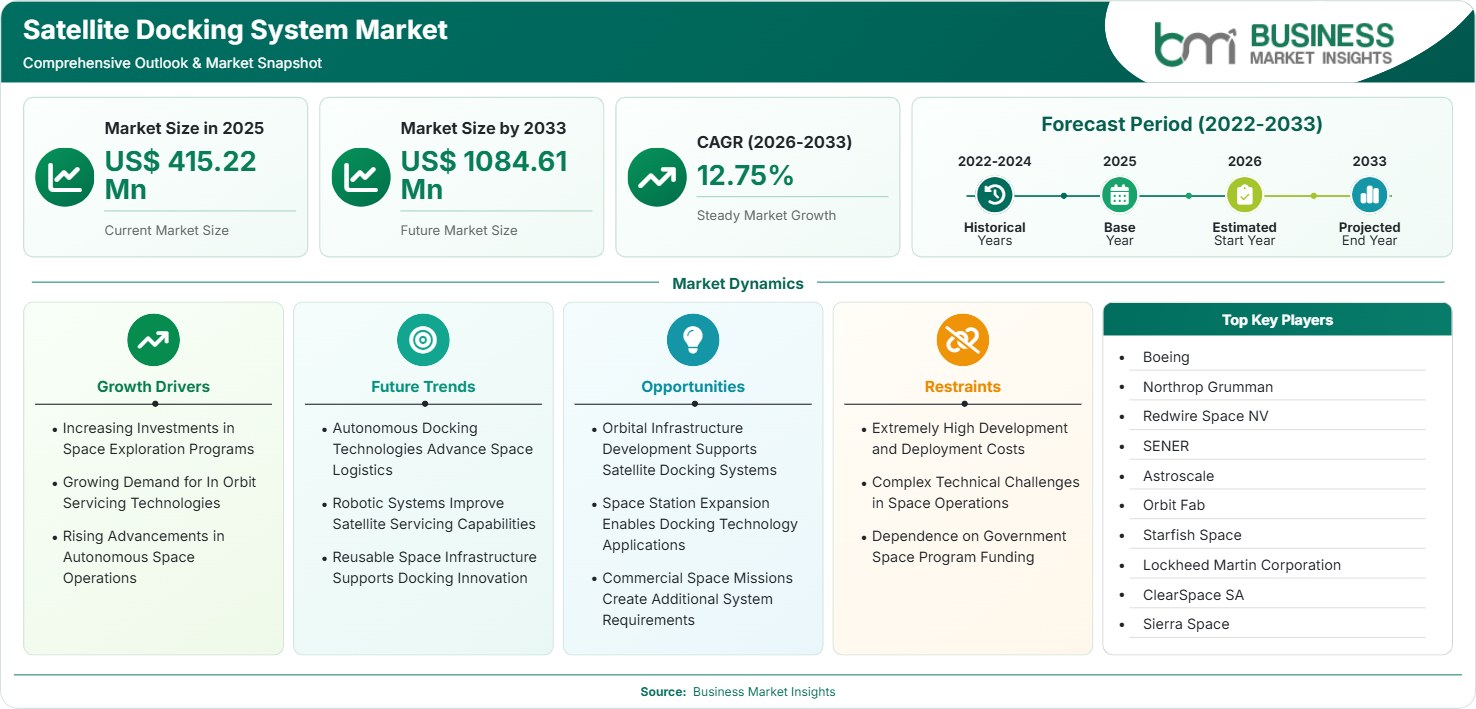
The Satellite Docking System Market size was valued at US$ 415.22 Million in 2025 and is projected to reach US$ 1084.61 Million by 2033, growing at a CAGR of 12.75% during 2026–2033, driven by servicing demand, refueling infrastructure, orbital logistics, debris mitigation, and modular spacecraft architectures.

Report Coverage
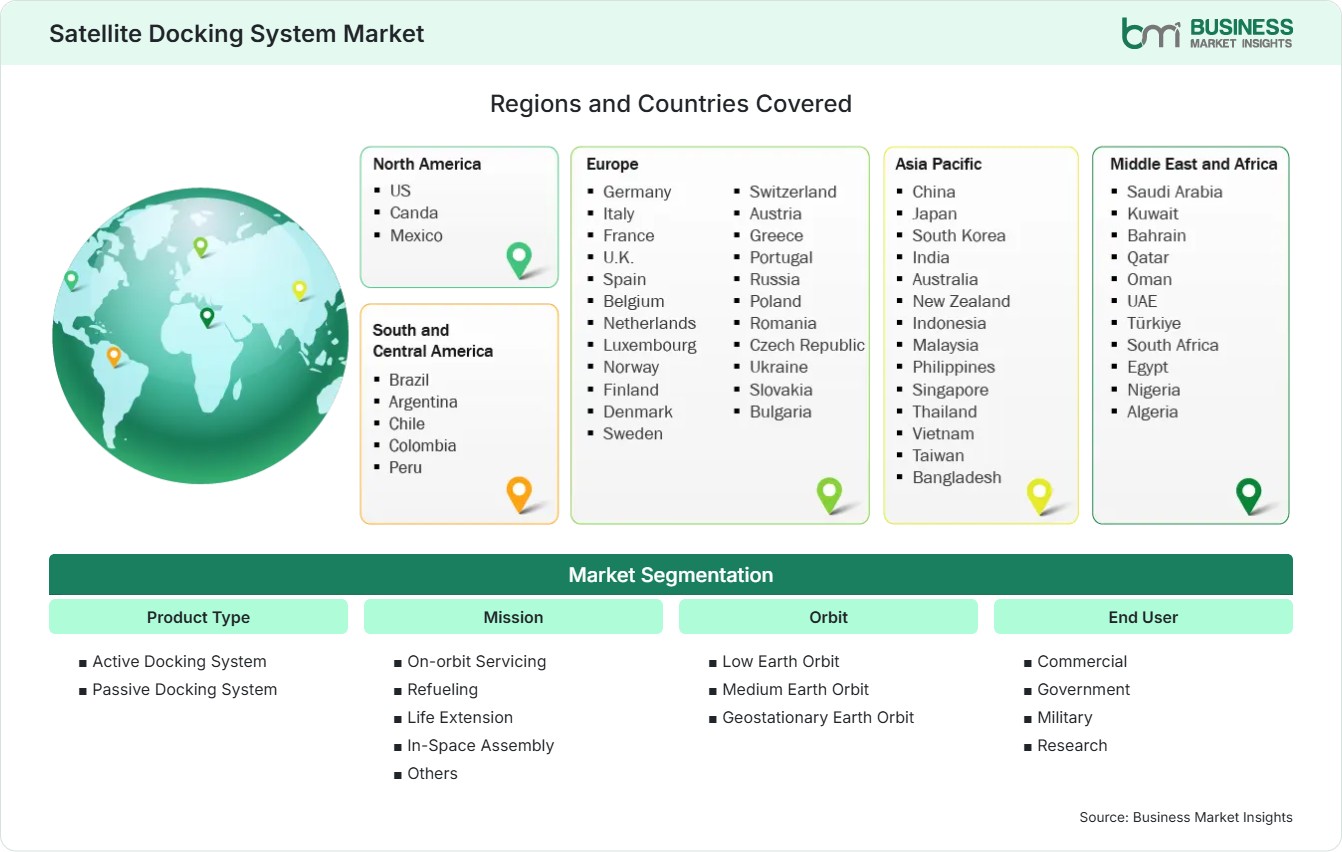
  • Product Type: Active Docking System, Passive Docking System
  • Mission: On-orbit Servicing, Refueling, Life Extension, In-Space Assembly, Others
  • Orbit: Low Earth Orbit, Medium Earth Orbit, Geostationary Earth Orbit
  • End User: Commercial, Government, Military, Research
US$ 415.22 Mn Market size in 2025
US$ 1084.61 Mn Market Size by 2033
12.75% CAGR, 2026 - 2033
2026-2033 Forecast Period

AI Overview

Satellite Docking System Market Summary

  • North America Region: North America holds a 42%–46% share in 2025, growing at a 12%–14% CAGR, supported by defense procurement, commercial servicing, autonomous rendezvous, refueling infrastructure, satellite life extension, and increasing investment in resilient orbital logistics. The U.S. Satellite Docking System market benefits from Space Force procurement, NASA technology programs, autonomous docking development, commercial servicing contracts, and a 12%–14% CAGR through 2033, supported by mature aerospace supply chains and venture-backed space infrastructure.
  • Fastest Growing Region: Asia Pacific holds a 18%–22% share in 2025 and is projected to expand at a 14%–16% CAGR, supported by Japan’s servicing programs, Chinese orbital infrastructure ambitions, commercial satellite growth, debris-removal requirements, and government-backed space technology investment.
  • Leading Segment: Active Docking System holds a 58%–62% share in 2025 and is projected to expand at a 13%–15% CAGR, supported by autonomous capture, servicing, refueling, life extension, standardized interfaces, robotic manipulation, and compatibility with increasingly diverse spacecraft architectures.
  • High Growth Segment: Refueling holds the strongest mission-level expansion trajectory at a 16%–19% CAGR, supported by commercial fuel logistics, reusable servicing vehicles, standardized fluid interfaces, satellite lifetime extension, maneuverability requirements, and emerging orbital infrastructure business models.
  • Key Market Opportunity: Standardized docking interfaces can convert servicing from bespoke missions into repeatable infrastructure by enabling compatible spacecraft, refueling vehicles, robotic servicers, modular platforms, and orbital logistics networks across multiple operators.
  • Major Market Players: The Satellite Docking System market report presents the competitive ecosystem, which includes Boeing, Northrop Grumman, Redwire Space NV, SENER, Astroscale, Orbit Fab, Starfish Space, Lockheed Martin Corporation, ClearSpace SA, and Sierra Space.
Strategic Insights

Satellite Docking System Market: Strategic Insights

Satellite Docking System Market Strategic Framework
FREE PDF
Request your free sample
Request free sample
Stakeholder View

Key Takeaways

  • The value chain is moving from standalone docking mechanisms toward integrated ecosystems combining spacecraft buses, navigation software, robotic capture, propulsion, fluid-transfer interfaces, mission planning, and orbital logistics services.
  • Refueling and life-extension missions provide the strongest commercial pathway because docking directly creates measurable economic value by preserving expensive spacecraft, reducing replacement frequency, and enabling additional operational years.
  • Autonomous relative navigation is becoming a core differentiator. Vision-based navigation, onboard guidance, and fault-tolerant control can reduce sensor complexity and enable smaller servicing vehicles to approach satellites without prepared infrastructure.
  • North America offers the strongest near-term investment case because government procurement, commercial GEO servicing, LEO constellation management, and defense-oriented dynamic space operations are developing simultaneously.
  • Funding is increasingly following validated orbital capability. Starfish Space secured a US$54.5 million U.S. Space Force contract in February 2026, while its April 2026 Series B exceeded US$100 million, demonstrating investor confidence in scalable servicing architectures.
  • Standardization represents a strategic moat. Companies capable of supplying docking hardware that conforms to international interfaces can participate across multiple spacecraft programs instead of relying on a single bespoke mission.
Geographic Outlook

Satellite Docking System Market Regional Highlights

North America Satellite Docking System Market

North America held a 42%–46% share in 2025 and is projected to grow at a 12%–14% CAGR through 2033. The region benefits from defense procurement, NASA programs, commercial GEO servicing, refueling demonstrations, and established aerospace manufacturing. The Satellite Docking System Market share is reinforced by early deployment of servicing vehicles and standardized interfaces. The market growth outlook remains supported by Space Force requirements for resilient orbital assets and commercial operators seeking life-extension economics.

  • Government procurement supports active docking development by funding autonomous rendezvous, proximity operations, satellite maneuverability, and servicing demonstrations for national-security spacecraft.
  • Commercial demand is expanding around GEO life extension and refueling, where docking can preserve high-value assets and postpone replacement launches.
  • Standardized interfaces are becoming strategically important because interoperability can reduce spacecraft redesign requirements and expand the addressable servicing fleet.
  • Venture-backed companies are commercializing smaller servicing vehicles, autonomous navigation, and universal docking technologies, creating competitive pressure on traditional aerospace architectures.

US Satellite Docking System Market

The U.S. accounted for 35%–39% of the global Satellite Docking System market in 2025 and is projected to grow at a 12%–14% CAGR through 2033. Its position reflects Space Force procurement, NASA technology programs, commercial servicing companies, and extensive aerospace manufacturing capacity. U.S. operators are also early adopters of refueling infrastructure and autonomous docking. North American market share is therefore heavily influenced by U.S. government demand and private-sector commercialization.

  • The Space Force is moving servicing concepts toward procurement, including Starfish Space’s US$54.5 million Otter contract announced in February 2026.
  • Orbit Fab’s RAFTI received Space Systems Command acceptance as a refueling interface for military satellites, strengthening interoperability prospects.
  • NASA continues developing ISAM capabilities, supporting technology maturation for servicing, assembly, manufacturing, and future orbital infrastructure.

Europe Satellite Docking System Market

Europe held a 22%–26% share in 2025 and is projected to expand at a 11%–13% CAGR. France, Germany, Italy, Spain, Switzerland, and the United Kingdom form important technology clusters, while the United Kingdom and Switzerland offer high-growth opportunities around debris removal and servicing. European demand is strengthened by ESA procurement, lunar infrastructure, satellite sustainability requirements, and commercial docking mechanisms. The regional Satellite Docking System Market share should benefit from standardized interfaces and cross-border industrial partnerships.

  • France and Switzerland are important servicing centers, with ClearSpace developing active debris-removal capabilities and European institutional support for close-proximity operations.
  • Spain contributes advanced aerospace mechanisms through SENER, supporting the broader European ecosystem for spacecraft interfaces and precision engineering.
  • The United Kingdom offers a high-growth opportunity through ESA-backed refueling development, including Orbit Fab’s RADICAL project for GEO communications satellites.
  • Redwire Space NV is strengthening European docking capability through International Berthing and Docking Mechanism contracts for lunar and commercial spacecraft.

Asia Pacific Satellite Docking System Market

Asia Pacific held a 18%–22% share in 2025 and is projected to grow at a 14%–16% CAGR, making it the fastest-growing region in the market. Japan leads commercial servicing development, while China, South Korea, India, and Australia contribute expanding space capabilities. Japan is particularly influential because Astroscale has demonstrated rendezvous and servicing technologies and is expanding commercial inspection and end-of-life capabilities. Regional Satellite Docking System market growth is supported by satellite proliferation and debris-management priorities.

  • Japan combines government support with private servicing expertise, giving Astroscale a strong platform for commercial inspection, servicing, and removal missions.
  • India is developing a broader orbital infrastructure ecosystem, creating long-term demand for rendezvous, docking, servicing, and modular spacecraft technologies.
  • China’s expanding space infrastructure creates a substantial future requirement for autonomous proximity operations, although market access remains constrained by geopolitical and regulatory barriers.
  • Australia and South Korea represent emerging opportunities where commercial satellite development and national space programs can create demand for standardized interfaces.

Rest of World Satellite Docking System Market

The Satellite Docking Systems Market in South and Central America accounted for 4%-6% in 2025, and the segment is projected to grow at a CAGR of 8%-10% owing to the maturity of satellite communication and Earth observation systems infrastructure. Brazil provides the best growth opportunity for Satellite Docking Systems in the region, owing to its aerospace facilities and space programs. Commercial servicing adoption remains in its early stages, but demand for orbital sustainability and longer satellite lifetimes can create future procurement opportunities.

The Middle East and Africa represented a 6%–8% share in 2025 and should expand at a 9%–11% CAGR. The UAE, Saudi Arabia, and Israel provide the strongest prospects because of government-backed space programs, defense applications, satellite communications, and investment in advanced space technologies.

  • Brazil is the leading South American opportunity, supported by national space capabilities and increasing relevance of satellite-enabled communications and observation services.
  • The UAE is emerging as a regional space technology hub, creating opportunities for advanced satellite operations, mission integration, and future servicing infrastructure.
  • Israel offers high-value opportunities in defense-oriented space systems where autonomous maneuvering, inspection, and satellite resilience can justify advanced docking technologies.
  • Saudi Arabia’s growing investment in space capabilities could create demand for commercial and government orbital logistics as satellite fleets mature.
Global Market Geography
FREE PDF
Request your free sample
Request free sample
Segment Analysis

Satellite Docking System Market Segmentation

Product Type

The Active Docking System held a market share of 58%–62% in 2025 and is expected to grow at a 13%–15% CAGR from 2026 to 2033, driven by the benefits of robotic capture, servicing, refueling, and autonomous rendezvous. The Passive Docking System remains a vital component for spacecraft compatibility and modularity.

  • Active Docking System (ADS): Active mechanisms provide controlled capture and alignment, enabling servicing vehicles to approach, secure, maneuver, refuel, inspect, or relocate client spacecraft across missions.
  • Structural Docking Interface: Structural interfaces transfer mechanical loads between spacecraft, supporting repeated attachment, modular assembly, crew or cargo transfer, and reliable integration within larger orbital architectures.
  • Grappel Interface: Grappling interfaces enable robotic or mechanical capture of satellites and modules, particularly valuable for servicing spacecraft, debris removal, assembly operations, and unprepared targets.
  • Passive Docking System: Passive interfaces reduce spacecraft-side complexity by providing standardized receiving structures that active servicers can engage, supporting interoperability and lower-cost spacecraft preparation.

Mission

On-orbit services were the largest segment in 2025 due to demand for life extension, inspection, debris removal, and resilience. Refueling is advancing fast due to the development of standardized interfaces. The Satellite Docking System Market Scope is growing due to docking applications ranging from maintenance to assembly and logistics.

  • On-orbit Servicing: Servicing missions use docking to inspect, repair, relocate, upgrade, or maintain spacecraft, converting docking infrastructure into a recurring operational capability.
  • Refueling: Refueling connects spacecraft to fuel depots or servicing vehicles, enabling additional maneuvering, longer mission duration, and reduced dependence on replacement satellites.
  • Life Extension: Life-extension missions attach propulsion or servicing vehicles to aging satellites, allowing operators to preserve revenue-generating assets and defer costly replacement programs.
  • In-Space Assembly: Assembly missions require repeatable docking and berthing interfaces to construct larger platforms, habitats, telescopes, and infrastructure from separately launched modules.

Orbit

Low Earth Orbit (LEO) offered the greatest operational potential due to the density of satellite constellations, the demand for space debris removal, and the growth of commercial space servicing operations. GEO continues to be attractive from a commercial perspective owing to the value of spacecraft. The Satellite Docking System market trends will thus vary by orbit, with LEO emphasizing scale and disposal while GEO emphasizes lifetime extension and refueling.

  • Low Earth Orbit (LEO): LEO supports high-volume servicing opportunities involving constellation maintenance, debris removal, inspection, orbital relocation, and end-of-life disposal.
  • Medium Earth Orbit (MEO): MEO presents specialized opportunities involving navigation satellites and high-value spacecraft where servicing can improve asset resilience and operational flexibility.
  • Geostationary Earth Orbit (GEO): GEO offers strong economic incentives for docking because communications satellites are expensive assets with long operating lives and substantial revenue potential.

End User

Commercial users were the largest end-user category in 2025, as operators increasingly evaluated life extension, fueling, and fleet management. The government and military sectors remain important drivers of technology, with research institutions contributing to demonstration missions and the validation of autonomous docking technologies.

  • Commercial: Operators use docking to extend spacecraft lives, refuel assets, reduce replacement requirements, and create more flexible fleet-management strategies.
  • Government: Government agencies fund technology demonstrations, orbital sustainability programs, infrastructure development, and missions that establish standards and reduce technical risk.
  • Military: Military users prioritize maneuverability, resilience, inspection, servicing, and rapid recovery of critical spacecraft supporting national-security missions.
  • Research: Research institutions use docking systems to validate autonomous navigation, robotic capture, modular assembly, microgravity experimentation, and future exploration infrastructure.
Market Forces

Satellite Docking System Market Dynamics

Key Market Drivers

Government Procurement and Orbital Resilience

Government organizations have been translating research on docking into practical procurement activities since resilient space architectures require more than just launch replacements. The U.S. Space Force is procuring the ability to service, whereas NASA is still involved in developing the ISAM technology. In February 2026, Starfish Space was awarded a US$54.5 million Space Force contract to build the Otter servicer to autonomously dock with and maneuver national security satellites. This shows that docking has evolved from a laboratory-based innovation into a technically feasible one. Further, it provides anchor customers to equipment and technology suppliers in the Satellite Docking Systems market segment. The requirements of the defense sector reduce the risks associated with technology development by enabling early deployments, which can be followed by subsequent missions in the commercial sector.

Expansion of Autonomous Rendezvous and Docking

Autonomous navigation is reducing reliance on heavy intervention by the ground segment and sensor sets. Starfish Space showcased autonomous relative navigation based on computer vision and guidance software; moreover, the Otter concept includes CETACEAN navigation, CEPHALOPOD guidance, and Nautilus docking technology. Astroscale has created a variety of docking technologies and servicing capabilities through orbital missions. Such improvements affect the Satellite Docking System market trends by enabling more missions with small servicing craft, reducing hardware and operating expenses. Software-based navigation supports multiple client geometries and unprepared targets. The architecture becomes dependent on algorithms, computing, failure handling, and sensor fusion, whereas mechanical interfaces become standard components.

Commercialization of Refueling Infrastructure

Refueling becomes the direct economic connection between the docking process and revenue generation. The RAFTI interface of Orbit Fab consists of docking and fluid delivery and is supposed to perform multiple docks with different satellites. According to the company's official page, over 100 commercial satellites are already connected to the ecosystem, and the RAFTI interface operates not only in LEO but also in GEO and other orbits. The RAVEN spacecraft, created by the company, was launched in April 2026 and can deliver 150-200 kg of propellant to satellites equipped with the RAFTI interface. This innovation contributes to the growth of the Satellite Docking System by transforming docking into a system for recurrent fuel delivery.

Key Market Opportunities

Standardized Interfaces for Multi-Mission Fleets

A standard interface is one of the most straightforward ways to achieve scale, as space operators would be able to outfit their spacecraft prior to launch while still having access to several servicing organizations in the future. In August 2025, NASA’s update of the International Docking System Standard further emphasizes the value of shared docking ports for cooperation in outer space. The IBDM contract for Redwire's Lunar Gateway, as well as the commercial Nyx spacecraft, is a good example of how standard interfaces can help in both institutional and commercial projects. Investors interested in the Satellite Docking System Market forecast may see greater potential in ongoing sales of hardware for spacecraft buses than in project-related engineering services.

GEO Refueling and Life-Extension Services

GEO provides a compelling commercial opportunity because communications satellites generate substantial economic value and replacement missions require considerable capital and schedule coordination. Orbit Fab is developing refueling services for GEO spacecraft, while Astroscale is positioning LEXI for multi-mission satellite life extension. Docking and refueling would allow satellites to maintain their orbital slots, manage their deployments, and delay their replacements. In terms of the business case, the more compelling case would be for a servicer that could visit many satellites throughout its lifetime. Satellite Docking System market forecasts favor systems that support docking, standard fluids, navigation, and servicing for multiple customers.

LEO Constellation Disposal and Servicing

Large LEO constellations create an opportunity for recurring servicing because spacecraft populations are numerous, distributed, and subject to propulsion depletion and end-of-life requirements. Starfish Space was awarded a contract worth US$52.5 million in January 2026 to provide Deorbit-as-a-Service for satellites in the Proliferated Warfighter Space Architecture. Astroscale will further develop its end-of-life removal service, and ESA will continue to support active debris removal missions. The process is much more than just disposal; it involves inspection, repositioning, maintenance, and even extending the operational lifespan of some satellites. Cost-effective servicing for multiple clients would enhance vehicle docking efficiency through standardization and autonomous target detection.

Market Restraints and Challenges

High Mission Risk and Complex Non-Cooperative Operations

Factor: Docking occurs during proximity operations where navigation, mechanical capture, propulsion, and spacecraft control must operate with extremely low tolerance for failure.

Impact: Failure to achieve successful capture poses risks for damaging the two objects, creating debris, or aborting a costly mission. This makes certification and development more demanding. The additional complexity in the case of unprepared objects arises from the service vehicle's lack of cooperation regarding the marking, geometric shapes, and attitude of the targeted objects. The system needs to detect the relative position, velocity, and angular motion while maintaining a safe distance. Research by Astroscale on capturing a spinning object showcases the difficulty of this engineering problem. These requirements increase testing costs, ground simulation needs, redundancy requirements, and insurance considerations, limiting the speed at which new suppliers can enter the market.

Lack of Standardized Servicing Interfaces

Factor: a large installed base of satellites was designed without standardized servicing interfaces or docking provisions.

Impact: servicing entities may require specific capture systems, robotics, navigation software, and mechanical modifications tailored to individual clients, which are non-repeatable and increase mission costs. Standardization is underway; however, several approaches remain for the servicing interface philosophy regarding refueling, berthing, and even crew support. Orbit Fab proposes the RAFTI system as a solution for the refueling problem, whereas NASA uses the IDSS standard for docking. The mix of specialized and standardized systems can impede the development of a space fleet, since it must be decided whether to add interfaces to existing craft or modify them during manufacturing. This challenge particularly affects older GEO satellites and unprepared LEO spacecraft.

Company Analysis

Competitive Landscape

Competitive Satellite Docking System market analysis indicates a market split between diversified aerospace primes, specialist servicing companies, docking-mechanism developers, and orbital logistics providers. The strongest competitive advantage increasingly comes from combining flight heritage with autonomous software, standardized interfaces, and repeatable servicing economics.

Company Name

Overview

Products and Services relevant to this market

Boeing

Major U.S. aerospace company with extensive spacecraft, human-spaceflight, defense, and orbital infrastructure capabilities.

Spacecraft docking systems, crew-space transportation technologies, orbital infrastructure, integration, and advanced space mechanisms.

Northrop Grumman

U.S. aerospace and defense leader with demonstrated GEO satellite servicing through SpaceLogistics Mission Extension Vehicles.

Mission Extension Vehicles, robotic servicing, docking, satellite relocation, life extension, inspection, repair, and augmentation services.

Redwire Space NV

Belgian space-infrastructure specialist providing advanced mechanisms and docking technologies for institutional and commercial missions.

International Berthing and Docking Mechanism, docking systems, spacecraft mechanisms, sensors, avionics, and orbital infrastructure technologies.

SENER

Spanish engineering group with deep aerospace mechanism expertise and experience supplying precision spacecraft hardware.

Space mechanisms, deployment systems, docking-related structures, precision electromechanical systems, and spacecraft integration technologies.

Astroscale

Japanese-founded orbital sustainability company focused on inspection, servicing, debris removal, and spacecraft life extension.

Docking plates, rendezvous and proximity operations, servicing vehicles, inspection, end-of-life removal, and life-extension solutions.

Orbit Fab

U.S. orbital logistics company developing standardized refueling interfaces and commercial in-space fuel delivery.

RAFTI refueling interface, GRIP active docking mechanism, RAVEN shuttle, NEST depot concepts, and refueling logistics.

Starfish Space

U.S. specialist developing compact autonomous servicing spacecraft for life extension and disposal missions.

Otter servicing vehicle, Nautilus docking mechanism, CETACEAN navigation, CEPHALOPOD guidance, and autonomous RPOD services.

Lockheed Martin Corporation

Diversified U.S. defense and aerospace prime supporting spacecraft, exploration, national security, and advanced orbital systems.

Spacecraft platforms, robotic systems, docking-related architectures, mission integration, autonomous operations, and defense space technologies.

ClearSpace SA

Swiss orbital-services company developing active debris removal and in-orbit servicing capabilities.

Robotic capture systems, rendezvous and proximity operations, debris removal, spacecraft servicing, and orbital sustainability missions.

Sierra Space

U.S. commercial space company developing reusable spacecraft, space infrastructure, and orbital transportation capabilities.

Space transportation, orbital infrastructure, spacecraft integration, autonomous operations, and technologies supporting future servicing ecosystems.

Trust & Transparency

Research Methodology

The market analysis combines proprietary research with secondary data from government agencies, company disclosures, regulatory filings, industry databases and expert interviews. Market estimates are validated through data triangulation, cross-market benchmarking and analyst review.

View Full Research Methodology

Questions Answered

Frequently Asked Questions

How will standardization affect future spacecraft design?

Standardization can encourage satellite manufacturers to integrate servicing interfaces during initial spacecraft production. Doing so can broaden future access to refueling, inspection, life extension, and disposal services. NASA’s continuing development of international docking standards demonstrates the strategic importance of interoperability for increasingly interconnected orbital infrastructure.

Why is refueling becoming an important docking application?

Refueling directly extends spacecraft maneuvering capability and can postpone replacement. Orbit Fab’s RAFTI interface combines cooperative docking with fluid transfer, while its RAVEN architecture is intended to deliver propellant to compatible spacecraft. This creates a potential recurring logistics model rather than a single-use servicing mission.

What role does autonomy play in docking?

Autonomy enables servicing vehicles to calculate relative position, velocity, attitude, and approach trajectories with limited ground intervention. Computer vision, guidance software, onboard processing, and fault-management systems are particularly important when targets are unprepared or non-cooperative. These capabilities can reduce spacecraft complexity while improving repeatability.

How does a docking interface improve spacecraft economics?

A standardized interface can allow a spacecraft to receive services from multiple compatible vehicles over its operating life. This can support refueling, propulsion augmentation, inspection, repairs, relocation, or disposal. The economic benefit increases when one servicing vehicle can serve several customers, spreading mission costs across multiple spacecraft.

What is driving demand for satellite docking systems?

Demand is being driven by the transition from disposable spacecraft toward serviceable orbital assets. Life extension, refueling, debris removal, inspection, relocation, and in-space assembly all require reliable rendezvous and attachment capabilities. Government procurement is accelerating technology validation, while commercial operators increasingly evaluate servicing as an alternative to premature satellite replacement.

Access the Full Satellite Docking System Market Report

Get segment-level forecasts, regional estimates, competitive benchmarking, company profiles and downloadable Excel datasets.

Access the full Satellite Docking System Market Report
350 pages PDF & Excel | 2026-09-22
Similar Research

Related Market Reports