
Satellite Communication (SATCOM) Market Outlook: Size, Share, Trends, Growth Analysis, Competitive Landscape & Forecast, 2026-2033

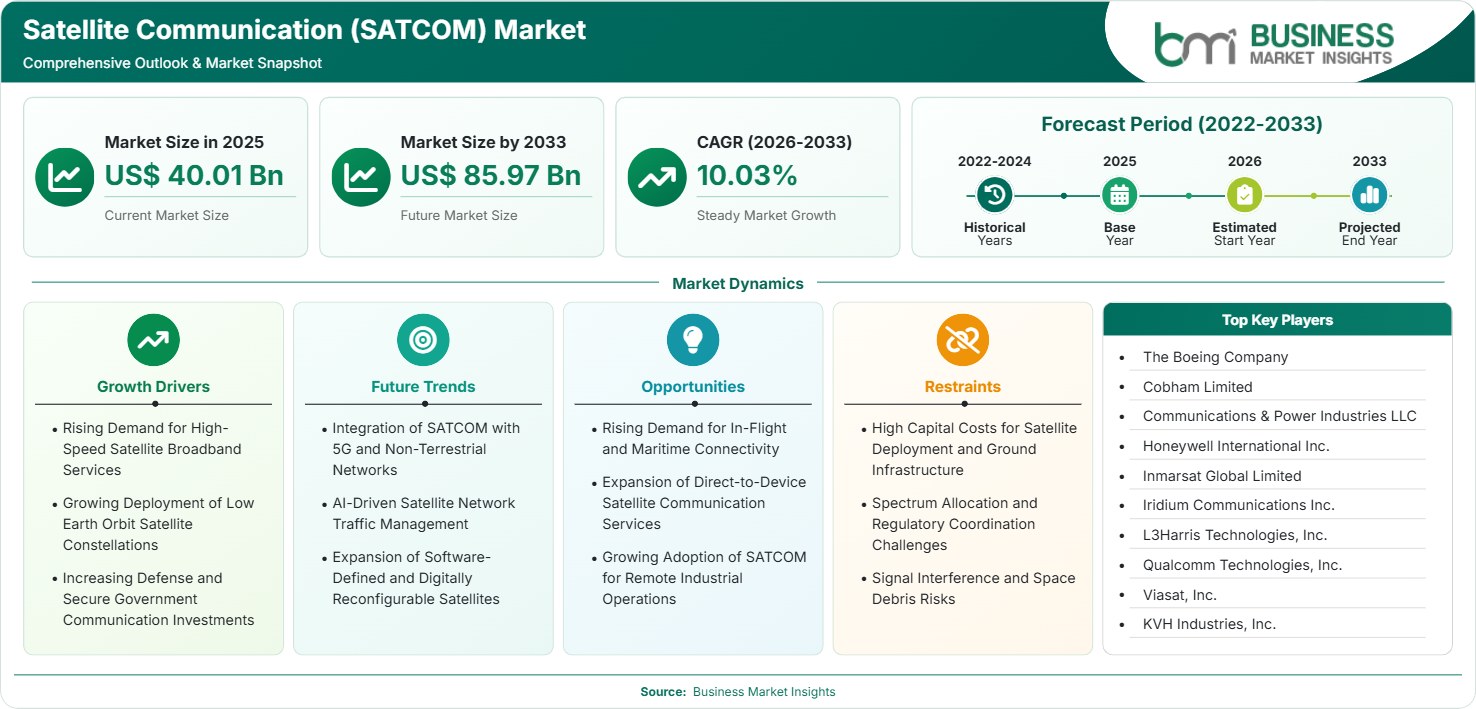
The Satellite Communication (SATCOM) Market size was valued at US$ 40.01 Billion in 2025 and is projected to reach US$ 85.97 Billion by 2033, growing at a CAGR of 10.03% during 2026–2033. Increased need for broadband connectivity, higher demands from defense sector for communications capabilities, growth of low earth orbit satellite constellations and rise in connected mobility deployments have been continuously opening up many more opportunities in the satellite communications industry.

Report Coverage
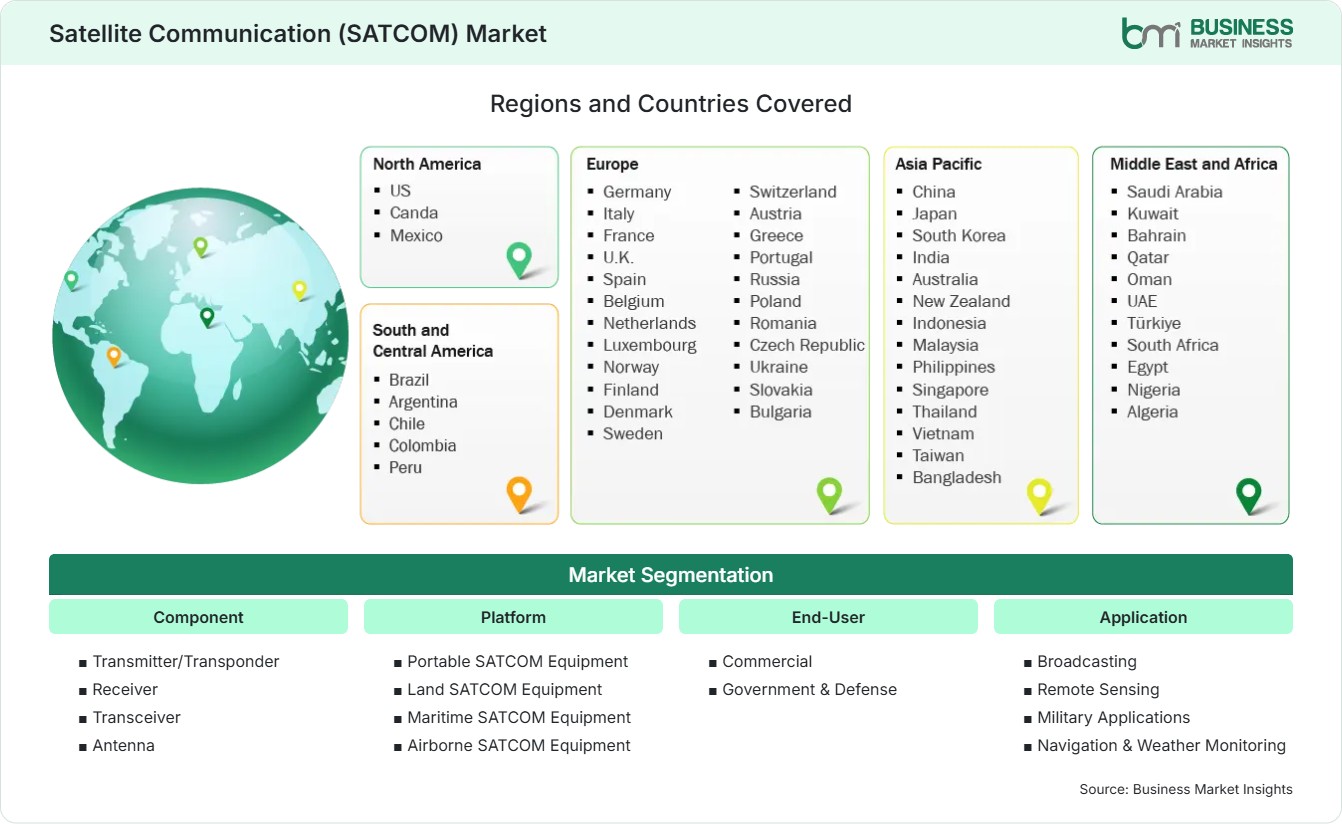
  • Component: Transmitter/Transponder, Receiver, Transceiver, Antenna
  • Platform: Portable SATCOM Equipment, Land SATCOM Equipment, Maritime SATCOM Equipment, Airborne SATCOM Equipment
  • End-User: Commercial, Government & Defense
  • Application: Broadcasting, Remote Sensing, Military Applications, Navigation & Weather Monitoring
US$ 40.01 Bn Market size in 2025
US$ 85.97 Bn Market Size by 2033
10.03% CAGR, 2026 - 2033
2026-2033 Forecast Period

AI Overview

Satellite Communication (SATCOM) Market Summary

  • North America Region: North America holds 36%–39% satellite communication (SATCOM) market share in 2025 and is projected to expand at a 9.4%–9.9% CAGR during 2026–2033. Strong defense spending, satellite network investments, airborne connectivity demand, and commercial broadband deployments continue supporting market growth. The United States dominates regional demand through advanced satellite infrastructure, government programs, and commercial space investments, advancing at approximately 9.7%–10.2% CAGR through 2033.
  • Fastest Growing Region: Asia Pacific accounts for 24%–27% market share in 2025 and is expected to register the fastest 11.2%–11.8% CAGR during the forecast period. Expanding digital connectivity initiatives, increasing satellite launches, maritime communication demand, and defense modernization programs continue accelerating regional growth.
  • Leading Segment: Government & Defense accounts for 52%–56% market share in 2025 and is anticipated to grow at a 9.8%–10.3% CAGR through 2033. Rising investments in secure communications, intelligence operations, surveillance systems, and military network modernization continue supporting segment leadership.
  • High Growth Segment: Airborne SATCOM Equipment holds 18%–21% market share in 2025 while expanding at a 11.5%–12.1% CAGR during 2026–2033. Increasing adoption of in-flight connectivity, military aircraft modernization, and demand for uninterrupted communication services continue driving deployment.
  • Key Market Opportunity: Expanding satellite-enabled broadband services, direct-to-device connectivity, next-generation mobility solutions, and integration of low Earth orbit constellations are creating substantial long-term opportunities for industry participants.
  • Major Market Players: The Boeing Company, Cobham Limited, Communications & Power Industries LLC, Honeywell International Inc., Inmarsat Global Limited, Iridium Communications Inc., L3Harris Technologies, Inc., Qualcomm Technologies, Inc., Viasat, Inc., and KVH Industries, Inc.
Strategic Insights

Satellite Communication (SATCOM) Market: Strategic Insights

Satellite Communication (SATCOM) Market Strategic Framework
FREE PDF
Request your free sample
Request free sample
Stakeholder View

Key Takeaways

  • Government and defense organizations remain the largest revenue contributors as secure communications, intelligence gathering, surveillance operations, and battlefield connectivity continue receiving substantial investment worldwide.
  • Airborne SATCOM equipment presents the strongest growth opportunity owing to rising demand for in-flight connectivity, military aircraft modernization, and real-time communication capabilities across commercial aviation networks.
  • Innovation is increasingly focused on low Earth orbit constellations, electronically steered antennas, software-defined satellites, and hybrid multi-orbit communication architectures that improve coverage and network resilience.
  • Asia Pacific offers the most compelling investment landscape due to increasing satellite deployments, defense modernization programs, expanding maritime trade routes, and growing digital connectivity initiatives.
  • Strategic collaboration among satellite operators, equipment manufacturers, telecommunications providers, and government agencies is becoming critical as demand grows for integrated and interoperable communication solutions.
  • The Satellite Communication (SATCOM) Market scope continues to expand beyond traditional communications into broadband connectivity, Internet of Things applications, emergency response systems, remote monitoring, and autonomous mobility platforms.
Geographic Outlook

Satellite Communication (SATCOM) Market Regional Highlights

North America Satellite Communication (SATCOM) Market

North America accounts for 36%–39% of the Satellite Communication (SATCOM) Market share in 2025 and is projected to grow at a 9.4%–9.9% CAGR through 2033. Strong government spending, military modernization, commercial satellite deployments, and increasing mobility connectivity requirements continue supporting regional growth. Advanced satellite infrastructure, high adoption of broadband services, and investments in next-generation communication systems further strengthen market demand across the region.

  • Defense agencies continue investing in secure satellite communication systems to support intelligence gathering, battlefield awareness, and global military operations.
  • Commercial airlines increasingly deploy in-flight connectivity solutions to improve passenger experience and enable real-time communication services.
  • Growing low Earth orbit satellite deployments are enhancing network coverage, reducing latency, and expanding broadband accessibility.
  • Enterprise demand for reliable connectivity across remote and underserved locations continues supporting commercial SATCOM investments.
  • Government-backed space initiatives remain important drivers of satellite communication infrastructure development.

US Satellite Communication (SATCOM) Market

The United States contributes 84%–87% of North American revenue and is anticipated to register a 9.7%–10.2% CAGR through 2033. Demand is driven by extensive defense programs, commercial satellite investments, increasing broadband requirements, and leadership in space technologies. Continued modernization of military communication systems and expansion of satellite-enabled services support long-term market growth.

  • Defense modernization programs continue supporting procurement of advanced secure communication and satellite networking solutions.
  • Commercial satellite operators are expanding capacity to address growing broadband and enterprise communication requirements.
  • Aviation connectivity demand is creating opportunities for airborne communication equipment manufacturers and service providers.
  • Investments in space innovation and satellite manufacturing continue strengthening industry competitiveness.

Europe Satellite Communication (SATCOM) Market

Europe represents 25%–28% market share in 2025 and is expected to expand at a 9.6%–10.1% CAGR through 2033. Increasing investments in satellite-based communications, defense modernization, and cross-border connectivity initiatives continue supporting regional demand. Germany leads the regional market through strong aerospace capabilities, while Poland records the fastest growth with a 10.3%–10.8% CAGR supported by defense and digital infrastructure investments.

  • Defense communication upgrades are increasing adoption of secure and resilient satellite communication networks.
  • Maritime connectivity investments continue supporting deployment across commercial and government-operated vessels.
  • Aerospace and satellite manufacturing capabilities strengthen regional competitiveness in communication technologies.
  • Cross-border connectivity initiatives are promoting wider adoption of satellite-enabled broadband services.
  • Digital sovereignty objectives continue encouraging investment in regional space and communication infrastructure.

Asia Pacific Satellite Communication (SATCOM) Market

Asia Pacific accounts for 24%–27% market share in 2025 and is forecast to register the fastest 11.2%–11.8% CAGR during 2026–2033. Increasing satellite launches, expanding connectivity programs, defense modernization efforts, and growth in aviation and maritime industries continue driving regional expansion. China remains the largest regional satellite communication (SATCOM) market, while India is projected to witness the fastest growth with a 11.8%–12.4% CAGR through 2033.

  • Government-led satellite programs are improving connectivity across remote and underserved geographic regions.
  • Expanding maritime trade routes continue creating demand for vessel-based communication systems.
  • Aviation sector growth is increasing adoption of airborne connectivity and communication solutions.
  • Defense modernization initiatives support procurement of advanced satellite communication equipment and services.
  • Growing demand for reliable broadband connectivity is encouraging investment in next-generation satellite networks.

Rest of World Satellite Communication (SATCOM) Market

The Rest of World region represents 8%–10% Satellite Communication (SATCOM) Market share in 2025 and is projected to expand at a 8.8%–9.4% CAGR through 2033. South & Central America continue investing in broadband access and remote communications, while the Middle East & Africa are strengthening defense communications and critical infrastructure connectivity. Brazil leads regional demand, whereas Saudi Arabia demonstrates the fastest growth with a 9.5%–10.0% CAGR.

  • Expanding broadband coverage initiatives are increasing adoption of satellite-enabled connectivity in underserved communities.
  • Defense and public security agencies continue investing in resilient communication networks for mission-critical operations.
  • Energy, mining, and remote industrial projects increasingly rely on satellite communication services for operational continuity.
  • Aviation and maritime sectors remain key adopters of mobile satellite communication platforms.
  • Government investments in digital infrastructure continue supporting long-term market development.
Global Market Geography
FREE PDF
Request your free sample
Request free sample
Segment Analysis

Satellite Communication (SATCOM) Market Segmentation

Component

Component demand is influenced by the growing complexity of satellite communication networks and the need for reliable transmission, reception, and signal processing capabilities. Transceiver & Antenna solutions account for approximately 38%–42% share in 2025 and are projected to grow at a 10.4%–10.9% CAGR through 2033. Increasing deployment of mobile satellite communication systems, broadband connectivity services, and multi-orbit satellite networks continues supporting demand across commercial and government applications.

  • Transmitter/Transponder: Essential for signal transmission and onboard satellite communication functions, supporting broadcasting, navigation, defense communications, and broadband connectivity services.
  • Receiver: Widely deployed across fixed and mobile communication platforms to ensure reliable signal reception and uninterrupted data transfer capabilities.
  • Transceiver & Antenna: Represents the leading component category due to growing requirements for bidirectional communication, mobility connectivity, and high-speed satellite broadband applications.

Platform

Platform adoption continues expanding as satellite communication systems become increasingly integrated across land, maritime, airborne, and portable communication environments. Mobility applications, digital transformation programs, and defense modernization initiatives are strengthening demand for platform-specific SATCOM solutions capable of delivering reliable connectivity under diverse operating conditions.

  • Portable SATCOM Equipment: Supports emergency response operations, military deployments, disaster recovery activities, and remote communication requirements where rapid deployment and mobility are critical.
  • Land SATCOM Equipment (Command and Control Centers, Ground Station & Satellite TV): Maintains significant demand through government communications, broadcasting services, and fixed ground infrastructure supporting satellite operations.
  • Maritime SATCOM Equipment (Commercial Ships & Military Ships): Demand is increasing as shipping operators, naval fleets, and offshore industries require continuous communication, navigation, and crew connectivity capabilities.
  • Airborne SATCOM Equipment (Commercial Aircraft & Military Aircraft): Fastest-growing platform because of rising in-flight connectivity demand, military aircraft modernization, and real-time communications requirements.

End-user

End-user demand remains heavily influenced by national security requirements, commercial connectivity expansion, and digital transformation initiatives. Government & Defense accounts for approximately 52%–56% share in 2025 and is forecast to expand at a 9.8%–10.3% CAGR through 2033. Secure communication networks, surveillance operations, intelligence systems, and strategic defense applications continue driving procurement activity worldwide.

  • Commercial: Demand is supported by broadband communication services, enterprise connectivity, transportation applications, broadcasting activities, and remote operations management.
  • Government & Defense: Remains the leading segment due to investments in secure communication systems, military modernization, intelligence gathering, and mission-critical operations.

Application

Application diversity continues broadening as satellite communication technologies support connectivity, monitoring, intelligence, and navigation functions across multiple industries. The Satellite Communication (SATCOM) Market trends indicate increasing adoption of high-throughput satellite services, enhanced mobility solutions, and low-latency communication architectures designed to support evolving user requirements.

  • Broadcasting: Continues serving television, radio, and multimedia distribution networks requiring broad geographic coverage and reliable transmission capabilities.
  • Remote Sensing: Supports earth observation, environmental monitoring, disaster assessment, resource management, and infrastructure planning activities.
  • Military Applications: Represents a major application area driven by secure communications, surveillance operations, situational awareness, and strategic defense requirements.
  • Navigation & Weather Monitoring: Expanding through growing demand for positioning services, aviation navigation, meteorological forecasting, and climate observation systems.
Market Forces

Satellite Communication (SATCOM) Market Dynamics

Key Market Drivers

Rising Demand for High-Speed Satellite Broadband Services

Increasing demand for internet connectivity through satellite broadband is fuelled by the requirement for high-speed connectivity in remote, rural, marine, and aerial locations. There is increasing demand from governments, businesses, and end-users for continuous connectivity irrespective of the geographic location. Technologies like high-throughput satellites, ground segment capabilities, and advanced bandwidth management solutions help improve network and user experience. The expansion of digital economies, cloud-based solutions, distance learning, telemedicine, and connected infrastructure is making demand stronger. These factors continue positioning satellite broadband as a critical solution for bridging connectivity gaps and supporting long-term satellite communication (SATCOM) market growth.

Growing Deployment of Low Earth Orbit Satellite Constellations

The rapid deployment of low Earth orbit satellite constellations is transforming the communications landscape by improving coverage, reducing latency, and increasing network capacity. Operators are investing heavily in next-generation satellite networks capable of supporting broadband, mobility, enterprise, and government communication requirements. Unlike traditional geostationary systems, low Earth orbit constellations offer enhanced responsiveness and broader service accessibility. Growing investments from commercial operators, technology providers, and government agencies continue accelerating deployment activities. As constellation networks expand globally, demand for supporting ground equipment, antennas, and communication technologies is expected to increase substantially.

Increasing Defense and Secure Government Communication Investments

Defense organizations worldwide continue prioritizing secure, resilient, and interoperable communication capabilities to support modern military operations. Satellite communication systems provide essential connectivity for intelligence gathering, command and control activities, surveillance missions, and strategic communications. Rising geopolitical uncertainties, modernization programs, and cybersecurity concerns are encouraging governments to strengthen satellite-enabled communication infrastructure. Military agencies increasingly seek protected communication networks capable of operating under contested and remote conditions. Ongoing investments in advanced satellite architectures, secure terminals, and next-generation communication technologies remain a significant growth catalyst for the global SATCOM ecosystem.

Key Market Opportunities

Rising Demand for In-Flight and Maritime Connectivity

Airlines and maritime operators increasingly view connectivity as a strategic service differentiator. Passengers, crew members, and operational teams expect reliable communications, entertainment access, and real-time information regardless of location. Satellite communication technologies enable continuous connectivity across oceans, remote air routes, and regions where terrestrial networks are unavailable. Growth in global air travel, commercial shipping activity, and cruise operations is creating attractive opportunities for equipment manufacturers and service providers. Companies offering high-bandwidth, low-latency connectivity solutions are positioned to benefit from expanding mobility communication requirements worldwide.

Expansion of Direct-to-Device Satellite Communication Services

Direct-to-device communication solutions are emerging as a transformative opportunity within the satellite communications industry. These systems enable smartphones and connected devices to communicate directly with satellites without relying exclusively on terrestrial infrastructure. The technology has potential applications across emergency response, disaster recovery, rural connectivity, and consumer communications. Advancements in network integration, spectrum utilization, and device compatibility are improving commercial feasibility. Long-term Satellite Communication (SATCOM) Market Forecasts remain favorable as operators and technology companies accelerate development of direct satellite connectivity ecosystems capable of reaching previously underserved populations.

Growing Adoption of SATCOM for Remote Industrial Operations

For industries that operate in isolated locations, satellite communication is fast becoming an essential service that helps to ensure smooth operation and safety for personnel. This is especially the case for mining operations, oil and gas facilities, renewable energy plants, transport links, and remote infrastructure development projects where robust connectivity services cannot be provided through landline-based telecommunications systems. Industrial digitization trends that are developing across the world are expected to provide significant growth potential for SATCOMs companies.

Market Restraints and Challenges

High Capital Costs for Satellite Deployment and Ground Infrastructure

Factor: The establishment of satellite communications networks involves considerable expenditure on satellite construction, launching services, ground facilities, spectrum allocation, user equipment, and operations. The development and maintenance of sophisticated satellite networks is very capital-intensive.

Impact: High costs associated with the network infrastructure may increase the payback period and serve as entry barriers to potential market competitors. It may be difficult for smaller firms to raise enough money for major deployments. Hence, industry players keep looking for ways to collaborate and innovate for increased cost-efficiency.

Spectrum Allocation and Regulatory Coordination Challenges

Factor: Satellite operators must navigate complex international regulations, spectrum allocation requirements, licensing processes, and coordination frameworks across multiple jurisdictions and frequency bands.

Impact: Regulatory delays, spectrum conflicts, and compliance obligations may slow service deployment and increase operational complexity. Operators must work closely with national regulators and international organizations to ensure efficient spectrum utilization and uninterrupted service availability. These challenges remain an important consideration for long-term market expansion and investment planning.

Company Analysis

Competitive Landscape

The Satellite Communication (SATCOM) Market analysis reflects strong competition among satellite communication equipment providers, aerospace companies, connectivity service providers, and defense communication specialists. Companies are focusing on low Earth orbit integration, high-throughput satellite solutions, advanced antenna systems, secure communication networks, and mobility connectivity platforms. Strategic partnerships, technology innovation, and expansion into broadband and direct-to-device services continue shaping competitive positioning across the industry.

Company Name

Overview

Products and Services Relevant to this Market

The Boeing Company

Global aerospace and defense company with extensive expertise in satellite systems, military communications, and space technologies.

Satellite communication systems, military communication solutions, satellite payloads, aerospace networks, and defense communication platforms.

Cobham Limited

Communications and aerospace technology provider serving defense, aviation, maritime, and government communication markets.

SATCOM terminals, antennas, military communication equipment, airborne communication systems, and connectivity solutions.

Communications & Power Industries LLC

Provider of advanced microwave, radio-frequency, and satellite communication technologies for commercial and government applications.

Satellite communication amplifiers, ground station equipment, antennas, transmitters, and space communication systems.

Honeywell International Inc.

Diversified technology company offering aerospace communication solutions and connected mobility technologies.

Airborne SATCOM systems, satellite connectivity platforms, navigation systems, communication hardware, and aviation solutions.

Inmarsat Global Limited

Global satellite connectivity provider delivering communication services across aviation, maritime, enterprise, and government sectors.

Satellite broadband services, aviation connectivity, maritime communications, IoT connectivity, and government communication services.

Iridium Communications Inc.

Satellite network operator specializing in global mobile voice and data communication services.

Mobile satellite communications, IoT connectivity, satellite voice services, data transmission solutions, and remote communication platforms.

L3Harris Technologies, Inc.

Defense and communication technology provider focused on secure communication and mission-critical systems.

Tactical communication systems, SATCOM terminals, defense communication equipment, airborne communication solutions, and secure networks.

Qualcomm Technologies, Inc.

Semiconductor and wireless technology company supporting satellite-enabled connectivity innovations.

Satellite-enabled communication chipsets, direct-to-device connectivity technologies, wireless communication platforms, and mobile solutions.

Viasat, Inc.

Global communications company providing broadband satellite services and mobility connectivity solutions.

High-throughput satellite services, inflight connectivity, broadband communication solutions, government communication services, and network technologies.

KVH Industries, Inc.

Specialized communication provider serving maritime, mobile, and remote connectivity applications worldwide.

Maritime SATCOM systems, mobile connectivity solutions, satellite communication equipment, vessel communication services, and network solutions.

Trust & Transparency

Research Methodology

The market analysis combines proprietary research with secondary data from government agencies, company disclosures, regulatory filings, industry databases and expert interviews. Market estimates are validated through data triangulation, cross-market benchmarking and analyst review.

View Full Research Methodology

Questions Answered

Frequently Asked Questions

What does the Satellite Communication (SATCOM) Market Report cover?

The report provides insights into market size, share, segmentation, regional trends, competitive landscape, growth drivers, opportunities, restraints, and forecast analysis through 2033.

Which platform segment is growing the fastest?

Airborne SATCOM Equipment is the fastest-growing platform segment because of increasing commercial aviation connectivity requirements, military aircraft modernization programs, and growing passenger demand for in-flight broadband services.

Why are low Earth orbit satellite constellations important?

Low Earth orbit constellations improve coverage, reduce communication latency, increase network capacity, and enable broadband connectivity in remote regions where terrestrial communication infrastructure is limited.

Which end-user segment dominates the market?

Government & Defense remains the leading end-user segment due to increasing investments in secure communication networks, intelligence systems, military modernization programs, and mission-critical communication infrastructure.

What is driving growth in the market?

Growth is primarily driven by rising demand for broadband connectivity, low Earth orbit satellite deployments, defense communication modernization, increasing airborne and maritime connectivity requirements, and expansion of remote communication services.

Access the Full Satellite Communication (SATCOM) Market Report

Get segment-level forecasts, regional estimates, competitive benchmarking, company profiles and downloadable Excel datasets.

Access the full Satellite Communication (SATCOM) Market Report
350 pages PDF & Excel | 2026-08-06