
Satellite Payload Market Outlook: Size, Share, Trends, Growth Analysis, Competitive Landscape & Forecast, 2026-2033

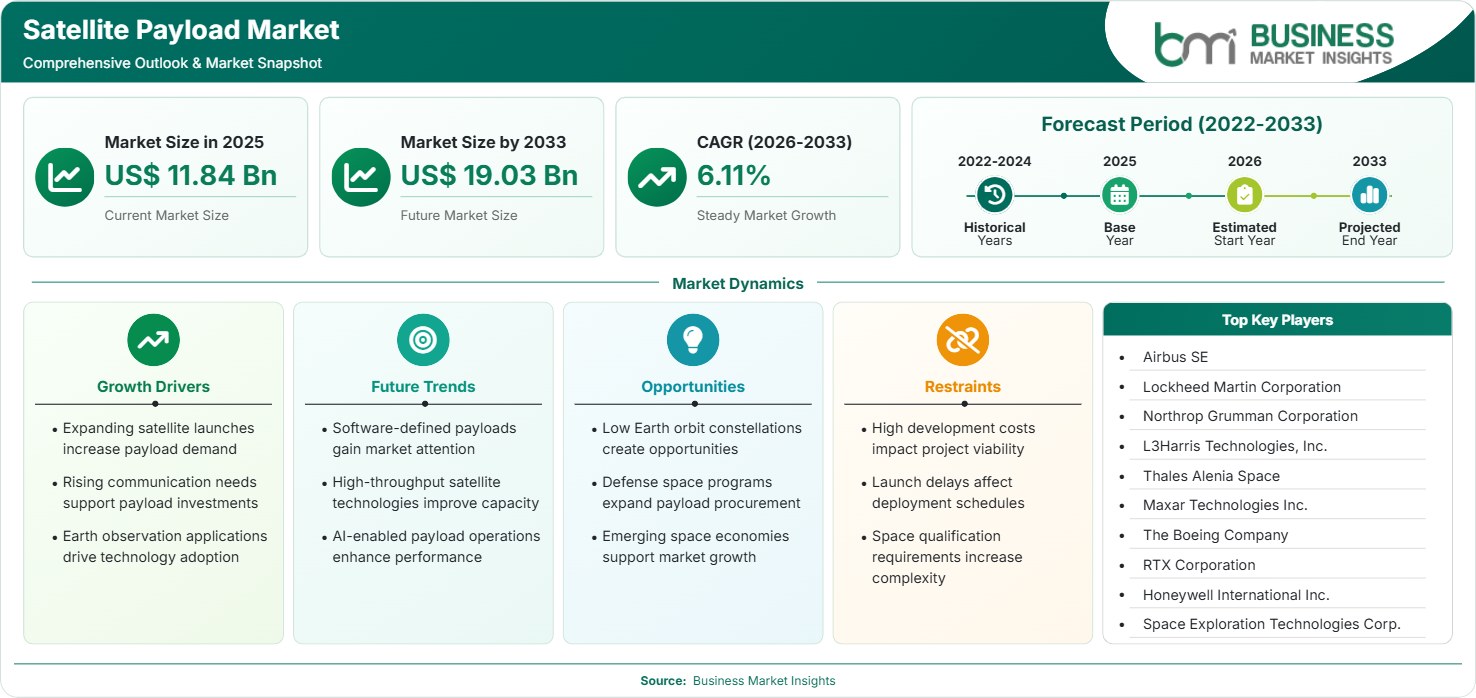
The Satellite Payload Market size was valued at US$ 11.84 Billion in 2025 and is projected to reach US$ 19.03 Billion by 2033, growing at a CAGR of 6.11% during 2026–2033, supported by expanding broadband constellations, defense modernization programs, Earth observation demand, software-defined payload adoption, and increasing public-private investment across commercial space ecosystems.

Report Coverage
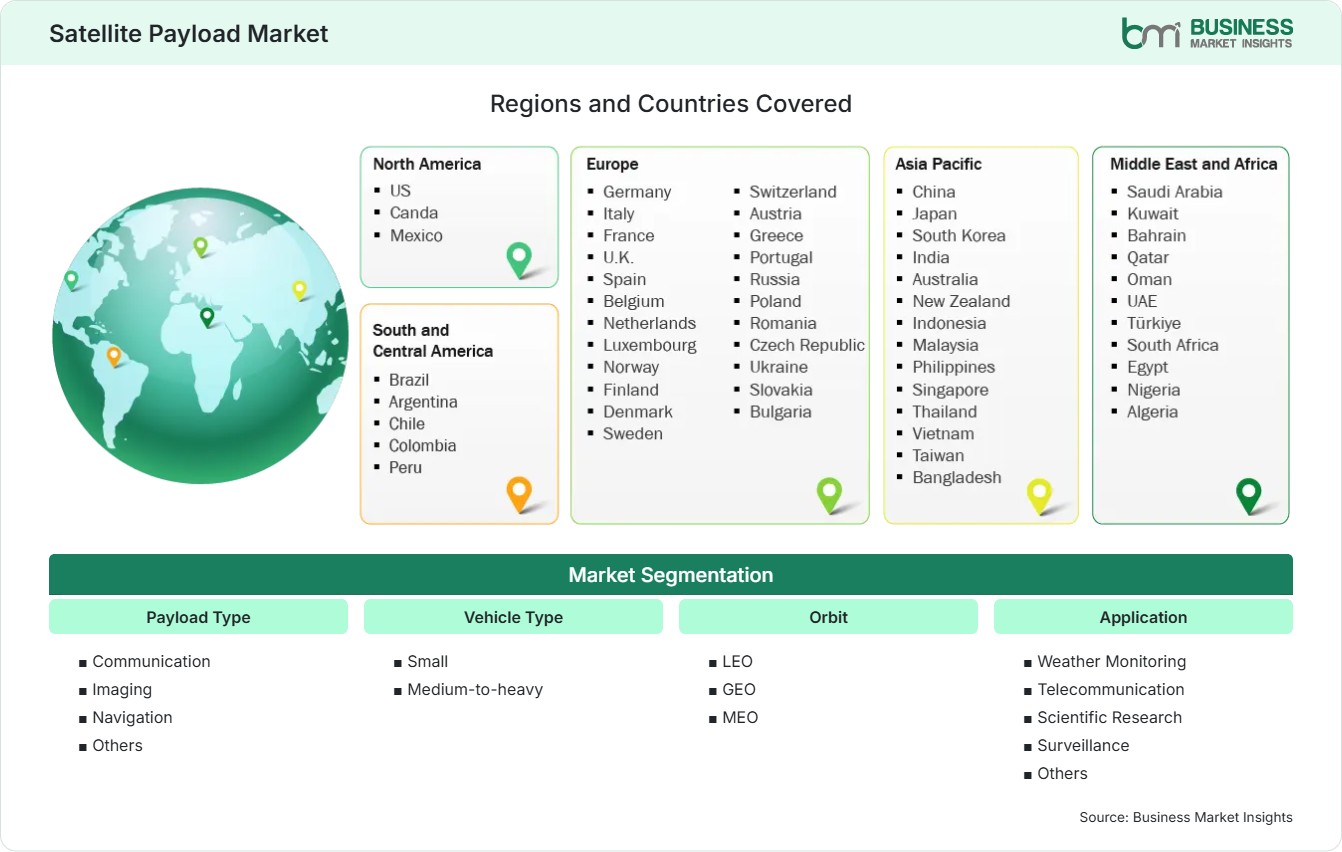
  • Payload Type: Communication, Imaging, Navigation, Others
  • Vehicle Type: Small, Medium-to-heavy
  • Orbit: LEO, GEO, MEO
  • Application: Weather Monitoring, Telecommunication, Scientific Research, Surveillance, Others
  • End-Use: Commercial, Military
US$ 11.84 Bn Market size in 2025
US$ 19.03 Bn Market Size by 2033
6.11% CAGR, 2026 - 2033
2026-2033 Forecast Period

AI Overview

Satellite Payload Market Summary

  • North America Region: North America holds a Satellite Payload Market share of 36%–39% in 2025, growing at a CAGR of 5.3%–5.8% during 2026–2033. Growth is driven by defense satellite procurement, commercial broadband networks, next-generation payload architectures, government space funding, private launch activity, secure communications demand, cybersecurity investments, Earth observation expansion, manufacturing localization, and constellation resilience initiatives. The U.S. market benefits from strong military spending, commercial constellation deployments, and advanced payload innovation, recording a CAGR of 5.4%–5.9%.
  • Fastest Growing Region: Asia Pacific accounts for 25%–28% share in 2025 and advances at 7.1%–7.8% CAGR through 2026–2033. Drivers include national space programs, indigenous manufacturing growth, expanding satellite internet coverage, launch capacity investments, imaging demand, navigation upgrades, regional security requirements, earth observation missions, university research satellites, and private-sector participation.
  • Leading Segment: Communication payloads represent 44%–48% of the Satellite Payload Market share in 2025 and expand at 5.8%–6.4% CAGR. Demand stems from broadband connectivity, mobility services, government communications, direct-to-device initiatives, increased throughput requirements, software-defined networking, satellite backhaul expansion, rural connectivity projects, enterprise networking applications, and capacity optimization strategies.
  • High Growth Segment: LEO orbit applications account for 47%–51% share in 2025 and achieve 7.0%–7.7% CAGR. Expansion is supported by constellation deployment activity, lower-latency connectivity, earth observation missions, climate monitoring programs, defense surveillance integration, launch cost reductions, miniaturized electronics adoption, digital infrastructure demand, and scalable spacecraft architectures.
  • Key Market Opportunity: Integration of software-defined payloads with multi-orbit networks enables operators to dynamically allocate capacity, improve spectrum utilization, support emerging connectivity applications, reduce lifecycle costs, and address evolving government requirements.
  • Major Market Players: Airbus SE, Lockheed Martin Corporation, Northrop Grumman Corporation, L3Harris Technologies, Inc., Thales Alenia Space, Maxar Technologies Inc., The Boeing Company, RTX Corporation, Honeywell International Inc., Space Exploration Technologies Corp.
Strategic Insights

Satellite Payload Market: Strategic Insights

Satellite Payload Market Strategic Framework
FREE PDF
Request your free sample
Request free sample
Stakeholder View

Key Takeaways

  • The industry value chain is becoming more vertically integrated as payload developers, satellite manufacturers, launch providers, and network operators collaborate to reduce deployment timelines and improve mission economics.
  • Communication and telecommunication applications continue offering the strongest revenue opportunities as governments and enterprises expand connectivity into underserved and remote geographies.
  • Research spending increasingly targets software-defined, reconfigurable, and AI-enabled payload systems capable of adapting coverage, bandwidth allocation, and mission profiles after launch.
  • Asia Pacific presents a compelling investment proposition due to accelerating space budgets, indigenous manufacturing initiatives, and growing private-sector participation across multiple countries.
  • Strategic partnerships, technology alliances, and selective acquisitions are helping manufacturers strengthen payload capabilities, access specialized components, and improve competitive positioning.
  • Satellite resilience, cybersecurity, and anti-jamming features are emerging as major differentiators as military and commercial operators prioritize mission assurance.
Geographic Outlook

Satellite Payload Market Regional Highlights

North America Satellite Payload Market

North America remains the largest regional market with a 36%–39% Satellite Payload Market share in 2025 and a projected CAGR of 5.3%–5.8% through 2033. Regional leadership is supported by strong defense investments, commercial broadband constellations, advanced manufacturing capabilities, and a mature supplier ecosystem. Government agencies continue funding communication, surveillance, and weather-monitoring missions. Commercial operators are deploying increasingly sophisticated payload technologies to improve throughput, latency, and operational efficiency while addressing national security and resilience requirements.

  • Defense procurement programs continue driving demand for secure communication payloads and advanced intelligence-gathering systems.
  • Commercial satellite internet expansion supports substantial investment in reconfigurable communications technology.
  • Strong private capital availability facilitates innovation across component manufacturing and integration activities.
  • Government-led research initiatives encourage adoption of advanced sensing and imaging capabilities.
  • Regional operators focus on resilient architectures supporting multi-domain communications environments.

US Satellite Payload Market

The United States accounts for around 82% to 86% of North American revenues and has a CAGR of 5.4% to 5.9%. There is demand driven by DoD modernization projects, satellite constellations, climate observation, and space exploration programs. The constant investments in R&D facilitate innovation in communication, imaging, and navigation payload technologies. Strong collaboration between government agencies and private aerospace firms sustains innovation and commercialization momentum.

  • Military satellite modernization programs strengthen demand for secure and anti-jam payload systems.
  • Commercial broadband operators support higher production volumes and manufacturing efficiency.
  • Earth observation missions increasingly require hyperspectral and multisensor payload capabilities.
  • Advanced launch availability accelerates fleet replenishment and constellation deployment schedules.

Europe Satellite Payload Market

The Europe Satellite Payloads market accounts for 24%–27% in 2025 and is growing at a CAGR of 5.8%–6.4%. The growth drivers in Europe include institutional programs, environmental monitoring, and autonomous mission objectives. France and Germany lead the segment, whereas Italy shows strong growth potential with a CAGR of 6.5%–7.1%. There are joint initiatives between leading aerospace industry players and governments to research next-generation communications and navigation technologies and sustainable space operations.

  • European operators emphasize sovereign communications and strategic space capability development.
  • Environmental monitoring missions continue supporting demand for advanced imaging payloads.
  • France leads regional deployment activity through established industrial infrastructure.
  • Italy exhibits strong growth through new investment and expanding space-sector partnerships.
  • Sustainability initiatives increase focus on efficient satellite designs and lifecycle management.

Asia Pacific Satellite Payload Market

Asia Pacific region has a market share of 25% - 28%, making it the fastest-growing segment with a CAGR of 7.1% - 7.8%. China remains the largest contributor to the region, while India is experiencing rapid growth at a CAGR of 7.8%-8.5%. Satellite broadband, national space policies, and frequent launches are opening up many avenues. Governments are making substantial investments in Earth observation, navigation, and secure communications to support economic and security objectives.

  • China continues expanding domestic satellite manufacturing and constellation deployment capabilities.
  • India benefits from commercialization reforms and increasing private-sector participation.
  • Regional governments prioritize broadband access and digital infrastructure development.
  • Demand for weather forecasting and disaster-management systems boosts imaging payload adoption.
  • Universities and research institutions support innovation through scientific satellite missions.

Rest of World Satellite Payload Market

The Rest of World region has a 10%-13% market share in 2025 and sees a CAGR of 6.2%-6.8%. Middle Eastern nations have begun investing in satellites used for communications and observation purposes to diversify their technological ecosystems.

Governments in Latin America have become more active in using space assets for environmental management, connectivity, and disaster relief efforts. Saudi Arabia leads regional investment, while the United Arab Emirates demonstrates strong innovation potential through its space programs and international collaborations.

  • Gulf countries expand sovereign capabilities through strategic satellite procurement programs.
  • Environmental monitoring applications support adoption across Latin America.
  • Saudi Arabia attracts investment into advanced communications infrastructure.
  • UAE initiatives strengthen regional innovation and international technology collaboration.
  • Connectivity projects focus on remote and underserved population coverage.
Global Market Geography
FREE PDF
Request your free sample
Request free sample
Segment Analysis

Satellite Payload Market Segmentation

Payload Type

Payload Type is considered a very important revenue segment, with communication payloads capturing a 44%-48% share in 2025 and growing at a 5.8%-6.4% CAGR. The scope of the Satellite Payload market is set to widen further with the increasing need for higher data capacity, superior sensing ability, and mission flexibility. Demand is fueled by broadband internet projects, navigation upgrades, and earth observation constellations.

  • Communication: Supports broadband, mobility, enterprise networking, and government communications applications through growing demand for higher capacity and flexible network coverage.
  • Imaging: Adoption is driven by earth observation, environmental monitoring, agricultural assessment, disaster management, and defense intelligence requirements.
  • Navigation: Expands through positioning services, transportation modernization, logistics optimization, and national infrastructure development initiatives.

Vehicle Type

Small satellite platforms are increasingly used due to reduced deployment costs and scalability, whereas larger satellites are crucial for missions requiring large capacities. The market demonstrates growth in line with the development of satellite constellations and government projects, with a CAGR of 6.0%-6.7% across major deployment categories.

  • Small: Favored for constellation architectures, rapid deployment cycles, commercial observation missions, and technology demonstration programs.
  • Medium-to-heavy: Preferred for complex communication, navigation, and long-duration missions requiring higher power and payload capacity.

Orbit

LEO systems lead the market, holding a share of 47%–51% in 2025 and enjoying a compound annual growth rate (CAGR) of 7.0%–7.7%. This is driven by broadband networks and observation constellations. The Satellite Payload Market Trends show increased convergence across orbital tiers to achieve optimal coverage and performance.

  • LEO: Enables low-latency communications, earth observation, surveillance activities, and scalable constellation deployment models.
  • GEO: Remains important for broadcasting, wide-area communications, and established network infrastructure requirements.
  • MEO: Supports navigation, positioning services, and specialized communication missions balancing latency and coverage.

Application

The applications of telecommunications create the largest pool of demand, whereas surveillance and science-related applications continue to grow. The growth of the market is associated with the increasing importance of satellite use in communications, environmental management, national security, and research. Growth remains supported by digitization and space-enabled infrastructure strategies across economies.

  • Weather Monitoring: Supports climate observation, forecasting accuracy, disaster preparedness, and environmental data collection.
  • Telecommunication: Driven by broadband expansion, enterprise connectivity, government communications, and rural access initiatives.
  • Scientific Research: Benefits from exploration missions, atmospheric studies, and technology validation programs.
  • Surveillance: Strengthened by defense modernization, border security, maritime awareness, and intelligence requirements.

End-Use

Commercial entities account for the largest share of demand, while military consumers increase their investments in secure, robust systems. Growth is driven by the increasing reliance on satellites in telecoms, defense, analysis, and sensing applications, with both categories benefiting from modernization and digital transformation initiatives.

  • Commercial: Driven by connectivity services, imaging analytics, environmental monitoring, and data-driven business models.
  • Military: Supports secure communications, intelligence gathering, navigation resilience, and operational awareness missions.
Market Forces

Satellite Payload Market Dynamics

Key Market Drivers

Rising Deployment of Broadband and Connectivity Constellations

Growing demand for global broadband coverage is accelerating procurement of communication payloads. Large-scale constellation strategies require high-throughput systems capable of handling increasing data traffic. The demands in international telecommunications, digital inclusion policies, and enterprise networks will continue to fuel investments. Industry associations, such as the International Telecommunication Union, emphasize the growing reliance on satellites for connectivity in underserved areas. The emphasis in technology has been on software-defined systems, spectrum efficiency, and capacity management.

Defense Modernization and Secure Communications Demand

Military agencies are increasingly spending on robust satellite systems that facilitate command and control, as well as intelligence and surveillance operations. Nations in North America, Europe, and Asia are improving their secure communication systems by mitigating operational risks. Applications include anti-jamming systems, secure communications, and continuous surveillance systems. The security-oriented upgrade projects are providing a steady stream of orders for payload makers. With growing geopolitical tensions, space assets are gaining importance in modern defense structures and architectures, strengthening long-term purchasing visibility for industry participants.

Expansion of Earth Observation and Environmental Monitoring

Efforts to monitor the climate, respond to disasters, evaluate agriculture, and manage resources are growing demands for high-performance imaging payloads. Government bodies, research institutions, and analytics companies rely on datasets gathered from space for their decision-making processes. Increased efficiency of sensors, processing, and multispectral imagery technologies is making these applications possible. Sustainability efforts that focus on environmental monitoring also make an important contribution to the growth in this space. Demand for actionable geospatial intelligence is expected to drive innovation and growth.

Key Market Opportunities

Software-Defined Payload Transformation

The concept of software-defined architectures enables operators to change the satellite's capabilities even after launch, thereby improving the efficiency of satellite use. In this regard, there are opportunities for companies capable of producing communication devices with adaptable software and processing capabilities. Network providers now look for platforms that can adapt to customer demands without requiring hardware replacements. For Long-term Satellite Payload Market Forecasts, this evolution is beneficial since such reconfigurable satellites may add value to their missions, make better use of spectrum, and lower costs throughout the life cycle. Suppliers investing in advanced software and onboard processing capabilities are positioned to capture premium opportunities.

Growth of Multi-Orbit Integrated Networks

The integration of LEO, MEO, and GEO networks enables innovative service models for connectivity, navigation, and observation missions. The operators are starting to adopt a hybrid network approach to maximize performance while accommodating diverse needs. The need for integration creates opportunities to develop payload systems that enable dynamic routing and resource management. Companies in the commercial sector, governments, and militaries are seeking an integrated architecture that can increase resilience and coverage.

Emerging Space Programs in Developing Economies

National space strategies among developing nations present an opportunity for payload manufacturers, integrators, and technology companies. Governments realize that satellites are strategic tools for achieving their goals in communication, environmental observation, and national security. The development of domestic manufacturing projects, international collaborations, and technology transfer will continue to enhance capacity in the region. First-time satellite operators present an opportunity for cost-effective systems. Businesses capable of offering flexible platforms and customization can establish early relationships and secure future procurement opportunities.

Market Restraints and Challenges

High Development Costs and Constrained Adoption

Factor: Satellite payload development requires specialized materials, testing facilities, engineering expertise, and compliance procedures. These requirements substantially increase project costs and create barriers for smaller organizations. Impact: Longer investment recovery periods, procurement delays, and constrained participation by emerging entrants. Budget limitations can influence program scope and technology selection, particularly in developing markets. Although manufacturing efficiencies continue improving, payload reliability standards remain exceptionally demanding. The resulting cost burden can reduce deployment frequency and limit broader adoption of advanced satellite capabilities.

Supply Chain Complexity and Delayed Production Schedules

Factor: Industry participants rely on highly specialized suppliers for electronics, sensors, radiation-hardened components, and subsystem integration. Impact: component shortages, export controls, or geopolitical disruptions affect production schedules. Long qualification cycles further complicate replacement sourcing and increase operational risk. Delayed deliveries can influence launch timelines, project economics, and customer confidence. As constellation programs expand, maintaining supply resilience becomes increasingly important. Manufacturers are responding through supplier diversification and inventory management strategies, yet supply chain vulnerability remains a continuing challenge.

Company Analysis

Competitive Landscape

The competitive environment reflects ongoing Satellite Payload Market analysis of communications, imaging, navigation, and defense-oriented technologies.

Company Name

Overview

Products and Services relevant to this market

Airbus SE

Global aerospace manufacturer with extensive satellite system and payload development capabilities serving commercial and government customers.

Communication payloads, observation instruments, satellite platforms, integration, engineering and mission-support services.

Lockheed Martin Corporation

Major defense and space contractor supporting advanced secure communications and national security missions.

Military payloads, navigation systems, surveillance technologies, satellite integration and mission solutions.

Northrop Grumman Corporation

Leading provider of strategic space systems and advanced payload technologies.

Communications payloads, defense sensors, space electronics, integration and engineering services.

L3Harris Technologies, Inc.

Specialized aerospace technology company with strong sensing and communications expertise.

Imaging payloads, communications systems, sensors, mission electronics and integration support.

Thales Alenia Space

International space manufacturer focused on telecommunications and observation platforms.

High-throughput payloads, navigation systems, observation technologies and satellite solutions.

Maxar Technologies Inc.

Recognized provider of earth observation and space infrastructure capabilities.

Imaging payloads, geospatial technologies, satellite systems and mission support services.

The Boeing Company

Aerospace leader supplying government and commercial satellite technologies.

Communication payloads, satellite architecture, engineering services and space mission support.

RTX Corporation

Defense technology organization supporting advanced sensing and communications applications.

Sensors, electronics, surveillance technologies and satellite subsystem solutions.

Honeywell International Inc.

Supplies critical aerospace components and space-qualified technologies.

Guidance systems, electronics, avionics, controls and payload-support components.

Space Exploration Technologies Corp.

Vertically integrated space company supporting large constellations and satellite deployment.

Communication payloads, broadband satellite systems, spacecraft production and launch services.

Trust & Transparency

Research Methodology

The market analysis combines proprietary research with secondary data from government agencies, company disclosures, regulatory filings, industry databases and expert interviews. Market estimates are validated through data triangulation, cross-market benchmarking and analyst review.

View Full Research Methodology

Questions Answered

Frequently Asked Questions

How can this Satellite Payload Market Report support strategic decisions?

The Market Report helps stakeholders evaluate competitive positioning, technology shifts, investment priorities, growth segments, regional opportunities, and evolving customer requirements.

Who are the primary buyers of satellite payload technologies?

Commercial operators, telecommunications companies, defense organizations, national space agencies, and research institutions represent the primary customer groups purchasing payload technologies.

Which region offers the strongest growth potential?

Asia Pacific offers the strongest growth potential due to expanding national space programs, manufacturing investments, commercial participation, and increasing demand for communication and observation capabilities.

Why is LEO becoming increasingly important?

LEO satellites provide lower latency, faster deployment cycles, and strong suitability for broadband internet and earth observation applications, making them attractive for both commercial and governmental missions.

Which payload type generates the highest revenue?

Communication payloads generate the highest revenue because broadband connectivity, enterprise networking, government communications, and mobility services require substantial satellite capacity and continued network expansion.

Access the Full Satellite Payload Market Report

Get segment-level forecasts, regional estimates, competitive benchmarking, company profiles and downloadable Excel datasets.

Access the full Satellite Payload Market Report
350 pages PDF & Excel | 2026-08-31