
Medium And Large Satellite Market Outlook: Size, Share, Trends, Growth Analysis, Competitive Landscape & Forecast, 2026-2033

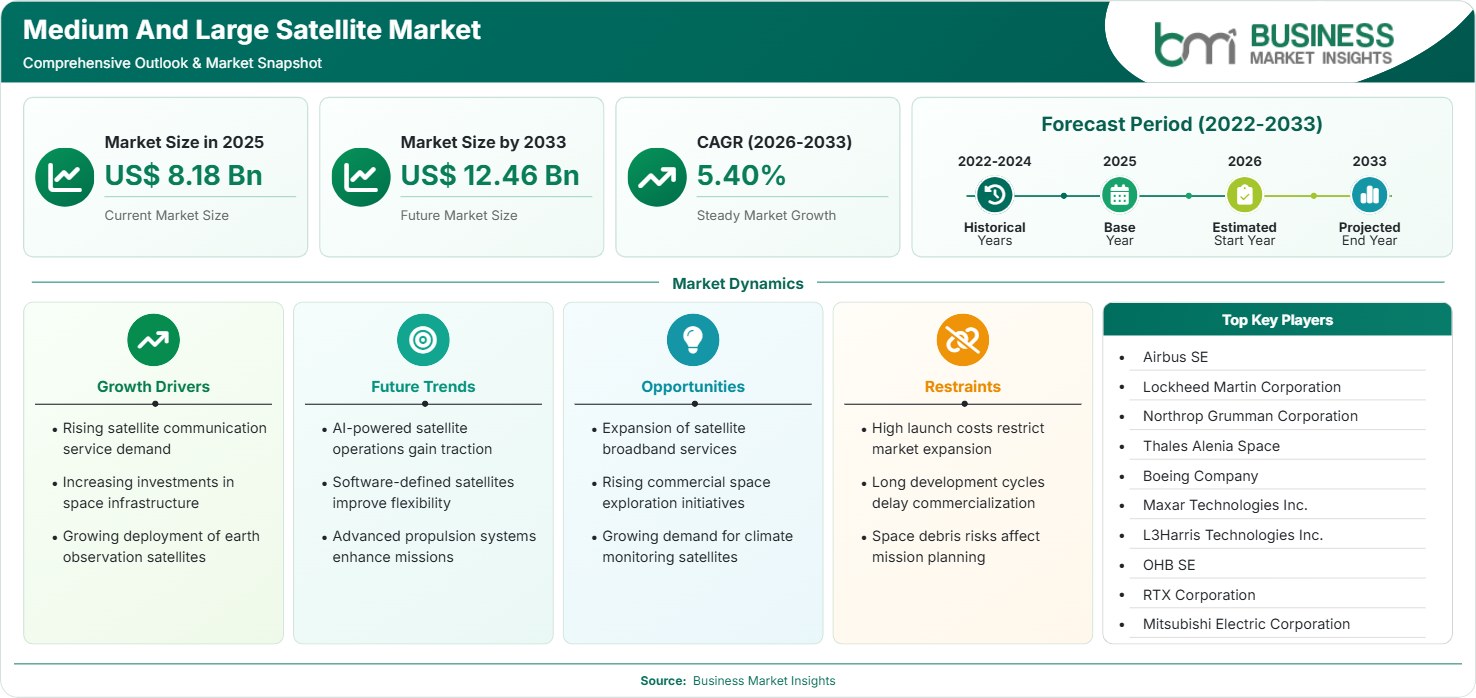
The Medium And Large Satellite Market size was valued at US$ 8.18 billion in 2025 and is projected to reach US$ 12.46 billion by 2033, growing at a CAGR of 5.40% during 2026–2033. Rising satellite communication service demand, increasing investments in space infrastructure, growing deployment of earth observation satellites, expanding commercial space programs, and continuous advancements in satellite payload technologies are creating new growth opportunities for satellite manufacturers and system integrators.

Report Coverage
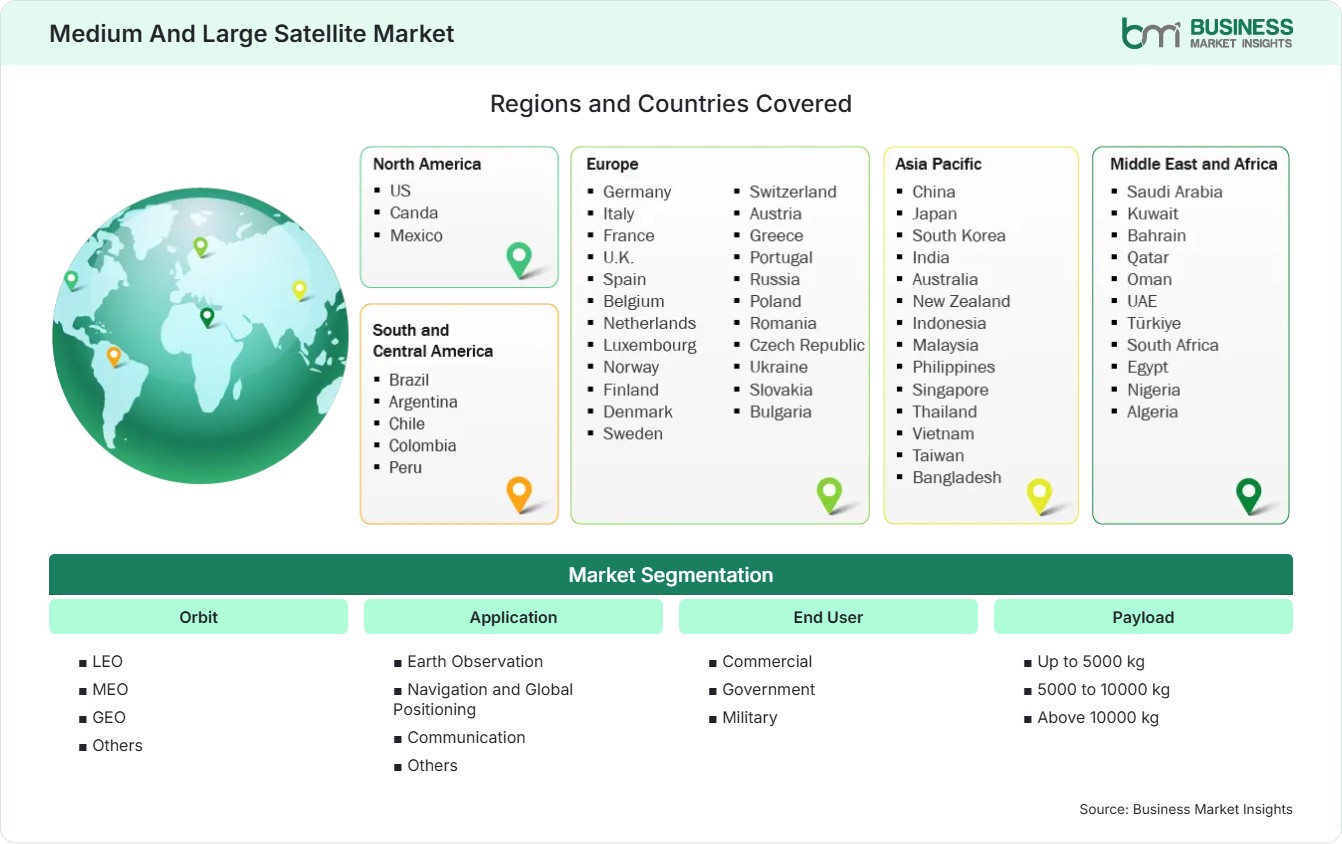
  • Orbit: LEO, MEO, GEO, Others
  • Application: Earth Observation, Navigation and Global Positioning, Communication, Others
  • End User: Commercial, Government, Military
  • Payload: Up to 5000 kg, 5000 to 10000 kg, Above 10000 kg
US$ 8.18 Bn Market size in 2025
US$ 12.46 Bn Market Size by 2033
5.40% CAGR, 2026 - 2033
2026-2033 Forecast Period

AI Overview

Medium And Large Satellite Market Summary

  • North America Region: North America holds 38%–41% market share in 2025 and is expected to grow at a CAGR of 5.1%–5.5% during 2026–2033. Strong government investments, expanding commercial satellite deployments, defense modernization programs, and increasing private-sector participation continue strengthening regional leadership. The United States remains the largest contributor with an estimated CAGR of 5.2%–5.6% through 2033, supported by continuous innovation in satellite manufacturing and launch capabilities.
  • Fastest Growing Region: Asia Pacific accounts for 24%–27% medium and large satellite market share in 2025 and is projected to register a CAGR of 6.2%–6.7% during 2026–2033. Expanding national space programs, rising investments in communication infrastructure, increasing satellite launches, and growing demand for remote sensing services continue accelerating regional expansion.
  • Leading Segment: Communication represents 39%–42% market share in 2025 and is forecast to expand at a CAGR of 5.4%–5.8% during 2026–2033. Increasing broadband connectivity requirements, satellite television services, secure government communications, and enterprise network expansion continue supporting segment leadership.
  • High Growth Segment: LEO accounts for 29%–32% market share in 2025 and is anticipated to grow at a CAGR of 6.6%–7.0% during 2026–2033. Expanding broadband constellations, lower latency communication, enhanced earth observation capabilities, and increasing commercial investments continue driving rapid deployment of low Earth orbit satellite systems.
  • Key Market Opportunity: Growing investments in next-generation satellite constellations, advanced payload technologies, climate monitoring missions, and commercial broadband networks are expected to create substantial long-term opportunities for satellite manufacturers and technology providers.
  • Major Market Players: Airbus SE, Lockheed Martin Corporation, Northrop Grumman Corporation, Thales Alenia Space, The Boeing Company, Maxar Technologies Inc., L3Harris Technologies, Inc., OHB SE, RTX Corporation, and Mitsubishi Electric Corporation.
Strategic Insights

Medium And Large Satellite Market: Strategic Insights

Medium And Large Satellite Market Strategic Framework
FREE PDF
Request your free sample
Request free sample
Stakeholder View

Key Takeaways

  • Integration of the satellite value chain is growing increasingly because of collaboration between spacecraft manufacturers, launch service providers, payload developers, ground infrastructure companies, and software suppliers to enhance efficiencies in their mission operations and improve their international service capabilities.
  • Communication satellite applications continue representing the largest commercial opportunity as broadband expansion, enterprise connectivity, government communication networks, and rural internet access programs drive sustained satellite procurement across global markets.
  • The development of innovations is increasingly oriented towards software-defined payload technologies, digital communications architecture, AI-based satellite control, advanced propulsion technologies, and modular space platforms that can accommodate various missions within an extended lifecycle.
  • Asia Pacific is emerging as an attractive investment destination due to expanding national space agencies, increasing commercial launch activity, rising satellite manufacturing capabilities, and strong government support for indigenous space technology development.
  • The development of strategic alliances, satellite manufacturing deals, foreign joint ventures, technology transfer pacts, and government acquisitions programs keeps on improving competitive positioning while accelerating the commercialization process of the latest generation of satellites.
  • The growing use of sustainable satellite manufacturing techniques, reuseable satellite launching processes, automatic satellite mission management techniques, and sophisticated satellite servicing technology is forecasted to enhance operational efficiency and satellite deployment strategy for the future.
Geographic Outlook

Medium And Large Satellite Market Regional Highlights

North America Medium And Large Satellite Market

North America accounted for 38%–41% of the Medium And Large Satellite Market Share in 2025 and is projected to expand at a CAGR of 5.1%–5.5% during 2026–2033. The region benefits from sustained government investments in space infrastructure, a well-established commercial satellite ecosystem, and continuous defense modernization initiatives. Strong collaboration between public space agencies and private aerospace companies continues supporting satellite manufacturing, launch activities, and advanced payload development.

  • Commercial satellite operators continue investing in high-capacity communication satellites to strengthen broadband connectivity, enterprise networking, and direct-to-home broadcasting services across urban and remote regions.
  • Government agencies continue expanding earth observation, navigation, and national security satellite programs, encouraging procurement of advanced spacecraft with enhanced mission capabilities and operational lifecycles.
  • Private aerospace companies are accelerating innovation in modular satellite platforms, digital payload technologies, and autonomous mission operations to improve deployment flexibility and reduce operating costs.
  • Continuous investment in launch infrastructure and reusable launch technologies strengthens regional competitiveness while supporting higher satellite deployment frequencies across commercial and government missions.
  • Strong research collaboration among aerospace manufacturers, universities, and defense organizations supports next-generation satellite technologies and long-term industry development.

US Medium And Large Satellite Market

The United States represented 33%–36% of global revenue in 2025 and is expected to register a CAGR of 5.2%–5.6% through 2026–2033. Continuous investments by government agencies, expanding commercial satellite constellations, advanced manufacturing capabilities, and strong private-sector participation continue reinforcing the country's leadership in satellite production and space technology innovation.

  • Defense modernization programs continue supporting procurement of secure communication satellites, advanced surveillance platforms, and resilient space infrastructure for strategic national security missions.
  • Commercial operators continue expanding satellite broadband networks to improve connectivity, enterprise communications, and digital inclusion across underserved geographic regions.
  • Significant investments in spacecraft manufacturing facilities and launch technologies accelerate production efficiency while strengthening domestic aerospace competitiveness.
  • Growing partnerships between government organizations and private space companies continue advancing innovation in satellite payloads, propulsion systems, and onboard processing technologies.

Europe Medium And Large Satellite Market

Europe held 27%–30% medium and large satellite market share in 2025 and is anticipated to grow at a CAGR of 5.0%–5.4% through 2026–2033. Strong institutional support from regional space programs, expanding commercial satellite services, and increasing investments in earth observation missions continue driving market expansion. France leads regional demand with a CAGR of 5.1%–5.5%, while Germany records the fastest growth at 5.5%–5.9% due to increasing aerospace investments and satellite manufacturing activities.

  • France maintains leadership through established satellite manufacturing capabilities, extensive government space programs, and strong participation in international satellite missions.
  • Germany continues expanding investments in advanced satellite technologies, digital payload systems, and commercial aerospace manufacturing capabilities supporting long-term industry growth.
  • European collaboration on earth observation and navigation programs continues stimulating demand for high-performance communication and remote sensing satellites.
  • Increasing investment in climate monitoring and environmental observation missions supports procurement of advanced satellite platforms with enhanced imaging capabilities.
  • Public-private partnerships continue strengthening innovation across satellite manufacturing, launch services, and ground infrastructure development.

Asia Pacific Medium And Large Satellite Market

Asia Pacific accounted for 24%–27% of total industry revenue in 2025 and is projected to register the fastest CAGR of 6.2%–6.7% during 2026–2033. Expanding national space programs, increasing satellite manufacturing capabilities, rising commercial investments, and growing demand for communication and earth observation services continue accelerating regional expansion. China leads the regional market with a CAGR of 6.1%–6.5%, while India records the highest growth at 6.8%–7.2%.

  • China continues strengthening indigenous satellite manufacturing through large-scale investments in communication, navigation, and remote sensing satellite programs.
  • India is expanding commercial space activities, launch capabilities, and private-sector participation while supporting indigenous satellite technology development.
  • Japan and South Korea continue investing in advanced satellite electronics, precision manufacturing, and next-generation payload technologies supporting regional innovation.
  • Increasing demand for disaster management, environmental monitoring, and agricultural observation continues driving deployment of earth observation satellite systems.
  • Rising commercial broadband initiatives and digital connectivity programs encourage continued investments in advanced satellite communication infrastructure.

Rest of World Medium And Large Satellite Market

The Rest of World accounted for 8%–10% medium and large satellite market share in 2025 and is expected to register a CAGR of 5.3%–5.8% during 2026–2033. South & Central America continue investing in satellite communication infrastructure to improve digital connectivity and environmental monitoring capabilities.

The Middle East & Africa are expanding investments in national space agencies, satellite communication systems, and earth observation programs supporting infrastructure development and national security objectives. Brazil leads South & Central America with a CAGR of 5.4%–5.8%, while the United Arab Emirates records the fastest regional growth at 6.0%–6.4%.

  • Brazil continues strengthening satellite-based communication services supporting rural connectivity, environmental monitoring, and agricultural resource management.
  • The United Arab Emirates is expanding national space initiatives through investments in satellite manufacturing, scientific research, and international space collaborations.
  • Growing investments in disaster management and climate resilience programs continue increasing demand for advanced earth observation satellites.
  • Expanding digital infrastructure initiatives encourage broader adoption of communication satellites across developing economies.
  • International partnerships continue supporting technology transfer, satellite deployment, and development of regional space capabilities.
Global Market Geography
FREE PDF
Request your free sample
Request free sample
Segment Analysis

Medium And Large Satellite Market Segmentation

Orbit

The Orbit segment accounted for 35%–38% of the global market in 2025 and is projected to expand at a CAGR of 5.8%–6.2% during 2026–2033. Increasing deployment of communication constellations, navigation satellites, and earth observation missions continues driving segment expansion. The Medium And Large Satellite Market Forecasts indicate sustained investment across multiple orbital platforms to address growing commercial, scientific, and defense requirements.

  • LEO: Experiences strong adoption due to lower communication latency, expanding broadband constellations, improved earth observation capabilities, and increasing commercial satellite deployment worldwide.
  • MEO: Supports global navigation, positioning, and timing services through stable orbital coverage and reliable operational performance across international satellite networks.
  • GEO: Remains essential for communication, weather forecasting, broadcasting, and strategic government missions requiring continuous coverage over fixed geographic regions.
  • Others: Includes specialized orbital deployments supporting scientific research, technology demonstrations, and mission-specific applications requiring unique orbital characteristics.

Application

The Application segment represented 39%–42% market share in 2025 and is expected to register a CAGR of 5.5%–5.9% during 2026–2033. Continuous demand for communication infrastructure, navigation services, and environmental monitoring supports sustained satellite procurement. The Medium And Large Satellite Market Trends increasingly emphasize software-defined payloads, high-throughput communication, and advanced remote sensing technologies.

  • Earth Observation: Continues expanding through increasing demand for environmental monitoring, disaster response, agricultural assessment, infrastructure planning, and climate research missions.
  • Navigation and Global Positioning: Supports transportation, defense, logistics, aviation, maritime operations, and autonomous mobility through highly accurate positioning and timing services.
  • Communication: Maintains leadership through expanding broadband connectivity, satellite broadcasting, enterprise communications, and secure government communication networks.
  • Others: Includes scientific exploration, space research, technology demonstration, and specialized government missions supporting long-term aerospace innovation.

End User

The End User segment generated 48%–51% of total revenue in 2025 and is forecast to grow at a CAGR of 5.3%–5.7% during 2026–2033. Increasing commercial satellite deployments, government space investments, and defense modernization continue supporting balanced market expansion across all user categories.

  • Commercial: Benefits from increasing investments in broadband services, satellite broadcasting, earth observation, and enterprise communication solutions worldwide.
  • Government: Continues investing in weather monitoring, scientific exploration, navigation infrastructure, and national communication systems supporting public service delivery.
  • Military: Expands procurement of secure communication, surveillance, reconnaissance, and strategic navigation satellites supporting defense modernization initiatives.

Payload

The Payload segment accounted for 31%–34% market share in 2025 and is projected to register a CAGR of 5.6%–6.0% during 2026–2033. Growing mission complexity and increasing payload performance requirements continue encouraging manufacturers to develop higher-capacity satellite platforms with improved operational flexibility.

  • Up to 5000 kg: Supports commercial communication, earth observation, and scientific missions requiring efficient deployment and cost-effective operational performance.
  • 5000 to 10000 kg: Widely deployed for advanced communication, navigation, and government missions requiring higher payload capacity and extended mission life.
  • Above 10000 kg: Designed for large-scale communication infrastructure, strategic defense applications, and high-capacity satellite missions demanding maximum payload performance.
Market Forces

Medium And Large Satellite Market Dynamics

Key Market Drivers

Rising satellite communication service demand

Increasing global demand for broadband connectivity, enterprise communication, broadcasting services, and secure government networks continues driving satellite procurement worldwide. The increasing use of high throughput satellites ensures better internet connectivity in underserved areas while at the same time supporting marine, aircraft, and other remote industry applications. The expansion of commercial communication services is helping to further reinforce the growth of the Medium And Large Satellite Market through increased investments in future satellite platforms.

Increasing investments in space infrastructure

Governments and private organizations continue expanding investments in satellite manufacturing facilities, launch infrastructure, ground stations, and mission control systems. The national space agencies focus on strategic autonomy, whereas private businesses increase funding for satellite constellations and next-generation manufacturing. The public-private cooperation plays an important role in developing new technologies, boosting domestic aerospace capacities, and enhancing competitiveness.

Growing deployment of earth observation satellites

Rising demand for environmental monitoring, disaster management, agriculture, urban planning, and climate research continues accelerating deployment of advanced earth observation satellites. Satellite imagery is being used by governments for resource management, security, and planning purposes, while geospatial intelligence is being used by commercial organizations to make decisions. Improvements in imaging resolution, processing capabilities, and data analysis have contributed significantly to the demand for such satellites.

Key Market Opportunities

Expansion of satellite broadband services

Growing investments in satellite broadband constellations are expanding connectivity across rural, maritime, aviation, and underserved regions. High-capacity communication satellites support digital inclusion while enabling governments and commercial operators to address increasing global bandwidth requirements. The Medium And Large Satellite Market Forecasts indicate continued investments in broadband infrastructure driven by rising digital transformation initiatives and expanding enterprise communication services.

Rising commercial space exploration initiatives

Private aerospace enterprises keep increasing their investments in scientific expeditions, commercial moon exploration, space logistics, and space infrastructure. The increasing commercialization of space activities will create additional demand for more sophisticated satellites that can be used for various purposes like exploration, navigation, communication, etc., as well as creating more opportunities for satellite manufacturers.

Growing demand for climate monitoring satellites

Governments, environmental agencies, and research institutions have started spending on sophisticated satellites that will help monitor the weather patterns, greenhouse gases, oceans, and natural disasters. Climate resiliency projects have been instrumental in purchasing such high-performing earth observation satellites with advanced sensing capabilities.

Market Restraints and Challenges

High launch costs restrict market expansion

Factor: Medium and large satellite missions require significant investments in spacecraft manufacturing, launch services, insurance, and mission operations. Impact: High capital requirements limit participation by smaller organizations while delaying satellite procurement decisions and reducing deployment frequency across cost-sensitive commercial markets.

Long development cycles delay commercialization

Factor: Complex satellite engineering, extensive testing requirements, regulatory approvals, and launch scheduling significantly extend project timelines. Impact: Lengthy development cycles increase financial risk, postpone revenue generation, and slow commercialization of innovative satellite technologies despite growing demand across communication, navigation, and earth observation applications.

Company Analysis

Competitive Landscape

The competitive environment is characterized by continuous investments in satellite platform innovation, digital payload technologies, software-defined architectures, and strategic government contracts. Leading manufacturers are expanding production capabilities while strengthening partnerships across the global aerospace ecosystem. Ongoing technological advancements and commercial space initiatives continue supporting comprehensive Medium And Large Satellite Market Analysis across communication, earth observation, navigation, and defense applications.

Company Name

Overview

Products and Services Relevant to this Market

Airbus SE

Global aerospace manufacturer specializing in commercial aircraft, defense systems, satellites, and advanced space technologies.

Communication satellites, earth observation spacecraft, navigation satellites, satellite integration, mission support, and space systems engineering.

Lockheed Martin Corporation

Leading aerospace and defense company delivering advanced satellite systems for commercial and government missions worldwide.

Military satellites, communication satellites, missile warning systems, spacecraft integration, satellite payloads, and mission support solutions.

Northrop Grumman Corporation

Aerospace and defense contractor focused on advanced space technologies, national security, and satellite manufacturing.

Satellite buses, national security satellites, space payloads, spacecraft servicing, and integrated satellite mission solutions.

Thales Alenia Space

International satellite manufacturer specializing in telecommunications, navigation, earth observation, and exploration missions.

Communication satellites, navigation platforms, earth observation satellites, satellite payloads, and complete space infrastructure solutions.

The Boeing Company

Global aerospace company providing commercial, defense, and advanced satellite technologies for diverse mission requirements.

Communication satellites, military spacecraft, satellite integration, payload systems, and satellite mission engineering services.

Maxar Technologies Inc.

Space technology company delivering satellite manufacturing and geospatial intelligence solutions worldwide.

Earth observation satellites, satellite manufacturing, geospatial imagery, remote sensing services, and mission support technologies.

L3Harris Technologies, Inc.

Aerospace technology company delivering mission-critical communication, surveillance, and space systems.

Satellite payloads, communication systems, space electronics, mission technologies, and advanced aerospace solutions.

OHB SE

European space technology company specializing in satellite manufacturing and space exploration systems.

Small, medium, and large satellite platforms, earth observation spacecraft, navigation satellites, and aerospace engineering services.

RTX Corporation

Aerospace and defense company providing advanced space electronics and satellite technologies.

Satellite electronics, communication technologies, defense space systems, mission components, and aerospace engineering solutions.

Mitsubishi Electric Corporation

Japanese multinational delivering advanced satellite manufacturing and space system technologies.

Communication satellites, earth observation systems, satellite electronics, navigation technologies, and integrated spacecraft manufacturing.

Trust & Transparency

Research Methodology

The market analysis combines proprietary research with secondary data from government agencies, company disclosures, regulatory filings, industry databases and expert interviews. Market estimates are validated through data triangulation, cross-market benchmarking and analyst review.

View Full Research Methodology

Questions Answered

Frequently Asked Questions

What does the Medium And Large Satellite Market Report include?

The Market Report provides comprehensive insights into market size, segmentation, regional outlook, competitive landscape, industry trends, growth drivers, restraints, opportunities, recent developments, and future business prospects.

What are the major challenges facing satellite manufacturers?

The primary challenges include high launch costs, lengthy satellite development cycles, regulatory complexity, substantial capital requirements, and technical risks associated with manufacturing, testing, launch operations, and mission deployment.

Why is Asia Pacific expected to register the fastest growth?

Asia Pacific benefits from expanding national space programs, increasing satellite launches, strong government funding, growing private-sector participation, and rising investments in communication and Earth observation satellite infrastructure.

Which application segment dominates the Medium And Large Satellite Market?

Communication remains the leading application segment due to increasing global demand for broadband connectivity, satellite broadcasting, enterprise communication services, secure government networks, and expanding satellite internet infrastructure.

What is driving the Market?

The industry is propelled by growing demand for satellite communications services, increased funding for the country’s space program, increasing number of Earth observation programs, and continuous developments in technologies related to the production of satellite payloads and satellites themselves.

Access the Full Medium And Large Satellite Market Report

Get segment-level forecasts, regional estimates, competitive benchmarking, company profiles and downloadable Excel datasets.

Access the full Medium And Large Satellite Market Report
350 pages PDF & Excel | 2026-08-04