
Helicopter Services Market Outlook: Size, Share, Trends, Growth Analysis, Competitive Landscape & Forecast, 2026–2033

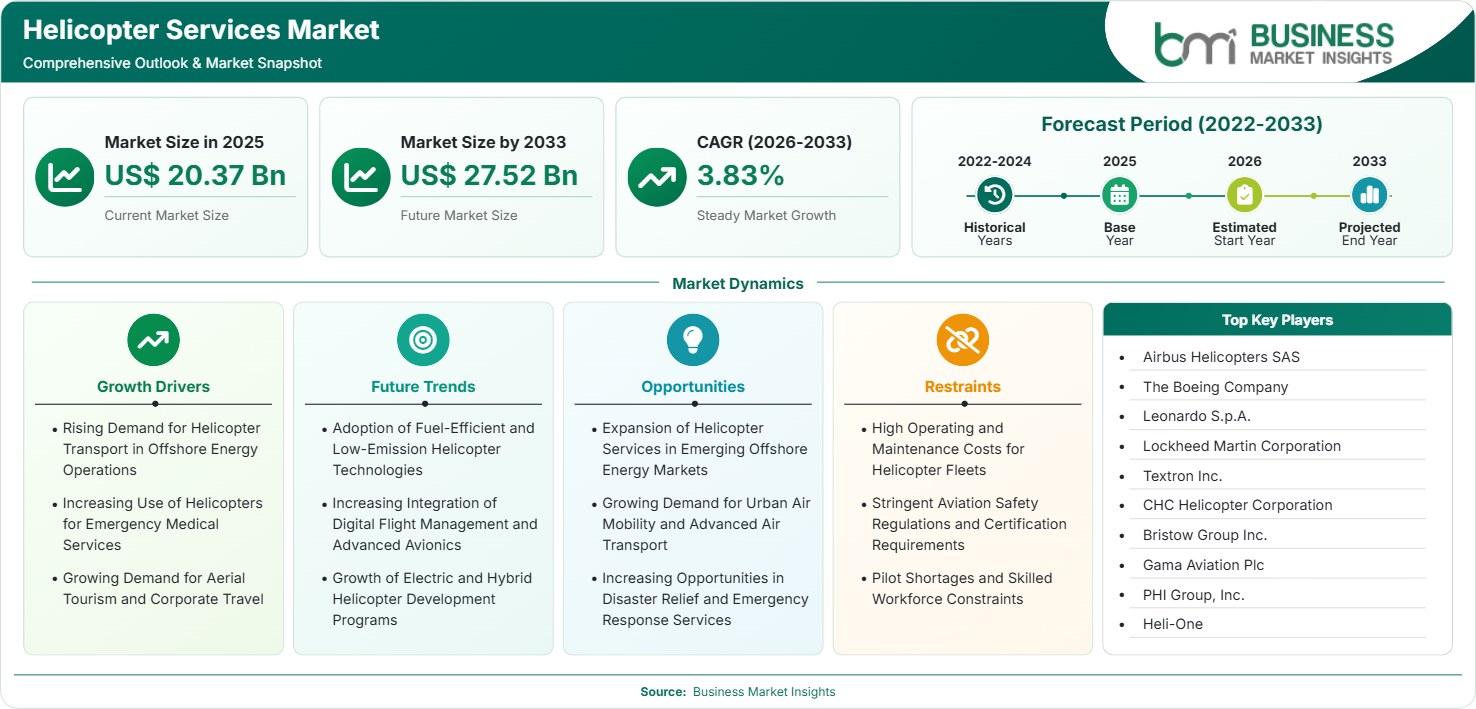
The Helicopter Services size was valued at US$ 20.37 Billion in 2025 and is projected to reach US$ 27.52 Billion by 2033, growing at a CAGR of 3.83% during 2026–2033, driven by rising offshore transport demand, emergency medical service adoption, corporate aviation requirements, tourism expansion, and disaster response opportunities.

Report Coverage
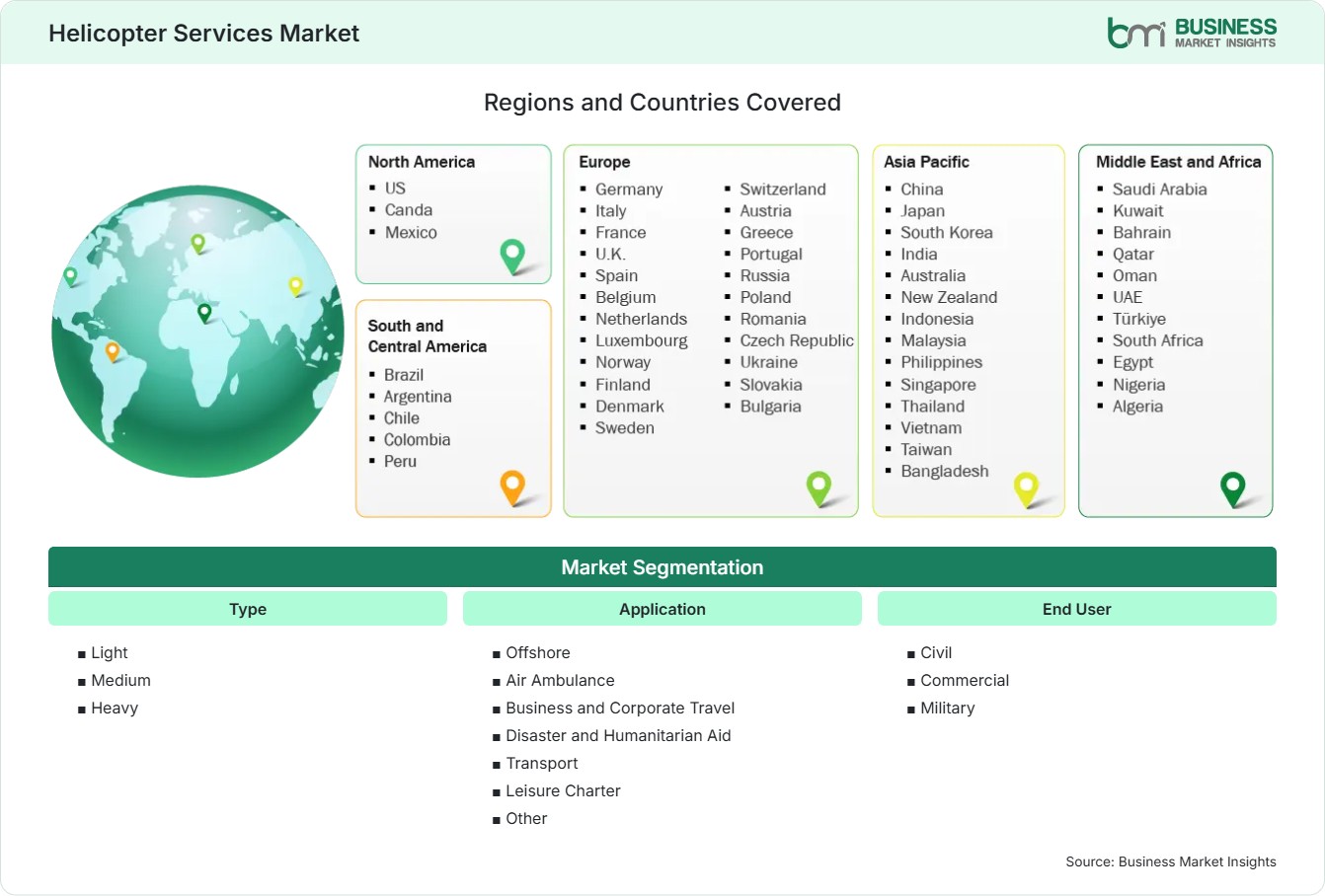
  • Type: Light, Medium, Heavy
  • Application: Offshore, Air Ambulance, Business and Corporate Travel, Disaster and Humanitarian Aid, Transport, Leisure Charter, Other
  • End User: Civil, Commercial, Military
US$ 20.37 Bn Market size in 2025
US$ 27.52 Bn Market Size by 2033
3.83% CAGR, 2026 - 2033
2026-2033 Forecast Period

AI Overview

Helicopter Services Market Summary

  • North America Region: North America holds a 38%–41% share in 2025, growing with a CAGR of 3.60%–4.00% during 2026–2033, supported by offshore energy operations, emergency medical services, corporate aviation, and fleet modernization programs. The U.S. market is expanding at a CAGR of 3.70%–4.10% during 2026–2033, driven by offshore transportation, air ambulance networks, and increasing commercial helicopter utilization.
  • Fastest Growing Region: Asia Pacific represents a 22%–25% share in 2025, expanding at a CAGR of 4.20%–4.60% during 2026–2033, supported by offshore energy development, infrastructure expansion, rising tourism activities, and increasing demand for emergency response aviation services.
  • Leading Segment: Medium helicopters account for a 45%–48% share in 2025, growing at a CAGR of 3.80%–4.20% during 2026–2033, driven by offshore operations, passenger transport requirements, emergency services, and versatile mission capabilities.
  • High Growth Segment: Air Ambulance applications hold a 18%–21% share in 2025, achieving a CAGR of 4.50%–5.00% during 2026–2033, supported by increasing healthcare accessibility, emergency response requirements, and expansion of specialized medical aviation services.
  • Key Market Opportunity: The market is witnessing opportunities through offshore energy expansion, urban air mobility integration, advanced air transport development, and increasing demand for rapid disaster relief and emergency response services.
  • Major Market Players: Airbus Helicopters SAS, The Boeing Company, Leonardo S.p.A., Lockheed Martin Corporation, Textron Inc., CHC Helicopter Corporation, Bristow Group Inc., Gama Aviation Plc, PHI Group, Inc., Heli-One.
Strategic Insights

Helicopter Services Market: Strategic Insights

Helicopter Services Market Strategic Framework
FREE PDF
Request your free sample
Request free sample
Stakeholder View

Key Takeaways

  • Helicopter service ecosystems are evolving through partnerships between aircraft manufacturers, operators, maintenance providers, and specialized aviation service companies.
  • Offshore energy transportation, air ambulance operations, and emergency response services represent high-potential application areas due to mission-critical requirements.
  • Innovation is focused on fuel-efficient helicopters, digital fleet management, predictive maintenance, and integration of advanced aviation technologies.
  • Asia Pacific provides strong growth potential due to offshore energy investments, infrastructure expansion, and increasing aviation service demand.
  • Strategic collaborations, fleet expansion programs, and service network development are shaping competitive positioning among major helicopter operators.
  • Urban air mobility concepts and next-generation aerial transportation solutions may create additional opportunities for helicopter service providers.
Geographic Outlook

Helicopter Services Market Regional Highlights

North America Helicopter Services Market

North America accounted for a 38%–41% helicopter services market share in 2025 and is projected to grow at a CAGR of 3.60%–4.00% during 2026–2033. The region maintains market leadership due to established aviation infrastructure, offshore energy activities, and strong emergency medical service networks. Helicopter Services share is supported by commercial operators, government agencies, and corporate aviation users. The Helicopter Services growth outlook is influenced by fleet modernization, replacement demand, and expanding specialized aviation services.

  • The United States dominates regional demand due to extensive offshore operations, medical aviation networks, and corporate helicopter usage.
  • Canada is expanding helicopter operations through mining, energy exploration, and remote transportation requirements.
  • Offshore energy companies are increasing helicopter utilization for personnel transportation and operational support activities.
  • Emergency medical service providers are investing in advanced helicopter fleets and regional coverage expansion.

US Helicopter Services Market

The U.S. accounted for a 33%–36% share of the global market in 2025 and U.S. Helicopter Services Market forecast to grow at a CAGR of 3.70%–4.10% between 2026–2033. The country benefits from mature aviation infrastructure, large commercial helicopter fleets, and extensive emergency medical service operations. Offshore oil and gas activities, corporate aviation demand, and government contracts continue supporting service expansion.

  • Offshore operators continue using helicopters for personnel transport, supporting demand in energy-producing regions.
  • Air ambulance networks are expanding to improve emergency healthcare access across rural locations.
  • Corporate and executive travel operators are adopting helicopters for time-efficient transportation solutions.

Europe Helicopter Services Market

Europe helicopter services market represented a 27%–30% share in 2025 and is projected to grow at a CAGR of 3.40%–3.80% during 2026–2033. The region benefits from offshore wind energy development, emergency services, and strong aviation regulations. The United Kingdom, Norway, France, Germany, and Italy are important markets.

  • The United Kingdom leads offshore helicopter operations due to North Sea energy activities and aviation service requirements.
  • Norway is expanding helicopter usage through offshore energy transportation and industrial operations.
  • France and Germany support growth through emergency medical services and commercial aviation applications.
  • European operators are focusing on fleet efficiency improvements and advanced maintenance solutions.
  • Aviation safety regulations are encouraging adoption of modern helicopter technologies and operational standards.

Asia Pacific Helicopter Services Market

Asia Pacific helicopter services market accounted for a 22%–25% share in 2025 and is expected to achieve a CAGR of 4.20%–4.60% during 2026–2033. The region represents the fastest-growing market due to offshore energy expansion, infrastructure development, tourism growth, and improving aviation connectivity. China, India, Japan, Australia, and Southeast Asian countries are major contributors. Increasing investment in aviation infrastructure is supporting service expansion.

  • China is developing helicopter services through infrastructure projects, emergency response programs, and commercial aviation expansion.
  • India is increasing adoption through tourism, medical evacuation, and government aviation initiatives.
  • Australia benefits from offshore energy activities, remote transportation needs, and resource industry applications.
  • Southeast Asian countries are expanding helicopter operations through tourism and offshore energy projects.
  • Regional governments are improving aviation infrastructure to support broader helicopter service accessibility.

Rest of World Helicopter Services Market

Rest of World accounted for a 6%–9% share in 2025 and is projected to grow at a CAGR of 3.20%–3.70% during 2026–2033. South and Central America, the Middle East, and Africa are gradually expanding helicopter service adoption due to offshore energy activities, tourism development, emergency response requirements, and infrastructure expansion. Brazil, Saudi Arabia, the UAE, and South Africa are emerging markets supported by aviation investments, energy projects, and specialized transport requirements.

  • Brazil is expanding helicopter services through offshore energy operations, tourism activities, and regional transportation needs.
  • Middle Eastern countries are increasing helicopter usage for corporate travel, emergency response, and energy sector operations.
  • Saudi Arabia and the UAE are investing in aviation infrastructure and premium transport services.
  • South Africa is developing helicopter applications for medical services, tourism, and remote area connectivity.
  • Latin American markets are improving aviation networks through commercial and government-supported helicopter operations.
Global Market Geography
FREE PDF
Request your free sample
Request free sample
Segment Analysis

Helicopter Services Market Segmentation

Type

The Type segment accounted for a 78%–81% helicopter services market share in 2025 and is expected to grow at a CAGR of 3.70%–4.10% during 2026–2033. Helicopter categories are selected based on mission requirements, passenger capacity, operational range, and payload needs. Medium and light helicopters continue to support diverse commercial and civil applications, while heavy helicopters serve specialized missions requiring higher capacity. Fleet modernization and replacement activities are influencing procurement decisions among operators.

  • Light: Light helicopters are widely used for short-distance transport, tourism, training, and emergency operations. Their lower operating costs and flexibility support adoption among commercial operators and private users.
  • Medium: Medium helicopters represent a major category due to their suitability for offshore transport, corporate travel, and emergency services. Their balance of range, capacity, and operational efficiency supports widespread utilization.
  • Heavy: Heavy helicopters support specialized operations requiring higher payload capacity, including military missions, heavy transport, and industrial applications. Demand is supported by infrastructure projects and complex operational requirements.

Application

The Application segment accounted for a 74%–77% share in 2025 and is projected to grow at a CAGR of 3.90%–4.30% during 2026–2033. Increasing demand across offshore energy, healthcare, tourism, and emergency response sectors is supporting application diversification. Operators are developing specialized services to meet industry-specific requirements, including remote transportation, medical evacuation, and disaster response. Growing infrastructure development and corporate mobility needs are creating additional opportunities.

  • Offshore: Offshore applications remain significant due to helicopter requirements for personnel transportation, energy exploration, and remote operational support. Growth is supported by offshore oil, gas, and renewable energy projects.
  • Air Ambulance: Air ambulance services are expanding due to increasing demand for rapid medical transportation and emergency healthcare access. Advanced medical helicopter capabilities are improving patient transfer efficiency.
  • Business and Corporate Travel: Corporate helicopter services provide efficient executive transportation solutions. Increasing focus on time-saving mobility and premium travel experiences supports adoption among businesses and high-net-worth users.
  • Disaster and Humanitarian Aid: Helicopters play a critical role in disaster response, rescue operations, and humanitarian missions. Increasing climate-related emergencies are strengthening demand for rapid aerial response capabilities.
  • Transport: Transport applications support passenger movement, remote connectivity, and industrial logistics. Demand is influenced by infrastructure development and accessibility requirements in geographically challenging locations.
  • Leisure Charter: Leisure charter services are expanding through tourism growth, luxury travel demand, and recreational aviation activities. Increasing interest in personalized travel experiences supports market opportunities.

End User

The End User segment accounted for a 70%–73% helicopter services market share in 2025 and is expected to grow at a CAGR of 3.60%–4.00% during 2026–2033. Civil, commercial, and military users require helicopters for different operational purposes, creating a diversified demand base. Commercial operators are expanding service networks, while government agencies continue investing in defense and emergency response capabilities.

  • Civil: Civil users include private operators, government agencies, and emergency service providers. Demand is supported by healthcare transportation, tourism, and regional connectivity requirements.
  • Commercial: Commercial users operate helicopters for offshore transport, corporate aviation, charter services, and industrial applications. Growth is influenced by business mobility requirements and specialized service demand.
  • Military: Military users utilize helicopters for defense operations, surveillance, transport, and emergency missions. Modernization programs and replacement of aging fleets support procurement activities.
Market Forces

Helicopter Services Market Dynamics

Key Market Drivers

Rising Demand for Helicopter Transport in Offshore Energy Operations

Increased offshore energy activity is driving increased demand for the use of helicopters in offshore transportation for both personnel and equipment. Offshore oil and gas as well as renewable energy activities require dependable aviation solutions given that they are far away from normal access. The International Energy Agency notes the investments being made in the energy infrastructure and in particular offshore renewable energy developments. Helicopter Services market trends include fleet modernization, digital maintenance solutions, and improved operational efficiency.

Increasing Use of Helicopters for Emergency Medical Services

Increasing healthcare accessibility requirements are driving adoption of helicopter-based emergency medical services worldwide. Air ambulances provide rapid patient transportation, especially in rural, remote, and geographically challenging areas where ground transportation may be insufficient. Healthcare providers and government agencies are expanding emergency aviation networks to improve response times and medical accessibility. Advanced medical equipment integration and specialized helicopter configurations are improving service capabilities. Growing investment in emergency healthcare infrastructure is supporting long-term demand for medical helicopter operations.

Growing Demand for Aerial Tourism and Corporate Travel

Rising demand for premium travel experiences and efficient executive transportation is supporting growth in aerial tourism and corporate helicopter services. Businesses are adopting helicopters to reduce travel time, improve connectivity, and access locations with limited infrastructure. Tourism operators are expanding helicopter sightseeing and charter services in destinations with high visitor demand. Growth in luxury travel markets and personalized transportation preferences is encouraging service providers to develop specialized offerings. Corporate users are increasingly valuing helicopter mobility for business efficiency and flexibility.

Key Market Opportunities

Expansion of Helicopter Services in Emerging Offshore Energy Markets

Expansion of offshore energy activities in emerging regions is creating opportunities for helicopter service providers supporting remote operational requirements. Countries investing in offshore oil, gas, and renewable energy projects require reliable aerial transportation solutions for personnel movement, maintenance activities, and emergency response. Growing offshore wind development in regions such as Asia Pacific and Europe is increasing demand for specialized helicopter operations. The transition toward offshore renewable infrastructure is creating additional demand for aviation support services.

Growing Demand for Urban Air Mobility and Advanced Air Transport

The development of urban air mobility and advanced air transport concepts is creating new opportunities for helicopter service companies to participate in next-generation aviation markets. Increasing urban congestion and demand for faster transportation solutions are encouraging investments in aerial mobility technologies and operational models. Helicopter operators are leveraging existing aviation expertise, infrastructure, and service networks to support future air mobility applications. Integration of electric propulsion, autonomous technologies, and digital flight management systems is creating opportunities for service innovation.

Increasing Opportunities in Disaster Relief and Emergency Response Services

Increasing climate-related disasters, humanitarian emergencies, and remote rescue requirements are creating opportunities for helicopter service providers specializing in emergency response operations. Helicopters offer critical advantages through rapid deployment, vertical access capabilities, and operation in challenging environments. Government agencies, humanitarian organizations, and emergency service providers are increasing investments in aviation resources to improve disaster preparedness. Advanced navigation systems and improved fleet capabilities are enhancing operational effectiveness. Rising demand for rapid response solutions is expected to support expansion of specialized helicopter services.

Market Restraints and Challenges

High Operating and Maintenance Costs for Helicopter Fleets

Factor: Helicopter operations require significant expenditure on fuel, maintenance, spare parts, pilot training, and regulatory compliance, resulting in higher operating costs compared with other transportation solutions. Impact: High ownership and operational expenses can limit fleet expansion, increase service pricing, and create financial pressure for operators, particularly smaller service providers. Companies need efficient maintenance strategies, fleet optimization, and advanced technologies to improve cost management.

Stringent Aviation Safety Regulations and Certification Requirements

Factor: Helicopter services are bound by stringent aviation regulations related to safety rules, certification procedures, pilots’ qualifications, and maintenance requirements. Impact: Compliance with the regulations can result in a higher level of operational complexity and a long process of obtaining certification due to continuous investments in safety and training systems. Operators must comply with regulations to ensure market sustainability.

Company Analysis

Competitive Landscape

The Helicopter Services market analysis highlights a competitive environment in the aviation sector with companies including helicopter manufacturers, operators, maintenance firms, and other specialized service firms. Top firms are seeking to improve their positions in the market by growing their fleets, increasing efficiency, improving safety standards, and incorporating technology. The firms are working on acquiring new helicopters, improved maintenance solutions, and specialized services.

Company Name

Overview

Products and Services relevant to this market

Airbus Helicopters SAS

Global helicopter manufacturer providing civil and military rotorcraft solutions worldwide.

Light, medium, and heavy helicopters, fleet support services, maintenance solutions, and helicopter technologies.

The Boeing Company

Aerospace company offering advanced military and commercial helicopter solutions.

Military helicopters, rotorcraft systems, defense aviation solutions, and lifecycle support services.

Leonardo S.p.A.

Aerospace company specializing in helicopter manufacturing and aviation services.

Civil and military helicopters, training solutions, maintenance services, and advanced rotorcraft systems.

Lockheed Martin Corporation

Defense technology company providing advanced military helicopter platforms.

Military rotorcraft, defense aviation systems, modernization programs, and support services.

Textron Inc.

Aerospace company offering helicopters and aviation solutions through its brands.

Commercial helicopters, utility aircraft, maintenance support, and aviation service solutions.

CHC Helicopter Corporation

Global helicopter operator specializing in offshore and aviation services.

Offshore transportation, emergency services, aircraft operations, and helicopter support solutions.

Bristow Group Inc.

Aviation services provider focused on specialized helicopter operations.

Offshore helicopter services, search and rescue, emergency response, and aviation logistics.

Gama Aviation Plc

Aviation services company providing helicopter and aircraft management solutions.

Charter services, aircraft management, maintenance support, and specialized aviation operations.

PHI Group, Inc.

Helicopter services provider serving energy, healthcare, and government sectors.

Offshore transport, air medical services, search and rescue, and helicopter operations.

Heli-One

Helicopter maintenance provider supporting global operators and fleets.

Maintenance, repair, overhaul services, component support, and helicopter fleet solutions.

Trust & Transparency

Research Methodology

The market analysis combines proprietary research with secondary data from government agencies, company disclosures, regulatory filings, industry databases and expert interviews. Market estimates are validated through data triangulation, cross-market benchmarking and analyst review.

View Full Research Methodology

Questions Answered

Frequently Asked Questions

What factors will influence the Helicopter Services market report outlook through 2033?

The Helicopter Services Report outlook will be influenced by fleet modernization, offshore energy investments, emergency aviation demand, regulatory developments, and emerging aerial mobility solutions.

What role will urban air mobility play in helicopter services?

Urban air mobility development is creating opportunities for helicopter operators through advanced aerial transportation models, infrastructure development, and integration of next-generation aviation technologies.

How are helicopter operators improving operational efficiency?

Operators are adopting fleet modernization, predictive maintenance systems, digital monitoring technologies, and advanced aircraft platforms to improve safety and reduce operating challenges.

Which applications are driving demand for helicopter services?

Offshore transport, air ambulance operations, corporate travel, disaster response, tourism, and defense missions are key applications supporting helicopter service demand.

Why are helicopter services important for offshore energy operations?

Helicopter services provide reliable transportation for personnel, equipment support, and emergency response in remote offshore locations where conventional transport options are limited.

Access the Full Helicopter Services Market Report

Get segment-level forecasts, regional estimates, competitive benchmarking, company profiles and downloadable Excel datasets.

Access the full Helicopter Services Market Report
350 pages PDF & Excel | 2026-08-25