
Civil Commercial Helicopter Market Outlook: Size, Share, Trends, Growth Analysis, Competitive Landscape & Forecast, 2026-2033

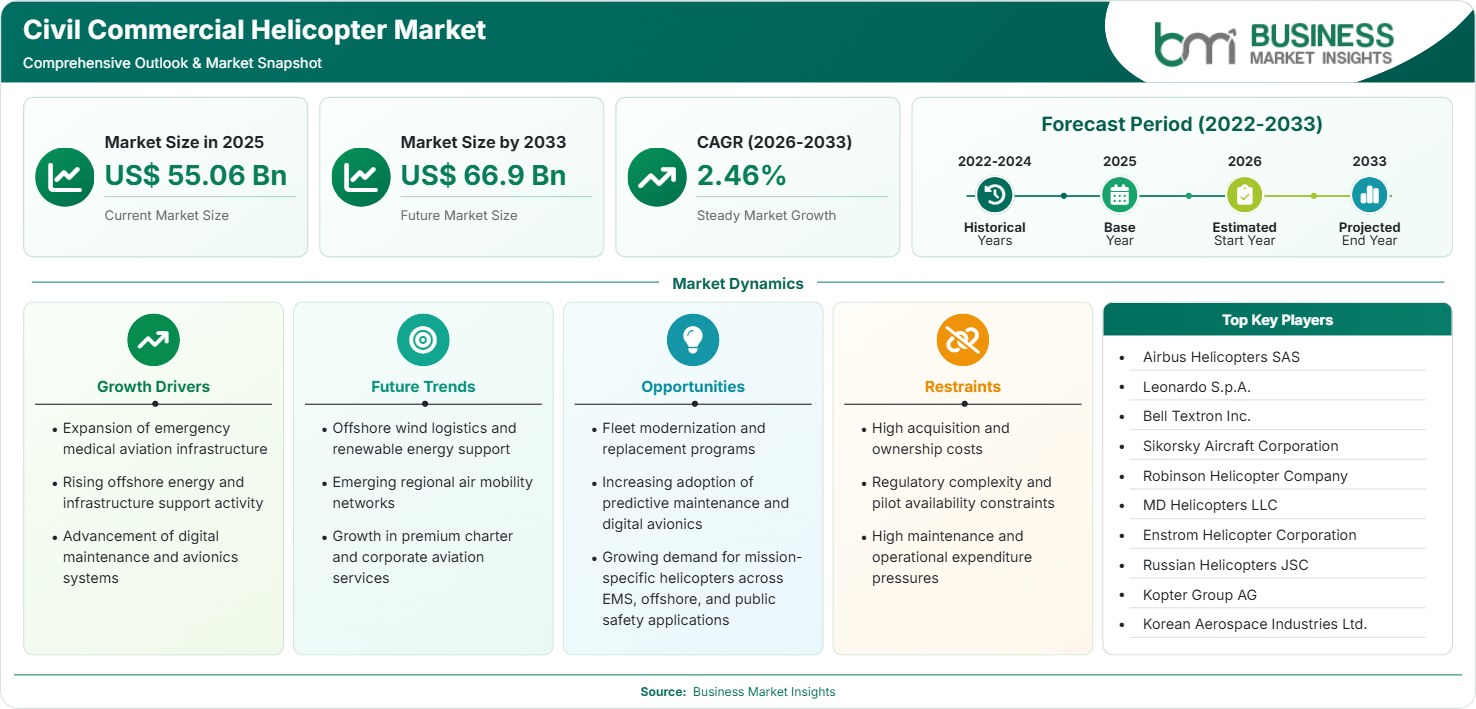
The Civil Commercial Helicopter Market size was valued at US$ 55.06 Billion in 2025 and is projected to reach US$ 66.9 Billion by 2033, growing at a CAGR of 2.46% during 2026–2033, driven by offshore energy transport demand, emergency medical aviation expansion, fleet modernization programs, digital avionics adoption, and increasing investment in urban and regional aerial mobility services.

Report Coverage
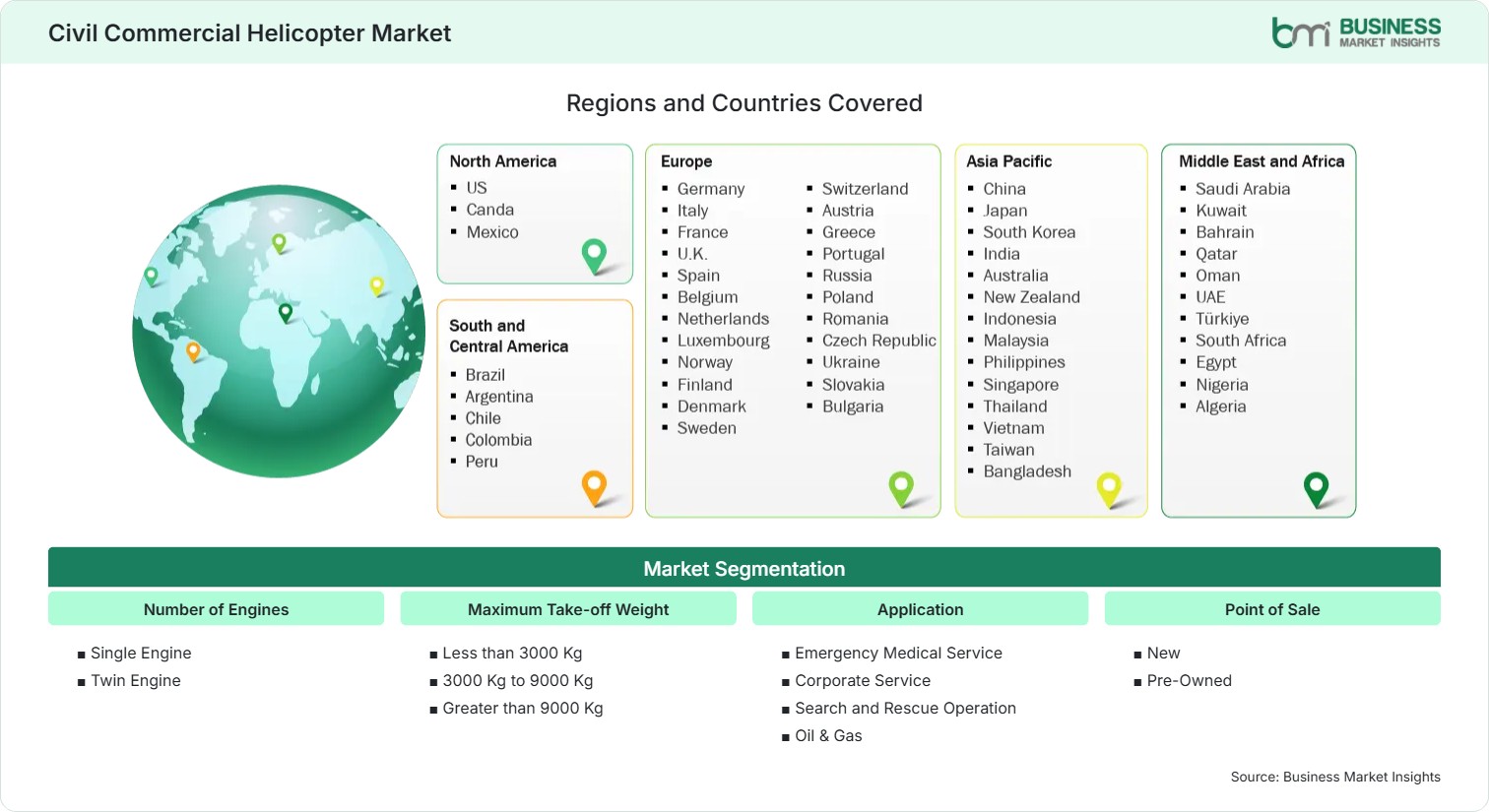
  • Number of Engines: Single Engine, Twin Engine
  • Maximum Take-off Weight: Less than 3000 Kg, 3000 Kg to 9000 Kg, Greater than 9000 Kg
  • Application: Emergency Medical Service, Corporate Service, Search and Rescue Operation, Oil & Gas
  • Point of Sale: New, Pre-Owned
US$ 55.06 Bn Market size in 2025
US$ 66.9 Bn Market Size by 2033
2.46% CAGR, 2026 - 2033
2026-2033 Forecast Period

AI Overview

Civil Commercial Helicopter Market Summary

  • North America Region: North America holds a market share of 34%–37% in 2025 and is expected to expand at a CAGR of 2.1%–2.4% during 2026–2033. Fleet renewal, offshore aviation demand, emergency response modernization, and advanced avionics integration support growth. Opportunities emerge from public safety contracts and energy-sector transportation requirements. US market benefits from strong EMS adoption, corporate aviation demand, and fleet upgrades, advancing at a CAGR of 2.2%–2.5%.
  • Fastest Growing Region: Asia Pacific accounts for 24%–27% market share in 2025 and is forecast to grow at 3.3%–3.8% CAGR during 2026–2033. Rising infrastructure investment, tourism aviation expansion, offshore exploration activity, and government-supported emergency response capabilities create strong opportunities across developing economies.
  • Leading Segment: Twin Engine represents 62%–66% share in 2025 and advances at 2.5%–2.9% CAGR. Strong safety preferences, offshore mission suitability, enhanced payload capability, and regulatory acceptance support sustained demand across commercial transportation and emergency response operations.
  • High Growth Segment: Emergency Medical Service contributes 21%–24% share in 2025 and is projected to expand at 3.8%–4.2% CAGR. Expanding trauma networks, rapid-response healthcare infrastructure, rural accessibility requirements, and technological upgrades encourage fleet procurement initiatives.
  • Key Market Opportunity: Growing integration of helicopters into offshore wind farm logistics, remote healthcare connectivity, disaster response networks, and premium charter mobility services creates diversified revenue streams for operators worldwide.
  • Major Market Players: Airbus Helicopters SAS, Leonardo S.p.A., Bell Textron Inc., Sikorsky Aircraft Corporation, Robinson Helicopter Company, MD Helicopters LLC, Enstrom Helicopter Corporation, Russian Helicopters JSC, Kopter Group AG, Korean Aerospace Industries Ltd.
Strategic Insights

Civil Commercial Helicopter Market: Strategic Insights

Civil Commercial Helicopter Market Strategic Framework
FREE PDF
Request your free sample
Request free sample
Stakeholder View

Key Takeaways

  • The market ecosystem is increasingly centered on integrated service models, where manufacturers generate recurring revenue through maintenance, digital analytics, pilot training, and fleet support services.
  • Emergency medical service and offshore energy transportation applications present the strongest medium-term demand outlook due to rapid-response requirements and expanding remote operations.
  • Innovation is shifting toward predictive maintenance, health monitoring systems, advanced autopilot capabilities, and enhanced cockpit automation that improve safety and utilization rates.
  • Asia Pacific offers one of the most compelling investment cases owing to infrastructure development, tourism expansion, healthcare access initiatives, and offshore energy projects.
  • Strategic partnerships, distributor expansion, and selective acquisitions remain important competitive tools as manufacturers seek stronger regional coverage and aftermarket penetration.
  • Sustainability initiatives, including optimized flight planning, lightweight materials, and exploration of hybrid-electric rotorcraft technologies, are shaping future product development priorities.
Geographic Outlook

Civil Commercial Helicopter Market Regional Highlights

North America Civil Commercial Helicopter Market

North America remains the largest regional market, accounting for 34%–37% Civil Commercial Helicopter Market share in 2025 and expanding at a CAGR of 2.1%–2.4% through 2033. Demand is supported by extensive emergency medical aviation networks, offshore oil and gas transportation, public safety missions, and corporate aviation activity. Fleet modernization programs continue across operators seeking improved fuel efficiency and digital flight management capabilities. Strong maintenance infrastructure and established leasing ecosystems support sustained procurement activity across the United States and Canada.

  • Emergency medical operators continue upgrading aircraft with advanced navigation, communication, and patient-support systems, improving mission readiness and dispatch reliability.
  • Offshore transportation demand remains supported by Gulf of Mexico operations and emerging offshore wind infrastructure servicing requirements.
  • Public safety agencies increasingly deploy multi-mission rotorcraft configured for law enforcement, disaster response, and aerial surveillance activities.
  • Corporate aviation users prioritize flexible point-to-point connectivity where fixed-wing alternatives face airport accessibility limitations.

US Civil Commercial Helicopter Market

The United States represents approximately 78%–82% of regional demand and advances at a CAGR of 2.2%–2.5% to 2033. The country supports one of the world's largest commercial rotorcraft fleets. Emergency healthcare access, utility inspection services, tourism operations, and executive aviation remain major demand generators. FAA-supported modernization initiatives and expanding digital maintenance capabilities reinforce long-term fleet utilization while supporting replacement demand for aging aircraft categories.

  • Hospital networks increasingly rely on rotorcraft transportation for specialized trauma and critical-care response coverage.
  • Utility operators use helicopters extensively for transmission line inspections and infrastructure monitoring programs.
  • Corporate charter services benefit from time-sensitive transportation needs in business-intensive metropolitan regions.
  • Disaster preparedness programs continue supporting procurement of multi-role aircraft platforms.

Europe Civil Commercial Helicopter Market

Europe holds 25%–28% of global revenue in 2025 and is expected to grow at 2.2%–2.7% CAGR. The region benefits from mature emergency medical service networks, offshore energy transportation, and search-and-rescue infrastructure. Germany, France, and the United Kingdom lead demand, while Norway demonstrates higher growth linked to offshore operations. Regulatory emphasis on aviation safety and environmental performance encourages adoption of newer aircraft variants equipped with advanced avionics and lower operating costs.

  • Offshore transport activity in the North Sea supports demand for twin-engine aircraft with long-range capabilities.
  • Germany remains a leading procurement center for medical aviation and public-service fleet expansion.
  • France benefits from strong aerospace manufacturing capabilities and extensive civil operator presence.
  • Norway records faster expansion, supported by offshore energy and remote-area connectivity requirements.
  • Digital fleet monitoring solutions gain broader acceptance among commercial operators.

Asia Pacific Civil Commercial Helicopter Market

Asia Pacific accounts for 24%–27% Civil Commercial Helicopter Market share in 2025 and records the highest CAGR of 3.3%–3.8% through 2033. China, Australia, Japan, and India are major contributors. Infrastructure development, tourism activity, offshore exploration, and disaster-response requirements stimulate procurement. Governments continue strengthening emergency aviation capabilities while encouraging aviation connectivity to remote regions. Rising private wealth also supports growing utilization of executive helicopter services across selected metropolitan centers.

  • China continues investing in general aviation infrastructure and regional aviation accessibility initiatives.
  • India shows strong demand potential from medical transport, tourism, and industrial support applications.
  • Australia maintains significant offshore, utility, and emergency response helicopter requirements.
  • Japan emphasizes disaster management preparedness and advanced operational safety standards.
  • Cross-border tourism expansion supports charter and sightseeing helicopter services.

Rest of World Civil Commercial Helicopter Market

Rest of World contributes 11%–14% share in 2025 and advances at 2.8%–3.2% CAGR. The Middle East benefits from offshore energy operations, VIP transportation, and government aviation programs. South and Central America continue generating demand from mining, agriculture, and emergency services. Countries including Brazil, Saudi Arabia, and the UAE remain key markets due to expanding infrastructure projects and operational requirements in geographically challenging areas.

  • Brazil leads regional demand through utility, agricultural, and energy-sector aviation operations.
  • Saudi Arabia invests in tourism, emergency response, and large-scale infrastructure developments.
  • UAE maintains strong demand for executive transportation and public-service rotorcraft fleets.
  • Mining and remote industrial activities support utilization across Latin American economies.
  • Medical evacuation programs expand gradually in underserved regions.
Global Market Geography
FREE PDF
Request your free sample
Request free sample
Segment Analysis

Civil Commercial Helicopter Market Segmentation

Number of Engines

This segment accounted for approximately 38%–42% market share in 2025 and is projected to grow at 2.4%–2.8% CAGR. The Civil Commercial Helicopter Market scope within engine configurations is shaped by mission requirements, regulatory standards, operating economics, and safety expectations. Twin-engine variants continue dominating demanding commercial operations.

  • Single Engine: Preferred for tourism, utility, agriculture, and light transport operations due to lower acquisition costs, operational simplicity, and efficient deployment in short-range missions.
  • Twin Engine: Widely adopted for offshore transportation, corporate mobility, EMS, and search-and-rescue missions where redundancy, safety performance, and regulatory compliance remain critical.

Maximum Take-off Weight (MTOW)

This category represents around 31%–35% market share in 2025 and expands at 2.5%–2.9% CAGR. Aircraft selection increasingly depends on payload requirements, mission duration, passenger capacity, and operating environment. Operators seek optimized performance across varying commercial applications.

  • Less than 3,000 Kg: Utilized extensively in tourism, charter services, training, and surveillance missions due to affordability and operational flexibility.
  • 3,000 Kg to 9,000 Kg: Serves diverse emergency response, corporate aviation, utility, and offshore support missions with balanced payload and range characteristics.
  • Greater than 9,000 Kg: Supports heavy transport, demanding offshore logistics, specialized rescue missions, and large-scale industrial operations requiring significant payload capacity.

Application

This segment contributes 29%–33% revenue share in 2025 and grows at 3.0%–3.4% CAGR. The Civil Commercial Helicopter Market trends across applications indicate stronger demand for mission-critical operations where speed, access, and flexibility outperform alternative transportation options.

  • Emergency Medical Service: Expands through healthcare accessibility initiatives, trauma-response networks, and increasing investment in rapid patient transportation capabilities.
  • Corporate Service: Benefits from executive mobility requirements, flexible regional connectivity, and premium charter transportation demand among business travelers.
  • Search and Rescue Operation: Experiences adoption across disaster management agencies, coast guard operators, and public safety organizations requiring rapid deployment.
  • Oil & Gas: Continues generating stable demand from offshore transportation, crew transfer operations, and infrastructure inspection activities.

Point of Sale

This segment accounts for 18%–22% market share in 2025 and advances at 2.1%–2.6% CAGR. Procurement decisions depend on budget allocation, availability, aftermarket support, and service life considerations. Replacement activity remains an important demand contributor.

  • New: Supported by modernization programs, advanced technology adoption, manufacturer financing options, and long-term maintenance planning objectives.
  • Pre-Owned: Attracts smaller operators seeking lower capital expenditure while maintaining operational capability across commercial missions.
Market Forces

Civil Commercial Helicopter Market Dynamics

Key Market Drivers

Expansion of Emergency Medical Aviation Infrastructure

Air medical transport is increasingly used in healthcare systems to minimize response times and improve patient survival rates. Various WHO programs, including improvements to the trauma network and emergency care in rural areas, increase demand for air medical transport services. Even developed countries are still developing their fleets of helicopter EMS with medical equipment and communication technologies. The resulting increase in mission frequency, fleet utilization rates, and replacement requirements continues to support Civil Commercial Helicopter Market growth across both developed and emerging economies.

Rising Offshore Energy and Infrastructure Support Activity

Global energy development projects require dependable transportation solutions for workers, equipment, and emergency response operations. Helicopters with dual engines are regularly used for offshore oil, gas, and wind facilities in difficult conditions. IEA trends in investment in energy reveal a continued investment in infrastructure related to the development and transition of energy. Due to the growth of offshore wind facilities and the development of new exploration programs, companies are investing more in aircraft with greater range and payload capacity.

Advancement of Digital Maintenance and Avionics Systems

Digitalization is emerging as a key differentiating element in the competitive landscape of the operators. Health monitoring and usage systems, predictive maintenance solutions, satellite communication capabilities, and avionics help reduce downtime along with ensuring safety. The manufacturers are now incorporating real-time diagnostic and performance analysis tools in the latest generation of aircrafts. Growing acceptance of data-driven operations continues supporting modernization strategies and reinforces positive Civil Commercial Helicopter Market growth fundamentals across commercial service providers.

Key Market Opportunities

Offshore Wind Logistics and Renewable Energy Support

The development of offshore wind power generation offers an enduring potential market for specialized transportation services. The need exists for technicians to have quick access to remote facilities where boat transport is not effective. Helicopters allow maintenance, inspection, and emergency procedures to be carried out in a timely manner. Civil Commercial Helicopter Market Forecasts increasingly incorporate offshore wind transportation as a meaningful demand driver. Operators investing in mission-specific fleets and training capabilities may benefit from growing infrastructure support contracts over the coming decade.

Emerging Regional Air Mobility Networks

Regional mobility services are gaining attention as governments seek improved connectivity for remote communities. The advantages of helicopter deployment are immediate, without having to invest in any significant airport infrastructure. Growing nations are looking at ways of connecting their industrial areas, tourism areas, health centers, and underdeveloped areas. With increased investment in heliport construction, air traffic control systems, and schedule coordination systems, there will be better economics of operation. Companies with versatile and economical helicopters are bound to succeed in this trend.

Growth in Premium Charter and Corporate Aviation Services

Rising private wealth, time-sensitive executive travel requirements, and growing demand for luxury mobility services support charter market expansion. Helicopters offer direct access to cities and remote places while saving time. There is an increasing use of charter services by business centers, tourist attractions, and sites of important events. Helicopter companies making investments in better facilities and digital booking systems have a competitive edge. There is a promising revenue stream for the future.

Market Restraints and Challenges

High Acquisition and Ownership Costs

Factor: Helicopters require significant capital investment, specialized maintenance infrastructure, certified personnel, and ongoing compliance expenditures. Impact: The high cost of ownership discourages new entrants and hinders the decision to replace old fleets. In addition to this, financing needs, insurance costs, and changing maintenance costs play their roles in purchasing decisions. Even though technology may lower total costs of ownership, the initial costs involved are quite significant. These economic factors are most visible in developing countries, where budgets are limited.

Regulatory Complexity and Pilot Availability Constraints

Factor: Commercial helicopter operations face stringent certification, safety, training, and operational compliance requirements across jurisdictions. Impact: Comprehensive regulatory processes may delay project deployments and result in higher operational costs. At the same time, industry participants keep encountering staff shortages of pilots and mechanics in some markets. The shortage of labor force imposes limitations on capacity, limits possibilities for expansion, and makes human resources more expensive. Large investments in hiring and training personnel are required.

Company Analysis

Competitive Landscape

Civil Commercial Helicopter Market analysis indicates competition is shaped by product reliability, mission specialization, global support networks, and aftermarket capabilities.

Company Name

Overview

Products and Services relevant to this market

Airbus Helicopters SAS

Global helicopter leader with strong presence across EMS, offshore, transport, and public-service operations.

H125, H130, H135, H145, H160, H175 helicopters, maintenance, training, digital services.

Leonardo S.p.A.

Major commercial rotorcraft manufacturer serving energy, rescue, utility, and executive transport sectors.

AW09, AW109, AW139, AW169, AW189 platforms and lifecycle support services.

Bell Textron Inc.

Established producer focused on commercial, utility, and corporate helicopter applications worldwide.

Bell 407, Bell 429, Bell 505, support solutions and training services.

Sikorsky Aircraft Corporation

Advanced rotorcraft provider with strong engineering and mission-platform expertise.

S-76 and commercial support offerings, modernization and maintenance services.

Robinson Helicopter Company

Leading manufacturer of light helicopters with extensive global operator base.

R22, R44, R66, R88 and aftermarket support programs.

MD Helicopters LLC

Specialized manufacturer serving utility, emergency response, and public safety missions.

MD 500 series, MD 530F, mission equipment integration services.

Enstrom Helicopter Corporation

Niche helicopter producer recognized for training and utility platforms.

280FX and 480B helicopters, support and training offerings.

Russian Helicopters JSC

Large rotorcraft producer with broad civil helicopter portfolio.

Mi and Ka family helicopters for transport, utility, and commercial operations.

Kopter Group AG

Rotorcraft developer focused on next-generation single-engine helicopter solutions.

SH09 program development and associated support capabilities.

Korean Aerospace Industries Ltd.

Aerospace manufacturer expanding rotary-wing capabilities through strategic programs.

Commercial helicopter development, engineering, support, and systems integration.

Trust & Transparency

Research Methodology

The market analysis combines proprietary research with secondary data from government agencies, company disclosures, regulatory filings, industry databases and expert interviews. Market estimates are validated through data triangulation, cross-market benchmarking and analyst review.

View Full Research Methodology

Questions Answered

Frequently Asked Questions

What does the Civil Commercial Helicopter Market Report typically evaluate?

The Civil Commercial Helicopter Market Report commonly examines demand patterns, competitive positioning, fleet trends, regional opportunities, technological developments, market segmentation, and future growth prospects.

Which regions are attracting the highest new investments?

Asia Pacific, the Middle East, and selected Latin American countries are attracting investment through infrastructure development, energy projects, tourism growth, and emergency aviation modernization.

How does the pre-owned market affect industry dynamics?

Pre-owned helicopters enable cost-sensitive operators to expand fleets while reducing capital expenditure, creating broader market participation and supporting fleet replacement cycles.

What factors influence helicopter purchasing decisions among operators?

Key considerations include mission requirements, acquisition cost, maintenance expenses, regulatory compliance, payload capacity, fuel efficiency, and availability of aftermarket support services.

Which application area offers the strongest growth potential in commercial helicopter operations?

Emergency medical services show the strongest growth prospects due to healthcare accessibility initiatives, trauma network expansion, and increasing reliance on rapid-response aviation capabilities across remote and urban environments.

Access the Full Civil Commercial Helicopter Market Report

Get segment-level forecasts, regional estimates, competitive benchmarking, company profiles and downloadable Excel datasets.

Access the full Civil Commercial Helicopter Market Report
350 pages PDF & Excel | 2026-08-27