Market Summary
Executive Summary and Global Market Analysis
The commercial aircraft oxygen systems market is used to describe safety-critical onboard systems that provide breathable oxygen to the occupants of an aircraft in case of emergency situations. These systems are used to ensure the survivability of passengers and crew members of aircraft in case of pressurization failure. Such systems are incorporated in the architecture of commercial aircraft.
The rising demand for air travel, together with the modernization of aircraft fleets, is encouraging airlines to incorporate such safety-critical systems. Furthermore, increasing emphasis on the safety regulations of passengers is also motivating them to adopt more efficient and effective safety systems. Moreover, increased use of aircraft has led airlines to upgrade their oxygen delivery systems.
The market for this industry can be segmented according to various criteria, including the type of system, the component of the system, its mechanism, and other technology-related factors. Passengers' oxygen systems are one of the important segments, as safety regulations require airlines to have mandatory provisions of oxygen in commercial aircraft.
Evolution in technology is making oxygen delivery more precise and light-weighted in aircraft equipment. The techniques of demand flow and pressure demand have become significant for efficient consumption and safe performance of oxygen systems. There is also a trend towards developing lighter systems, without compromising the compliance with safety requirements and robustness of systems.
Competitive trends are driven by aerospace safety standards and supply chain management through contracts. Market players concentrate on certification-oriented innovations and compatibility with future-generation aircraft. Innovations in light weighting and energy efficiency affect the differentiation of products.
Segment Analysis
Commercial Aircraft Oxygen Systems Market Segmentation
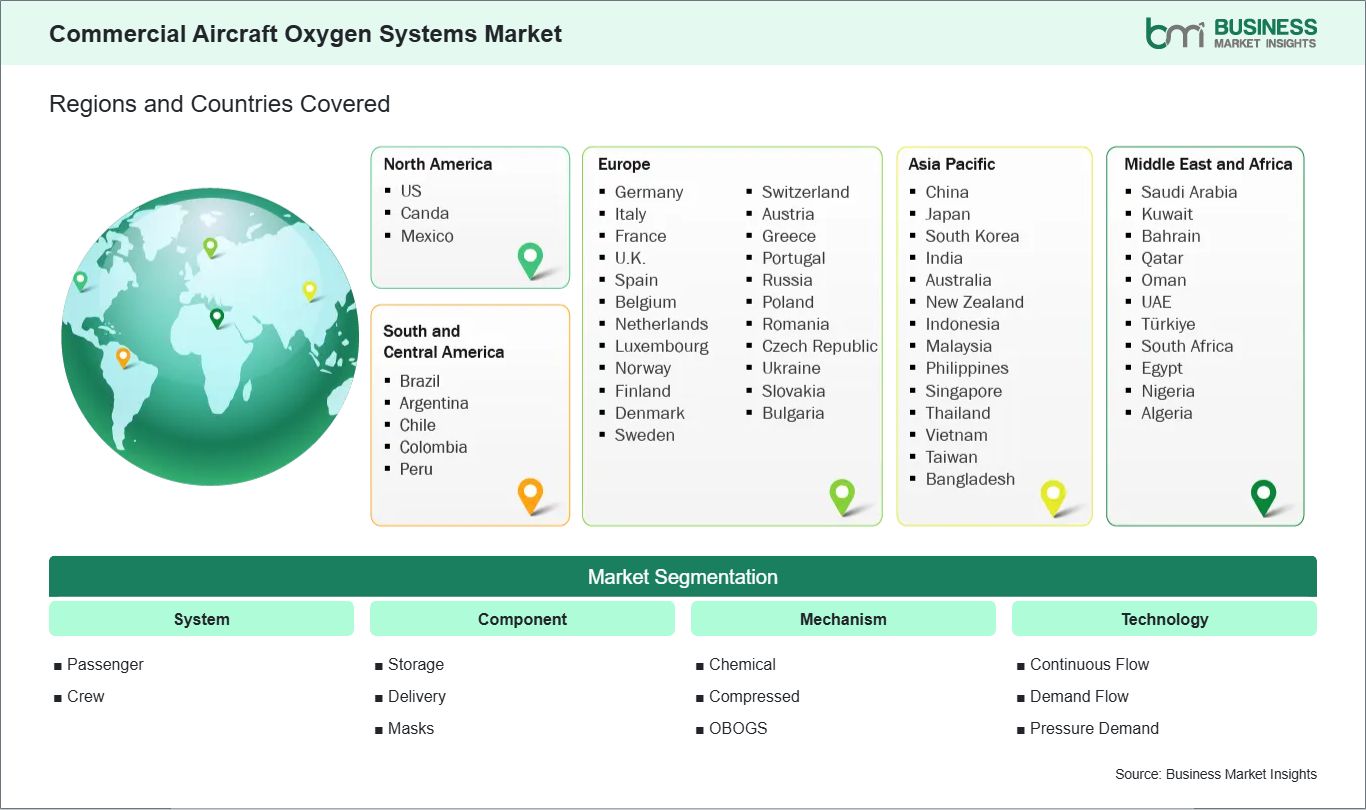
The commercial aircraft oxygen systems market is segmented based on system, component, mechanism, and technology, reflecting safety integration requirements across aircraft platforms.
By System
- Passenger: Cabin oxygen supply systems activated during decompression events across commercial flights.
- Crew: Cockpit oxygen systems ensuring pilot safety during high-altitude emergency conditions.
By Component
- Storage: High-pressure cylinders designed to securely contain oxygen for onboard use.
- Delivery: Distribution assemblies regulating oxygen flow across aircraft cabin and cockpit zones.
- Masks: Protective breathing interfaces enabling immediate oxygen access during emergencies.
By Mechanism
- Chemical: On-demand oxygen generation through chemical reaction processes for emergency use.
- Compressed: Stored gaseous oxygen systems delivering rapid supply during cabin pressure loss.
- OBOGS: On-board generation systems producing oxygen continuously from ambient air sources.
By Technology
- Continuous Flow: Steady oxygen delivery suited for passenger emergency deployment scenarios.
- Demand Flow: Oxygen supplied only upon inhalation, improving system efficiency.
- Pressure Demand: High-altitude optimized delivery ensuring adequate oxygen concentration under stress conditions.
Market Forces
Commercial Aircraft Oxygen Systems Market Drivers and Opportunities
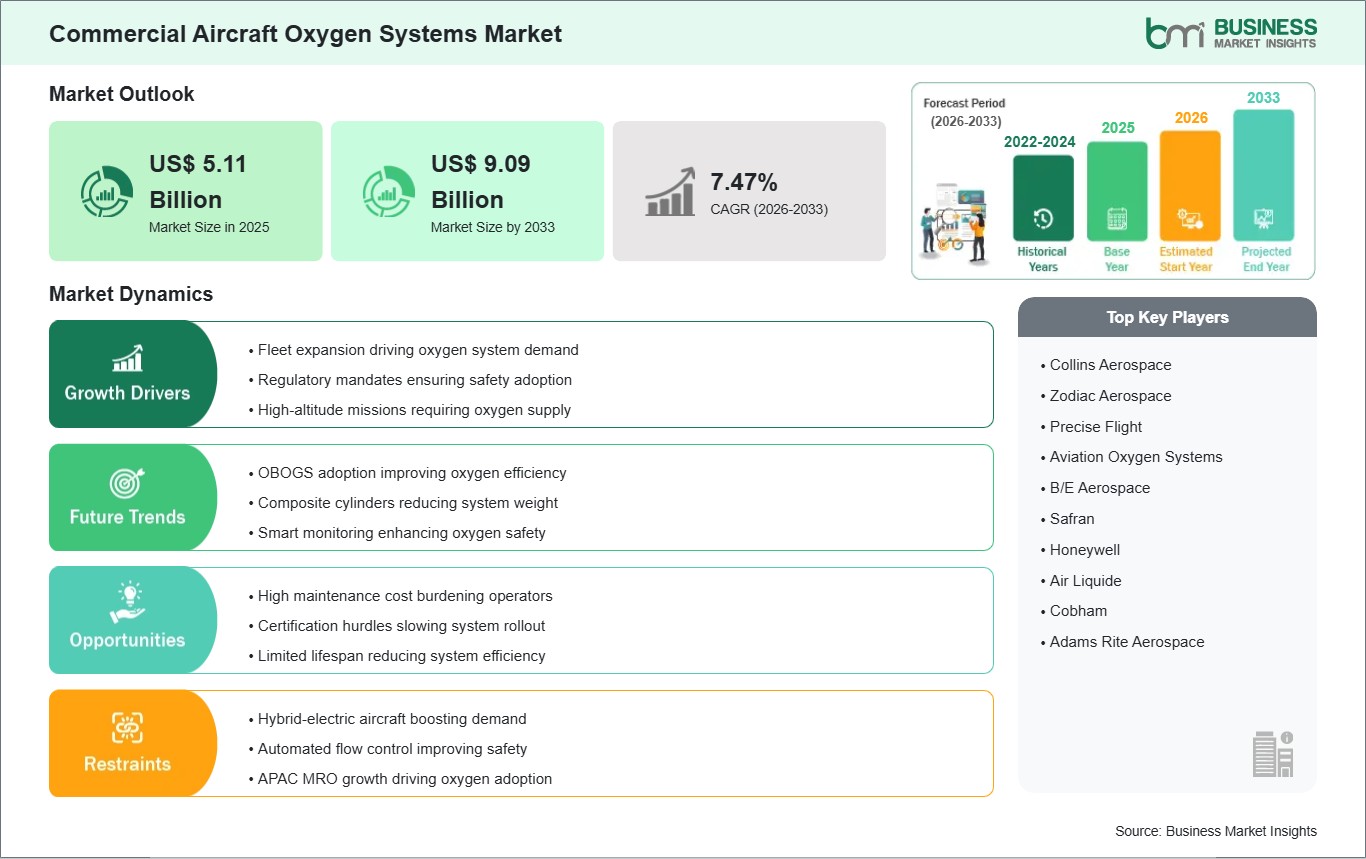
Fleet expansion driving oxygen system demand
With an increase in global delivery volumes of commercial aircraft, there is also an increased demand for onboard oxygen systems in such aircraft, especially with the certification of such systems. An increase in airline routes and capacity makes the use of safety equipment more crucial. Oxygen systems are being integrated into aircraft production processes to make sure that the system is ready for operation. This is seen in all new narrow-body and wide-body aircraft.
With regards to the mandatory requirements set up by regulatory bodies for safety in aviation, it is important for commercial aircraft to have oxygen systems installed in order to be certified. Manufacturers have been required to make sure that their designs incorporate all the requirements set out by such regulatory authorities. Improvement in lightweight storage and delivery processes has been achieved in this case.
Hybrid-electric aircraft boosting demand
The rise in the use of hybrid-electric aircraft will see the creation of new operation models, which would need to be addressed by the definition of new safety system concepts. The new generation of aircraft utilizes different propulsion methods, and this makes it necessary for manufacturers to redesign the concept of oxygen systems that would work well with the new cabin pressurization and emergency oxygen needs of such a type of plane.
Innovation in aviation technology will ensure the increased application of the oxygen system in future generations of planes. Hybrid-electric aircraft will need innovative storage and delivery systems for efficient oxygen supply. The process of certification of new aircraft types will ensure the adoption of the system in the near future.
Size and Share Analysis
Commercial Aircraft Oxygen Systems Market Size and Share Analysis
The Commercial Aircraft Oxygen Systems Market is projected to grow from US$ 5.11 Billion in 2025 to US$ 9.09 Billion by 2033 , registering a CAGR of 7.47% from 2026 to 2033.
By system, passenger maintains the leading position due to mandatory aviation safety regulations requiring emergency oxygen supply for all passengers during cabin depressurization. Their large-scale deployment across commercial aircraft fleets and higher seat capacity significantly increases overall system demand compared to crew systems.
By component, masks dominates as they are essential safety equipment installed in both passenger and crew compartments for emergency use. Their high unit volume per aircraft, frequent replacement cycles, and strict regulatory requirements drive consistent and large-scale demand.
By mechanism, chemical leads the market owing to the lightweight it provides, self-contained oxygen generation without requiring heavy storage tanks. Their reliability, low maintenance, and suitability for overhead passenger deployment make them the preferred choice for commercial aircraft emergency oxygen supply.
By technology, continuous flow systems holds a significant share due to their simplicity, cost-effectiveness, and suitability for rapid oxygen distribution during decompression events. Their compatibility with chemical oxygen generators and widespread use in passenger aircraft cabin systems further strengthen their market dominance.
Report Coverage
Commercial Aircraft Oxygen Systems Market Report Coverage and Deliverables
The "Commercial Aircraft Oxygen Systems Market Size and Forecast (2022-2033)" report provides a detailed analysis of the market covering below areas:
- The market size and forecast at global, regional, and country levels for all market segments covered under the scope
- The market trends, as well as drivers, restraints, and opportunities
- The market analysis covering key trends, global and regional framework, major players, regulations, and recent developments
- Industry landscape and competition analysis covering market concentration, heat map analysis, prominent players, and recent developments for the market
- Detailed company profiles, including SWOT analysis
Geographic Insights
Commercial Aircraft Oxygen Systems Market Geographic Insights
The adoption trends in the commercial aircraft oxygen systems market exhibit varied patterns across regions based on factors such as the growth in the number of aircraft, aviation safety regulations, and changes in aircraft design requirements. Regional differences arise from various factors like growth in passenger numbers, aircraft purchase decisions, and levels of regulation. Well-established aviation regions constantly invest in safety systems, whereas new regions steadily increase adoption via their fleet acquisitions and growth in their airline networks.
High adoption is observed in North America owing to its developed aviation infrastructure and widespread use of commercial aircraft. This is mainly because of ongoing efforts at fleet replacement and stringent aviation safety practices. Canada also provides support for sustained adoption owing to an expanding regional network along with the modernization of its commercial aircraft fleet. A high focus on certification and maintenance further enhances adoption in this region.
There is an increased uptake in the Asia Pacific because of an increase in demand for air travel and the number of airplanes in the fleets of airlines in the region. Countries like China, India, and Japan have been investing in new deliveries of aircraft aimed at improving connectivity both domestically and internationally. Growth in low-cost carriers and the development of airports have also contributed to increased uptake. The manufacturers are concentrating more on developing oxygen systems that can easily be installed during high-volume procurement processes in this region.
Europe has remained steady due to existing aerospace industry capacity and an effective regulatory environment. Some of the countries in Europe, such as Germany, France, and the United Kingdom, continue supporting advanced aircraft manufacturing and fleet upgrade. On the other hand, emerging countries in the Middle East and Latin America have been gradually adopting oxygen system integration in commercial aircraft through expansion of their airline networks and investments in aviation infrastructure.
Industry Activity
Recent Developments
The commercial aircraft oxygen systems market is evaluated by gathering qualitative and quantitative data post primary and secondary research, which includes important corporate publications, association data, and databases. A few of the key developments in the commercial aircraft oxygen systems market are:
- In January 2023, Honeywell Aerospace announced the launch of a European consortium project to develop hydrogen fuel cell propulsion systems for aircraft, advancing onboard energy systems that directly influence future aircraft life-support architecture, including cabin air and oxygen system design considerations.
- In June 2023, Safran Aerosystems announced that it had entered into exclusive negotiations with Air Liquide to acquire its aeronautical oxygen and nitrogen activities, strengthening Safran on-board oxygen generation systems (OBOGS), portable breathing equipment, and aircraft oxygen supply portfolio.
Trust & Transparency
Research Methodology
The market analysis combines proprietary research with secondary data from government agencies, company disclosures, regulatory filings, industry databases and expert interviews. Market estimates are validated through data triangulation, cross-market benchmarking and analyst
review.
View Full Research Methodology
Key Sources Referred:
Federal Aviation Administration (FAA) European Union Aviation Safety Agency (EASA) International Civil Aviation Organization (ICAO) Civil Aviation Administration of China (CAAC) Transport Canada Civil Aviation (TCCA) UK Civil Aviation Authority (UK CAA) International Air Transport Association (IATA) National Transportation Safety Board (NTSB) Company Websites Company Annual Reports Company Investor Presentations