Market Summary
Executive Summary and Global Market Analysis
Commercial electric aircraft are an emerging market that seeks to transform the current aviation paradigm by substituting the existing propulsion technology with its electric counterpart. Modern commercial electric aircraft incorporate innovative battery technology and powertrains to minimize carbon emission rates, increase operational efficiency, and achieve sustainability goals. Commercial electric aircraft can be integrated into regional transport as well as business jet applications.
The emergence of electric aircraft in the industry has been facilitated by global sustainability goals and regulations favoring green aviation solutions. Airlines have seen their benefits in terms of reducing reliance on jet fuel. The environmental benefits of electric propulsion technology make the market relevant to airlines and operators. Stakeholders in the aviation industry stress the need to lower carbon emissions.
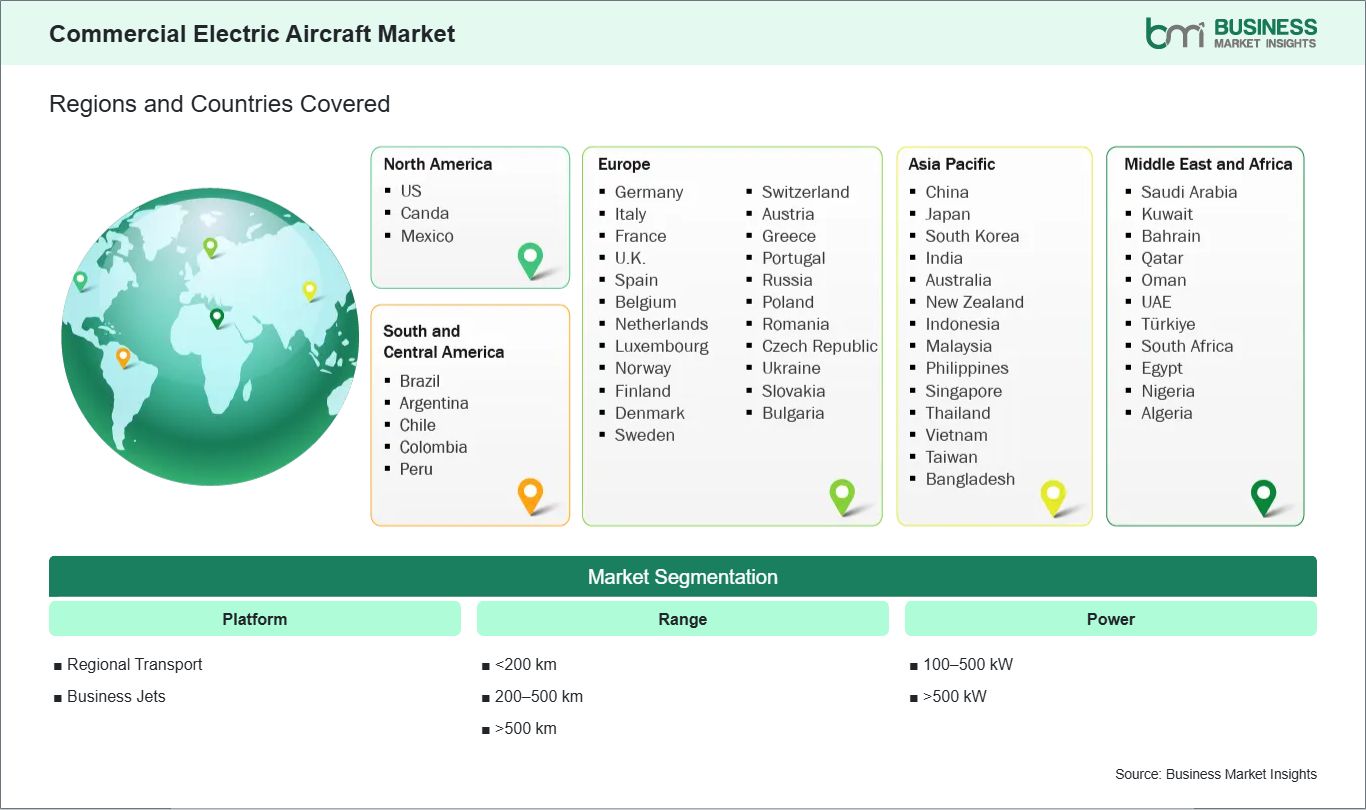
The segmentation of the market demonstrates the variety in terms of platform, range, and power used in different types of electric aircraft. This is because regional transport aircraft are designed to provide connectivity. Business jets cater to corporate clients. First of all, range can be divided into several categories – ranging from less than 200 km for city missions, to 200-500 km in order to establish connections between cities, as well as more than 500 km for longer distances. Segmentation regarding power capacity includes options of 100-500 kW and more than 500 kW, reflecting a variety of different types of aircraft available.
Technological progress plays an important role in the development of this type of transport market. Initial projects were oriented toward short-haul flights. However, thanks to increased efficiency of batteries, as well as improvements in charging systems and use of lighter materials, it became possible to design larger aircraft, as well as introduce hybrid and distributed systems. Current applications extend far beyond mere passenger transport, involving cargo transportations and regional missions as well.
The commercial electric aircraft market is highly competitive; there is competition in terms of integration of electric systems offered by large OEMs, which is opposed by innovations in design offered by startups. Battery capacity, safety standards, and flexibility are more relevant than costs when discussing competitive factors. Thus, it seems that electric propulsion will become an integral part of the sustainable transition towards greener aviation in the future.
Segment Analysis
Commercial Electric Aircraft Market Segmentation
The commercial electric aircraft market is segmented based on platform, application, and solutions, reflecting the integration of multi-domain operational command infrastructures and digital defense coordination systems.
By Platform
- Regional Transport: Electric propulsion supports short-haul connectivity with reduced emissions.
- Business Jets: Corporate operators adopt electric systems for sustainable mobility and efficiency.
By Range
- <200 km: Urban operations benefit from compact electric propulsion for short flights.
- 200-500 km: Regional connectivity solutions balance efficiency with extended operational scope.
- >500 km: Long-range missions explore advanced battery and hybrid-electric technologies.
By Power
- 100-500 kW: Mid-range systems enable efficient propulsion for smaller aircraft.
- >500 kW: High-capacity systems support larger platforms and extended missions.
Market Forces
Commercial Electric Aircraft Market Drivers and Opportunities
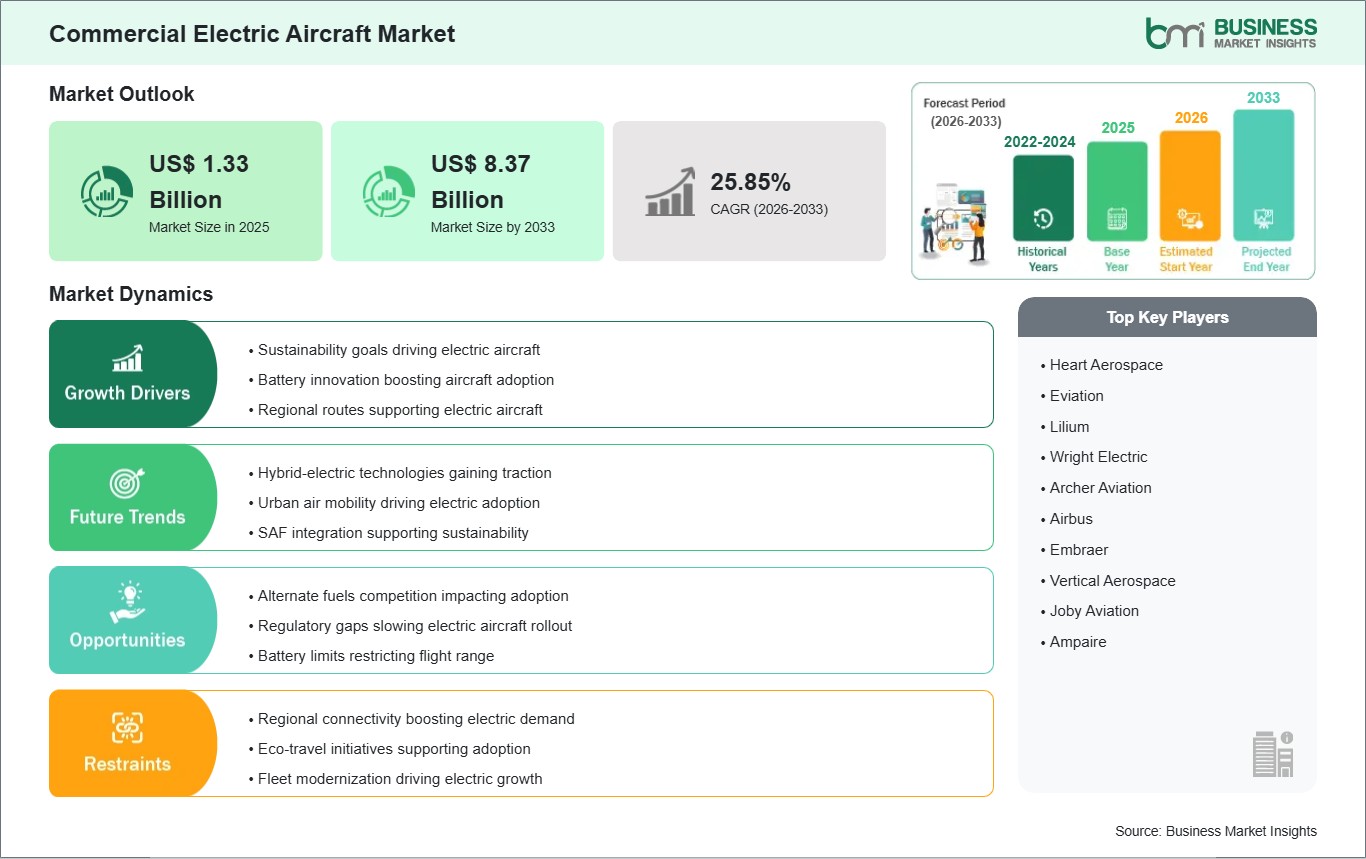
Sustainability goals driving electric aircraft
Sustainability measures on a global level have driven the adoption of electric planes. Indeed, the aviation sector is responsible for considerable levels of emissions, and hence the need for regulators and other key players in the industry to look for environmentally friendly solutions. Electric planes represent an obvious choice, which helps to address issues related to sustainability goals. Thus, this driving force stems from the necessity for the aviation industry to pursue sustainable development objectives.
This driver plays an important role in the regulatory and technological aspects of electric plane adoption. For instance, governments may introduce favorable regulations that promote electrification in the aviation sector, and new technological developments can ensure effective implementation of such measures. Therefore, the importance of this driver comes from its ability to combine environmental and technological aspects.
Regional connectivity boosting electric demand
The regional connectivity initiative provides a great opportunity for the adoption of electric aircraft. In this case, the use of electric propulsion is beneficial since short-distance flights are perfect for such an initiative. The new approach to regional connectivity includes regional air mobility and emphasizes sustainability in order to enhance mobility. New technologies can be used to promote electric aircraft through improved battery density and charging systems.
In addition, further application in the future includes more extensive use of electric aircraft in metropolitan and rural environments, enhancing economic growth and mobility in the regions. Positive impacts include improved sustainability and safety of flights due to the reduction of environmental pollution by using electric propulsion. Therefore, the adoption of the initiative will be vital to ensure a sustainable regional aviation system.
Size and Share Analysis
Commercial Electric Aircraft Market Size and Share Analysis
The Commercial Electric Aircraft Market is projected to grow from US$ 1.33 Billion in 2025 to US$ 8.37 Billion by 2033 , registering a CAGR of 25.85% from 2026 to 2033.
By platform, regional transport aircraft accounts for a significant share due to their suitability for short-haul operations where current electric propulsion technology is most practical. Airlines and operators focus on reducing fuel costs and emissions on high-frequency regional routes, making electrification more viable in this segment compared to larger or long-haul aircraft categories.
By range,>200 km dominates because present battery energy density limitations restrict electric aircraft to short-distance operations. This range is ideal for urban air mobility and short regional connectivity, where frequent flights, lower payload requirements, and quick turnaround times align well with electric propulsion capabilities.
By power, 100-500 kW power segment leads the market as it represents the most commercially viable power range for current electric aircraft prototypes and small regional models. It balances performance and battery efficiency, enabling feasible flight operations while maintaining manageable weight, cost, and energy consumption for early-stage commercial deployment.
Report Coverage
Commercial Electric Aircraft Market Report Coverage and Deliverables
The "Commercial Electric Aircraft Market Size and Forecast (2022-2033)" report provides a detailed analysis of the market covering below areas:
- The market size and forecast at global, regional, and country levels for all market segments covered under the scope
- The market trends, as well as drivers, restraints, and opportunities
- The market analysis covering key trends, global and regional framework, major players, regulations, and recent developments
- Industry landscape and competition analysis covering market concentration, heat map analysis, prominent players, and recent developments for the market
- Detailed company profiles, including SWOT analysis
Geographic Insights
Commercial Electric Aircraft Market Geographic Insights
Commercial electric aircraft adoption varies based on the region and has been determined by various factors, such as sustainability movements, fleet upgrades, and operational considerations, among other aspects within the aviation industry. Globally, there has been an even adoption pattern, where established aviation centers are balanced against new markets that add unique perspectives to the electrification efforts in the industry.
In North America, electric aircraft adoption is driven by supportive regulations and the availability of innovative environments. In North America, airlines have adopted electric airplanes because of the need to comply with sustainability standards in their region. Also, business aviation companies have considered sustainable aircraft for mobility purposes. With a thriving startup environment, the region is leading in electric aircraft adoption.
In the Asia Pacific, there is a high rate of growth owing to the implementation of fleet growth and modernization projects in nations such as China, India, and Japan. Airline organizations in the region are highly concerned about improving their performance and managing costs. Electric aircraft can offer immense value to regional airlines due to their efficient cost model. Moreover, government policies that promote sustainable aviation will facilitate adoption.
There is an advanced stage of development of air transport services in Europe. The adoption of electric aircraft in the region is largely driven by the harmonization of the regulatory framework and sustainable practices among the major players. Airlines in Germany, France, and the United Kingdom have implemented such planes in order to facilitate operational transparency and efficiency. The emerging markets in Latin America, the Middle East, and Africa are characterized by an increasing level of interest in electric planes. Airlines in such nations as Brazil, the UAE, and South Africa understand the value that comes with adopting such technology. They see great prospects in terms of improving connectivity in these regions.
Industry Activity
Recent Developments
The commercial electric aircraft market is evaluated by gathering qualitative and quantitative data post primary and secondary research, which includes important corporate publications, association data, and databases. A few of the key developments in the commercial electric aircraft market are:
- In June 2023, Eviation announced that Aerolease had placed an order for up to 50 Alice all-electric commuter aircraft, strengthening demand for electric regional aviation and scaling its global commercial order pipeline.
- In December 2023, Airbus announced that its EcoPulse hybrid-electric aircraft demonstrator successfully completed its first hybrid-electric flight, validating distributed electric propulsion and battery-assisted systems for future commercial aircraft programs.
Trust & Transparency
Research Methodology
The market analysis combines proprietary research with secondary data from government agencies, company disclosures, regulatory filings, industry databases and expert interviews. Market estimates are validated through data triangulation, cross-market benchmarking and analyst
review.
View Full Research Methodology
Key Sources Referred:
Federal Aviation Administration (FAA) European Union Aviation Safety Agency (EASA) International Civil Aviation Organization (ICAO) National Aeronautics and Space Administration (NASA) Company Websites Company Annual Reports Company Investor Presentations