Market Summary
Executive Summary and Global Market Analysis
The market of commercial avionic systems includes integrated technological solutions that allow providing aircraft with reliable and efficient performance, as well as the coordination of flights. This technology incorporates navigational systems, communicational systems, a flight management system, collision avoidance systems, weather detection technology, and power/data systems. Such a comprehensive range of systems constitutes the basis of modern aviation.
The application of avionic systems is explained by the increase in the level of complexity of global aviation networks, where communication, navigation, and automation of flight performance are essential for dealing with increasing traffic. Besides, avionic systems are widely used in the military and general aviation sectors in order to improve the efficiency and safety of missions conducted there.
A segmentation of the market of avionic systems illustrates the variety of its applications concerning the type of system, platform type, and fit type. Navigational and communicational systems are considered the basic ones in aviation, while collision avoidance and weather detection systems provide increased safety for flights. Flight management and power/data systems allow optimizing aircraft performance. Platforms include commercial aviation, military, general aviation, and special mission aviation.
Evolution in technology has played a key role in this market segment. While early products centered around basic communication and navigation, new innovations have increasingly concentrated on automated processes, interconnectivity, and data analysis. The ability to integrate with satellite navigation, digital communication channels, and real-time weather reporting adds more features to modern-day solutions. The trend towards a connected aircraft ecosystem indicates that modern avionic systems are crucial in achieving such operations.
Innovation is the main characteristic of this competitive market segment. Original equipment manufacturers emphasize standard integrations of their products when producing aircraft, whereas aftermarket suppliers offer solutions that can be integrated into existing aircraft fleets. This competition focuses on compliance, interactivity, and user-friendliness rather than just price. The aviation sector, which is going through a digital revolution, still depends on these systems for operational modernization.
Segment Analysis
Commercial Avionic Systems Market Segmentation
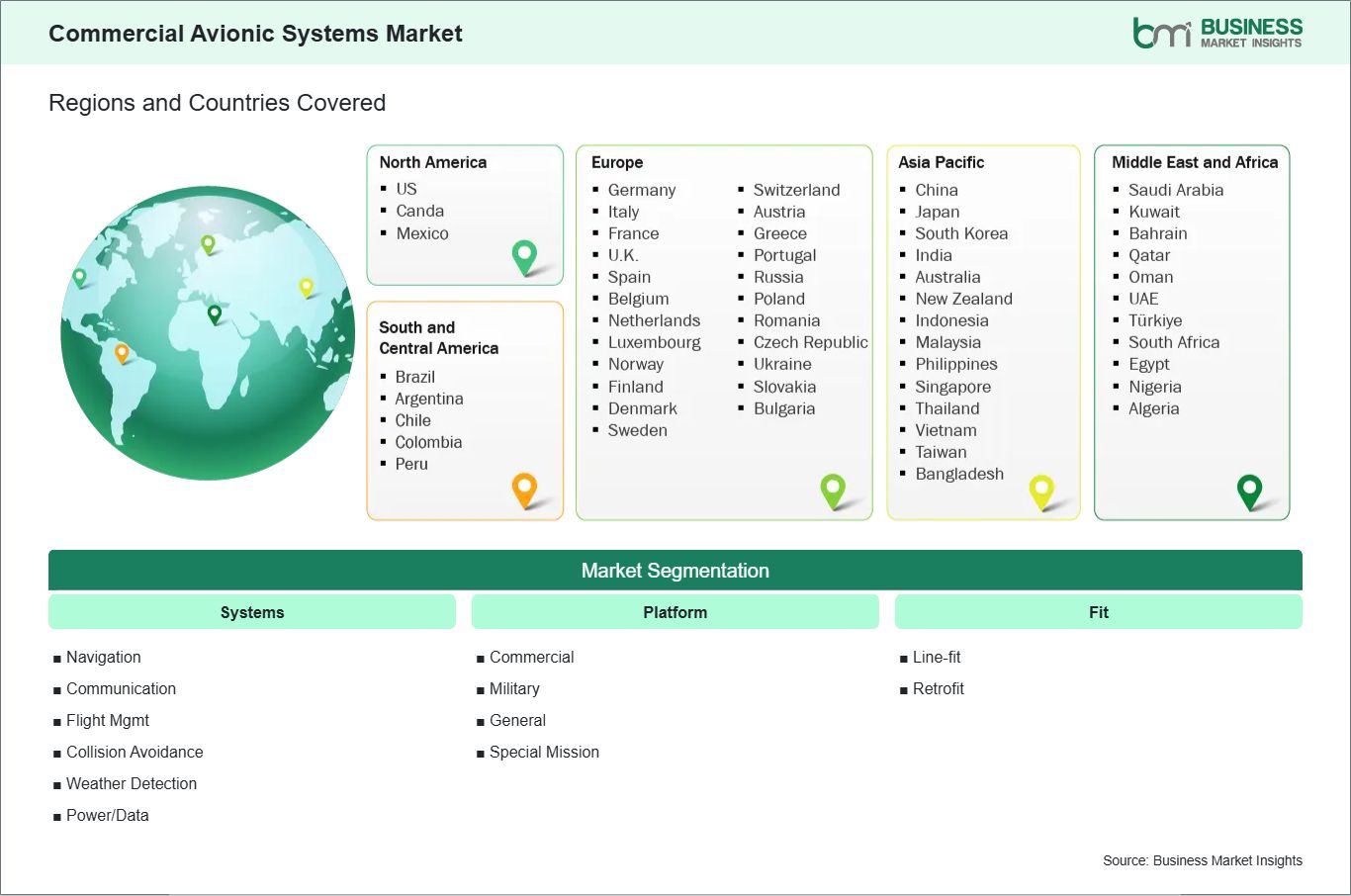
The commercial avionic systems market is segmented based on systems, platform, and fit, reflecting the aviation industry's transition toward integrated digital operations and connected aircraft ecosystems.
By Systems
- Navigation: Satellite-based solutions enhance route precision and flight efficiency.
- Communication: Digital protocols ensure secure and uninterrupted cockpit-ground connectivity.
- Flight Management: Automated systems optimize fuel usage and performance monitoring.
- Collision Avoidance: Integrated sensors reduce mid-air risk and improve safety margins.
- Weather Detection: Advanced radar supports proactive route adjustments during adverse conditions.
- Power/Data: Reliable infrastructure enables seamless avionics synchronization and data flow.
By Platform
- Commercial: Airlines emphasize operational efficiency and compliance with global standards.
- Military: Defense programs require mission-specific avionics with secure communication.
- General: Private operators adopt systems for safety and navigation reliability.
- Special Mission: Customized solutions support surveillance, rescue, and specialized operations.
By Fit
- Line-fit: Factory-installed systems ensure standardized integration in new aircraft.
- Retrofit: Modernization solutions extend digital capabilities across existing fleets.
Market Forces
Commercial Avionic Systems Market Drivers and Opportunities
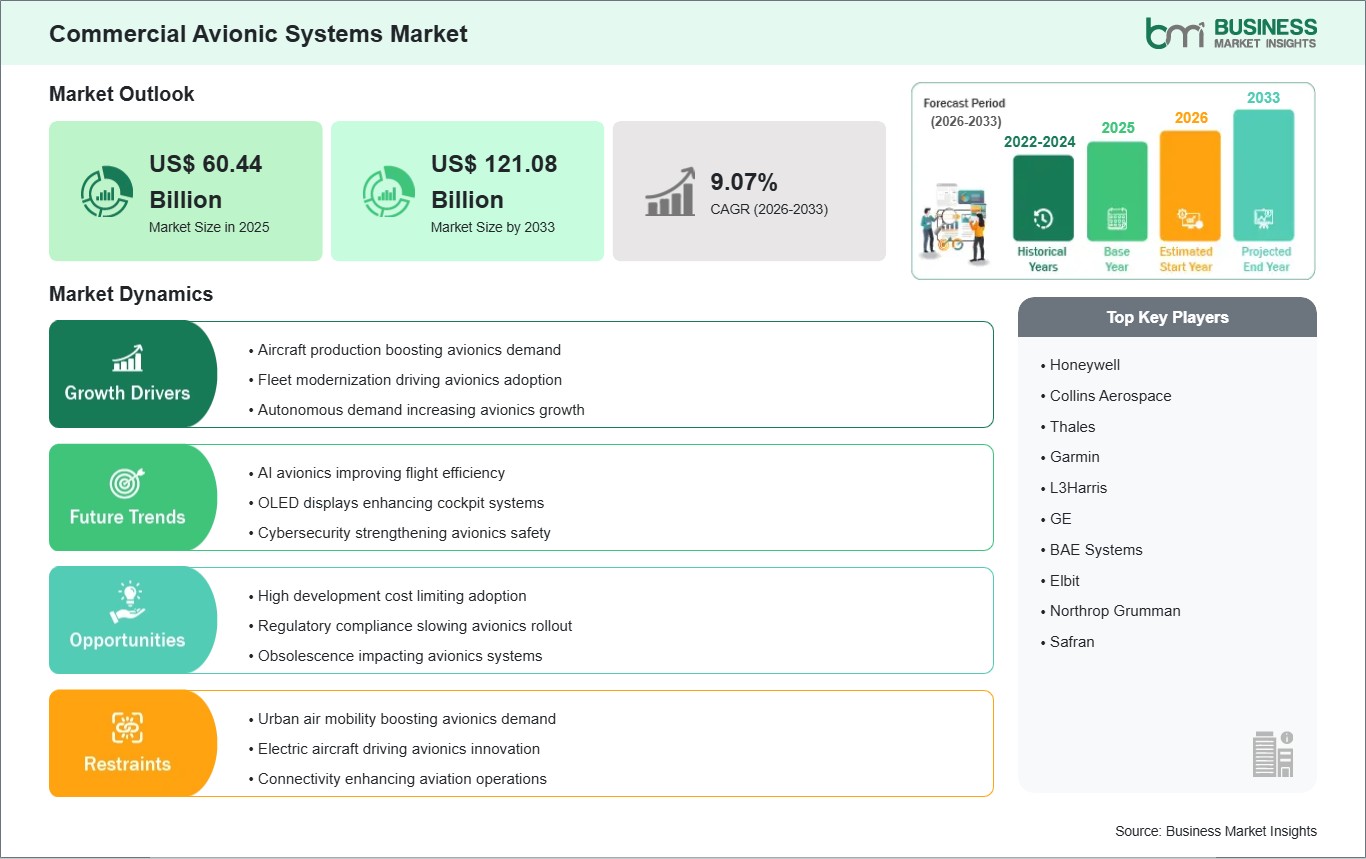
Aircraft production boosting avionics demand
Increased production of aircraft worldwide has led to increased demand for avionics systems, as manufacturers install them in new aircraft in order to fulfill regulations and ensure the proper functioning of those aircraft. Increased deliveries of various aircraft models have shown how important standard avionics systems have become because of the requirement to ensure safety and efficiency in different conditions. Thus, the importance of avionics systems is related to the growing industry focus on digital equipment that becomes the basis of modern airplanes.
The driver under analysis plays an important role in regulatory and technological spheres. On the one hand, authorities require compliance with updated safety standards, which require installing new avionics systems. On the other hand, technological progress makes the integration of such systems easier. Therefore, the importance of the considered driver is determined by the opportunity to link the industry development and operations.
Urban air mobility boosting avionics demand
Urban air mobility initiatives present new opportunities for avionic system deployment. Emerging concepts such as electric vertical takeoff and landing aircraft require advanced navigation, communication, and collision avoidance technologies to operate safely in dense urban environments. Innovations in compact, lightweight avionics support these platforms, enabling efficient integration without compromising performance. This trend highlights the adaptability of avionic systems to new aviation paradigms.
Future scope for urban air mobility includes expanded deployment across metropolitan regions, supporting passenger transport and logistics. Long-term impact will be seen in enhanced connectivity, reduced congestion, and sustainable operations. Avionic systems will serve as critical enablers of these initiatives, ensuring safe integration into existing airspace and reinforcing their strategic importance in shaping the future of aviation.
Size and Share Analysis
Commercial Avionic Systems Market Size and Share Analysis
The Commercial Avionic Systems Market is projected to grow from US$ 60.44 Billion in 2025 to US$ 121.08 Billion by 2033 , registering a CAGR of 9.07% from 2026 to 2033.
By systems, communication accounts for a significant share due to the critical need for continuous, real-time connectivity between aircraft and ground control, especially for safe and efficient flight operations. The rise of satellite-based communication, air traffic modernization, and increasing adoption of connected aircraft technologies further strengthens their role as a core avionics function.
By platform, commercial aviation dominates because it represents the largest operational aircraft fleet globally, with consistently high aircraft deliveries driven by rising passenger air travel demand. Airlines increasingly invest in advanced avionics to enhance safety, optimize flight operations, reduce fuel consumption, and comply with evolving international aviation regulations.
By fit, line-fit leads the market as avionics systems are increasingly integrated during aircraft manufacturing to ensure seamless compatibility, lower installation costs, and full regulatory certification compliance. Growing aircraft production rates and the shift toward next-generation digital avionics architectures further reinforce preference for OEM-installed systems over aftermarket retrofits.
Report Coverage
Commercial Avionic Systems Market Report Coverage and Deliverables
The "Commercial Avionic Systems Market Size and Forecast (2022–2033)" report provides a detailed analysis of the market covering below areas:
- The market size and forecast at global, regional, and country levels for all market segments covered under the scope
- The market trends, as well as drivers, restraints, and opportunities
- The market analysis covering key trends, global and regional framework, major players, regulations, and recent developments
- Industry landscape and competition analysis covering market concentration, heat map analysis, prominent players, and recent developments for the market
- Detailed company profiles, including SWOT analysis
Geographic Insights
Commercial Avionic Systems Market Geographic Insights
There are varied regional trends of adoption for commercial avionic systems that depend on several factors, including regulations and operational needs within different sectors of aviation. The trends of adoption within North America are influenced by regulatory incentives and the presence of significant commercial fleets. In the U.S. and Canada, commercial airlines focus on meeting regulatory requirements for digital documentation while incorporating avionics systems within the cockpit. This is also true for military aviation sectors, which have an emphasis on mission-specific avionics.
The Asia Pacific region is characterized by fast growth due to fleet growth and development in states such as China, India, and Japan. In this region, airline operations revolve around efficiency and cost-effectiveness, hence a major market for avionic systems. Military aviation in this region relies heavily on these systems due to secure communication and missions. Digital transformation in this region is supported economically, making these systems relevant.
The European market is already advanced and influenced by regulations and initiatives for sustainability. Airlines operating in European countries like Germany, France, and the United Kingdom incorporate these systems to ensure efficiency and transparency. Operators from business aviation seek customization while military aviation focuses on interoperability. Environmental responsibility in the region favors the adoption of these systems to minimize paperwork and ensure efficiency.
New markets in Latin America, the Middle East, and Africa exhibit potential through the adoption of these systems. Countries like Brazil, the United Arab Emirates, and South Africa benefit from the digital transformation of operations. Despite varying levels of adoption in these regions, the future holds great promise. The global landscape reflects a dynamic balance between established hubs and emerging economies, positioning avionic systems as integral components of aviation's digital future.
Industry Activity
Recent Developments
The commercial avionic systems market is evaluated by gathering qualitative and quantitative data post primary and secondary research, which includes important corporate publications, association data, and databases. A few of the key developments in the commercial avionic systems market are:
- In April 2024, Thales Group announced that it had completed the acquisition of Cobham Aerospace Communications, strengthening its avionics portfolio in connected cockpit communications and integrated commercial aviation systems.
- In July 2024, Honeywell Aerospace announced that United Airlines selected its advanced avionics suite, including 3D weather radar, flight data recorders, and traffic avoidance systems, for new Boeing 737 MAX aircraft entering service over the next decade.
Trust & Transparency
Research Methodology
The market analysis combines proprietary research with secondary data from government agencies, company disclosures, regulatory filings, industry databases and expert interviews. Market estimates are validated through data triangulation, cross-market benchmarking and analyst
review.
View Full Research Methodology
Key Sources Referred:
Federal Aviation Administration (FAA) European Union Aviation Safety Agency (EASA) International Civil Aviation Organization (ICAO) Radio Technical Commission for Aeronautics (RTCA) European Organisation for Civil Aviation Equipment (EUROCAE) Company Websites Company Annual Reports Company Investor Presentations