Commercial Electronic Flight Bag Market Outlook: Size, Share, Trends, Growth Analysis, Competitive Landscape & Forecast, 2026-2033

Historic Data: 2022-2024   |   Base Year: 2025   |   Forecast Period: 2026-2033
Report Content: Market Scope, Market Segmentation, Market Dynamics, and Competitive Analysis

Report Coverage:
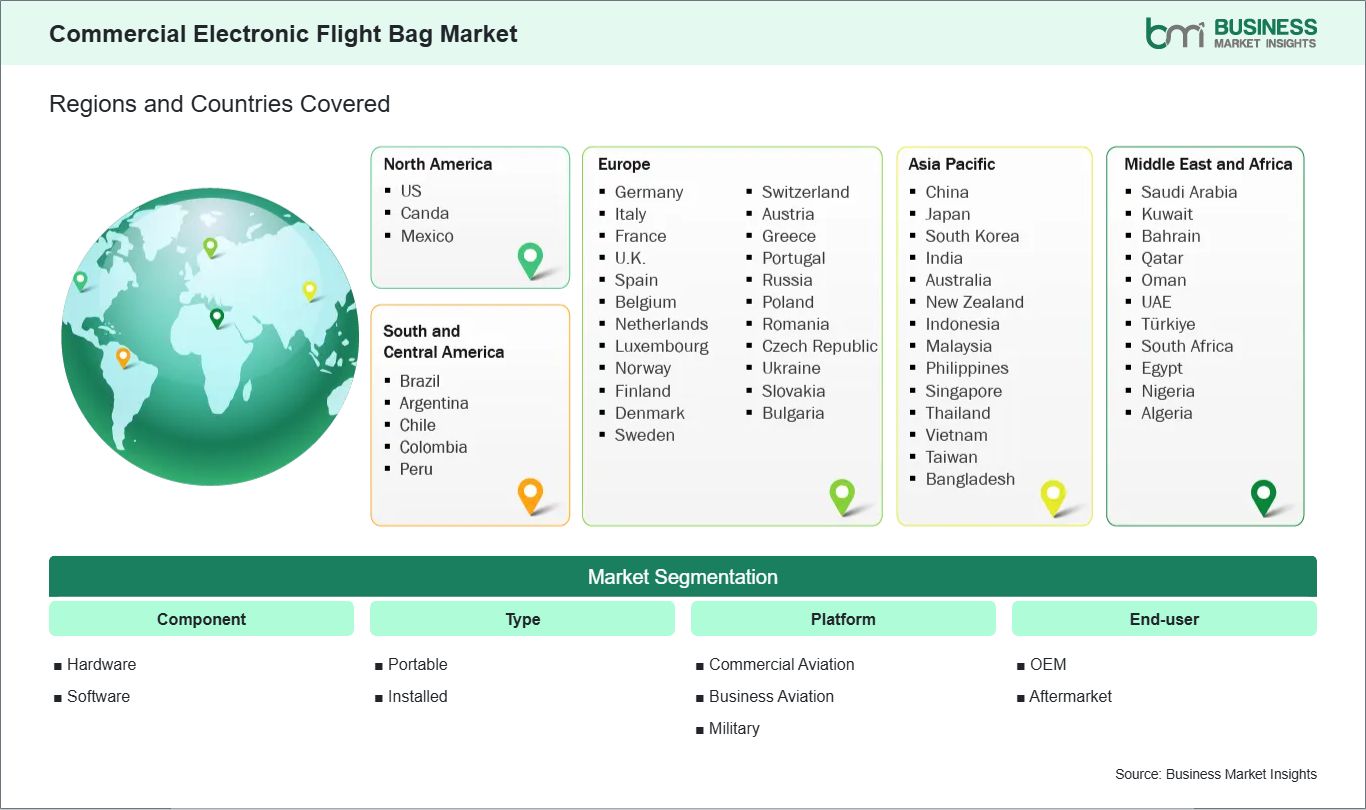
  • Component (Hardware, Software)
  • Type (Portable (Class 1, 2), Installed (Class 3))
  • Platform (Commercial Aviation, Business Aviation, Military)
  • End-user (OEM, Aftermarket)

No. of Pages: 400
Report Code: BMIPUB00035337
Category: Aerospace and Defense
Commercial Electronic Flight Bag Market

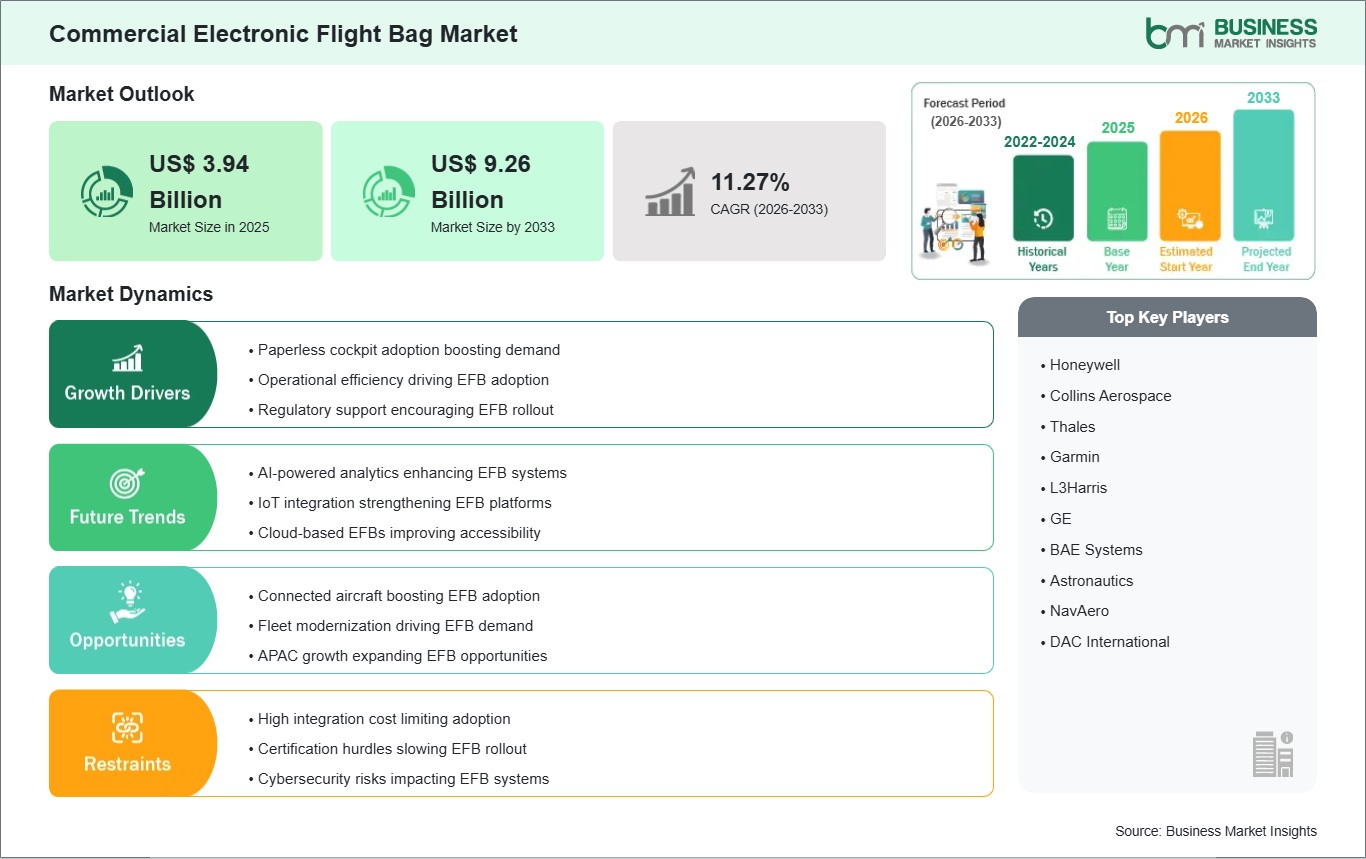
The Commercial Electronic Flight Bag Market size is expected to reach US$ 9.26 Billion by 2033 from US$ 3.94 Billion in 2025.The market is estimated to record a CAGR of 11.27% from 2026 to 2033.

Executive Summary and Global Market Analysis:

Electronic flight bag systems are digital tools that replace paper flight manuals, navigation charts, and other documents in aircraft. They give pilots and crews easy access to flight planning, analytics, weather updates, and performance apps. The industry is moving toward integrated cockpit systems that focus on accuracy and real-time information. Airlines and aviation authorities are pushing for more digital cockpit technology to make operations smoother and reduce paperwork.

Operators now look for solutions that boost situational awareness, cut down on manual paperwork, and help with quicker pre-flight decisions. More aircraft deliveries, modernization, and a focus on fuel efficiency are driving demand in both commercial and business aviation. Within the market, software platforms maintain substantial utilization because airlines require continuously updated navigation databases, performance applications, and operational management tools. Portable electronic flight bag systems remain widely deployed due to lower integration complexity and operational flexibility.

Commercial aviation platforms continue representing a key implementation area as carriers seek enhanced operational coordination across expanding route networks. Technological advancement within this sector increasingly centers on cloud synchronization, cybersecurity reinforcement, and real-time cockpit connectivity. Installed Class 3 systems are gaining strategic relevance because they integrate directly with onboard avionics and aircraft communication infrastructure. Integration between flight bag software and airline operational control systems has also accelerated digital workflow alignment throughout aviation operations.

Competition in this market depends on reliable software, aviation certifications, and strong service integration. Companies are working to improve user interfaces, boost data security, and add more analytics-based support tools. Partnerships between avionics companies, software developers, and aircraft makers are helping create more connected aviation information systems.

Commercial Electronic Flight Bag Market - Strategic Insights:

global-market-strategic-framework
Get more information on this report

Commercial Electronic Flight Bag Market Segmentation Analysis:

The commercial electronic flight bag market is segmented based on component, type, platform, and end-user, reflecting the aviation industry transition toward digitally integrated cockpit operations and connected flight management systems.

By Component

  • Hardware: Rugged cockpit devices support uninterrupted operational accessibility during flight operations.
  • Software: Digital applications improve navigation management and performance calculation accuracy.

By Type

  • Portable (Class 1, 2): Flexible deployment models simplify operational integration across mixed aircraft fleets.
  • Installed (Class 3) : Embedded cockpit systems enhance avionics synchronization and data continuity.

By Platform

  • Commercial Aviation: Airlines prioritize digital workflow optimization and operational coordination capabilities.
  • Business Aviation: Corporate operators emphasize mobility and customized flight management functions.
  • Military: Defense aviation programs require mission-focused operational information systems.

By End-user

  • OEM: Factory-integrated systems support standardized cockpit technology deployment.
  • Aftermarket: Retrofit solutions enable digital modernization across existing aircraft fleets.

Commercial Electronic Flight Bag Market Drivers and Opportunities:

Paperless cockpit adoption boosting demand

The shift to paperless cockpits is a major factor driving the electronic flight bag market. Airlines are swapping out paper manuals, charts, and flight documents for digital tools that make operations more efficient and reduce paperwork. Electronic flight bag systems let pilots access real-time flight info, weather, performance data, and route planning all in one place. This change cuts down on bulky paper in the cockpit and makes it easier for crews to manage information. Airlines also want to lower aircraft weight for better fuel efficiency, and using electronic systems instead of paper helps achieve this.

Digital transformation programs for cockpits of commercial airlines are increasingly being developed to improve communications, compliance management, and the safety of flights. The use of the electronic flight bag technology helps update flight and operation manuals rapidly and ensures standardization of procedures by airlines operating globally. Due to the increased use of efficient flight operations and improved situational awareness, airlines are encouraged to adopt advanced electronic flight bags that can be portable or installed within aircraft. In addition, integration of the system with avionics, airport databases, and airline operations systems enhances decision-making processes while flights are ongoing.

Connected aircraft boosting EFB adoption

The growth of connected aircraft systems is opening up big opportunities for the electronic flight bag market. Airlines are using more connected aviation technology, which allows constant communication between planes, operations centers, maintenance teams, and airports. Electronic flight bag platforms use these connections to give pilots and crews real-time data, analytics, weather updates, fuel-saving tips, and maintenance alerts. This better data sharing helps with more accurate flight planning and smoother operations across airline networks.

Connected aircraft systems also let electronic flight bag platforms offer advanced digital services like electronic logbooks, live airport navigation, automated reports, and cloud document syncing. More airlines are using satellite communications, onboard Wi-Fi, and aviation data platforms, which make electronic flight bag solutions more powerful and flexible. Airlines want digital systems that bring together efficient operations, passenger service, and maintenance in one connected setup. This is pushing tech companies to build smarter, more compatible electronic flight bag platforms for the future. As airlines invest in smart aviation and digital upgrades, there will be more long-term opportunities for connected electronic flight bag technologies.

Commercial Electronic Flight Bag Market Size and Share Analysis:

The Commercial Electronic Flight Bag Market is projected to grow from US$ 3.94 Billion in 2025 to US$ 9.26 Billion by 2033 , registering a CAGR of 11.27% from 2026 to 2033.

By component, the hardware dominates the market due to increasing deployment of cockpit tablets, mounting systems, display units, and onboard connectivity devices across airline fleets to support digital flight operations and improve pilot accessibility to operational data.

By type, the portable leads the market owing to its lower installation cost, operational flexibility, faster regulatory approval process, and growing airline preference for lightweight portable devices that simplify navigation, flight planning, and performance calculations.

Commercial Electronic Flight Bag Market Report Highlights:

Report Attribute Details
Market size in 2025 US$ 3.94 Billion
Market Size by 2033 US$ 9.26 Billion
Global CAGR (2026 - 2033)11.27%
Historical Data 2022-2024
Forecast period 2026-2033
Segments Covered By Component
  • Hardware
  • Software
By Type
  • Portable
  • Installed
By Platform
  • Commercial Aviation
  • Business Aviation
  • Military
By End-user
  • OEM
  • Aftermarket
Regions and Countries Covered
North America US, Canada, Mexico
Europe Germany, Italy, France, U.K., Spain, Belgium, Netherlands, Luxembourg, Norway, Finland, Denmark, Sweden, Switzerland, Austria, Greece, Portugal, Russia, Poland, Romania, Czech Republic, Ukraine, Slovakia, Bulgaria
Asia-Pacific China, Japan, South Korea, India, Australia, New Zealand, Indonesia, Malaysia, Philippines, Singapore, Thailand, Vietnam, Taiwan, Bangladesh
South and Central America Brazil, Argentina, Chile, Colombia, Peru
Middle East and Africa Saudi Arabia, United Arab Emirates, Kuwait, Bahrain, Qatar, Oman, Turkiye, South Africa, Egypt, Nigeria, Algeria
Market leaders and key company profiles
  • Honeywell
  • Collins Aerospace
  • Thales
  • Garmin
  • L3Harris
  • GE
  • BAE Systems
  • Astronautics
  • NavAero
  • DAC International
Get more information on this report

Commercial Electronic Flight Bag Market Report Coverage and Deliverables:

The "Commercial Electronic Flight Bag Market Size and Forecast (2022-2033)" report provides a detailed analysis of the market covering below areas:

  • The market size and forecast at the regional and country levels for segments covered under the scope
  • The market trends, as well as drivers, restraints, and opportunities
  • The market analysis covering key trends, regional framework, major players, regulations, and recent developments
  • Industry landscape and competition analysis covering market concentration, heat map analysis, prominent players, and recent developments for the market
  • Detailed company profiles, including SWOT analysis

Commercial Electronic Flight Bag Market Geographic Insights:

The Commercial Electronic Flight Bag market shows diverse regional adoption patterns influenced by aviation modernization priorities, aircraft fleet expansion, regulatory compliance requirements, and digital cockpit integration strategies. Aviation operators across developed and emerging economies continue transitioning toward connected operational environments emphasizing real-time flight information accessibility and streamlined cockpit workflows. Integration between electronic flight bag systems and airline operational infrastructure remains a major focus area across global aviation markets.

North America is positioned strongly owing to well-developed aviation infrastructure, numerous airlines, and consistent investments in new cockpit technology. Digital operational platforms have been consistently incorporated by commercial airlines and private aircraft operating within North America in order to coordinate flights better, streamline route planning, and manage regulatory documentation. Active involvement of providers of avionics technology is another significant contributing factor to continued platform innovations and software integration.

The Asia Pacific market shows growing implementation momentum driven by an increase in procurement of new aircraft, development of aviation infrastructure, and rising volume of regional air traffic operations. The airlines operating in this region are upgrading their operational systems to enhance efficiency in the cockpit and advance other digital initiatives. The growth in operations of low-cost carriers, together with fleet expansions, is providing positive dynamics for the deployment of portable and installed electronic flight bags.

In Europe, there are defined adoption trends influenced by strict aviation compliance regulations, sustainable aviation policies, and efficient air traffic management systems. Increasingly, airline operators are looking for cockpit systems that would help them optimize their operations and synchronize data securely. Aviation markets in the Middle East, Africa, and South America are also showing rising adoption trends due to continued fleet modernization and airport infrastructure development programs.

global-market-geography
Get more information on this report

Commercial Electronic Flight Bag Market Research Report Guidance:

  • The report includes qualitative and quantitative data for the Commercial Electronic Flight Bag market across component, type, platform, end-user, and geography.
  • The report starts with the key takeaways (chapter 2), highlighting the key trends and outlook of the Commercial Electronic Flight Bag market.
  • Chapter 3 focuses on the research methodology of the study.
  • Chapter 4 includes ecosystem analysis.
  • Chapter 5 highlights the major industry dynamics in the Commercial Electronic Flight Bag market, including factors that are driving the market, prevailing deterrents, potential opportunities, as well as future trends. Impact analysis of these drivers and restraints is also covered in this section.
  • Chapter 6 discusses the Commercial Electronic Flight Bag market scenario, in terms of historical market revenues, and forecast till the year 2033.
  • Chapters 7 to 11 cover the Commercial Electronic Flight Bag market segments by component, type, platform, end-user, and geography across North America, Europe, Asia Pacific, the Middle East and Africa, and South and Central America. They cover the market revenue, forecast, and factors driving the market.
  • Chapter 12 describes the competitive analysis along with the heat map analysis for the key players operating in the market.
  • Chapter 13 describes the industry landscape analysis. It provides detailed descriptions of business activities such as market initiatives, new developments, mergers, and joint ventures globally, along with a competitive landscape.
  • Chapter 14 provides detailed profiles of the major companies operating in the Commercial Electronic Flight Bag market. Companies have been profiled on the basis of their key facts, business descriptions, products, financial overview, SWOT analysis, and key developments.
  • Chapter 15, i.e., the appendix, is inclusive of a brief overview of the company, list of abbreviations, and disclaimer.

Commercial Electronic Flight Bag Market News and Key Development:

The commercial electronic flight bag market is evaluated by gathering qualitative and quantitative data post primary and secondary research, which includes important corporate publications, association data, and databases. A few of the key developments in the commercial electronic flight bag market are:

  • In February 2024, Collins Aerospace announced that it had been selected by Air India to provide advanced avionics hardware for 140 Boeing 737 MAX aircraft, supporting enhanced cockpit digitization and Electronic Flight Bag (EFB)-enabled operational efficiency for the airline expanding fleet.
  • In December 2023, Honeywell Aerospace announced that Boom Supersonic selected the Honeywell Anthem integrated flight deck for its Overture aircraft program, incorporating next-generation connected cockpit and EFB-compatible avionics technologies to improve pilot situational awareness and flight operations.
  • In May 2023, Honeywell Aerospace announced the successful first flight managed entirely by its Honeywell Anthem integrated flight deck, a cloud-connected cockpit platform designed to support advanced digital flight operations and Electronic Flight Bag functionalities across commercial and business aviation aircraft.

Key Sources Referred:

  • International Air Transport Association (IATA)
  • International Civil Aviation Organization (ICAO)
  • Federal Aviation Administration (FAA)
  • European Union Aviation Safety Agency (EASA)
  • Civil Aviation Administration of China (CAAC)
  • Directorate General of Civil Aviation (DGCA)
  • Japan Civil Aviation Bureau (JCAB)
  • Company Websites
  • Company Annual Reports
  • Company Investor Presentations
The List of Companies - Commercial Electronic Flight Bag Market
  • Honeywell
  • Collins Aerospace
  • Thales
  • Garmin
  • L3Harris
  • GE
  • BAE Systems
  • Astronautics
  • NavAero
  • DAC International
Frequently Asked Questions
How big is the Commercial Electronic Flight Bag Market?

The Commercial Electronic Flight Bag Market is valued at US$ 3.94 Billion in 2025, it is projected to reach US$ 9.26 Billion by 2033.

What is the CAGR for Commercial Electronic Flight Bag Market by (2026 - 2033)?

As per our report Commercial Electronic Flight Bag Market, the market size is valued at US$ 3.94 Billion in 2025, projecting it to reach US$ 9.26 Billion by 2033. This translates to a CAGR of approximately 11.27% during the forecast period.

What segments are covered in this report?

The Commercial Electronic Flight Bag Market report typically cover these key segments-

  • Component (Hardware, Software)
  • Type (Portable (Class 1, 2), Installed (Class 3))
  • Platform (Commercial Aviation, Business Aviation, Military)
  • End-user (OEM, Aftermarket)

What is the historic period, base year, and forecast period taken for Commercial Electronic Flight Bag Market?

The historic period, base year, and forecast period can vary slightly depending on the specific market research report. However, for the Commercial Electronic Flight Bag Market report:

  • Historic Period : 2022-2024
  • Base Year : 2025
  • Forecast Period : 2026-2033
  • Who are the major players in Commercial Electronic Flight Bag Market?

    The Commercial Electronic Flight Bag Market is populated by several key players, each contributing to its growth and innovation. Some of the major players include:

  • Honeywell
  • Collins Aerospace
  • Thales
  • Garmin
  • L3Harris
  • GE
  • BAE Systems
  • Astronautics
  • NavAero
  • DAC International
  • Who should buy this report?

    The Commercial Electronic Flight Bag Market report is valuable for diverse stakeholders, including:

    • Investors: Provides insights for investment decisions pertaining to market growth, companies, or industry insights. Helps assess market attractiveness and potential returns.
    • Industry Players: Offers competitive intelligence, market sizing, and trend analysis to inform strategic planning, product development, and sales strategies.
    • Suppliers and Manufacturers: Helps understand market demand for components, materials, and services related to concerned industry.
    • Researchers and Consultants: Provides data and analysis for academic research, consulting projects, and market studies.
    • Financial Institutions: Helps assess risks and opportunities associated with financing or investing in the concerned market.

    Essentially, anyone involved in or considering involvement in the Commercial Electronic Flight Bag Market value chain can benefit from the information contained in a comprehensive market report.

    Available Report Formats

    pdf-format excel-format pptx-format
    Buy Now
    Sales Assistance
    +1 646 791 7070 (US & UK)
    Customization Form

    Please tell us your area of interest
    (Market Segments/ Regions and Countries/ Companies)