
Flight Navigation System Market Outlook: Size, Share, Trends, Growth Analysis, Competitive Landscape & Forecast, 2026-2033

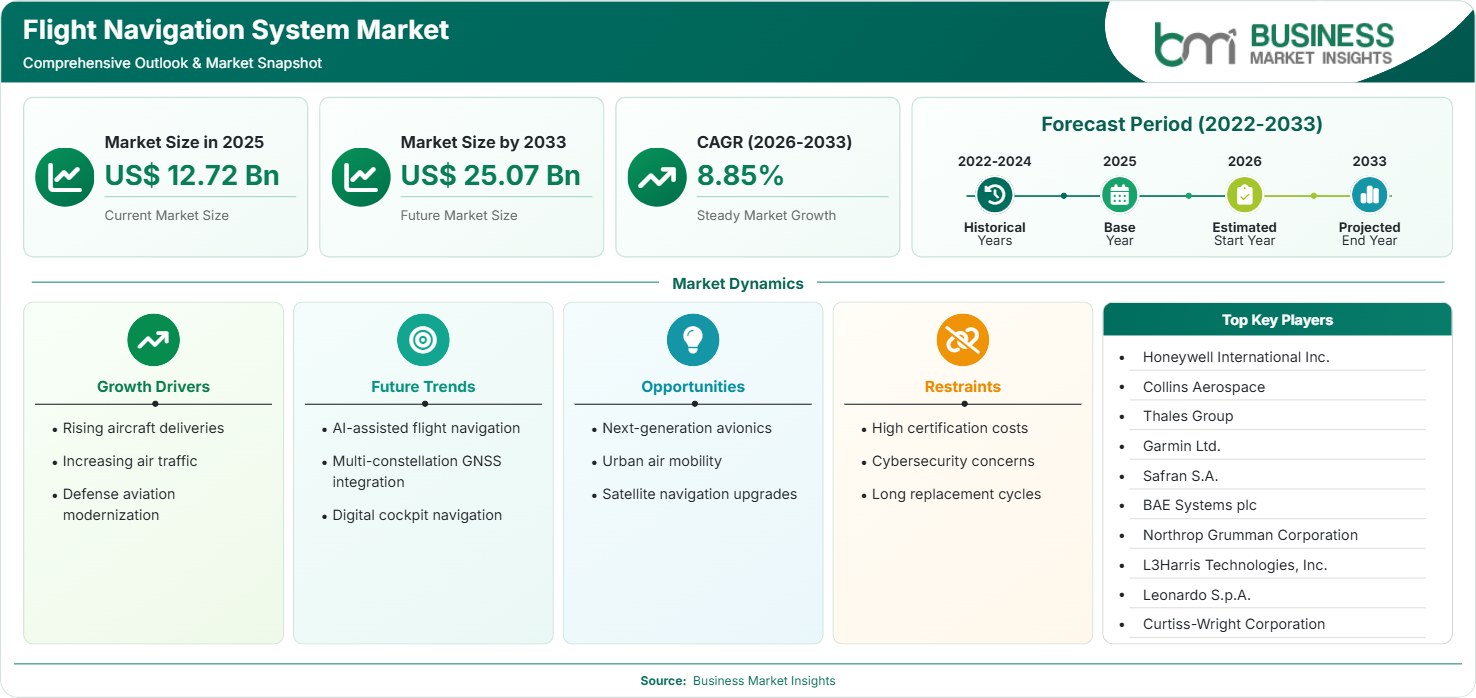
The Flight Navigation System Market size was valued at US$ 12.72 billion in 2025 and is projected to reach US$ 25.07 billion by 2033, growing at a CAGR of 8.85% during 2026–2033, driven by rising aircraft deliveries, increasing air traffic, defense aviation modernization, next-generation avionics adoption, and satellite navigation upgrades.

Report Coverage
  • Component: Autopilot, Altimeter, Gyroscope, Sensors, Others
  • Subsystem: Inertial Navigation System, Global Positioning System, Flight Management System, Flight Control System, Communication System, Others
  • Platform: Commercial Aircraft, Helicopter, Military Aircraft, UAV
  • End Users: Civil, Commercial, Military
US$ 12.72 Bn Market size in 2025
US$ 25.07 Bn Market Size by 2033
8.85% CAGR, 2026 - 2033
2026-2033 Forecast Period

01 AI Overview

Flight Navigation System Market Summary

  • North America Region: North America holds a 36%–39% share in 2025, growing at a CAGR of 8.2%–8.8% due to advanced aerospace manufacturing, military aviation investments, and commercial fleet modernization. The US market demonstrates a CAGR of 8.3%–8.7% during 2026–2033, supported by defense procurement, avionics upgrades, and aircraft replacement programs.
  • Fastest Growing Region: Asia Pacific accounts for a 25%–28% share in 2025, expanding at a CAGR of 9.6%–10.4% due to commercial aviation expansion, airport infrastructure development, rising aircraft procurement, and increasing defense modernization initiatives across emerging economies, promoting flight navigation system market growth.
  • Leading Segment: Commercial Aircraft holds a 42%–46% share in 2025, growing at a CAGR of 8.6%–9.1% due to airline fleet expansion, passenger traffic growth, and increasing demand for advanced navigation and flight management technologies.
  • High Growth Segment: UAV platforms are advancing at a CAGR of 10.5%–11.5% during 2026–2033, supported by defense applications, autonomous flight development, surveillance missions, and expanding commercial drone operations.
  • Key Market Opportunity: The market opportunity is driven by next-generation avionics, urban air mobility platforms, satellite navigation improvements, autonomous aircraft technologies, and increasing integration of digital flight control systems.
  • Major Market Players: Honeywell International Inc., Collins Aerospace, Thales Group, Garmin Ltd., Safran S.A., BAE Systems plc, Northrop Grumman Corporation, L3Harris Technologies, Inc., Leonardo S.p.A., Curtiss-Wright Corporation.
02 Strategic Insights

Flight Navigation System Market: Strategic Insights

Flight Navigation System Market Strategic Framework
FREE PDF
Request your free sample
Request free sample
03 Stakeholder View

Key Takeaways

  • The aviation navigation ecosystem is shifting toward integrated avionics architectures that combine sensors, satellite navigation, flight management systems, and automated control technologies to improve aircraft efficiency and safety.
  • Commercial aircraft modernization represents a major growth avenue as airlines invest in upgraded avionics systems to improve operational performance, fuel efficiency, and route optimization.
  • Navigation technology innovation is increasingly focused on artificial intelligence, multi-sensor fusion, resilient positioning systems, and autonomous flight capabilities for future aviation platforms.
  • Asia Pacific presents strong investment potential due to expanding airline fleets, increasing aircraft deliveries, and government-backed aerospace development programs in China, India, and Southeast Asia.
  • Strategic partnerships, defense contracts, and avionics modernization programs are shaping competitive positioning among established aerospace technology providers.
04 Geographic Outlook

Flight Navigation System Market Regional Highlights

North America Flight Navigation System Market

North America represented a 36%–39% share in 2025 and is projected to expand at a CAGR of 8.2%–8.8% between 2026–2033. The region maintains leadership due to established aerospace manufacturers, advanced defense aviation programs, and strong commercial aircraft demand. The Flight Navigation System Market share is supported by significant investments in avionics upgrades, military modernization, and next-generation aircraft development across the United States and Canada.

  • The United States drives regional demand through defense aviation programs, commercial fleet modernization, and advanced avionics development.
  • Aerospace manufacturers invest in integrated navigation systems supporting new-generation aircraft platforms and operational efficiency improvements.
  • Defense agencies prioritize resilient navigation technologies for military aircraft and unmanned aviation applications.
  • Canada contributes through commercial aviation expansion and aerospace technology development initiatives.

US Flight Navigation System Market

The US market accounted for a 31%–34% share in 2025 and is forecast to grow at a CAGR of 8.3%–8.7% during 2026–2033. The country remains a major contributor due to strong aerospace manufacturing capabilities, defense spending, and commercial aviation activity. Demand is supported by aircraft modernization programs, military procurement, and increasing adoption of advanced navigation technologies.

  • Defense modernization programs accelerate demand for precision navigation systems across military aircraft platforms.
  • Commercial airlines upgrade avionics systems to improve operational efficiency and regulatory compliance.
  • Aerospace technology companies expand research activities focused on autonomous and digital navigation solutions.

Europe Flight Navigation System Market

Europe accounted for a 27%–30% share in 2025 and is expected to grow at a CAGR of 7.8%–8.5% from 2026–2033. Germany, France, and the United Kingdom represent key markets supported by aerospace manufacturing capabilities and defense aviation investments. European aircraft programs increasingly emphasize advanced navigation systems, satellite integration, and improved flight safety technologies.

  • France supports market development through aerospace manufacturing and defense aviation modernization programs.
  • Germany contributes through aircraft production capabilities and advanced avionics engineering expertise.
  • The United Kingdom invests in military aviation technologies and next-generation navigation solutions.
  • European aviation regulations encourage adoption of reliable and efficient navigation systems.

Asia Pacific Flight Navigation System Market

Asia Pacific represented a 25%–28% share in 2025 and is projected to expand at a CAGR of 9.6%–10.4% during 2026–2033. The region is the fastest-growing market due to increasing aircraft procurement, expanding passenger traffic, airport infrastructure development, and defense aviation modernization. China, India, Japan, and Southeast Asian economies are strengthening aerospace capabilities and increasing investments in advanced navigation technologies for commercial and military platforms.

  • China drives regional demand through commercial aircraft expansion, domestic aerospace programs, and military aviation modernization initiatives.
  • India supports growth through airline fleet expansion, defense procurement, and indigenous aerospace development programs.
  • Japan contributes through advanced aircraft technologies, satellite navigation integration, and aviation safety investments.
  • Southeast Asian countries increase adoption through airport development, airline growth, and regional connectivity improvements.

Rest of World Flight Navigation System Market

Rest of World accounted for a 7%–10% share in 2025 and is expected to grow at a CAGR of 8.5%–9.3% between 2026–2033. Latin America, the Middle East, and Africa are experiencing increasing demand through aviation infrastructure development, defense modernization, and commercial fleet expansion. Countries including Brazil, the UAE, and Saudi Arabia are strengthening aviation capabilities through aircraft investments and technology upgrades.

  • Brazil supports regional growth through commercial aviation expansion and aerospace manufacturing capabilities.
  • Middle Eastern countries invest in aviation infrastructure and defense systems requiring advanced navigation technologies.
  • Saudi Arabia and the UAE expand aircraft fleets and airport capabilities through long-term aviation strategies.
  • African aviation markets gradually adopt modern navigation solutions through connectivity and safety improvement programs.
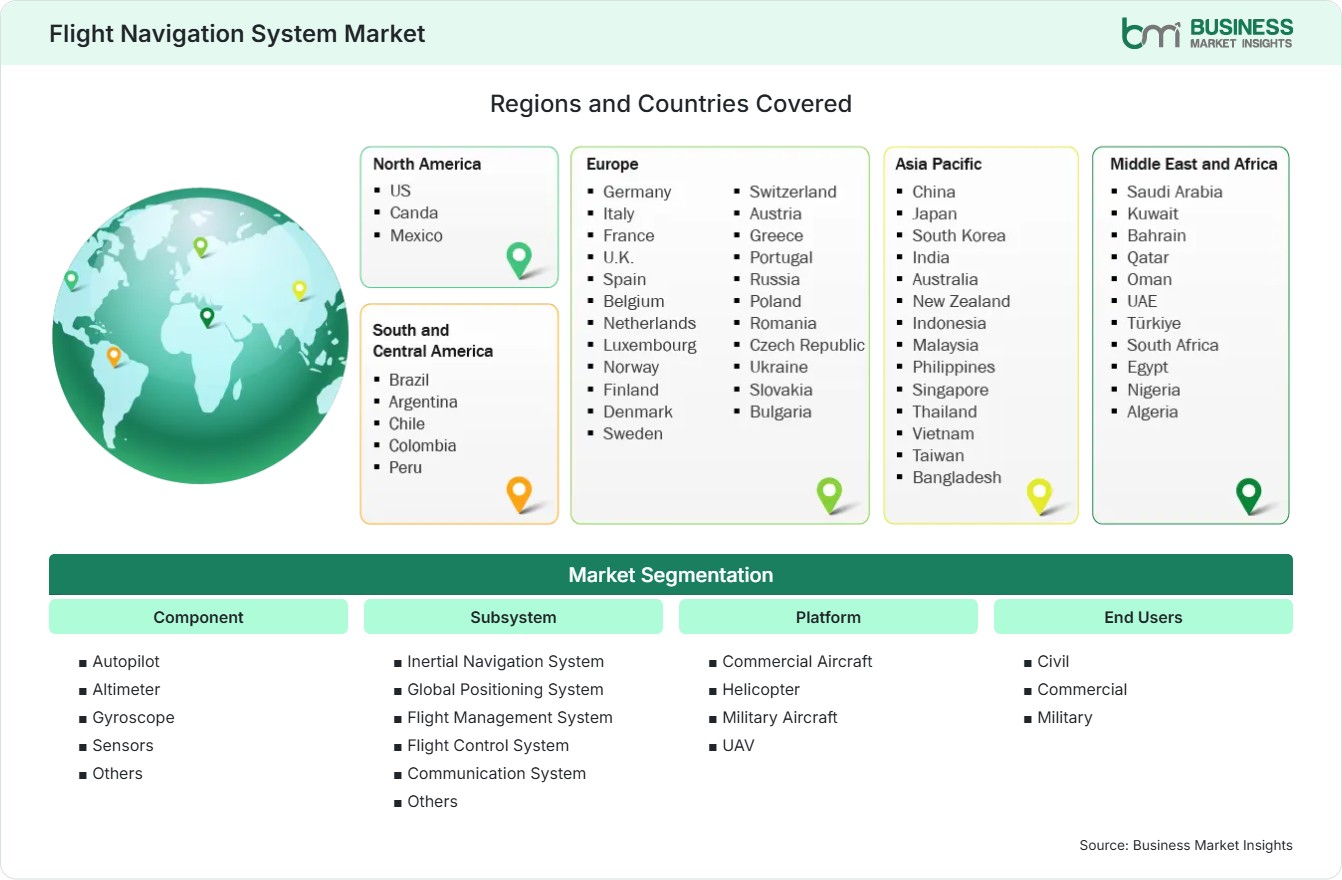
Global Market Geography
FREE PDF
Request your free sample
Request free sample
05 Segment Analysis

Flight Navigation System Market Segmentation

Component

Component segmentation in the flight navigation system market includes Autopilot, Altimeter, Gyroscope, Sensors, and Others. Navigation hardware components remain essential for aircraft safety, automation, and operational efficiency. Sensors and autopilot technologies are gaining importance due to increasing aircraft automation and autonomous flight development. The segment composition reflects rising demand for integrated avionics solutions, with the overall component category accounting for a 45%–48% share in 2025 and expanding at a CAGR of 8.7%–9.2% between 2026–2033.

  • Autopilot: Autopilot systems support automated flight operations, reducing pilot workload and improving aircraft stability across commercial and defense platforms.
  • Altimeter: Altimeters enable accurate altitude measurement and remain critical for flight safety, navigation precision, and aircraft operational control.
  • Gyroscope: Gyroscopes provide orientation and motion sensing capabilities, supporting inertial navigation, stabilization, and advanced flight control functions.
  • Sensors: Sensors enable real-time aircraft data collection, supporting navigation accuracy, system integration, and enhanced situational awareness.

Subsystem

Subsystem segmentation in the flight navigation system market includes Inertial Navigation System (INS), Global Positioning System (GPS), Flight Management System (FMS), Flight Control System, Communication System, and Others. Advanced navigation subsystems are increasingly integrated to improve accuracy, automation, and operational reliability. Flight Management Systems and GPS-based solutions benefit from airline modernization programs, while INS remains essential for military and commercial aviation requiring independent navigation capabilities.

  • Inertial Navigation System (INS): INS provides autonomous navigation capabilities through motion sensing technologies, supporting aircraft operations where external signals are limited.
  • Global Positioning System (GPS): GPS systems deliver satellite-based positioning information, improving route accuracy, navigation efficiency, and operational reliability.
  • Flight Management System (FMS): FMS optimizes flight planning, navigation management, fuel efficiency, and automated aircraft operations.
  • Flight Control System: Flight control systems manage aircraft movement and stability through integrated control technologies and automated functions.
  • Communication System: Communication systems support aircraft connectivity, navigation data exchange, and coordination with ground-based aviation networks.

Platform

Platform segmentation includes Commercial Aircraft, Helicopter, Military Aircraft, and UAVs. Commercial aircraft form the largest platform segment with a market share of 42% to 46% by 2025 and will be growing at a CAGR of 8.6% to 9.1% till 2033. UAV platforms have been exhibiting higher growth because of their use for defense purposes, automation, surveillance, and commercial drones.

  • Commercial Aircraft: Commercial aircraft demand increases through airline fleet expansion, passenger growth, and avionics modernization initiatives.
  • Helicopter: Helicopter platforms require advanced navigation systems for defense missions, emergency services, and specialized aviation operations.
  • Military Aircraft: Military aircraft adoption is supported by defense modernization programs, mission requirements, and advanced navigation capabilities.
  • UAV: UAV platforms experience rapid adoption due to autonomous operations, surveillance applications, and expanding defense and commercial use cases.

End Users

End User segmentation includes Civil, Commercial, and Military. Commercial aviation represents a significant demand category due to aircraft deliveries, airline expansion, and fleet modernization. Military users continue investing in advanced navigation technologies for operational readiness and mission efficiency. Civil aviation authorities and operators increasingly prioritize navigation accuracy, safety compliance, and improved airspace management capabilities, aligning with flight navigation system market trends.

  • Civil: Civil aviation users adopt navigation systems to support passenger safety, air traffic management, and regulatory compliance requirements.
  • Commercial: Commercial operators invest in avionics upgrades to improve efficiency, reduce operating costs, and enhance flight management capabilities.
  • Military: Military organizations utilize advanced navigation systems for mission-critical operations, defense modernization, and autonomous aviation platforms.
06 Market Forces

Flight Navigation System Market Dynamics

Key Market Drivers

Rising Aircraft Deliveries

The growing production of aircraft has raised the demand for navigation systems among commercial and military aircraft. Aircraft manufacturers need new and sophisticated avionics systems that are more accurate and have auto-flight features. In addition, fleet replacements being carried out by the airlines are forcing them to upgrade their navigation systems to increase fuel efficiency and performance. There has been an increased collaboration between the navigation system manufacturers and the aircraft manufacturers to meet production demands.

Increasing Air Traffic

The increase in air traffic worldwide has created a need for better navigation technology, which will help in the efficient use of airspace, improve flight operations, and increase the safety of flights. The airlines have started using new navigation technology to plan optimal routes and reduce fuel costs while coping with operational complexities. The airports and aviation organizations have also embarked upon the process of modernization, which requires the improvement in the positioning and communication capability of the aircraft.

Defense Aviation Modernization

Defense sectors are equipping their aircraft with sophisticated navigation features to increase the efficiency and resiliency of the missions. The current trend in military modernization focuses on accurate positioning, resilient electronics, and autonomy of fighter planes, transport planes, helicopters, and unmanned aircraft. The navigation companies are offering technologies that can operate in harsh conditions while maintaining accuracy. Increased defense spending in major economies has boosted the demand for such technologies.

Key Market Opportunities

Next-generation Avionics Development

The next-generation avionics systems offer significant growth potential because aircraft owners are seeking more efficient automation, better connectivity, and greater effectiveness. Modern avionics include navigation, communication, and flight management functions to reduce the load on pilots and help them make better decisions. Companies are developing new processors, AI solutions, and sensor technology to be able to equip future airplanes with all the necessary things.

Urban Air Mobility Expansion

Urban Air Mobility innovations have generated new demands for more compact, precise, and reliable navigation systems. Vertical take-off and landing planes require highly sophisticated navigation technology to enable autonomous flights, ensure passenger safety, and operate within urban airspace. Businesses that specialize in providing navigation services to new transport platforms have the chance to tap into new growth potential as authorities create the regulatory framework to enable commercial flights.

Satellite Navigation Upgrades

Satellite navigation advancements are providing opportunities for the enhancement of positioning accuracy and reliability in aviation applications. Advanced satellite technology and augmentations allow for better navigation performance for commercial airliners, military platforms, and unmanned vehicles. Aviation companies are implementing new navigation capabilities to optimize flight routes and ensure flight safety. System developers who develop systems in line with the development of satellites will have an advantage due to the modernization process in the aviation industry, according to flight navigation system market forecasts.

Market Restraints and Challenges

High Certification Costs

Factor: The aviation navigation systems undergo considerable testing and certification prior to being used commercially. Impact: High costs associated with the certification process led to extended development cycles and high entry barriers into the market. The aerospace companies must invest in verification processes to comply with aviation standards in aviation, thus making it more costly to develop advanced navigation systems.

Cybersecurity Concerns

Factor: Increased connectivity and integration into aircraft navigation systems expose the system to the risk of cybersecurity attacks. Impact: Possible vulnerabilities might have impacts on reliability, safety, and the application of connected avionics. This will require aircraft manufacturers to design cybersecurity into their aircraft through developing software architecture, encryption techniques, and detection of threats. Increased focus on cyber resilience makes it costly but necessary to ensure the trustworthiness of digital aviation systems.

07 Company Analysis

Competitive Landscape

The Flight Navigation System Market analysis highlights intense competition that is technology-driven, as influenced by innovation in avionics technology, aircraft integration abilities, defense contracts, and long-term relationships with original equipment manufacturers. The market leaders are concentrating on developing navigation technology, autonomous flight technology, satellite navigation systems, and avionics platforms.

Company Name

Overview

Products and Services relevant to this market

Honeywell International Inc.

Aerospace technology company providing avionics and aircraft system solutions globally.

Flight management systems, navigation systems, sensors, autopilot technologies, and integrated avionics.

Collins Aerospace

Aerospace systems provider specializing in aircraft electronics and mission solutions.

Navigation systems, flight controls, GPS solutions, and integrated cockpit avionics.

Thales Group

Global technology company delivering aerospace and defense electronics solutions.

Navigation systems, flight management systems, avionics platforms, and satellite navigation solutions.

Garmin Ltd.

Technology company developing aviation electronics and navigation equipment.

Aircraft navigation systems, GPS avionics, flight displays, and cockpit solutions.

Safran S.A.

Aerospace company specializing in aircraft systems and defense technologies.

Navigation equipment, inertial systems, avionics components, and flight control solutions.

BAE Systems plc

Defense and aerospace company providing advanced military technologies.

Military navigation systems, avionics, mission systems, and aircraft electronics.

Northrop Grumman Corporation

Aerospace and defense company focused on advanced aviation technologies.

Navigation solutions, autonomous systems, military avionics, and sensor technologies.

L3Harris Technologies, Inc.

Technology company providing aerospace communication and navigation systems.

Navigation equipment, avionics solutions, mission systems, and communication technologies.

Leonardo S.p.A.

Aerospace and defense company manufacturing aircraft technologies.

Helicopter navigation systems, avionics, sensors, and integrated mission systems.

Curtiss-Wright Corporation

Aerospace and defense supplier of engineered technologies.

Navigation components, aircraft electronics, sensors, and control systems.

08 Industry Activity

Recent Developments

July 2026

The Greek Ministry of Infrastructure and Transport announced one of the country's largest air navigation modernization projects, introducing Performance-Based Navigation (PBN) procedures at 31 airports. The initiative includes the development of 191 new satellite-based flight procedures and modernization of existing instrument approaches to improve operational efficiency, shorten flight routes, and reduce fuel consumption.

June 2026

Honeywell Aerospace launched the Kestrel compact navigation system for uncrewed aerial systems (UAS), designed to provide accurate navigation in environments where GPS signals are degraded, jammed, or spoofed. The solution delivers enhanced navigation accuracy in a smaller form factor while reducing operational costs for advanced drone applications.

June 2026

Directorate General of Civil Aviation (DGCA) successfully conducted India's first satellite-based landing system approach on a commercial jet aircraft using GAGAN.

May 2026

Gulf Air expanded its fleet with the delivery of an additional Airbus A320neo, reinforcing its fleet modernization strategy and supporting the airline's long-term growth through enhanced operational efficiency and next-generation aircraft deployment.

10 Trust & Transparency

Research Methodology

The market analysis combines proprietary research with secondary data from government agencies, company disclosures, regulatory filings, industry databases and expert interviews. Market estimates are validated through data triangulation, cross-market benchmarking and analyst review.

View Full Research Methodology

11 Questions Answered

Frequently Asked Questions

What insights are included in the Flight Navigation System Report?

The Flight Navigation System Report provides analysis of market size, segmentation, regional performance, competitive dynamics, technology trends, growth factors, and future opportunities.

Why are UAVs considered a high-growth application area?

UAV adoption is increasing due to defense surveillance requirements, autonomous mission capabilities, commercial drone operations, and demand for advanced navigation solutions.

How are emerging technologies influencing navigation system development?

Artificial intelligence, satellite navigation upgrades, sensor integration, and autonomous flight technologies are improving navigation accuracy, reliability, and operational capabilities across aviation platforms.

Which platform segment represents the largest opportunity?

In the in-flight navigation system market report, commercial aircraft represent the leading platform segment due to airline fleet expansion, aircraft replacement programs, and increasing adoption of advanced avionics systems.

What factors are driving demand for flight navigation systems?

Demand is driven by increasing aircraft deliveries, rising air traffic volumes, defense modernization programs, and the aviation industry's focus on improved safety, efficiency, and automated flight operations.

Access the Full Flight Navigation System Market Report

Get segment-level forecasts, regional estimates, competitive benchmarking, company profiles and downloadable Excel datasets.

Access the full Flight Navigation System Market Report
350 pages PDF & Excel | 2026-07-31