Market Summary
Executive Summary and Global Market Analysis
Aircraft flight control systems are responsible for managing and controlling the movement and stability of aircraft during flight operations. These systems include primary and secondary flight controls, sensors, actuators, onboard computers, and advanced electronic technologies that help pilots maintain safe and efficient aircraft performance. Modern aircraft increasingly use fly-by-wire and power-by-wire technologies to improve operational precision, reduce aircraft weight, and enhance fuel efficiency. The Aircraft Flight Control System market is growing steadily due to rising aircraft production, increasing air travel demand, and the aviation industry's focus on advanced automation and flight safety technologies.
There are several factors that may limit market growth in certain areas. Advanced flight control systems require high development and certification costs because aviation authorities enforce strict safety and reliability standards. The inclusion of advanced electronics for flight control in existing planes could be technologically difficult and costly as well. As the reliance on digital technology and software increases, there will be new requirements regarding cybersecurity and redundancy in the system. In addition, supply chain disruptions affecting aerospace electronics, semiconductors, and precision components may impact production schedules and system integration activities across the aviation sector.
Despite these challenges, the market is expected to expand as aircraft manufacturers continue to invest in lightweight, energy-efficient, and highly automated flight control technologies. The growing adoption of unmanned aerial vehicles, advanced air mobility platforms, and next-generation commercial aircraft is creating new opportunities for advanced control architectures and intelligent flight management systems. Increased focus on autonomous flight operations, predictive maintenance, and real-time monitoring technologies is also encouraging innovation in sensors, actuators, and onboard computing systems. Furthermore, ongoing modernization of military aircraft fleets and the expansion of electric and hybrid-electric aircraft programs are expected to support long-term demand for advanced Aircraft Flight Control System technologies globally.
Segment Analysis
Aircraft Flight Control System Market Segmentation
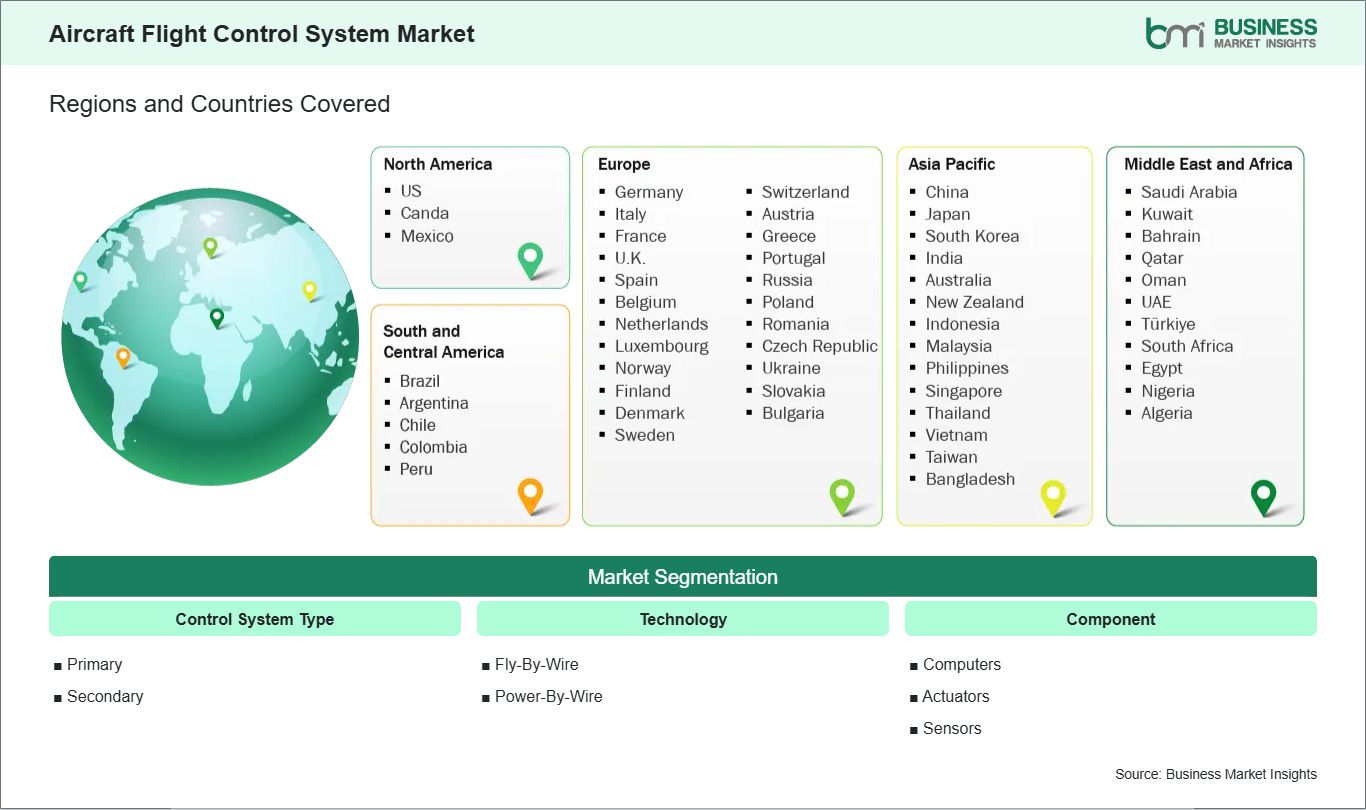
The Aircraft Flight Control System market is segmented based on control system type, technology, and component. Increasing aircraft automation, modernization programs, and demand for advanced flight safety systems continue to support market growth across these segments.
By Control System Type
- Primary: Includes critical flight control surfaces such as ailerons, rudders, and elevators used for aircraft stability and directional control.
- Secondary: Covers systems such as flaps, spoilers, and slats that improve aircraft performance during takeoff, landing, and maneuvering operations.
By Technology
- Fly-By-Wire: Uses electronic signals and computerized controls to replace traditional mechanical flight control mechanisms.
- Power-By-Wire: Supports advanced electrically powered actuation systems designed to improve aircraft efficiency and reduce hydraulic dependency.
By Component
- Computers: Enable flight management, signal processing, system monitoring, and automated control functions.
- Actuators: Convert electronic control signals into physical movement of flight control surfaces.
- Sensors: Monitor aircraft position, motion, pressure, and environmental conditions for accurate flight control operations.
Market Forces
Aircraft Flight Control System Market Drivers and Opportunities
Rising Aircraft Automation and Demand for Safer Flight Operations
The growing adoption of automated aircraft systems is one of the major factors driving the Aircraft Flight Control System market. Airlines, aircraft manufacturers, and defense organizations are increasingly investing in advanced flight control technologies to improve operational safety, fuel efficiency, and aircraft performance. Modern fly-by-wire systems enable greater precision, decreased workload for pilots, and aircraft stability when compared to the traditional mechanical control systems. The rising number of air passengers in the world and the increasing manufacture of planes are contributing significantly to the high demand for control systems.
The aviation industry is focusing on lightweight and energy-efficient technologies to support sustainability goals and reduce operational costs. Advanced flight control systems help improve fuel efficiency by optimizing aircraft movement and reducing overall aircraft weight through electronic and digital control architectures. Military aircraft modernization programs are also contributing to market growth, as defense organizations upgrade fleets with advanced avionics and intelligent flight control technologies. Furthermore, stringent aviation safety norms also motivate the need for robust control systems that can safely operate aircraft under challenging flight circumstances.
Expansion of Autonomous and Electric Aircraft Platforms
The growing development of autonomous aircraft, electric aircraft, and advanced air mobility platforms is creating significant opportunities for the Aircraft Flight Control System market. These next-generation aircraft platforms require highly advanced control technologies capable of managing automated navigation, real-time flight adjustments, and intelligent system coordination. Manufacturers are increasingly developing compact, lightweight, and digitally integrated control systems suitable for electric propulsion architectures and urban air mobility applications.
The rising adoption of unmanned aerial vehicles across commercial, military, and logistics applications is also supporting demand for advanced flight control technologies. Intelligent sensors, predictive control algorithms, and AI-enabled flight management systems are becoming more important as autonomous operations expand within the aerospace industry. In addition, ongoing research into power-by-wire systems and advanced actuation technologies is expected to create new growth opportunities by reducing hydraulic complexity and improving aircraft efficiency. Retrofit activities for older aircraft fleets and increasing investments in connected aircraft technologies are further supporting innovation in advanced Aircraft Flight Control System solutions worldwide.
Size and Share Analysis
Aircraft Flight Control System Market Size and Share Analysis
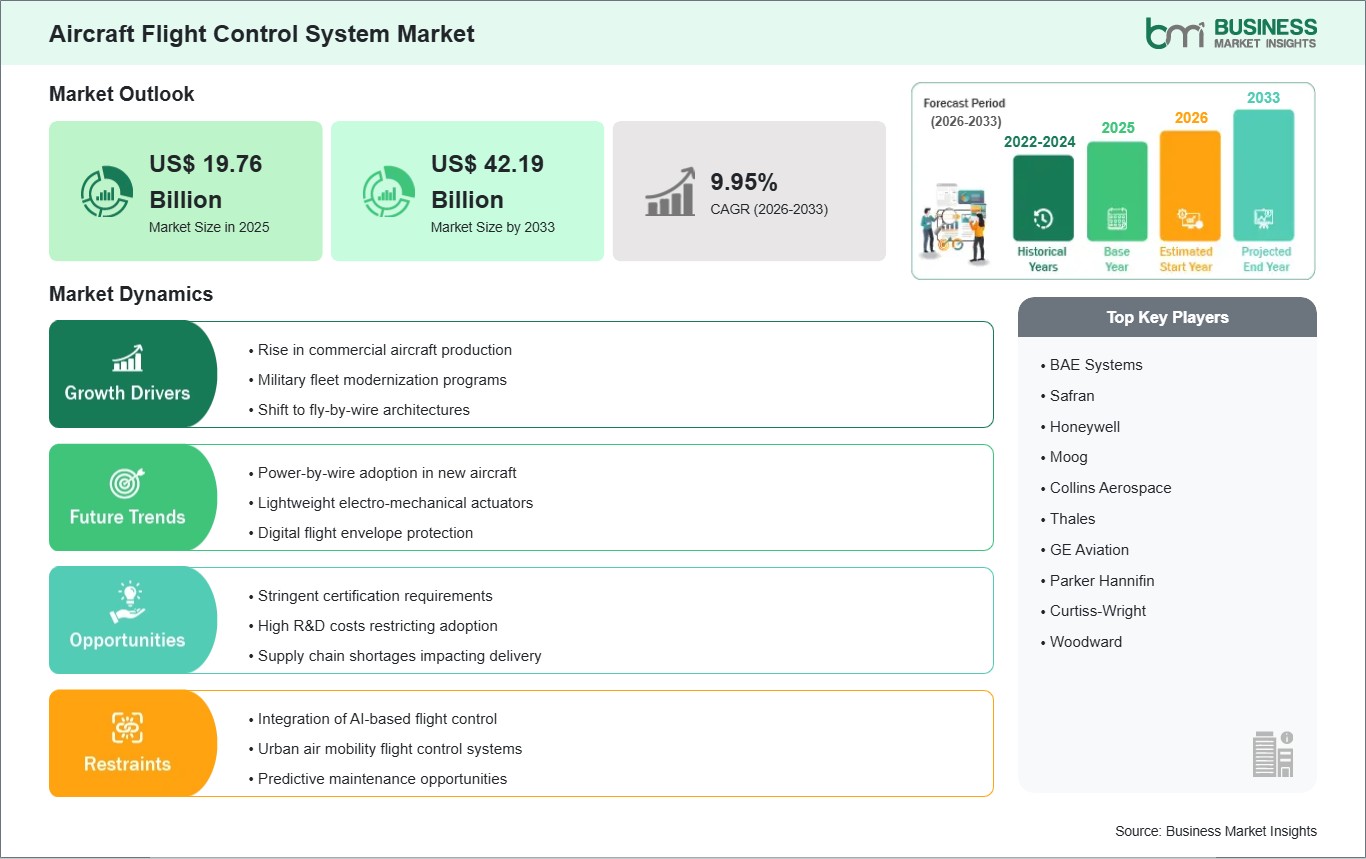
The Aircraft Flight Control System Market is projected to grow from US$ 19.76 Billion in 2025 to US$ 42.19 Billion by 2033 , registering a CAGR of 9.95% from 2026 to 2033.
By control system type, primary flight control systems account for a significant share due to their critical role in maintaining aircraft stability, maneuverability, and operational safety during flight. Secondary flight control systems are also witnessing strong demand as airlines and aircraft manufacturers focus on improving aircraft performance during takeoff, landing, and fuel-efficient flight operations.
By technology, fly-by-wire systems dominate the market owing to their widespread adoption in modern commercial and military aircraft. These systems help reduce aircraft weight, improve flight precision, and support advanced automation capabilities. Power-by-wire technologies are gaining attention with the increasing development of electric aircraft and next-generation aviation platforms focused on reducing hydraulic system dependency.
Report Coverage
Aircraft Flight Control System Market Report Coverage and Deliverables
The "Aircraft Flight Control System Size and Forecast (2022-2033)" report provides a detailed analysis of the market covering below areas:
- Aircraft Flight Control System Market size and forecast at global, regional, and country levels for all the key market segments covered under the scope
- Aircraft Flight Control System Market trends, as well as market dynamics such as drivers, restraints, and key opportunities
- Aircraft Flight Control System Market analysis covering key market trends, global and regional framework, major players, regulations, and recent market developments
- Industry landscape and competition analysis covering market concentration, heat map analysis, prominent players, and recent developments for the market
- Detailed company profiles, including SWOT analysis
Geographic Insights
Aircraft Flight Control System Market Geographic Insights
The Aircraft Flight Control System Market shows diverse regional adoption patterns influenced by aircraft modernization programs, aviation infrastructure development, technological advancements, and increasing investments in aerospace automation systems.
North America remains a major market due to the strong presence of aircraft manufacturers, advanced aerospace technology providers, and defense aviation programs. The United States leads regional demand with continuous investments in commercial aircraft production, military aircraft modernization, and autonomous aviation technologies. Airlines and aerospace companies across the region are increasingly adopting advanced fly-by-wire systems, intelligent actuators, and connected aircraft technologies to improve operational efficiency and flight safety. Canada also supports market growth through aerospace manufacturing activities, research programs, and investments in next-generation aircraft systems and avionics technologies.
Asia Pacific is witnessing strong market expansion due to rising air passenger traffic, increasing aircraft procurement, and rapid growth in regional aviation infrastructure. Countries such as China and India are investing heavily in domestic aircraft manufacturing, airline fleet expansion, and defense modernization initiatives, creating demand for advanced flight control systems. Japan and South Korea continue to focus on aerospace innovation, precision electronics, and unmanned aerial vehicle development. Growing urban air mobility initiatives and increasing adoption of modern aircraft platforms across Southeast Asia are also supporting demand for digitally integrated flight control technologies throughout the region.
Industry Activity
Recent Developments
The Aircraft Flight Control System Market is analyzed using a mix of primary and secondary research sources, including corporate publications, industry associations, and verified databases. This approach ensures accurate tracking of innovation trends and strategic developments influencing the market.
- In February 2024, Honeywell announced advancements in its next-generation flight control and avionics technologies designed to support improved aircraft automation, operational efficiency, and flight safety across commercial and defense aviation platforms. The company focused on expanding connected cockpit systems and intelligent flight management capabilities for modern aircraft applications.
- In September 2023, Collins Aerospace introduced advanced electric actuation and flight control technologies aimed at supporting future aircraft electrification and autonomous aviation systems. The initiative focused on improving aircraft performance, reducing hydraulic dependency, and enhancing system reliability for next-generation aerospace platforms.
Trust & Transparency
Research Methodology
The market analysis combines proprietary research with secondary data from government agencies, company disclosures, regulatory filings, industry databases and expert interviews. Market estimates are validated through data triangulation, cross-market benchmarking and analyst
review.
View Full Research Methodology
Key Sources Referred:
World Bank - Global Trade Indicators
World Trade Organization (WTO)
International Monetary Fund (IMF)
International Trade Administration (ITA)
Company Websites
Company Annual Reports
Company Investor Presentations