Market Summary
Executive Summary and Global Market Analysis
The command and control systems market represents integrated military communications systems, which provide an efficient decision-making system for coordination in various environments. The command and control systems help to combine all the sensors, operators, and command centers in a single operational environment. In addition, they help to facilitate information exchange in real time during mission planning and execution for efficiency across military networks.
Market growth factors include high dependence on network-centric warfare and digital defense systems. There is a greater need for governments to develop systems that allow faster coordination and operation response times. Higher levels of complexity in threats facing modern militaries also contribute to higher demand for coordinated systems and visibility.
The platform-wise segmentation shows significant use of the command and control systems on the land and air-based platforms because of the regular usage of these platforms in military operations. Maritime and space platforms have grown in significance with increased needs for surveillance. The cyber domain is also gaining importance in developing command systems.
Innovation of technology in hardware, software, and services will enhance system performance through analytics, communications, and AI decision-making capabilities. Technologies such as cloud architecture and edge computing will improve system responses and scalability. There will be an expansion of application segments, especially in hybrid defense communications and civilian crisis response systems.
There will continue to be intense competition involving technology and its capabilities, specifically interoperability, cybersecurity, and modular system design. Players are now investing heavily in life cycle support services and solutions. Innovation of mission-critical communication systems is influencing positioning within the Command and Control Systems Market.
Segment Analysis
Command & Control Systems Market Segmentation
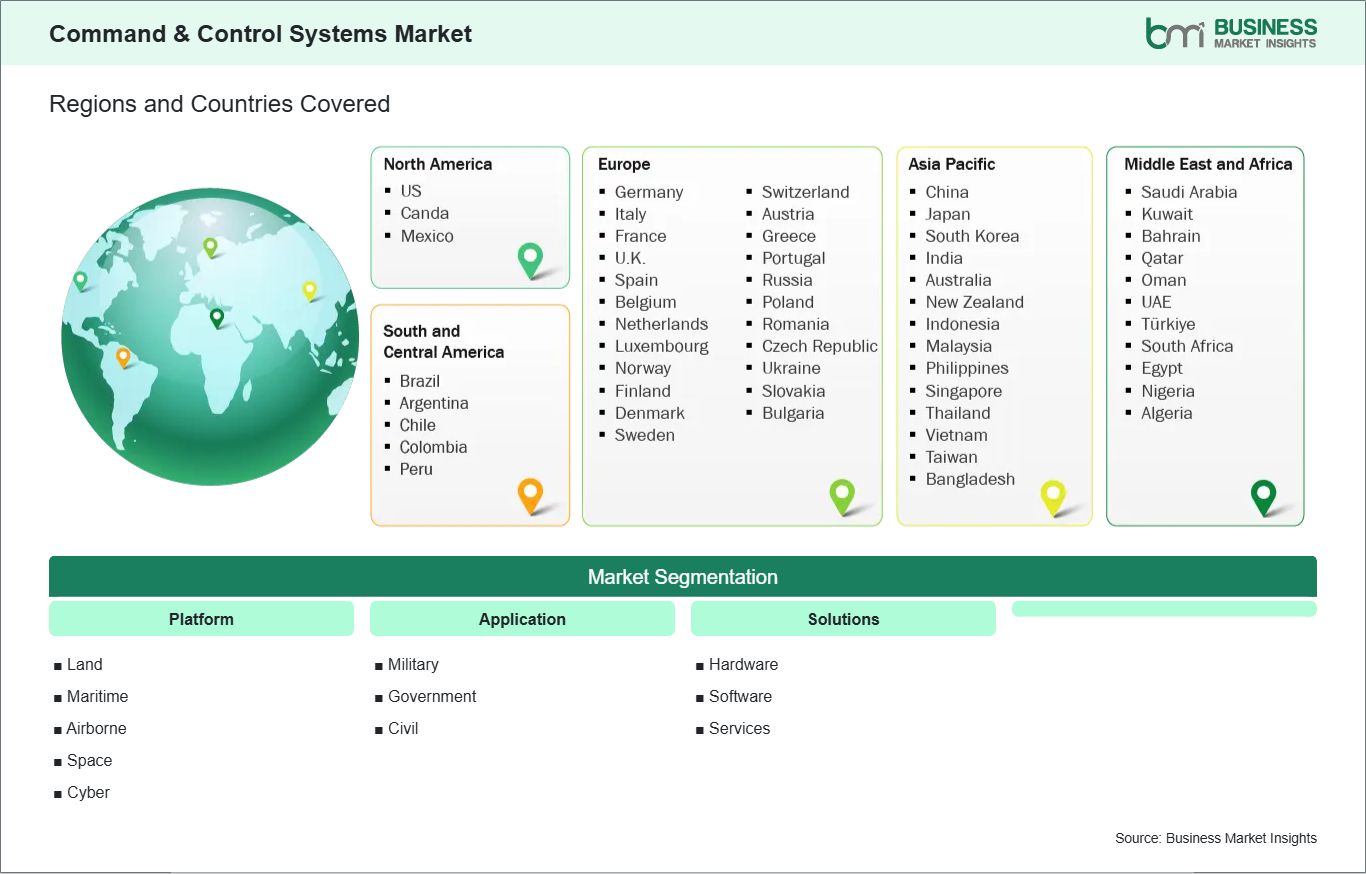
The command and control systems market is segmented based on platform, application, and solutions, reflecting the integration of multi-domain operational command infrastructures and digital defense coordination systems.
By Platform
- Land: Ground-based command infrastructure supports tactical coordination and field operations management.
- Maritime: Naval systems enhance fleet coordination and situational tracking across sea operations.
- Airborne: Aircraft-based systems enable real-time mission control and aerial surveillance integration.
- Space: Satellite-linked systems support global communication and strategic monitoring capabilities.
- Cyber: Digital defense layers strengthen threat detection and network-based command operations.
By Application
- Military: Defense organizations deploy systems for mission planning and battlefield coordination.
- Government: Public agencies utilize platforms for emergency response and infrastructure control.
- Civil: Non-military institutions apply systems for disaster management and public safety coordination.
By Solutions
- Hardware: Physical infrastructure supports command centers and operational data processing.
- Software: Analytical platforms enable decision support, visualization, and mission planning.
- Services: Integration and maintenance support ensure system continuity and upgrades.
Market Forces
Command & Control Systems Market Drivers and Opportunities
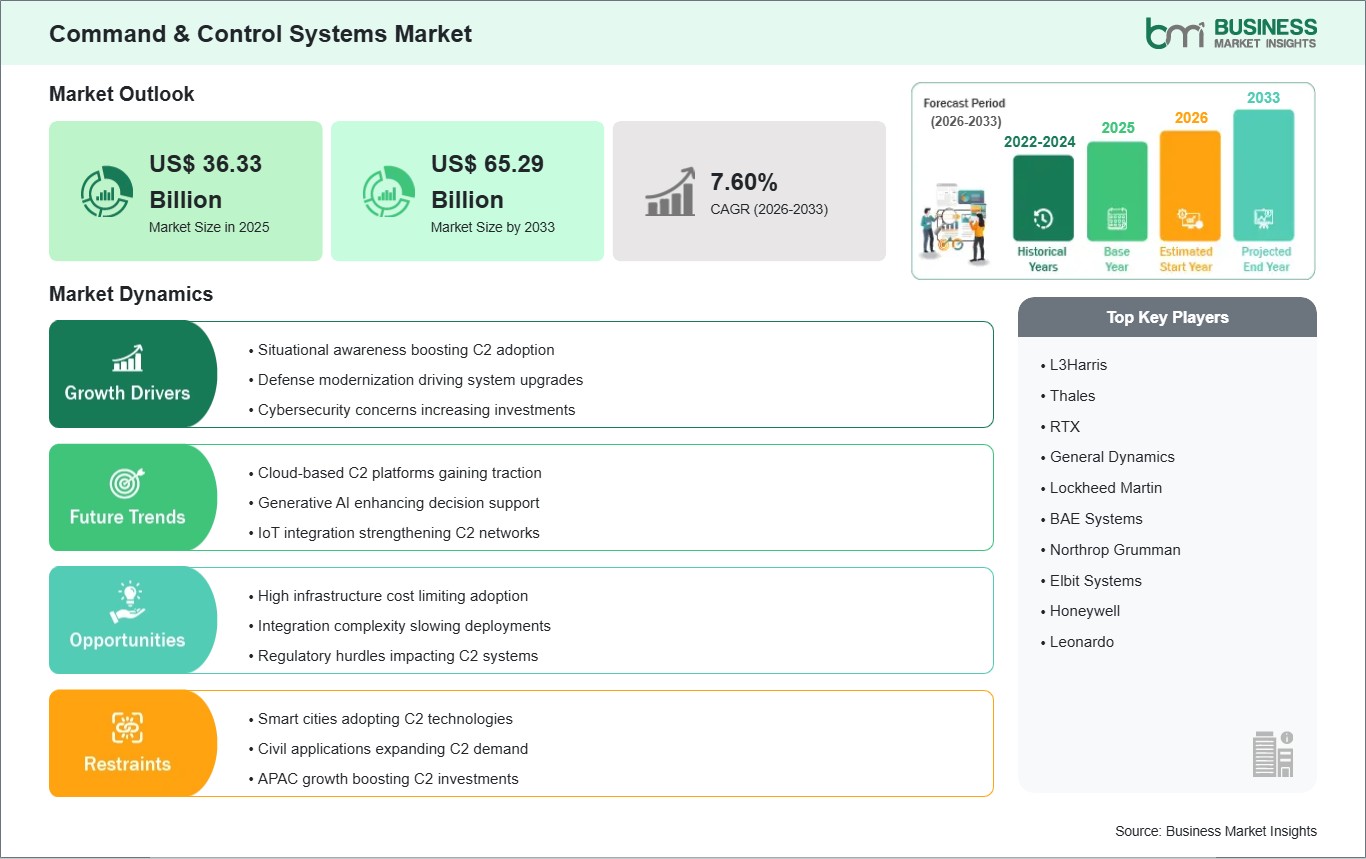
Situational awareness boosting C2 adoption
The ability to gain enhanced situational awareness has made it easier for the use of Command and Control Systems Market products to increase in defense and security applications. Today, modern missions are carried out in an environment that requires real-time visibility in both land, airspace, at sea, and cyberspace, thus enabling decisions to be taken instantly and effectively. This trend has encouraged companies to embrace integrated platforms that help aggregate multi-source information to one point where decisions can be easily made within seconds.
Modern technologies, such as the fusion of sensors, geo-intelligence, and real-time communications, are playing a key role in making command systems effective. The development of new technologies is focused on increasing battlefield awareness and precision operations. There is also a regulatory push towards the creation of secure communication and mission readiness capabilities that can enable fast decision-making capabilities in any situation.
Smart cities adopting C2 technologies
Smart city initiatives are leading to the development of Commandand Control Systems Market applications as cities seek better coordination for their operations and infrastructure systems. Smart cities are installing control platforms to monitor the city's traffic system, utility services, surveillance cameras, and emergency service units. Such platforms allow the city administration to be up-to-date with the happenings within the city by facilitating quicker coordination between various city departments.
IoT sensors, data analysis, and communications networks have played an integral role in developing a command platform for future smart cities. With such systems in place, it would be easy to carry out predictive analysis and respond to situations in a timely manner across all the systems of the city. In the coming years, more cities will implement a sustainable digital command platform.
Size and Share Analysis
Command & Control Systems Market Size and Share Analysis
The Command & Control Systems Market is projected to grow from US$ 36.33 Billion in 2025 to US$ 65.29 Billion by 2033 , registering a CAGR of 7.60% from 2026 to 2033.
By platform, land accounts for a significant share due to the extensive deployment of command systems in army operations and large-scale modernization of ground forces worldwide. It also benefits from widespread use of mobile and battlefield command centers across defense forces.
By application, military dominates as defense forces are the primary end users, relying heavily on C2 systems for real-time situational awareness, mission coordination, and battlefield decision-making, with growing defense budgets and geopolitical tensions further accelerating adoption.
By solutions, software leads the market because modern C2 systems are increasingly software-driven, enabling AI-based analytics, real-time data fusion, and interoperability across multi-domain operations, while also offering flexibility, scalability, and easier upgrades compared to hardware-based solutions.
Report Coverage
Command & Control Systems Market Report Coverage and Deliverables
The "Command and Control Systems Market Size and Forecast (2022-2033)" report provides a detailed analysis of the market covering below areas:
- The market size and forecast at global, regional, and country levels for all market segments covered under the scope
- The market trends, as well as drivers, restraints, and opportunities
- The market analysis covering key trends, global and regional framework, major players, regulations, and recent developments
- Industry landscape and competition analysis covering market concentration, heat map analysis, prominent players, and recent developments for the market
- Detailed company profiles, including SWOT analysis
Geographic Insights
Command & Control Systems Market Geographic Insights
The command and control systems market experiences diverse adoption trends in each region due to various factors such as defense modernization, digital transformation, and security coordination. Many regions around the world have adopted integrated command platforms in efforts to enhance visibility and make more efficient decisions. Growing adoption of platforms that enable multi-domain integration, intelligence sharing in real time, and central monitoring frameworks characterizes the adoption trends globally.
North America leads the market, as adoption in North America has been facilitated by well-established defense infrastructures and the ongoing modernization process. The USA tops adoption rates with an increased focus on multi-domain integration of commands in land, air, maritime, and cyber domains. Canada also adopts this technology, with its defense system being upgraded digitally and with improved emergency response management platforms.
The Asia Pacific region continues to experience steady growth due to the rising investments in defense modernization programs. Advanced command solutions are being adopted by countries like China, India, Japan, and South Korea in order to improve their surveillance, border protection, and coordination abilities. In addition, urbanization and the rise of security threats have led many governments to incorporate these solutions into their civil security and disaster management plans.
Europe has been working towards enhancing the interoperability of its defense command systems to facilitate collaborative security initiatives. Countries such as the UK, Germany, and France have begun upgrading their command platforms to enable integrated operation controls among the alliance forces. Furthermore, there is a gradual increase in the adoption rates of command systems in emerging markets of the Middle East, Latin America, and Africa. These nations include UAE, Brazil, and South Africa.
Industry Activity
Recent Developments
The command and control systems market is evaluated by gathering qualitative and quantitative data post primary and secondary research, which includes important corporate publications, association data, and databases. A few of the key developments in the command & control systems market are:
- In February 2023, Lockheed Martin announced that it had been awarded a U.S. Navy contract to integrate the Conventional Prompt Strike (CPS) hypersonic weapon system onto ZUMWALT-class destroyers, advancing networked command-and-control strike capabilities across naval platforms.
- In May 2023, Northrop Grumman announced that its Integrated Battle Command System (IBCS) achieved Initial Operational Capability, enabling a unified air and missile defense command-and-control architecture for the U.S. Army and strengthening multi-domain sensor-to-shooter integration.
Trust & Transparency
Research Methodology
The market analysis combines proprietary research with secondary data from government agencies, company disclosures, regulatory filings, industry databases and expert interviews. Market estimates are validated through data triangulation, cross-market benchmarking and analyst
review.
View Full Research Methodology
Key Sources Referred:
U.S. Department of Defense (DoD) North Atlantic Treaty Organization (NATO) S. Department of Homeland Security (DHS) National Institute of Standards and Technology (NIST) Institute of Electrical and Electronics Engineers (IEEE) International Organization for Standardization (ISO) European Defence Agency (EDA) Defense Advanced Research Projects Agency (DARPA) Company Websites Company Annual Reports Company Investor Presentations