
Command and Control System Market Outlook: Size, Share, Trends, Growth Analysis, Competitive Landscape & Forecast, 2026-2033

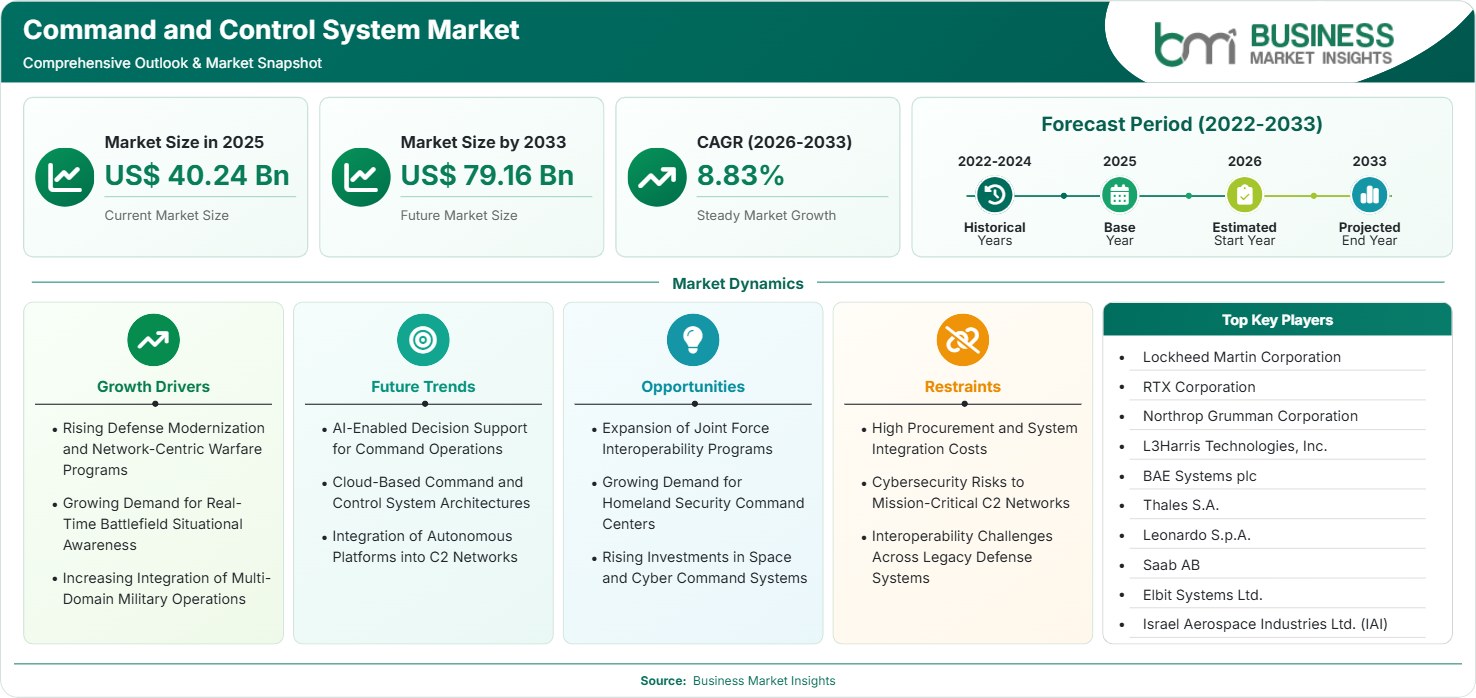
The Command and Control System Market size was valued at US$ 40.24 Billion in 2025 and is projected to reach US$ 79.16 Billion by 2033, growing at a CAGR of 8.83% during 2026–2033. Defense modernization programs on the rise, increasing requirements for real-time situational awareness, increased adoption of network-centric warfare principles, and investments in critical infrastructure security are helping drive market growth. The emergence of multi-domain operations, decision support systems with artificial intelligence, secure communication networks, and command systems is providing market opportunities.

Report Coverage
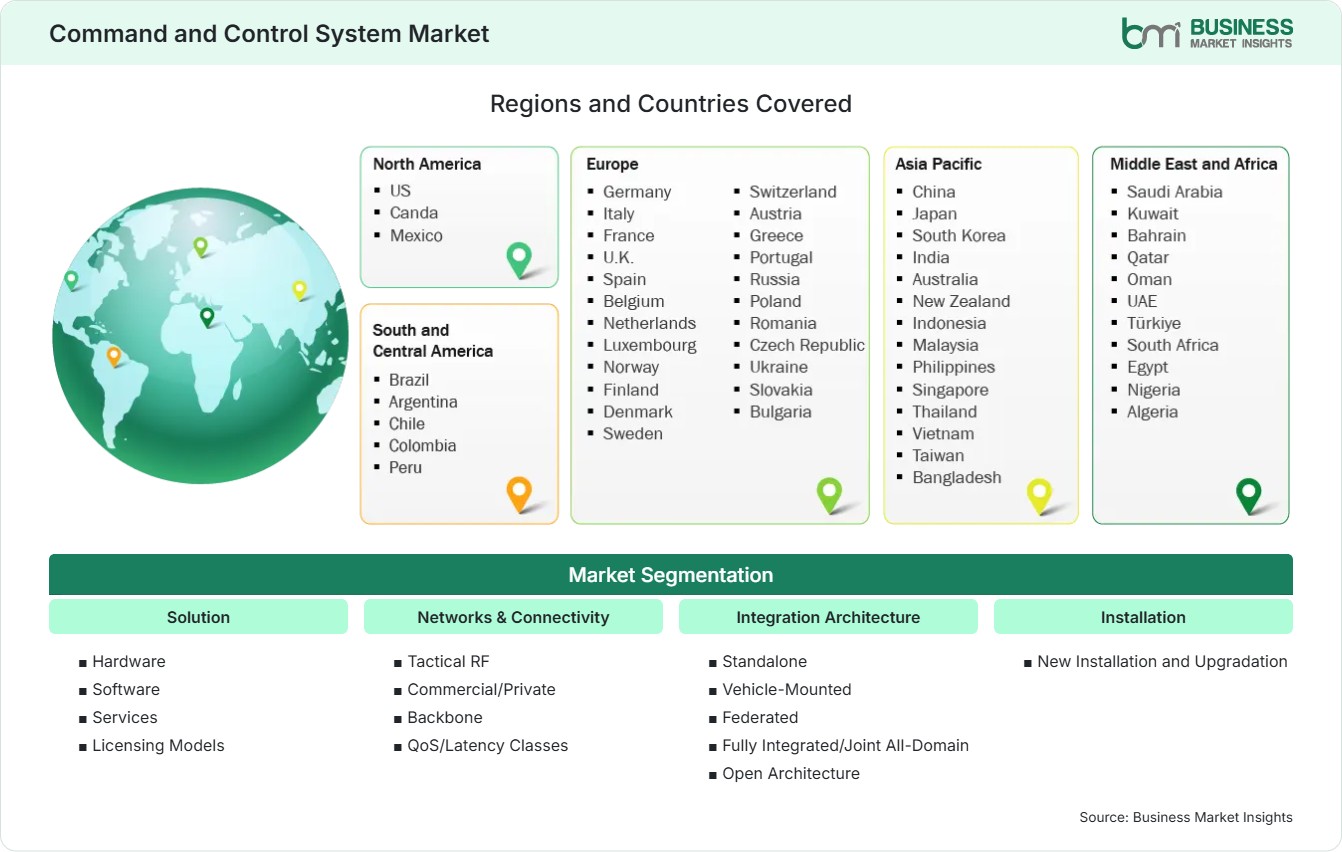
  • Solution: Hardware, Software, Services, Licensing Models
  • Networks & Connectivity: Tactical RF, Commercial/Private, Backbone, QoS/Latency Classes
  • Integration Architecture: Standalone, Vehicle-Mounted, Federated, Fully Integrated/Joint All-Domain, Open Architecture
  • Installation: New Installation and Upgradation
  • System: Communications & Networks, Weapon Control Systems, Command Posts, Security Systems, Others
US$ 40.24 Bn Market size in 2025
US$ 79.16 Bn Market Size by 2033
8.83% CAGR, 2026 - 2033
2026-2033 Forecast Period

AI Overview

Command and Control System Market Summary

  • North America Region: North America holds a command and control system market share of 36%–39% in 2025 and is projected to grow at a CAGR of 8.4%–9.4% during 2026–2033. Strong defense spending, extensive military modernization initiatives, and advanced command network deployment continue supporting regional demand. The US market is projected to grow at a CAGR of 8.5%–9.5% through 2033.
  • Fastest Growing Region: Asia Pacific accounts for 24%–27% share in 2025 and is expected to grow at a CAGR of 9.5%–10.5% during the forecast period. Rising defense budgets, border security modernization, and increasing deployment of integrated battlefield management systems are driving growth.
  • Leading Segment: Software represents 44%–47% share in 2025 and is projected to grow at a CAGR of 9.0%–10.0% through 2033 owing to increasing demand for real-time analytics, decision support tools, and command management applications.
  • High Growth Segment: Fully Integrated/Joint All-Domain Integration Architecture holds 16%–19% share in 2025 and is projected to grow at a CAGR of 10.5%–11.5% during 2026–2033 due to increasing emphasis on interoperable multi-domain operations.
  • Key Market Opportunity: Expansion of AI-powered command centers, secure tactical communications, and joint all-domain command and control frameworks is creating substantial opportunities across defense and security sectors.
  • Major Market Players: Lockheed Martin Corporation, RTX Corporation, Northrop Grumman Corporation, L3Harris Technologies, Inc., BAE Systems plc, Thales S.A., Leonardo S.p.A., Saab AB, Elbit Systems Ltd., and Israel Aerospace Industries Ltd. (IAI).
Strategic Insights

Command and Control System Market: Strategic Insights

Command and Control System Market Strategic Framework
FREE PDF
Request your free sample
Request free sample
Stakeholder View

Key Takeaways

  • Software solutions remain the largest component segment due to their central role in operational coordination and decision support.
  • Defense organizations continue accounting for the majority of deployments worldwide.
  • Integrated and joint-domain architectures are increasingly becoming procurement priorities.
  • North America maintains market leadership through sustained defense modernization investments.
  • Asia Pacific represents the fastest-growing regional market driven by security modernization programs.
  • Command and control system market trend suggest that the AI-enabled decision support, real-time battlefield awareness, and multi-domain command integration are transforming command and control capabilities.
  • Secure communications networks continue receiving significant investment across military and homeland security applications.
Geographic Outlook

Command and Control System Market Regional Highlights

North America Command and Control System Market

North America accounted for a 36%–39% share in 2025 and is projected to expand at a CAGR of 8.4%–9.4% during 2026–2033. Market forecast for the command and control system suggests that this region continues to be the biggest market due to its heavy spending on defense, ongoing programs for military modernization and investments in communication networks. US and Canada are both adopting new command and control systems in order to facilitate better coordination, increased situational awareness, cybersecurity and mission success in all domains. Greater importance being given to joint force operations and real time intelligence sharing is encouraging the use of integrated command architecture across all domains.

  • Defense modernization programs continue generating demand for next-generation command platforms.
  • Joint all-domain operations are increasing requirements for interoperability and data sharing.
  • AI-powered situational awareness tools are gaining adoption across military organizations.
  • Homeland security agencies are expanding investments in integrated command centers.
  • Cybersecurity and resilient communications remain major procurement priorities.

US Command and Control System Market

The US represented a 32%–35% share in 2025 and is estimated to grow at a CAGR of 8.5%–9.5% through 2033. Strong military modernization initiatives, advanced defense technology development, and increasing focus on multi-domain command capabilities continue supporting command and control system command and control system market growth. Significant investments in integrated battlefield management systems, network-centric operations, and secure data-sharing frameworks are creating opportunities for technology providers. The country continues emphasizing rapid decision-making capabilities and operational superiority through digital command networks.

  • Multi-domain warfare initiatives continue driving technology adoption.
  • Investments in AI-enabled command centers are increasing.
  • Secure tactical communications remain a strategic priority.
  • Integrated sensor-to-shooter networks are enhancing operational effectiveness.

Europe Command and Control System Market

Europe held a 23%–26% share in 2025 and is expected to grow at a CAGR of 8.2%–9.2% from 2026–2033. France, the UK, Germany, and Italy remain key markets due to increasing defense modernization efforts, rising geopolitical concerns, and investments in secure military communications. Governments across the region are strengthening command capabilities to improve operational readiness and support multinational defense cooperation. Growing focus on battlefield digitization, cybersecurity, and integrated surveillance systems is creating strong demand for advanced command platforms. Investments in critical infrastructure protection and emergency response systems are also contributing to command and control system market expansion.

  • Military modernization initiatives are supporting procurement of advanced command systems.
  • Multinational defense collaboration is increasing interoperability requirements.
  • Cyber defense investments continue expanding.
  • Governments are enhancing critical infrastructure security operations.
  • Integrated intelligence and surveillance capabilities are gaining importance.

Asia Pacific Command and Control System Market

Asia Pacific accounted for a 24%–27% share in 2025 and is projected to register a CAGR of 9.5%–10.5% during 2026–2033. The region represents the fastest-growing command and control system market due to increasing defense budgets, evolving security challenges, and modernization of military command structures. China, India, Japan, South Korea, and Australia continue investing in advanced operational networks, battlefield management systems, and secure communication platforms. Rising border security requirements, maritime surveillance activities, and regional military modernization efforts are supporting strong command and control system market growth. Governments are increasingly deploying integrated command systems to improve situational awareness, operational coordination, and rapid response capabilities.

  • China continues investing heavily in network-centric warfare capabilities.
  • India is strengthening battlefield communication and command infrastructure.
  • Maritime security initiatives are increasing demand for integrated solutions.
  • Advanced surveillance and reconnaissance systems are supporting deployment growth.
  • AI-enabled command platforms are receiving increasing investment.

Rest of World Command and Control System Market

Rest of World accounted for a 9%–12% share in 2025 and is expected to grow at a CAGR of 8.4%–9.4% through 2033. The Middle East, Latin America, and Africa are increasingly investing in command and control capabilities to strengthen national security, border protection, and critical infrastructure resilience. Regional governments are modernizing defense networks and communication systems while improving interoperability across military and security agencies. Increased focus on disaster management, emergency response coordination, and infrastructure protection is also generating demand for advanced command platforms. Growing procurement of integrated surveillance, intelligence, and communication systems is expected to support long-term command and control system market expansion in these regions.

  • Defense modernization programs continue supporting technology adoption.
  • Border security initiatives are increasing investment in command systems.
  • Critical infrastructure operators are upgrading security management platforms.
  • Emergency response and disaster management applications are expanding.
  • Governments are strengthening communications and operational coordination capabilities.
Global Market Geography
FREE PDF
Request your free sample
Request free sample
Segment Analysis

Command and Control System Market Segmentation

Solution

Solution demand is driven by increasing requirements for operational visibility, mission planning, intelligence processing, and secure communications. Software accounted for 44%–47% share in 2025 and is projected to grow at a CAGR of 9.0%–10.0% through 2033 due to rising adoption of decision-support systems, battlefield management applications, and data fusion platforms. Modern command environments increasingly depend on software-driven architectures to integrate information from multiple sources and support real-time operational decision-making.

  • Hardware: Includes command consoles, communication devices, servers, displays, networking equipment, and mission-critical computing infrastructure.
  • Software: The leading segment owing to growing deployment of situational awareness platforms, command applications, intelligence processing tools, and operational analytics systems.
  • Services: Demand is supported by system integration, maintenance, cybersecurity support, consulting, training, and lifecycle management activities.
  • Licensing Models: Increasingly adopted as organizations seek scalable deployment and long-term software management capabilities.

Networks & Connectivity

Network infrastructure forms the backbone of command and control operations by enabling secure data transmission and operational coordination. Tactical RF accounted for 34%–37% share in 2025 and is projected to grow at a CAGR of 8.8%–9.8% through 2033 due to its critical role in battlefield communications and mission execution.

  • Tactical RF: The leading segment supported by extensive deployment in military communication, surveillance, and operational coordination systems.
  • Commercial/Private: Utilized for enterprise security operations, public safety applications, and non-combat communication environments.
  • Backbone: Provides high-capacity communication infrastructure supporting integrated command networks and information sharing.
  • QoS/Latency Classes: Increasingly important for ensuring mission-critical data delivery and network performance optimization.

Integration Architecture

Architecture selection is influenced by interoperability requirements, mission complexity, operational flexibility, and modernization objectives. Federated Architecture accounted for 28%–31% share in 2025 and is projected to grow at a CAGR of 8.5%–9.5% through 2033 because it enables coordination across multiple existing systems without complete infrastructure replacement.

  • Standalone: Utilized in isolated operational environments requiring dedicated command capabilities.
  • Vehicle-Mounted: Supports mobile command and tactical field operations across defense and homeland security applications.
  • Federated: The dominant segment due to its ability to integrate separate systems while preserving operational flexibility.
  • Fully Integrated/Joint All-Domain: The fastest-growing segment, holding 16%–19% share in 2025 and projected to expand at a CAGR of 10.5%–11.5% through 2033 as military organizations pursue multi-domain operational capabilities.
  • Open Architecture: Gaining adoption through improved interoperability, scalability, and future technology integration capabilities.

Installation

Installation demand is shaped by modernization programs, technology upgrades, and expansion of command infrastructure. Upgradation accounted for 54%–57% share in 2025 and is projected to grow at a CAGR of 9.0%–10.0% through 2033 due to the widespread modernization of legacy command systems.

  • New Installation: Supported by defense infrastructure expansion, new command centers, and emerging security requirements.
  • Upgradation: The leading segment as governments increasingly modernize existing systems with advanced software, communications, and networking capabilities.

System

System demand varies according to operational requirements, mission objectives, security challenges, and communication needs. Communications & Networks accounted for 31%–34% share in 2025 and is projected to grow at a CAGR of 8.9%–9.9% through 2033.

  • Communications & Networks: The dominant segment supported by increasing demand for secure, resilient, and interoperable communication infrastructure.
  • Weapon Control Systems: Adoption continues rising due to modernization of precision engagement and integrated weapons management capabilities.
  • Command Posts: Essential for operational planning, mission execution, and real-time coordination activities.
  • Security Systems: Demand is increasing across critical infrastructure, homeland security, and public safety organizations.
  • Others: Includes surveillance integration, intelligence management, operational analytics, and emergency response command solutions.

End User

End-user demand is driven by security requirements, operational complexity, threat environments, and modernization initiatives. Defense accounted for 61%–64% share in 2025 and is projected to grow at a CAGR of 8.8%–9.8% through 2033 due to continued investment in military command infrastructure and strategic defense capabilities.

  • Defense: The leading command and control system market segment supported by ongoing modernization programs, multi-domain operations, and battlefield digitization initiatives.
  • Homeland Security: Increasing adoption of integrated command platforms for border security, national resilience, and threat management.
  • Public Safety: Utilized for emergency response coordination, disaster management, and law enforcement command operations.
  • Critical Infrastructure Operators: Deploying command systems to improve operational visibility and security monitoring.
  • Enterprise GSOC/NOC: Organizations are increasingly utilizing centralized command environments to manage security and network operations across large facilities.
Market Forces

Command and Control System Market Dynamics

Key Market Drivers

Rising Defense Modernization Programs

There is considerable growth in the amount of resources being allocated by governments worldwide to the modernization of their armed forces. Modern command and control systems have become an important part of such military modernization programs due to the benefits associated with them. They give commanders improved situational awareness and enable them to make better decisions with the use of intelligence information. There is a move on the part of armed forces to replace their existing command infrastructure with new-age digital tools that would allow them to conduct network-centric warfare operations. Modernization efforts are being made to integrate artificial intelligence, cloud computing, and networking technologies into command and control.

Growing Demand for Real-Time Battlefield Situational Awareness

Military organizations increasingly require real-time operational visibility to improve mission effectiveness, response speed, and tactical coordination. Modern command systems integrate data from surveillance platforms, sensors, satellites, communication networks, and intelligence sources to provide a comprehensive operating picture. This capability enables commanders to make informed decisions while adapting rapidly to changing operational environments. The growing complexity of military operations has increased the need for accurate, timely, and actionable information across all levels of command. Investments in advanced analytics, intelligence fusion, sensor integration, and secure communication platforms are helping improve situational awareness capabilities. As modern missions become increasingly data-driven, demand for technologies that enhance visibility and operational decision-making continues to grow across defense and security organizations.

Increasing Integration of Multi-Domain Military Operations

Modern warfare tactics have started relying on multi-domain operations that coordinate activities in the areas of land, air, sea, cyber, and space. Command and control systems play an integral role in facilitating multi-domain operations through facilitating communication, intelligence gathering, and coordination among assets and different platforms. Military entities are developing architectures that integrate sensors, weapon systems, control rooms, and operational units into a single system. The integration enhances the process of mission synchronization, resource management, and decision-making. With the rise of multi-domain operations and doctrines by military entities, the need for command systems that facilitate multi-domain missions will be higher during the forecast period.

Key Market Opportunities

Expansion of Joint Force Interoperability Programs

Joint force interoperability initiatives are creating substantial opportunities for command and control solution providers. Military organizations increasingly require systems that can operate effectively across different branches of service, allied forces, and coalition partners. Interoperable architectures enable seamless information exchange, coordinated mission planning, and improved operational effectiveness during complex missions. Governments are allocating significant resources toward modern communication standards, integrated command frameworks, and networked operational environments. Vendors capable of delivering scalable and interoperable technologies are well positioned to benefit from these modernization efforts. As multinational defense collaboration continues expanding, interoperability-focused programs are expected to generate long-term demand for advanced command platforms and supporting technologies.

Growing Demand for Homeland Security Command Centers

It is evident that the homeland security organizations are gradually developing an interest in the use of centralized command centers that can help improve their threat detection, coordination of emergency responses, disaster management, and critical infrastructure protection. In these types of command centers, the means of communication, surveillance equipment, intelligence, and operational management systems come together into one place. Terrorist activities, cybersecurity issues, border security, and public safety are becoming more significant worries, which is promoting the development of new command capabilities. Technologies that will help with coordination between various agencies are gaining significance because of the need for faster response and efficiency.

Rising Investments in Space and Cyber Command Systems

The Command and Control System Market forecast remains positive as investments in space and cyber command systems continue to accelerate worldwide. Space and cyber domains have become critical components of modern defense strategies, prompting governments to establish dedicated cyber and space commands to address emerging security threats and protect critical infrastructure. These operations require advanced command platforms capable of real-time monitoring, secure communications, coordinated defensive actions, and strategic decision-making across complex digital environments. Increasing investments in cybersecurity infrastructure, satellite communications, space-based intelligence, and cyber defense programs are driving demand for next-generation command and control solutions. As nations strengthen multi-domain defense capabilities, integrated command systems are expected to witness sustained long-term growth.

Market Restraints and Challenges

High Procurement and System Integration Costs

Factor: Command and control systems involve sophisticated hardware, software platforms, secure communication networks, integration services, and long-term maintenance programs. Large-scale deployments often require substantial capital investment and extensive customization to meet operational requirements.

Impact: High acquisition and integration costs can delay procurement decisions, particularly for budget-constrained organizations. Complex deployment requirements may also extend implementation timelines and increase lifecycle expenses. Stakeholders must balance operational benefits against financial considerations when planning modernization programs.

Cybersecurity Risks to Mission-Critical C2 Networks

Factor: Increasing connectivity, data sharing, and digital integration expose command networks to cyber threats, unauthorized access attempts, and potential disruption of operational capabilities. Modern command environments rely heavily on interconnected systems that can become attractive targets for adversaries.

Impact: Cybersecurity incidents may compromise operational effectiveness, disrupt communications, and affect mission execution. Organizations are required to invest significantly in network protection, encryption technologies, cyber resilience measures, and continuous monitoring capabilities. Managing cyber risk remains one of the most critical challenges facing command and control operators globally.

Company Analysis

Competitive Landscape

The Command and Control System Market analysis indicates a highly competitive landscape, with defense contractors, aerospace companies, battlefield networking providers, secure communications specialists, and military systems integrators competing through technological innovation and advanced defense capabilities. Companies are focusing on AI-enabled command platforms, multi-domain operational integration, secure tactical communications, cyber-resilient architectures, and advanced battlefield management systems to strengthen their market positions. Strategic defense contracts, military modernization programs, joint force interoperability initiatives, and investments in space and cyber command capabilities continue shaping the competitive landscape. Additionally, market participants are emphasizing open architectures, integrated command ecosystems, and next-generation digital defense solutions to support evolving operational requirements and long-term market growth.

Company Name

Overview

Products and Services Relevant to this Market

Lockheed Martin Corporation

Global defense and aerospace technology company.

Command and control systems, integrated battle management solutions, mission systems, and secure communications platforms.

RTX Corporation

Defense and aerospace systems provider.

Battlefield management systems, tactical communications, sensor integration, and command network solutions.

Northrop Grumman Corporation

Defense technology company specializing in advanced mission systems.

C4ISR solutions, command platforms, integrated defense systems, and operational management technologies.

L3Harris Technologies, Inc.

Provider of secure communications and defense technologies.

Tactical radios, battlefield networking, command systems, and mission-critical communication platforms.

BAE Systems plc

International defense and security company.

Command and control software, operational management systems, defense communications, and situational awareness solutions.

Thales S.A.

Defense, aerospace, and digital security solutions provider.

Integrated command systems, secure communications, battlefield management platforms, and defense networking technologies.

Leonardo S.p.A.

Aerospace, defense, and security technology company.

Command centers, surveillance integration systems, defense electronics, and operational coordination solutions.

Saab AB

Defense and security solutions provider.

Combat management systems, command platforms, tactical communications, and military networking technologies.

Elbit Systems Ltd.

Defense electronics and integrated systems company.

Battle management systems, digital command platforms, tactical networking, and situational awareness solutions.

Israel Aerospace Industries Ltd. (IAI)

Aerospace and defense systems provider.

Command and control platforms, integrated intelligence systems, communication networks, and mission management solutions.

Trust & Transparency

Research Methodology

The market analysis combines proprietary research with secondary data from government agencies, company disclosures, regulatory filings, industry databases and expert interviews. Market estimates are validated through data triangulation, cross-market benchmarking and analyst review.

View Full Research Methodology

Questions Answered

Frequently Asked Questions

What opportunities exist for command and control system providers?

Key opportunities include joint force interoperability programs, homeland security command centers, cyber command modernization, AI-powered operational decision support, and space-domain command systems.

Why does North America lead the market?

North America leads due to high defense spending, advanced military modernization programs, strong technology development capabilities, and extensive deployment of integrated command networks.

Which integration architecture segment is growing the fastest?

Fully Integrated/Joint All-Domain architecture is the fastest-growing segment due to increasing military focus on interoperable operations across land, air, sea, cyber, and space domains.

Which solution segment dominates the market?

Software dominates the market due to its critical role in mission management, decision support, battlefield visualization, intelligence fusion, and operational coordination.

What is driving growth in the command and control system market report?

Growth is driven by rising defense modernization programs, increasing demand for real-time battlefield situational awareness, expansion of multi-domain military operations, and growing investments in secure communications infrastructure.

Access the Full Command and Control System Market Report

Get segment-level forecasts, regional estimates, competitive benchmarking, company profiles and downloadable Excel datasets.

Access the full Command and Control System Market Report
350 pages PDF & Excel | 2026-08-05