
Voice Communication Control System Market Outlook: Size, Share, Trends, Growth Analysis, Competitive Landscape & Forecast, 2026-2033

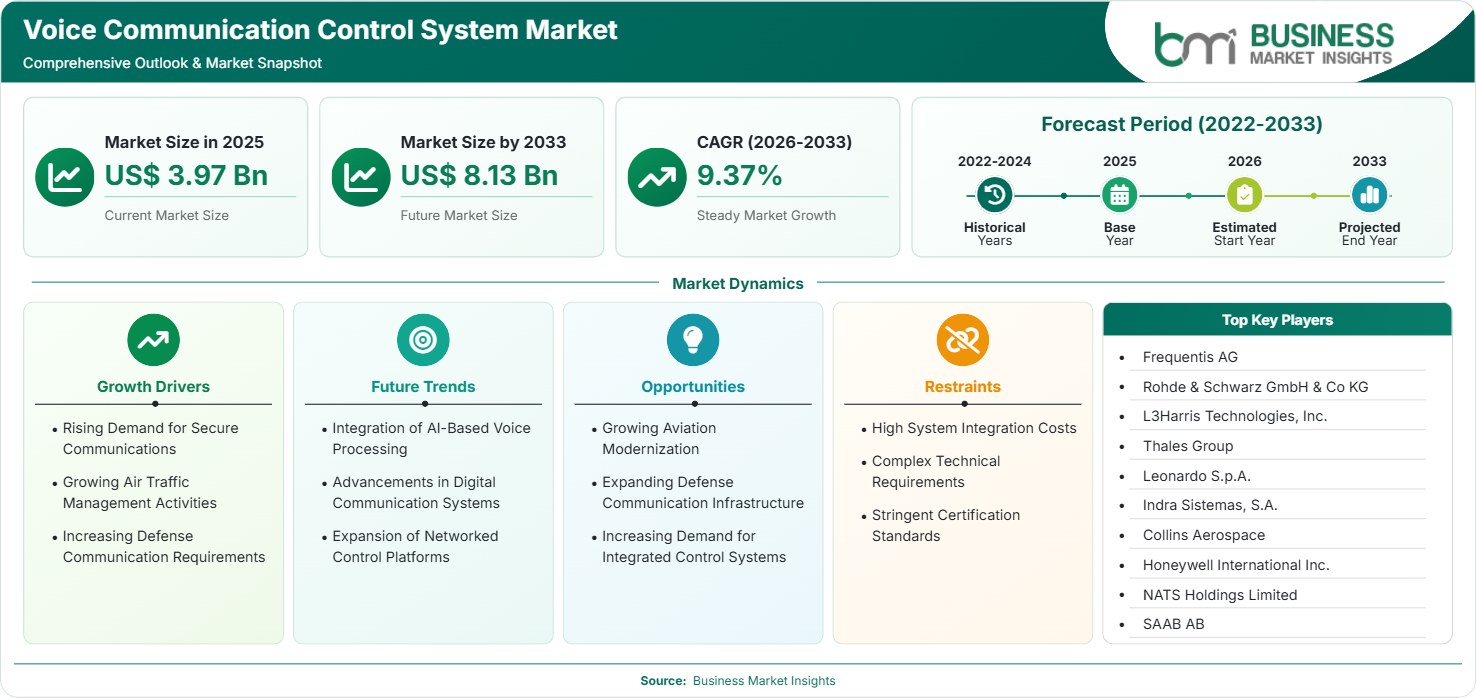
The Voice Communication Control System Market size was valued at US$ 3.97 Billion in 2025 and is projected to reach US$ 8.13 Billion by 2033, growing at a CAGR of 9.37% during 2026–2033, driven by air traffic modernization, defense communication upgrades, maritime safety mandates, and rising demand for secure, resilient, interoperable voice switching infrastructure worldwide.

Report Coverage
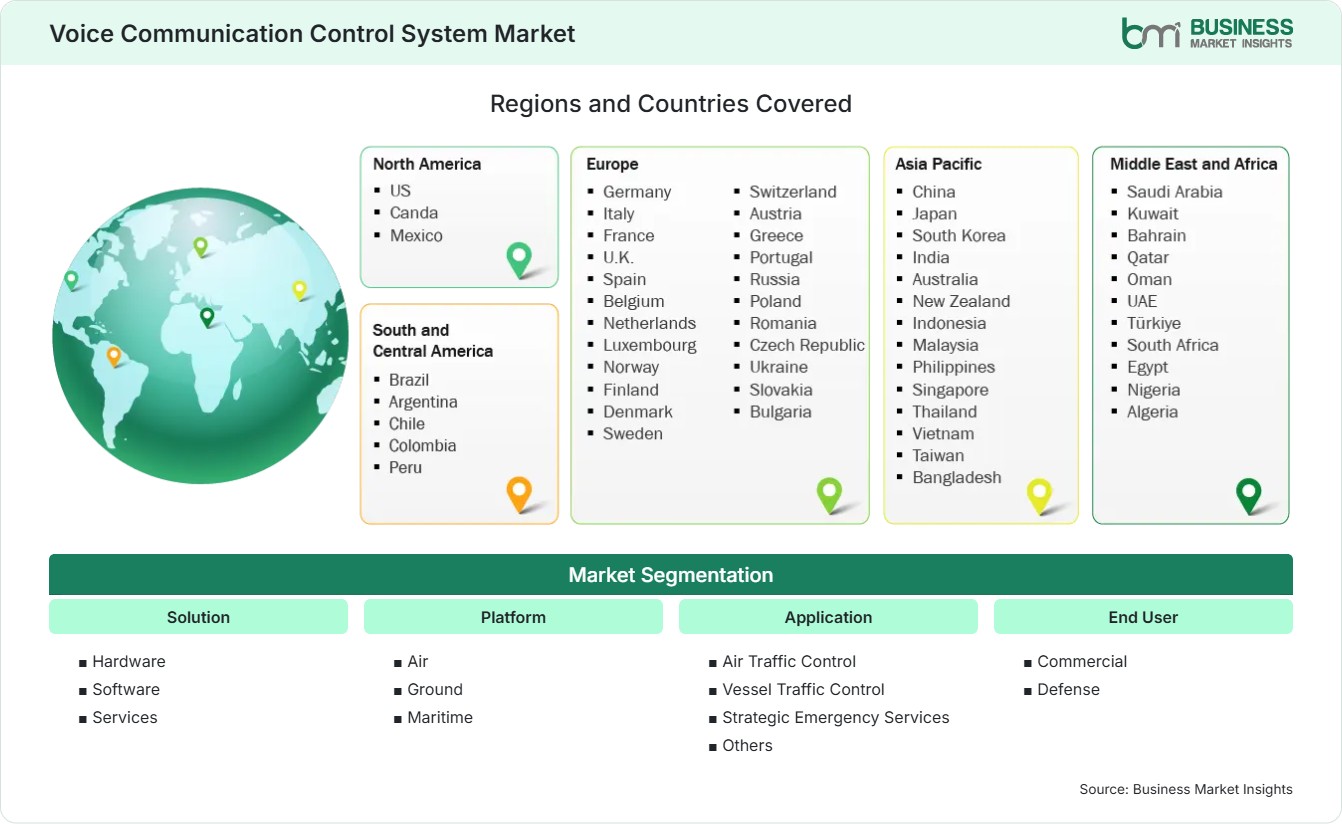
  • Solution: Hardware, Software, Services
  • Platform: Air, Ground, Maritime
  • Application: Air Traffic Control, Vessel Traffic Control, Strategic Emergency Services, Others
  • End User: Commercial, Defense
US$ 3.97 Bn Market size in 2025
US$ 8.13 Bn Market Size by 2033
9.37% CAGR, 2026 - 2033
2026-2033 Forecast Period

AI Overview

Voice Communication Control System Market Summary

  • North America Region: North America holds market share of 34%–37% in 2025, growing with a CAGR of 8.2%–9.1% between 2026 and 2033, influenced by FAA modernization programs, defense communication upgrades, and dense air traffic corridors. The U.S. market analysis shows a CAGR near 8.5%–9%, led by NextGen air traffic modernization.
  • Fastest Growing Region: Asia Pacific holds market share of 22%–25% in 2025, growing with a CAGR of 11.4%–12.8% between 2026 and 2033, influenced by airport expansion, naval fleet modernization, and rising defense budgets across China, India, and Southeast Asia.
  • Leading Segment: Hardware holds market share of 45%–48% in 2025, growing with a CAGR of 8.4%–9.1% between 2026 and 2033, influenced by radio consoles, switching units, and recorder replacement cycles across control towers and naval bases.
  • High Growth Segment: Software holds market share of 25%–28% in 2025, growing with a CAGR of 11.2%–12.5% between 2026 and 2033, influenced by IP-based architectures, virtualization, and cybersecurity-hardened dispatch platforms replacing legacy analog systems.
  • Key Market Opportunity: Rapid airspace modernization and naval digitalization programs are creating substantial upside for IP-based voice switching platforms, particularly across emerging aviation hubs and coastal defense networks through 2033.
  • Major Market Players: Frequentis AG, Rohde & Schwarz GmbH & Co KG, L3Harris Technologies, Inc., Thales Group, Leonardo S.p.A., Indra Sistemas, S.A., Collins Aerospace, Honeywell International Inc., NATS Holdings Limited, and SAAB AB.
Strategic Insights

Voice Communication Control System Market: Strategic Insights

Voice Communication Control System Market Strategic Framework
FREE PDF
Request your free sample
Request free sample
Stakeholder View

Key Takeaways

  • Ecosystem consolidation is intensifying as system integrators bundle radio hardware, dispatch software, and lifecycle maintenance contracts, shifting value capture toward long-term service agreements rather than one-time equipment sales.
  • Vessel traffic and strategic emergency service applications present the strongest incremental upside, as port authorities and public safety agencies replace aging analog consoles with interoperable digital dispatch networks.
  • Virtualization and cloud-hosted dispatch architectures are redefining product roadmaps, allowing operators to deploy voice switching capacity on commercial off-the-shelf servers rather than proprietary hardware racks.
  • Southeast Asia represents a compelling investment case, with airport capacity expansion and naval modernization programs in Vietnam, Indonesia, and the Philippines driving fresh procurement cycles through 2033.
  • Strategic partnerships and targeted acquisitions among avionics and defense communication specialists are accelerating, as larger integrators absorb niche software vendors to strengthen cybersecurity and interoperability portfolios.
Geographic Outlook

Voice Communication Control System Market Regional Highlights

North America Voice Communication Control System Market

North America commands market share of 34%–37% in 2025, expanding at a CAGR of 8.2%–9.1% through 2033. The region benefits from mature air traffic networks, sustained defense modernization spending, and early adoption of IP-based dispatch consoles across federal and municipal control facilities, reinforcing steady replacement and upgrade cycles.

  • FAA NextGen modernization programs continue funding tower and terminal radar approach control upgrades, sustaining consistent hardware and software refresh demand across the region.
  • Defense communication interoperability mandates under NORAD and allied coalition frameworks are driving procurement of encrypted, multi-channel voice switching platforms.
  • Canadian airport authorities are investing in remote and virtual tower technology, expanding addressable demand beyond traditional control-tower installations.
  • Growing coastal surveillance requirements are prompting U.S. Coast Guard modernization of vessel traffic communication infrastructure along major shipping corridors.

US Voice Communication Control System Market

The United States accounts for the majority of North American demand, growing at a CAGR of 8.5%–9%. Federal aviation modernization budgets, homeland security priorities, and naval communication upgrades collectively anchor sustained procurement across commercial airports and defense installations nationwide.

  • FAA contract awards for next-generation voice switching systems are replacing decades-old analog infrastructure across dozens of terminal facilities nationwide.
  • U.S. Navy fleet modernization programs are integrating secure digital voice consoles aboard next-generation surface combatants and shore command centers.
  • Rising general aviation traffic is pressuring regional airports to adopt scalable, cost-efficient digital dispatch platforms ahead of certification deadlines.

Europe Voice Communication Control System Market

Europe Voice Communication Control System Market holds share of 26%–29% in 2025, growing at a CAGR of 8.6%–9.5% through 2033. Single European Sky harmonization efforts and cross-border defense cooperation are accelerating standardized voice switching deployments across civil and military networks throughout the region.

  • Germany leads regional demand with a CAGR near 9%–9.8%, supported by Eurocontrol-aligned modernization and strong domestic defense communication manufacturing capacity.
  • The United Kingdom shows high growth potential with a CAGR of 10%–11.2%, driven by NATS-led airspace modernization and naval command infrastructure upgrades.
  • France and Italy are expanding joint defense communication procurement under European interoperability frameworks, supporting steady regional equipment renewal cycles.
  • Nordic countries are prioritizing resilient, redundant maritime traffic control systems given extensive coastline and offshore energy infrastructure protection needs.
  • Eastern European NATO members are upgrading legacy Soviet-era communication infrastructure, creating fresh replacement demand across border and coastal installations.

Asia Pacific Voice Communication Control System Market

Asia Pacific Voice Communication Control System Market share of 22%–25% in 2025, expanding at the fastest CAGR of 11.4%–12.8% through 2033. Rapid airport construction, rising defense budgets, and expanding maritime trade routes are collectively driving accelerated adoption of digital voice switching infrastructure across the region.

  • China leads regional demand with a CAGR of 12.5%–13.8%, supported by aggressive airport expansion and naval fleet digitalization under national modernization plans.
  • India shows exceptional growth potential with a CAGR of 13%–14.5%, driven by civil aviation capacity expansion and coastal surveillance network upgrades.
  • Japan and South Korea are modernizing air defense communication networks amid heightened regional security considerations and alliance interoperability requirements.
  • Southeast Asian nations including Vietnam and Indonesia are investing in port and airport communication infrastructure to support rising trade volumes.
  • Australia is upgrading remote tower and maritime patrol communication systems to strengthen coverage across vast, sparsely populated coastal territories.

Rest of World Voice Communication Control System Market

Rest of World, spanning South and Central America alongside the Middle East and Africa, Voice Communication Control System Market share of 8%–10% in 2025, growing at a CAGR of 9.8%–11%. Gulf aviation hub expansion and Latin American airport privatization are accelerating regional voice infrastructure procurement.

  • Brazil leads Latin American demand with a CAGR of 10.5%–11.8%, supported by airport privatization and expanding domestic air traffic volumes nationwide.
  • United Arab Emirates shows high growth potential with a CAGR of 12%–13.2%, driven by Gulf aviation hub expansion and naval modernization investment.
  • Saudi Arabia is investing heavily in airport and coastal defense communication infrastructure under national economic diversification strategies.
  • African civil aviation authorities are gradually upgrading legacy analog systems to meet international safety oversight audit requirements.
Global Market Geography
FREE PDF
Request your free sample
Request free sample
Segment Analysis

Voice Communication Control System Market Segmentation

Solution

The Solution segment anchors overall Voice Communication Control System Market scope, with hardware, software, and services collectively shaping deployment economics. Hardware retains 45%–48% share in 2025, growing at a CAGR of 8.4%–9.1% between 2026 and 2033, while software adoption accelerates fastest as operators pursue virtualization, cybersecurity hardening, and IP-based dispatch modernization.

  • Hardware: Radio consoles, switching units, and recording systems form the backbone of control facilities, sustaining steady replacement demand across aging installations.
  • Software: Dispatch and configuration software enables multi-channel management, virtualization, and cybersecurity hardening, driving fastest adoption among modernization-focused operators.
  • Services: Installation, integration, and lifecycle maintenance services support long-term system reliability, generating recurring revenue streams for solution providers.

Platform

Air platforms dominate deployment volume given extensive civil and military airspace networks, while maritime and ground platforms show accelerating adoption. Air-based systems hold the largest platform share in 2025, supported by dense control-tower infrastructure, while maritime platforms grow fastest amid vessel traffic and coastal surveillance expansion.

  • Air: Airport towers and terminal approach facilities rely on multi-channel voice switching to coordinate departures, arrivals, and emergency response communications continuously.
  • Ground: Ground-based command centers integrate voice switching with radar and surveillance data for coordinated military and civil defense operations.
  • Maritime: Port authorities and naval commands deploy maritime voice systems to manage vessel movements, coastal surveillance, and emergency maritime response coordination.

Application

Air traffic control applications generate the largest revenue pool given global aviation capacity expansion, while vessel traffic control and strategic emergency services applications show accelerating growth. This segmentation defines the practical Voice Communication Control System Market trends shaping procurement priorities across control-tower and dispatch environments worldwide.

  • Air Traffic Control: Control towers rely on multi-channel voice switching to coordinate aircraft movements safely across congested and expanding airspace corridors.
  • Vessel Traffic Control: Port and coastal authorities deploy dedicated voice systems to manage vessel movements and prevent maritime collision incidents.
  • Strategic Emergency Services: Emergency dispatch centers use resilient voice switching to coordinate first responders during crisis and disaster response operations.

End User

Commercial aviation and maritime operators drive baseline procurement volume, while defense end users sustain premium-value contracts tied to encrypted, mission-critical communication requirements. Defense demand grows fastest given rising global military modernization budgets and heightened emphasis on secure, interoperable command infrastructure.

  • Commercial: Airports, seaports, and civil aviation authorities prioritize scalable, cost-efficient voice switching platforms to support rising passenger and cargo traffic volumes.
  • Defense: Military branches deploy encrypted, hardened voice communication systems to ensure secure, interoperable command and control across joint operations.
Market Forces

Voice Communication Control System Market Dynamics

Key Market Drivers

Rising Demand for Secure Communications

Global aviation and defense authorities are prioritizing encrypted, tamper-resistant voice switching infrastructure as cyber threats targeting critical communication networks intensify. Regulatory organizations such as ICAO and national civil aviation agencies have raised the bar on certification in cybersecurity measures for control tower and dispatch systems, thereby obliging airlines to upgrade their old analog equipment with more secure digital solutions. These factors are having a direct impact on the Voice Communication Control System Market growth, since procurement timelines are being sped up for commercial as well as military airfields. The market trends are characterized by providers combining cybersecurity audits with equipment installations.

Growing Air Traffic Management Activities

International forecasts predict that worldwide passenger air traffic will continue to grow, with yearly growth exceeding levels seen before the pandemic in the majority of geographic regions. Voice Communication Control System Market trend is creating an immediate pressure on traditional air traffic control tower technology, driving government aviation authorities to speed up voice switching upgrade initiatives due to increased channel congestion and higher controller loads. New airport terminals under development in the Asia Pacific and Middle East regions demand new, fully integrated IP dispatch consoles right from the ground up. At the same time, established regions like North America and Europe are updating their old towers to increase life cycle and comply with new interoperability requirements.

Increasing Defense Communication Requirements

Global Defense budgets are rising amid heightened geopolitical tensions, with several NATO members increasing spending allocations toward interoperable command and control infrastructure. With regards to the development of naval and army forces, it is common practice to develop encrypted voice switching technology that will be able to work seamlessly in a joint and coalition environment. This has increased the procurement value of robust and mobile communication systems that will be able to work in both shore and naval environments. The defense contractors have been developing modular systems that are capable of being rapidly deployed yet conforming to stringent security measures. With the increase in multinational exercises, interoperability has become a critical procurement requirement.

Key Market Opportunities

Growing Aviation Modernization

Civil aviation authorities in developing countries are launching multi-year airspace modernization programs that bundle radar, navigation, and voice switching infrastructure into unified procurement packages. There is significant opportunity here for those vendors who can provide integrated solutions. The motivation is based on lifecycle value, since the modernization projects will include long-term commitments to maintenance and software updates over a period of a decade. Some emerging applications include the installation of remote and virtual towers, whereby one control tower monitors several smaller airports through voice and video connectivity, thus saving costs and also extending coverage to secondary airports that have previously been neglected.

Expanding Defense Communication Infrastructure

The naval modernization efforts across the Asia Pacific, Middle East, and Europe regions are offering ample opportunities to develop voice switching solutions onboard ships as well as onshore, in line with the Voice Communication Control System Market Forecast. The investments are driven by understanding that traditional analog naval communication systems pose both the risk of vulnerability and lack of interoperability in case of joint exercises. Potential use cases for voice switching involve the development of voice switching protocols for unmanned surface vessels, in addition to existing use cases. Ministries of defense are leaning towards voice switching solution providers that have strong credentials in terms of cybersecurity and interoperability across several countries, giving an edge to established companies over newcomers.

Increasing Demand for Integrated Control Systems

Operators across aviation, maritime, and emergency services are increasingly seeking unified platforms that integrate voice switching with radar, surveillance, and data communication systems rather than procuring standalone components. This convergence provides an opportunity for those vendors who provide an open-architecture platform that works with the third-party sensor and navigation solutions. The logic behind investing supports integration solutions that help in reducing the cost of ownership by utilizing the common infrastructure and easy maintenance contract management. Some of the emerging use cases include interoperable communication network among agencies for coordinating emergencies wherein police, fire departments, and medical dispatch services will work on the same voice network during emergencies.

Market Restraints and Challenges

High System Integration Costs

Factor: Deploying modern voice switching infrastructure requires extensive integration with legacy radar, navigation, and telephony systems, often necessitating custom engineering work rather than off-the-shelf installation. Impact: This substantially raises upfront project costs, particularly for smaller regional airports and developing-economy defense agencies operating under constrained capital budgets. Integration complexity frequently extends project timelines beyond initial estimates, as compatibility testing across heterogeneous legacy systems reveals unforeseen technical conflicts requiring additional engineering resources. This cost sensitivity disproportionately affects emerging markets, where capital constraints limit the pace of digital transformation despite clear operational and safety benefits associated with modern integrated voice switching infrastructure adoption.

Complex Technical Requirements

Factor: Voice communication control systems must satisfy stringent certification standards spanning cybersecurity resilience, redundancy, latency, and interoperability across multiple regulatory jurisdictions simultaneously. Impact: This complexity extends procurement and certification timelines, often requiring twelve to twenty-four months between contract award and full operational deployment. Vendors must maintain specialized engineering teams capable of navigating varying national certification frameworks, raising fixed operating costs that smaller specialist firms may struggle to sustain. Additionally, rapid technology evolution means certified systems can face obsolescence pressure within a few years, requiring continuous re-certification investment.

Company Analysis

Competitive Landscape

The Voice Communication Control System Market analysis reveals a moderately consolidated competitive landscape dominated by established aerospace, defense, and communication technology specialists with deep certification expertise and long-standing government relationships.

Company Name

Overview

Products and Services relevant to this market

Frequentis AG

Austrian specialist in air traffic and public safety voice communication for towers and dispatch centers.

Voice communication systems, integrated control-room platforms, and ATM dispatch consoles.

Rohde & Schwarz GmbH & Co KG

German group providing secure radio communication and signal management for aviation and defense.

Digital voice switching, secure radio relay networks, and ATC communication infrastructure.

L3Harris Technologies, Inc.

U.S. defense and aerospace firm delivering mission-critical communication systems for military and civil clients.

Tactical voice switching, encrypted radio networks, and command communication platforms.

Thales Group

French multinational providing aerospace, defense, and security technology across global markets.

ATM voice systems, naval communication suites, and secure dispatch infrastructure.

Leonardo S.p.A.

Italian aerospace and defense conglomerate supplying communication systems for civil and military use.

Ground command communication, naval voice switching, and air defense dispatch systems.

Indra Sistemas, S.A.

Spanish technology firm specializing in air traffic management and defense electronics.

Voice control platforms, ATM software suites, and radar-integrated dispatch systems.

Collins Aerospace

U.S. avionics supplier delivering communication infrastructure for commercial and defense aviation.

Cockpit and ground voice systems, ATC consoles, and navigation-integrated dispatch.

Honeywell International Inc.

American conglomerate providing avionics and communication technologies across aerospace and defense.

Air traffic voice switching, control-tower dispatch consoles, and airport communication solutions.

NATS Holdings Limited

UK air navigation service provider operating control towers and airspace infrastructure.

ATC voice systems, remote tower communication platforms, and airspace dispatch operations.

SAAB AB

Swedish defense and security company delivering surveillance and traffic management technology.

Vessel traffic voice systems, naval communication suites, and maritime dispatch platforms.

Trust & Transparency

Research Methodology

The market analysis combines proprietary research with secondary data from government agencies, company disclosures, regulatory filings, industry databases and expert interviews. Market estimates are validated through data triangulation, cross-market benchmarking and analyst review.

View Full Research Methodology

Questions Answered

Frequently Asked Questions

Where can stakeholders access detailed segment-level data?

Stakeholders seeking granular segment, country, and company-level breakdowns can consult the full Voice Communication Control System Market Report, detailing methodology, forecasts, and competitive benchmarking through 2033.

What are the key challenges facing system vendors?

High integration costs and complex, multi-jurisdictional certification requirements remain primary challenges, particularly for smaller regional airports and budget-constrained defense procurement programs.

Which segment holds the largest revenue share currently?

The Hardware segment under Solution holds the largest share, driven by ongoing console, switching unit, and recorder replacement cycles across towers and naval command facilities.

Which region is expected to grow fastest through 2033?

Asia Pacific is expected to register the fastest growth, supported by airport expansion, naval digitalization, and rising defense communication budgets across China, India, and Southeast Asia.

What is the projected size of the Voice Communication Control System Market by 2033?

It is projected to reach US$ 8.13 Billion by 2033, expanding from US$ 3.97 Billion in 2025 at a CAGR of 9.37% between 2026 and 2033.

Access the Full Voice Communication Control System Market Report

Get segment-level forecasts, regional estimates, competitive benchmarking, company profiles and downloadable Excel datasets.

Access the full Voice Communication Control System Market Report
350 pages PDF & Excel | 2026-08-21
Similar Research

Related Market Reports