
Flight Simulator Market Outlook: Size, Share, Trends, Growth Analysis, Competitive Landscape & Forecast, 2026-2033

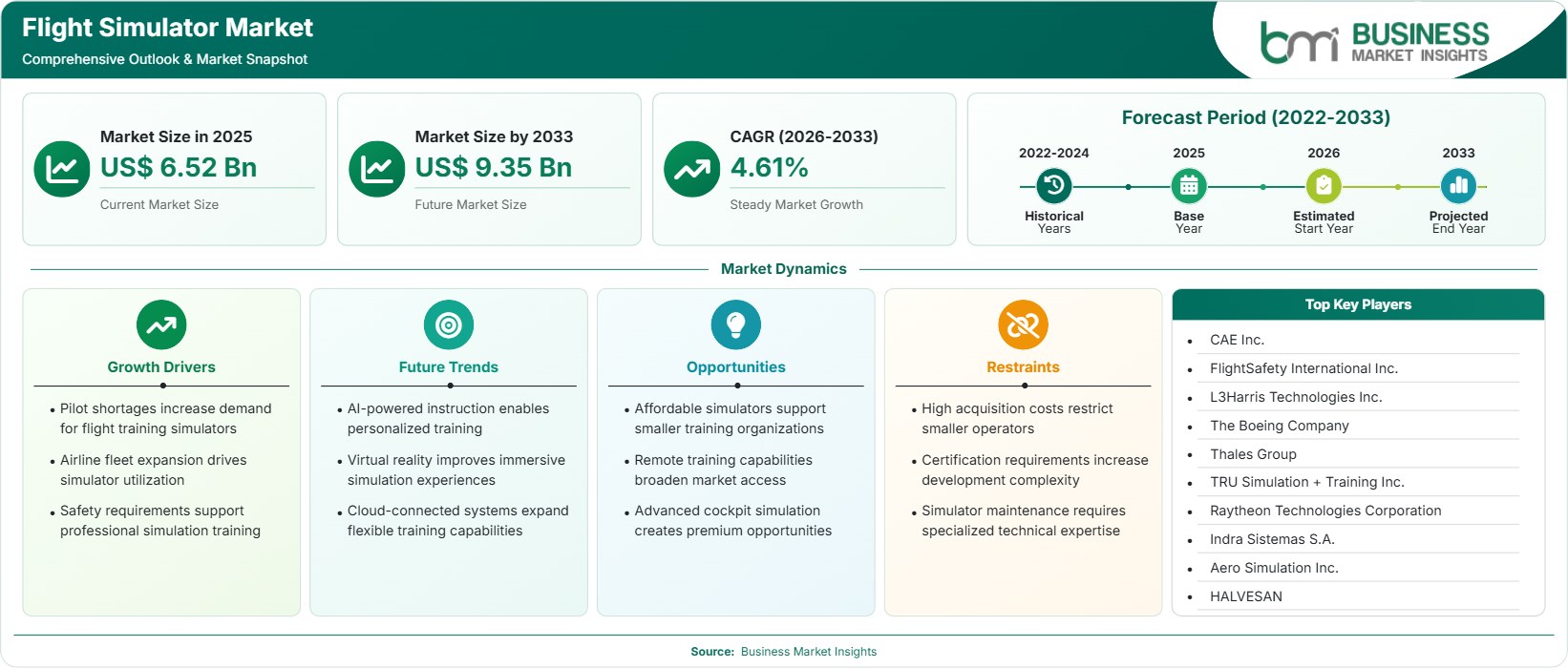
The Flight Simulator Market size was valued at USD 6.52 Billion in 2025 and is projected to reach USD 9.35 Billion by 2033, growing at a CAGR of 4.61% during 2026–2033. Rising pilot demand, airline fleet expansion, advanced simulation technologies, and increasing emphasis on aviation safety and cost-efficient training continue creating growth opportunities across commercial and military aviation sectors.

Report Coverage
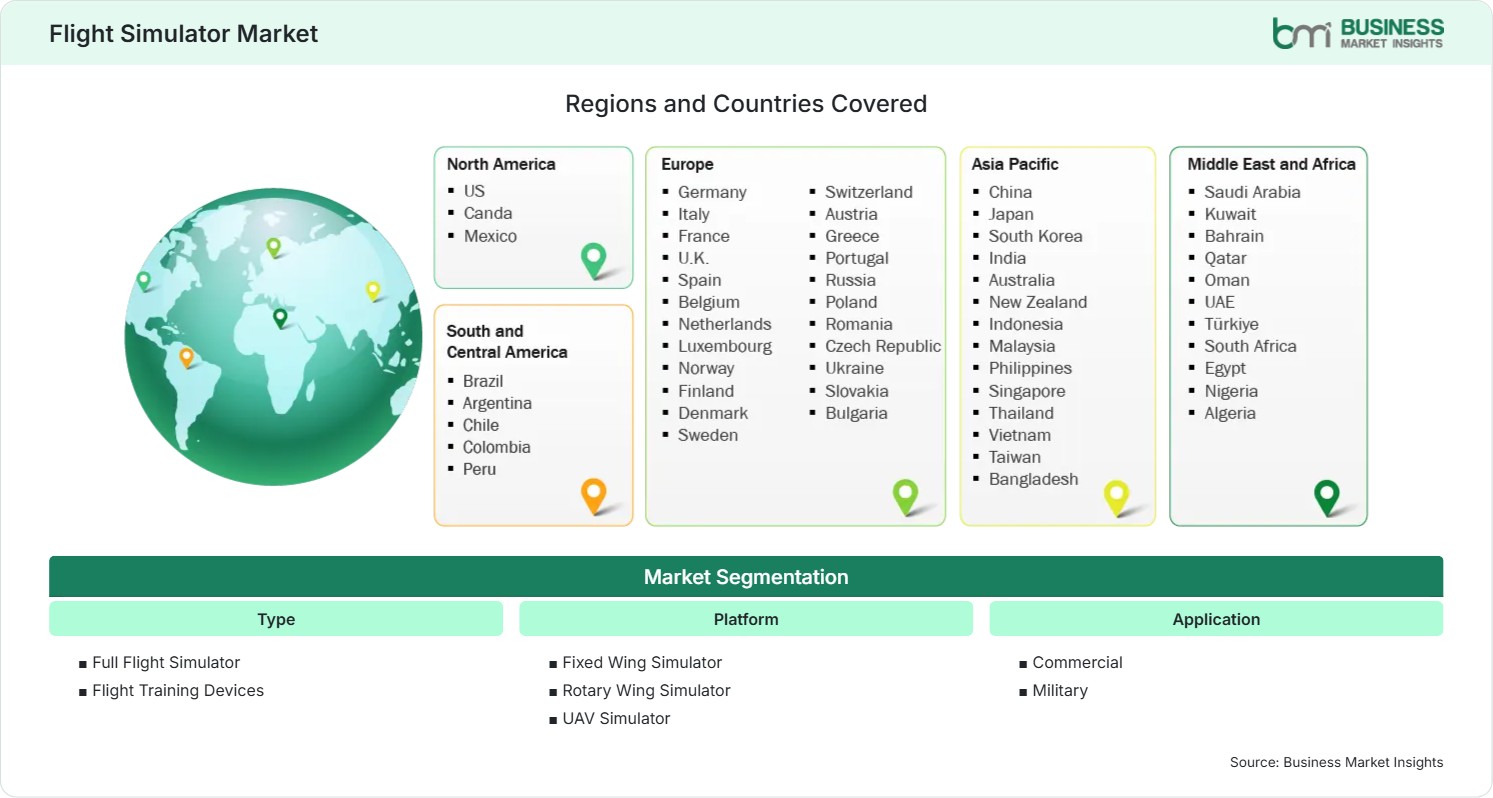
  • Type: Full Flight Simulator, Flight Training Devices
  • Platform: Fixed Wing Simulator, Rotary Wing Simulator, UAV Simulator
  • Application: Commercial, Military
US$ 6.52 Bn Market size in 2025
US$ 9.35 Bn Market Size by 2033
4.61% CAGR, 2026 - 2033
2026-2033 Forecast Period

01 AI Overview

Flight Simulator Market Summary

  • North America Region: North America holds 38%–41% share in 2025 and is projected to grow at a 4.0%–4.6% CAGR during 2026–2033. Strong aviation infrastructure, extensive airline training requirements, military modernization programs, and widespread simulator deployment continue supporting market demand. US market benefits from large pilot-training networks and defense investments, advancing at 4.1%–4.8% CAGR.
  • Fastest Growing Region: Asia Pacific accounts for 24%–28% share in 2025 and is forecast to expand at a 5.6%–6.3% CAGR during 2026–2033. Expanding airline fleets, pilot shortages, rising air travel volumes, and growing aviation-training investments continue accelerating simulator adoption.
  • Leading Segment: Full Flight Simulator represents 58%–62% share in 2025 and is expected to grow at a 4.5%–5.1% CAGR. High-fidelity pilot training requirements, regulatory compliance standards, and operational realism support widespread utilization.
  • High Growth Segment: UAV Simulator accounts for 18%–22% share in 2025 and is projected to expand at a 6.2%–6.8% CAGR. Growing military drone deployment, commercial unmanned operations, and advanced mission-training requirements continue strengthening demand.
  • Key Market Opportunity: Integration of immersive technologies, artificial intelligence, cloud-based training environments, and distributed simulation networks creates opportunities for scalable pilot-training and mission-rehearsal solutions worldwide.
  • Major Market Players: CAE Inc., FlightSafety International Inc., L3Harris Technologies, Inc., The Boeing Company, Thales S.A., TRU Simulation + Training Inc., RTX Corporation, Indra Sistemas, S.A., Aero Simulation, Inc., HAVELSAN A.Ş.
02 Strategic Insights

Flight Simulator Market: Strategic Insights

Flight Simulator Market Strategic Framework
FREE PDF
Request your free sample
Request free sample
03 Stakeholder View

Key Takeaways

  • The industry ecosystem increasingly combines simulator manufacturers, avionics suppliers, software developers, airlines, military organizations, and training institutions to deliver integrated pilot-training solutions.
  • UAV simulation and advanced military-training applications represent significant growth opportunities due to rising defense investments and expanding autonomous-aircraft operations.
  • Innovation is increasingly focused on artificial intelligence, mixed reality technologies, cloud-based simulation platforms, and predictive training analytics to improve learning outcomes.
  • Asia Pacific offers the strongest regional expansion potential due to growing commercial aviation fleets and increasing demand for qualified aviation professionals.
  • Strategic partnerships between simulator providers and aviation-training organizations continue supporting long-term recurring revenue and technology adoption.
  • Increasing emphasis on cost-efficient training, fuel savings, and operational safety is accelerating the transition from traditional flight hours toward simulation-based learning.
04 Geographic Outlook

Flight Simulator Market Regional Highlights

North America Flight Simulator Market

North America represented 38%–41% Flight Simulator Market share in 2025 and is expected to expand at a 4.0%–4.6% CAGR through 2033. An experienced aerospace environment, stringent pilot training standards, and heavy defense spending remain as key factors fueling growth. Commercial aviation companies have started focusing on building simulators due to development needs in the labor force, whereas defense forces have begun utilizing simulation technology in their mission preparations and training programs.

  • Large commercial airlines continue expanding simulator utilization to support pilot recruitment, recurrent training requirements, and fleet-transition programs across multiple aircraft platforms.
  • Defense organizations increasingly deploy high-fidelity simulation environments to enhance readiness while reducing operational costs associated with live-flight exercises.
  • Aviation-training providers continue investing in modern simulator systems capable of supporting competency-based training methodologies and regulatory compliance requirements.
  • Growing adoption of digital training platforms improves accessibility, scheduling flexibility, and training efficiency across aviation organizations.
  • Advanced visualization systems, motion technologies, and AI-enabled assessment tools continue enhancing simulation realism and trainee performance measurement.

US Flight Simulator Market

The United States accounts for approximately 80%–84% share within North America and is projected to grow at a 4.1%–4.8% CAGR during 2026–2033. The strength of the airline industry, high defense spending, and the aviation training industry make it easier for national leaders to take control. The training companies keep growing their fleet of simulators to cope with more and more pilots, while defense organizations are building mission training simulators.

  • Commercial pilot shortages continue encouraging investment in expanded simulator infrastructure and capacity additions.
  • Military organizations prioritize simulation technologies to improve mission readiness and reduce operational training expenditures.
  • Aircraft fleet modernization programs support demand for next-generation simulation platforms aligned with evolving aircraft technologies.
  • Aviation academies increasingly integrate immersive learning environments and advanced training analytics into pilot-development programs.

Europe Flight Simulator Market

Europe accounted for 26%–29% share in 2025 and is projected to expand at a 4.3%–4.9% CAGR through 2033. Stringent regulation, high-quality aviation training standards, and ongoing modernization efforts for the defense sector help sustain the uptake of the simulators. Germany stands out as the biggest market in the region owing to its strong presence in the aerospace industry and commercial aviation, whereas the countries from Eastern Europe are growing at a rapid pace owing to the improvements in their pilot training facilities.

  • Germany leads regional demand through extensive airline-training activities, military aviation programs, and strong aerospace manufacturing capabilities.
  • Poland and Romania demonstrate accelerated growth as aviation-training infrastructure expands and regional air traffic continues increasing.
  • Aviation regulators continue encouraging advanced simulator usage to improve pilot proficiency and operational safety outcomes.
  • Airlines increasingly rely on simulation-based training to reduce fuel costs and improve training efficiency.
  • Defense organizations continue expanding mission-training capabilities through investment in advanced simulation environments.

Asia Pacific Flight Simulator Market

Asia Pacific represented 24%–28% share in 2025 and is anticipated to register the fastest growth at 5.6%–6.3% CAGR through 2033. Rapid expansion of commercial aviation networks, increasing passenger traffic, and rising pilot demand continue supporting market development. China leads regional revenues through large-scale fleet growth and aviation investments, while India demonstrates the strongest expansion due to increasing airline operations and pilot-training requirements. Growing investments in defense aviation training further contribute to regional demand for advanced simulation platforms.

  • China benefits from extensive fleet-expansion programs and significant investment in aviation-training infrastructure.
  • India records strong growth driven by increasing aircraft deliveries, rising air traffic, and higher pilot-certification requirements.
  • Regional airlines continue investing in simulator capacity to support workforce development and fleet-transition programs.
  • Defense modernization initiatives support growing adoption of fixed-wing, rotary-wing, and UAV simulation technologies.
  • Training organizations increasingly deploy advanced digital simulation systems to improve training throughput and efficiency.

Rest of World Flight Simulator Market

Rest of World accounted for 8%–11% share in 2025 and is expected to expand at a 4.8%–5.4% CAGR through 2033. South and Central America benefit from growing regional aviation activity and pilot-development initiatives. The Middle East and Africa region demonstrates strong demand driven by airline expansion, defense procurement programs, and international aviation-training investments. Brazil remains the leading contributor in Latin America, while the United Arab Emirates exhibits strong growth through aviation-sector development and advanced training infrastructure projects.

  • Airline expansion across emerging aviation markets continues supporting investments in simulation-based pilot training programs.
  • Defense organizations increasingly adopt simulator technologies to improve mission readiness and operational preparedness.
  • Aviation academies are expanding training capacity to address growing pilot demand and workforce shortages.
  • Modern training centers increasingly deploy advanced simulation platforms aligned with international certification standards.
  • Rising aviation safety requirements continue strengthening demand for high-fidelity simulation technologies.
Global Market Geography
FREE PDF
Request your free sample
Request free sample
05 Segment Analysis

Flight Simulator Market Segmentation

Type

Full Flight Simulator represents approximately 58%–62% share in 2025 and is projected to expand at a 4.5%–5.1% CAGR through 2034. The Flight Simulator Market scope continues broadening as aviation authorities, airlines, and defense organizations prioritize highly immersive training environments that replicate real-world operational scenarios. Superior realism, regulatory acceptance, and extensive deployment across pilot-certification programs continue supporting segment leadership.

  • Full Flight Simulator: Widely utilized for pilot certification, recurrent training, emergency procedures, and aircraft-transition programs requiring maximum training realism and regulatory compliance.
  • Flight Training Devices: Cost-effective training solutions supporting procedural instruction, cockpit familiarization, and foundational pilot-training requirements across aviation organizations.

Platform

Fixed Wing Simulator accounts for approximately 54%–58% share in 2025 and is expected to grow at 4.4%–5.0% CAGR through 2034. Strong deployment across commercial airlines, business aviation operators, and military organizations supports continued demand. Fixed-wing simulation remains essential for pilot qualification, recurrent training, and aircraft-type transition programs.

  • Fixed Wing Simulator: Supports training requirements across commercial aviation, military aviation, and corporate flight operations using highly realistic mission environments.
  • Rotary Wing Simulator: Increasingly adopted for helicopter pilot training involving emergency-response, offshore, military, and utility aviation operations.
  • UAV Simulator: Supports training for unmanned aircraft operations, mission planning, payload management, and defense-oriented drone applications.

Application

Commercial aviation remains the leading application segment with approximately 64%–68% share in 2025 and projected growth of 4.3%–4.8% CAGR through 2034. The Flight Simulator Market trends indicate increasing simulator utilization as airlines seek scalable training solutions capable of supporting rapid pilot development while maintaining high operational safety standards.

  • Commercial: Strong demand is driven by airline fleet growth, pilot shortages, regulatory requirements, and increasing passenger traffic worldwide.
  • Military: Defense organizations continue investing in advanced simulation technologies to improve operational readiness and reduce live-flight training expenditure.
06 Market Forces

Flight Simulator Market Dynamics

Key Market Drivers

Pilot shortages increase demand for flight training simulators

The global aviation industry continues facing pilot shortages, encouraging airlines and training organizations to expand simulator-based instruction programs. The Flight Simulator Market growth outlook is supported by increasing commercial aircraft deliveries, rising retirement rates among experienced pilots, and growing demand for cost-efficient training methods. Flight simulators permit operators to fast-track pilot training while at the same time upholding stringent safety and regulatory requirements. Airlines are more than ever using sophisticated simulation systems to complement flight hours and enhance efficiency of their training programs. With the growth of traffic and aircraft fleets, the use of simulators is on the rise.

Airline fleet expansion drives simulator utilization

Commercial airlines worldwide continue expanding fleets to accommodate increasing passenger volumes and route-network growth. Each additional aircraft results in an increased requirement of pilot training, which leads to increased requirements for simulation. Recurrent training, type ratings, and transition training are required by airlines, and each of these requires simulation. Full flight simulators provide a realistic environment for pilots and ensure readiness while keeping training expenses low. The growing number of aircraft in service will increase the need for flight simulators in the future.

Safety requirements support professional simulation training

Aviation regulators and operators maintain stringent safety requirements that emphasize continuous pilot proficiency and operational preparedness. Simulators ensure the safe reproduction of complicated atmospheric situations, malfunctioning systems, and emergency scenarios which cannot be replicated through real-world flights. Simulation technology is widely used by many training institutions to achieve better results and facilitate meeting aviation requirements. The commitment to safety excellence and competency-based training models constitutes one of the important factors in the development of simulation technology.

Key Market Opportunities

Affordable simulators support smaller training organizations

Cost-effective simulator platforms are creating opportunities among regional flight schools, independent training centers, and smaller aviation operators. Advances in computing power, software development, and visualization technologies have made simulation systems more accessible without compromising training effectiveness. Flight Simulator Market Forecasts indicate growing demand for affordable solutions that support pilot qualification and procedural training. Suppliers capable of delivering scalable and flexible platforms can benefit from expanding adoption across emerging aviation markets. These developments broaden market participation while supporting workforce development initiatives globally.

Remote training capabilities broaden market access

Digital connectivity and cloud-based training systems help companies increase access to simulated learning experiences. Remote monitoring and assistance, along with distributed training systems, can overcome geographical limitations and make better use of resources. Airlines are more often opting for hybrid learning programs, whereby simulator training is complemented by online education services. With increasing needs for training on a global scale, there are plenty of promising options for tech companies.

Advanced cockpit simulation creates premium opportunities

Growing demand for immersive training experiences is increasing interest in advanced cockpit simulation technologies. Advanced technologies include artificial intelligence, sophisticated motion platforms, real-time analytics, and higher visual resolution. Advanced simulations make it possible for aviation institutions to enhance their training programs and operational readiness. Those simulation system providers who offer the most realistic simulation experience can differentiate themselves and generate demand from commercial airlines, military institutions, and training centers.

Market Restraints and Challenges

High acquisition costs restrict smaller operators

Factor: Full-flight simulators require substantial investment in hardware, software, motion systems, facility infrastructure, and certification processes. Impact: Financial constraints may be faced by smaller airlines, private training organizations, and developing countries' aviation training schools that prevent them from making use of simulators on a large scale. High purchase costs make the payback period of the simulation process long. Although simulator use results in savings over time, capital is still a recurring issue among budgeted companies.

Certification requirements increase development complexity

Factor: Flight simulation systems must satisfy extensive regulatory standards and certification requirements before deployment. Impact: The compliance requirements result in longer development time frames, higher testing costs, and greater engineering challenges for simulation manufacturers. Compliance requirements may entail substantial costs incurred during the process of validation, verification, and performance evaluation. Nevertheless, compliance requirements are extremely necessary to provide realistic environment of training and preserve the safety goals of aviation.

07 Company Analysis

Competitive Landscape

The Flight Simulator Market analysis reflects competition centered on simulation realism, digital training technologies, regulatory compliance expertise, military modernization programs, and integrated pilot-training solutions.

Company Name

Overview

Products and Services relevant to this market

CAE Inc.

Global aviation training and simulation leader serving commercial and defense customers worldwide.

Full-flight simulators, training services, digital aviation solutions, and mission training systems.

FlightSafety International Inc.

Aviation training specialist focused on pilot development and safety enhancement.

Flight simulators, pilot training services, maintenance training, and operational readiness programs.

L3Harris Technologies, Inc.

Defense and aerospace technology company providing advanced simulation and training systems.

Flight simulators, military training platforms, mission rehearsal systems, and avionics-based solutions.

The Boeing Company

Aerospace manufacturer with extensive pilot-training and simulation capabilities.

Commercial aircraft simulators, training solutions, digital learning systems, and aviation services.

Thales S.A.

Global technology company serving defense, aerospace, and transportation sectors.

Full-flight simulators, training devices, military simulation systems, and immersive training platforms.

TRU Simulation + Training Inc.

Aviation training company specializing in simulator development and pilot instruction.

Flight training devices, full-flight simulators, support services, and pilot-training technologies.

RTX Corporation

Aerospace and defense company delivering advanced simulation and mission-training technologies.

Military flight simulators, integrated training systems, and operational preparedness solutions.

Indra Sistemas, S.A.

Technology company providing simulation and defense-training solutions globally.

Flight simulators, mission-training platforms, air traffic simulation, and defense systems.

Aero Simulation, Inc.

Specialized aviation-training company serving regional and commercial operators.

Flight training devices, simulator support services, and pilot-training programs.

HAVELSAN A.Ş.

Defense technology company developing advanced training and simulation systems.

Flight simulators, military training systems, mission rehearsal applications, and virtual training solutions.

10 Trust & Transparency

Research Methodology

The market analysis combines proprietary research with secondary data from government agencies, company disclosures, regulatory filings, industry databases and expert interviews. Market estimates are validated through data triangulation, cross-market benchmarking and analyst review.

View Full Research Methodology

11 Questions Answered

Frequently Asked Questions

What insights does a Flight Simulator Market Report provide?

A Market Report provides insights into market size, competitive dynamics, technology developments, regulatory influences, training demand patterns, and future business opportunities across commercial and military aviation.

How do simulators reduce training costs?

Simulators reduce fuel consumption, aircraft wear, maintenance expenses, and operational disruptions while enabling repeatable training environments for pilots.

Which platform segment is growing fastest?

UAV simulators are demonstrating the strongest growth due to expanding military drone programs and increasing commercial unmanned-aircraft applications.

Why are full-flight simulators widely adopted?

They provide highly realistic aircraft replication, support regulatory certification requirements, improve training effectiveness, and allow safe practice of emergency procedures.

What is a flight simulator?

A flight simulator is a training system that replicates aircraft behavior, cockpit functions, weather conditions, and operational scenarios to support pilot training without actual flight operations.

Access the Full Flight Simulator Market Report

Get segment-level forecasts, regional estimates, competitive benchmarking, company profiles and downloadable Excel datasets.

Access the full Flight Simulator Market Report
350 pages PDF & Excel | 2026-08-20