UAV Simulator Market Regional Highlights
North America UAV Simulator Market
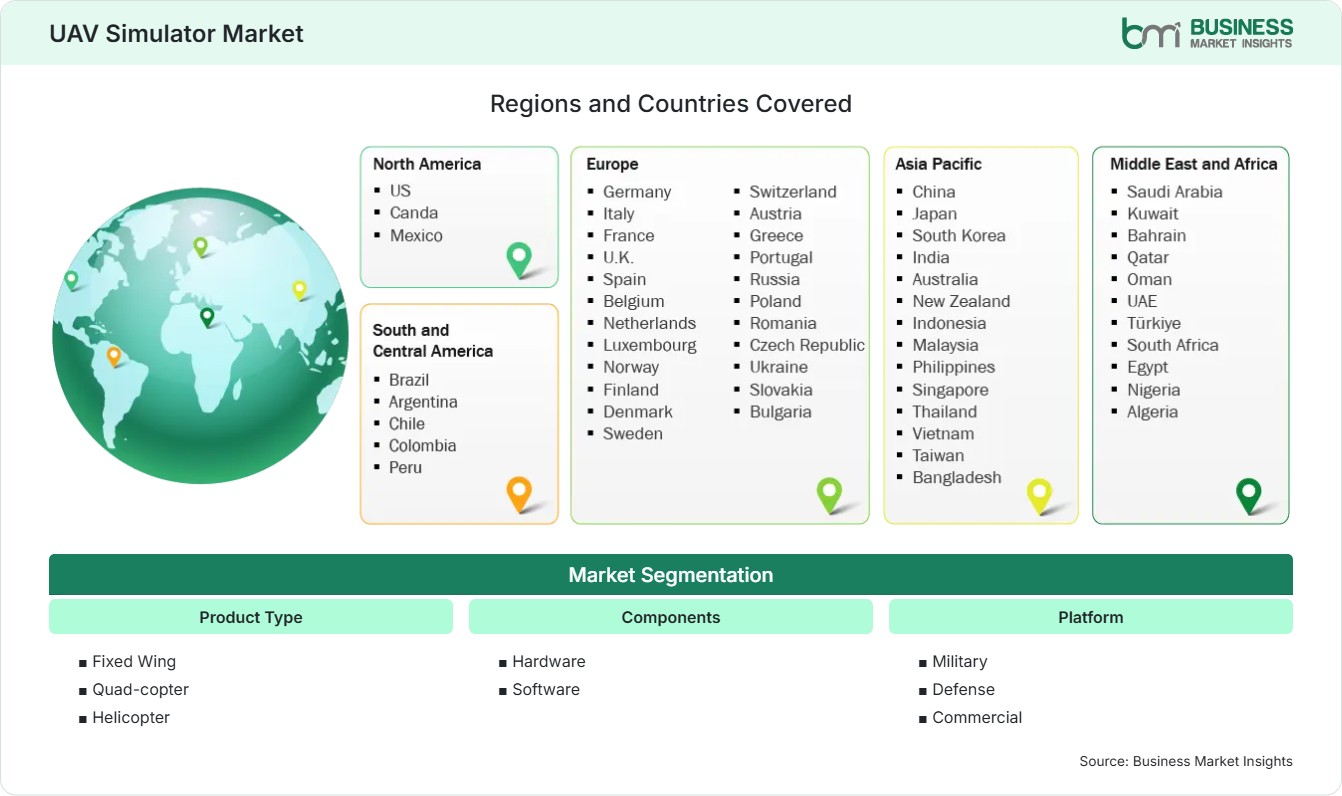
North America accounts for 36%–39% of global revenue in 2025 and is projected to expand at a 17%–19% CAGR through 2033. Strong defense expenditures, advanced UAV deployment, and established aerospace infrastructure underpin regional leadership. The UAV Simulator Market share remains concentrated in the United States and Canada, where military modernization initiatives and commercial drone expansion continue to generate demand. Growth is supported by synthetic training technologies, AI-enabled mission simulation, and increasing adoption of digital training frameworks across defense and civilian operator programs.
- Defense agencies continue replacing portions of live-flight training with simulation platforms to reduce costs, improve safety, and enhance mission readiness while supporting increasingly sophisticated unmanned systems.
- Commercial drone service providers are investing in operator qualification systems aligned with evolving FAA requirements and beyond-visual-line-of-sight operational frameworks.
- AI-assisted mission rehearsal solutions are gaining traction for complex surveillance, logistics, and emergency response scenarios requiring repeatable performance evaluation.
- Collaboration between aerospace primes and training providers supports integrated simulation ecosystems that connect planning, execution, and post-mission analysis capabilities.
US UAV Simulator Market
The US accounts for 78%-82% of North American revenue share and grows at a 18%-20% CAGR through 2033. Federal government defense spending, innovative drone developments in the commercial sector, and advanced research projects boost the market demand. A high number of simulator developers, UAV suppliers, and military customers facilitates technology commercialization and deployment. Government efforts towards autonomy, swarm technologies, and synthetic environment solutions continue to boost procurement potential across various training fields.
- Defense modernization strategies prioritize immersive simulation platforms for operator proficiency and mission preparation involving increasingly autonomous unmanned systems.
- Growing use of drones in infrastructure monitoring, energy inspections, and public safety creates new certification and training requirements.
- Federal research funding accelerates development of digital-twin-based evaluation tools and next-generation synthetic training environments.
Europe UAV Simulator Market
Europe represents 25%–28% market share in 2025 and exhibits a CAGR of 18%–20%. The region’s demand in the UAV market will be driven by defense preparedness programs, cross-border security needs, and increased commercial use of drones. Germany ranks as the most prominent adopter in the region, while Poland experiences rapid growth, with a CAGR above the regional average. Growth in the UAV market is sustained by indigenous UAV development, NATO interoperability requirements, and simulation infrastructure.
- European defense organizations increasingly emphasize simulation-based preparedness, reducing operating expenses while enhancing mission effectiveness.
- Drone regulations supporting industrial inspection and infrastructure monitoring strengthen commercial training demand.
- Cross-border security concerns are encouraging investment in advanced mission rehearsal and operator proficiency systems.
- Collaboration among aerospace manufacturers and technology providers promotes development of interoperable and scalable simulation solutions.
Asia Pacific UAV Simulator Market
Asia Pacific is projected to have a market share of 24% to 27% in 2025 and the highest CAGR of 21% to 23% through 2033. The UAV Simulator market in China is the largest in the region, whereas India's is the fastest-growing in terms of national opportunities, driven by rising defense procurement and the indigenous development of UAVs. The rising need for surveillance, drones, and public sector investments ensures high demand.
- Indigenous UAV development programs are creating sustained simulator procurement opportunities for military and civilian training institutions.
- Growing drone deployments in agriculture, logistics, and infrastructure inspection support broader operator training investments.
- National security requirements are increasing demand for high-fidelity mission rehearsal systems and synthetic environments.
- Partnerships between domestic manufacturers and technology firms are accelerating local simulator ecosystem development.
Rest of World UAV Simulator Market
The Rest of World accounts for 10%–13% of market share in 2025 and experiences a 19%–21% CAGR through 2033. In South and Central America, Brazil is the leading adopter of UAVs due to growing defense and commercial use cases. In the Middle East and Africa, the key demand generators are Saudi Arabia and the UAE, driven by the modernization of military and smart infrastructure programs. The UAV Simulator Market share is growing, driven by increasing government efforts to improve training and efficiency.
- Defense modernization across Gulf countries supports procurement of advanced operator-training solutions and mission simulation capabilities.
- Commercial drone deployment for energy infrastructure inspection is increasing simulator utilization requirements.
- Latin American governments are investing in surveillance and border management technologies requiring enhanced operator preparation.
- Local training centers increasingly adopt simulation to lower costs while improving operational consistency and certification outcomes.