
Hybrid UAV Market Outlook: Size, Share, Trends, Growth Analysis, Competitive Landscape & Forecast, 2026–2033

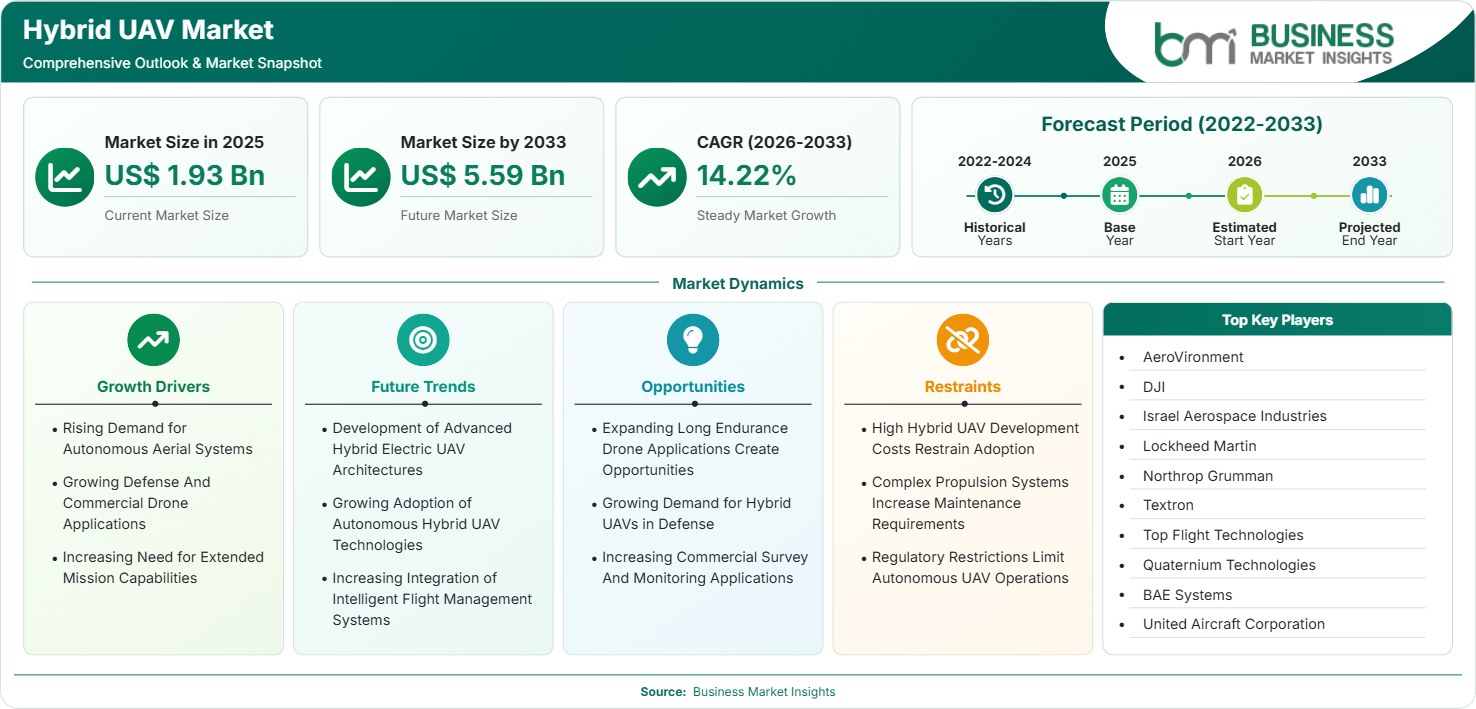
The Hybrid UAV Market size was valued at US$ 1.93 billion in 2025 and is projected to reach US$ 5.59 billion by 2033, growing at a CAGR of 14.22% during 2026–2033, driven by autonomous aerial systems, defense modernization, commercial monitoring, extended endurance, and diversified propulsion architectures.

Report Coverage
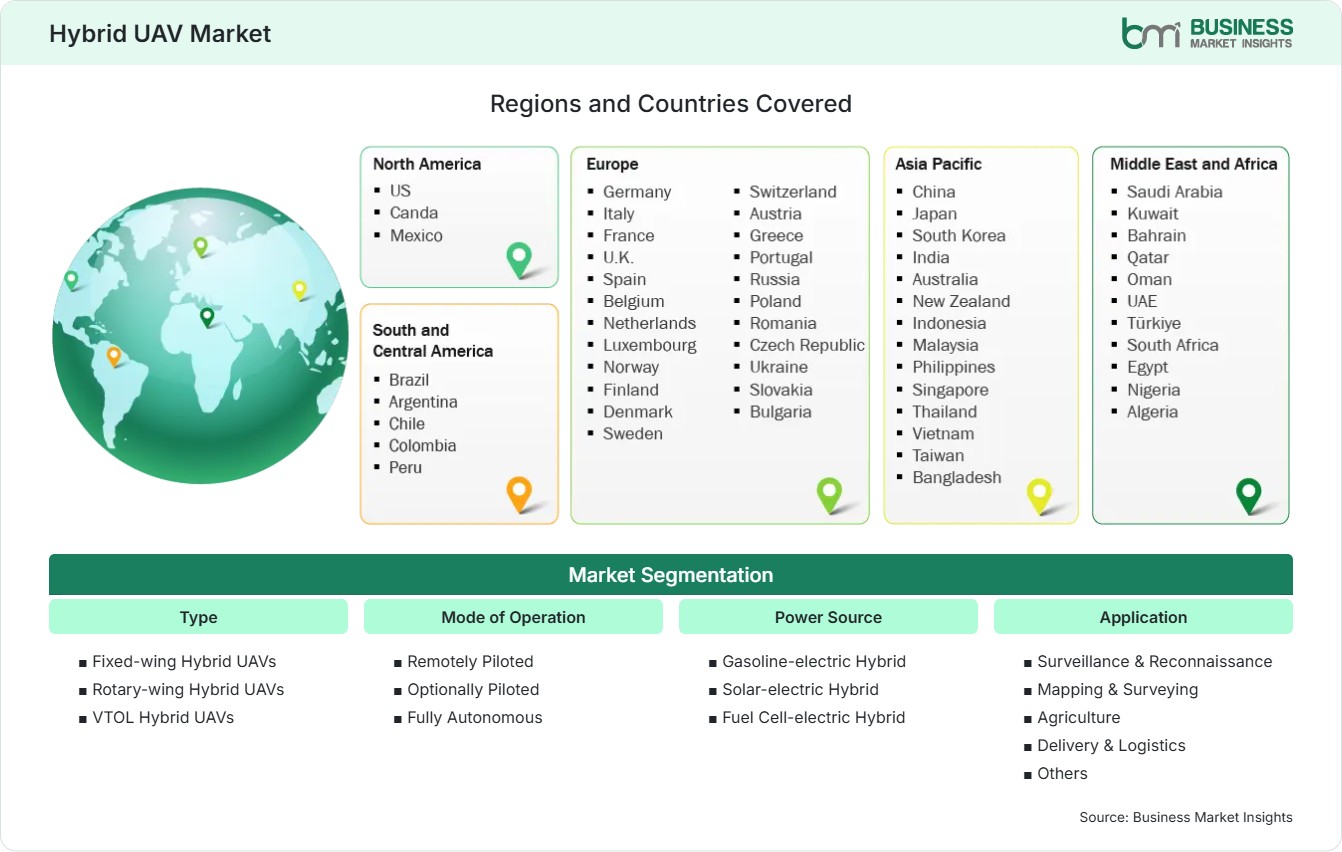
  • Type: Fixed-wing Hybrid UAVs, Rotary-wing Hybrid UAVs, VTOL Hybrid UAVs
  • Mode of Operation: Remotely Piloted, Optionally Piloted, Fully Autonomous
  • Power Source: Gasoline-electric Hybrid, Solar-electric Hybrid, Fuel Cell-electric Hybrid
  • Application: Surveillance & Reconnaissance, Mapping & Surveying, Agriculture, Delivery & Logistics, Others
  • End User: Defense & Military, Commercial, Government & Law Enforcement, Others
US$ 1.93 Bn Market size in 2025
US$ 5.59 Bn Market Size by 2033
14.22% CAGR, 2026 - 2033
2026-2033 Forecast Period

AI Overview

Hybrid UAV Market Summary

  • North America: North America holds a 31%-35% share in 2025, growing at a CAGR of 13.5%-14.5%, influenced by defense modernization, commercial inspection, autonomous flight development, advanced payload integration, and long-endurance mission requirements. The US accounts for 84%-88% of regional demand, growing at a CAGR of 13.8%-14.8%.
  • Fastest Growing Region: Asia Pacific holds a 27%-31% share in 2025 and grows at a CAGR of 15.0%-16.0%, driven by defense modernization, precision agriculture, infrastructure surveying, disaster response, logistics applications, and expanding domestic UAV manufacturing capabilities.
  • Leading Segment: VTOL Hybrid UAVs hold a 38%-43% share in 2025 and grow at a CAGR of 14.0%-15.0%, supported by runway-independent operation, flexible deployment, maneuverability, extended range, and suitability for surveillance, logistics, and inspection missions.
  • High Growth Segment: Fully Autonomous systems hold a 18%-22% Hybrid UAV Market share in 2025 and grow at a CAGR of 17.0%-18.0%, supported by autonomous navigation, mission automation, onboard intelligence, reduced operator workload, and expanding beyond-line-of-sight applications.
  • Key Market Opportunity: Long-endurance aerial platforms can address persistent surveillance, infrastructure inspection, precision agriculture, remote logistics, emergency response, and environmental monitoring while combining vertical access with efficient forward flight.
  • Major Market Players: AeroVironment, DJI, Israel Aerospace Industries, Lockheed Martin, Northrop Grumman, Textron, Top Flight Technologies, Quaternium Technologies, BAE Systems, United Aircraft Corporation.
Strategic Insights

Hybrid UAV Market: Strategic Insights

Hybrid UAV Market Strategic Framework
FREE PDF
Request your free sample
Request free sample
Stakeholder View

Key Takeaways

  • The value chain is shifting from aircraft-only procurement toward integrated platforms combining propulsion, avionics, autonomy, communications, payloads, ground systems, software, and lifecycle support.
  • Long-endurance surveillance, remote inspection, precision agriculture, and logistics provide strong application upside because hybrid architectures can address missions requiring both vertical access and efficient forward flight.
  • Product innovation is moving toward modular airframes, intelligent energy management, autonomous navigation, lightweight materials, adaptive flight controls, and propulsion systems optimized for mission-specific endurance.
  • Emerging economies offer attractive opportunities where infrastructure monitoring, agricultural modernization, disaster response, border surveillance, and remote logistics require flexible aerial platforms.
  • Investment priorities are increasingly focused on dual-use architectures that can transition between commercial and defense missions, helping suppliers diversify revenue opportunities and improve platform utilization.
  • Competitive differentiation will increasingly depend on endurance, payload flexibility, autonomy, maintainability, operational safety, and the ability to integrate aircraft systems with mission-specific software.
Geographic Outlook

Hybrid UAV Market Regional Highlights

North America Hybrid UAV Market

North America holds a 31%-35% share in 2025 and grows at a CAGR of 13.5%-14.5%. The region benefits from advanced aerospace capabilities, defense modernization, commercial drone adoption, sophisticated payload ecosystems, and increasing demand for persistent autonomous aerial missions.

  • Defense applications remain important, particularly for surveillance, reconnaissance, communications support, logistics, and persistent monitoring where hybrid propulsion can extend mission flexibility.
  • Commercial demand is expanding across infrastructure inspection, agriculture, energy monitoring, surveying, and emergency response, favoring aircraft that can operate across difficult terrain.
  • The US leads regional adoption because its aerospace ecosystem supports advanced autonomy, propulsion development, payload integration, and dual-use UAV programs.
  • Canada provides opportunities in resource monitoring, remote infrastructure inspection, environmental surveying, and agricultural applications requiring long-range aerial coverage.

US Hybrid UAV Market

The US represents 84%-88% of North American demand in 2025 and grows at a CAGR of 13.8%-14.8%. Demand is supported by defense applications, commercial inspection, autonomous flight development, logistics, public safety, and advanced aerial intelligence requirements.

  • Defense missions create demand for long-endurance platforms capable of persistent surveillance, reconnaissance, communications support, tactical logistics, and operations across geographically dispersed environments.
  • Commercial applications are expanding across infrastructure inspection, energy monitoring, agriculture, surveying, and emergency response, increasing interest in flexible aircraft architectures.
  • Autonomous flight capabilities are becoming more important as operators seek reduced workload, repeatable mission execution, improved navigation, and greater operational scalability.

Europe Hybrid UAV Market

Europe holds a 21%-25% share in 2025 and grows at a CAGR of 12.8%-13.8%. Germany, France, the United Kingdom, and Italy lead demand, while Spain and Nordic markets provide opportunities through industrial monitoring and specialized aerial applications.

  • Germany benefits from industrial inspection, infrastructure monitoring, precision agriculture, and advanced aerospace engineering capabilities supporting hybrid UAV development.
  • The United Kingdom offers opportunities in defense modernization, infrastructure surveying, environmental monitoring, logistics, and autonomous flight applications.
  • France and Italy support demand through aerospace capabilities, defense requirements, agricultural applications, and expanding interest in unmanned monitoring systems.
  • Spain and Nordic markets can develop faster adoption in agriculture, energy infrastructure, environmental monitoring, and remote-area surveying.

Asia Pacific Hybrid UAV Market

Asia Pacific holds a 27%-31% share in 2025 and grows at a CAGR of 15.0%-16.0%. China, Japan, India, and South Korea lead regional activity, while Southeast Asia offers expanding opportunities through agriculture, logistics, infrastructure, and public safety.

  • China supports extensive UAV development across defense, commercial operations, agriculture, surveying, logistics, and infrastructure monitoring, creating broad demand for hybrid configurations.
  • India presents opportunities through agricultural modernization, infrastructure development, disaster management, surveillance, and expanding domestic unmanned aviation capabilities.
  • Japan and South Korea emphasize advanced robotics, autonomous systems, industrial inspection, disaster response, and sophisticated aerial monitoring applications.
  • Southeast Asian markets can experience strong adoption as infrastructure development, precision agriculture, environmental monitoring, and remote logistics expand across geographically diverse territories.

Rest of World Hybrid UAV Market

Rest of World holds a 15%-19% share in 2025 and grows at a CAGR of 13.8%-14.8%. Latin America, the Middle East, and Africa offer opportunities through agriculture, resource monitoring, border surveillance, infrastructure inspection, and remote logistics.

Latin American demand is supported by agricultural monitoring, mining, energy infrastructure, and environmental applications. Middle Eastern Hybrid UAV Markets emphasize surveillance, security, infrastructure monitoring, and specialized logistics, while African markets provide opportunities for remote-area connectivity, agriculture, conservation, and emergency response.

  • Brazil offers opportunities in precision agriculture, environmental monitoring, infrastructure inspection, and resource management across large geographic areas.
  • Saudi Arabia and the United Arab Emirates provide opportunities for surveillance, infrastructure monitoring, logistics, and advanced autonomous aerial applications.
  • South Africa presents demand across agriculture, mining, environmental monitoring, infrastructure inspection, and public-safety missions requiring extended aerial coverage.
  • Selected African markets can adopt hybrid UAVs for agricultural assessment, conservation, disaster response, and remote logistics where conventional infrastructure remains difficult to deploy.
Global Market Geography
FREE PDF
Request your free sample
Request free sample
Segment Analysis

Hybrid UAV Market Segmentation

Type

VTOL Hybrid UAVs hold a 38%-43% share in 2025 and grow at a CAGR of 14.0%-15.0% through 2033, supported by runway-independent operation and flexible deployment. Fixed-wing systems remain valuable for endurance, while rotary-wing platforms address maneuverability and confined operating environments.

  • Fixed-wing Hybrid UAVs: Fixed-wing platforms support long-range missions and efficient forward flight, making them suitable for surveillance, mapping, environmental monitoring, and infrastructure assessment across broad geographic areas.
  • Rotary-wing Hybrid UAVs: Rotary-wing systems provide maneuverability and hover capability, supporting inspection, emergency response, agriculture, and operations requiring precise positioning around complex environments.
  • VTOL Hybrid UAVs: VTOL platforms combine vertical access with efficient forward flight, making them attractive for logistics, surveillance, mapping, and missions where runway infrastructure is unavailable.

Mode of Operation

Remotely Piloted systems hold a 42%-47% share in 2025 and grow at a CAGR of 12.8%-13.8% through 2033, reflecting established operator-controlled workflows. Autonomous modes offer stronger long-term upside as navigation, sensing, and onboard decision-making capabilities mature.

  • Remotely Piloted: Operator-controlled aircraft remain widely applicable because they provide direct mission supervision, flexible decision-making, and established operational procedures across diverse UAV applications.
  • Optionally Piloted: Optionally piloted systems combine human control with automated capabilities, providing operational flexibility where missions require either direct intervention or automated flight functions.
  • Fully Autonomous: Autonomous platforms use navigation, sensing, mission software, and onboard decision-making to reduce operator workload and support repeatable long-duration missions.

Power Source

Gasoline-electric Hybrid systems hold a 45%-50% share in 2025 and grow at a CAGR of 13.4%-14.4% through 2033, supported by established fuel availability and practical endurance. Solar-electric and fuel cell-electric architectures offer specialized opportunities where extended endurance and lower operating emissions are prioritized.

  • Gasoline-electric Hybrid: Gasoline-electric systems combine conventional energy density with electric propulsion flexibility, supporting extended missions where endurance and payload capability are priorities.
  • Solar-electric Hybrid: Solar-electric systems can supplement onboard energy during flight, supporting persistent monitoring, environmental observation, and specialized missions requiring prolonged operation.
  • Fuel Cell-electric Hybrid: Fuel cell-electric systems provide quiet, efficient power for applications requiring extended endurance, lower thermal signatures, and specialized environmental performance.

Application

Surveillance & Reconnaissance holds a 34%-39% share in 2025 and grows at a CAGR of 14.2%-15.2% through 2033, supported by persistent monitoring and flexible deployment. Mapping, agriculture, delivery, and logistics broaden commercial adoption through specialized payload requirements.

  • Surveillance & Reconnaissance: These missions require extended endurance, reliable communications, stable payload operation, and flexible flight profiles for persistent observation across demanding environments.
  • Mapping & Surveying: Hybrid UAVs support broad-area mapping, terrain assessment, infrastructure inspection, and data collection where efficient flight and precise positioning improve operational productivity.
  • Agriculture: Agricultural platforms enable crop monitoring, field assessment, targeted treatment, and multispectral data collection across large farming areas.
  • Delivery & Logistics: Hybrid systems can support longer-distance deliveries and remote logistics by combining vertical access with efficient forward flight and adaptable payload capacity.
  • Others: Specialized applications include disaster response, environmental monitoring, emergency services, conservation, communications support, and other missions requiring flexible aerial mobility.

End User

Defense & Military holds a 35%-40% Hybrid UAV Market share in 2025 and grows at a CAGR of 14.5%-15.5% through 2033, supported by persistent surveillance and extended mission requirements. Commercial users provide expanding demand across inspection, agriculture, logistics, and mapping applications.

  • Defense & Military: Military users value endurance, surveillance capability, payload flexibility, autonomous functions, and operational range for intelligence and tactical support missions.
  • Commercial: Commercial operators increasingly adopt hybrid UAVs for inspection, agriculture, surveying, logistics, environmental monitoring, and specialized data-collection services.
  • Government & Law Enforcement: Government users employ hybrid platforms for emergency response, border monitoring, public safety, infrastructure oversight, and environmental protection.
  • Others: Additional users include research institutions, conservation organizations, utilities, resource operators, and specialized service providers requiring flexible aerial monitoring capabilities.
Market Forces

Hybrid UAV Market Dynamics

Key Market Drivers

Rising Demand for Autonomous Aerial Systems

The hybrid UAV Market growth is being influenced by increased demand for UAVs that operate on their own with minimal input from the operators. Navigation, sensing, on-board computing, communications, and flight control software have become increasingly advanced for more complicated missions to be carried out autonomously. Hybrid propulsion increases value through the extended range provided, along with the flexibility of operating in various flight stages. It becomes very applicable in missions like surveillance, mapping, inspection, agriculture, and remote logistics. The benefit of autonomy is also repeatability, where the system can follow pre-defined routes and deal with mission situations.

Growing Defense And Commercial Drone Applications

The Hybrid UAV Market trend will be boosted further with the use of the technology in different fields, in both defense and commercial usage. There is a need for military users to have a platform that offers constant surveillance, communication support, and logistical assistance, whereas for commercial uses, there is a need to solve their problems related to inspection, agriculture, surveys, and remote monitoring. The market will serve this purpose by offering vertical lift along with effective forward flight and long-duration capabilities. This makes it possible for the same platform to perform different missions with the help of payload and software configurability. At the same time, commercial uses will have less dependency on runways.

Increasing Need for Extended Mission Capabilities

Greater mission duration continues to be an absolute necessity for both surveillance, mapping, inspection, agriculture, and logistics purposes. Standard battery-powered unmanned aerial vehicles may experience restrictions on their endurance due to higher payload requirements, greater range, or specific mission conditions. One possible solution to overcome such limitations might involve the use of hybrid propulsion that will incorporate fuel or other types of energy sources with electricity that is optimized for either the takeoff or cruise phases of a mission. Such a configuration will allow for a better approach to managing energy throughout different phases of a mission. Greater endurance will lead to fewer launches and recoveries, improved coverage, and greater information gathering per mission.

Key Market Opportunities

Expanding Long Endurance Drone Applications Create Opportunities

The Hybrid UAV Market forecast growth opportunities lie in the increasing need for UAVs with the ability to fly long distances with fewer returns or battery changes. Long-term surveillance, oil pipeline inspections, environment monitoring, maritime surveillance, and other tasks related to remote infrastructure monitoring may have an added value from the endurance of hybrids. Hybrid solutions may be capable of combining economical cruise performance and an electricity-based control system that is responsive enough for takeoffs, landings, and slow flights. The value of such a solution lies in the continuity of the mission instead of just the cost of the airplane itself. Additional product differentiation opportunities may arise in the form of modularity of payload interfaces, mission planning automation software, and energy management software.

Growing Demand for Hybrid UAVs in Defense

There is potential for the use of UAVs that have hybrid capabilities such as persistence, reconnaissance, logistic support, communication support, and border patrol. Hybrid propulsion will enable UAVs that need to operate for long periods of time but still be able to operate vertically from forward bases or areas without sufficient infrastructure. The modularity of the payload system will enable UAVs to carry electro-optical payloads, thermal payloads, communication gear, mapping payloads, or other mission systems. Manufacturers can take advantage of the defense market by designing UAVs that can accommodate different mission kits, different propulsion, and different autonomy levels.

Increasing Commercial Survey And Monitoring Applications

Surveying and monitoring use cases within industries such as agriculture, construction, mining, utilities, energy, environment management, and infrastructure inspection will arise due to the benefits that hybrid UAVs will provide. The integration of a large flight area capacity alongside constrained launch capabilities will provide opportunities in overcoming some of the disadvantages of fixed-wing UAVs while also being able to offer more endurance than traditional multirotors. The inclusion of high-resolution cameras, thermal, multispectral sensors, and inspection equipment will also improve the value proposition of the platform. Software can be used to convert aerial data into useful insights for asset management and crop assessment.

Market Restraints and Challenges

High Hybrid UAV Development Costs Restrain Adoption

Factor: hybrid UAV design necessitates well-coordinated engineering of airframe, power, battery, fuel system, electronics, flight control, communications, and mission software. Impact: greater cost of developing a hybrid UAV may result in higher cost of the aircraft itself, increased time to market, and reduced ability of small enterprises to adopt the technology. Testing becomes essential for the hybrid UAV design as the elements of its propulsion have to function reliably at all stages of flight in varying environments. The integration of payload increases engineering challenges if the customers ask for specific sensors and mission-related devices. The following are some ways that the manufacturer could use to reduce the constraint: modularity, commonality, digital simulation, standardization, and scalability.

Complex Propulsion Systems Increase Maintenance Requirements

Factor: hybrid power systems use several energy conversion and control devices, resulting in the presence of more interfaces to be monitored and serviced. Impact: increased maintenance complexity will add to operating expenses and may limit operational effectiveness due to the lack of availability of specialized engineers or parts. Thermal management, vibration management, fuel processing, electric conversion, and battery control have to work in concert without sacrificing the safety of flight. This means operators may opt for designs that reduce maintenance complexity and offer automated condition monitoring. The vendors can facilitate adoption through standardizing maintenance operations and providing support.

Company Analysis

Competitive Landscape

The Hybrid UAV Market analysis centers on endurance, propulsion efficiency, autonomous operation, payload flexibility, flight control, modularity, mission software, and lifecycle support. Competition is increasingly shaped by the ability to combine aircraft hardware with intelligent systems and application-specific capabilities.

Company Name

Overview

Products and Services relevant to this market

AeroVironment

Aerospace and defense company focused on unmanned aircraft and autonomous aerial systems for demanding missions.

UAV platforms, autonomous systems, tactical aircraft, payload integration, mission software, and support services.

DJI

Drone technology company serving professional, commercial, industrial, and specialized aerial applications.

UAV platforms, flight controllers, imaging payloads, mapping solutions, software, and enterprise drone systems.

Israel Aerospace Industries

Aerospace and defense organization providing unmanned aerial systems for intelligence and operational missions.

Long-endurance UAVs, surveillance platforms, mission systems, payloads, ground stations, and support services.

Lockheed Martin

Aerospace and defense company developing advanced autonomous and unmanned systems for military applications.

UAV platforms, autonomous technologies, sensors, communications, mission systems, and integrated defense solutions.

Northrop Grumman

Defense technology company specializing in autonomous systems, surveillance, and advanced unmanned aircraft.

Long-endurance UAVs, ISR platforms, autonomous systems, sensors, communications, and mission support.

Textron

Aerospace and defense company with capabilities spanning unmanned aircraft and advanced aviation systems.

UAV platforms, unmanned aircraft systems, propulsion integration, mission equipment, and support services.

Top Flight Technologies

UAV technology specialist focused on hybrid-electric propulsion and extended-endurance aerial platforms.

Hybrid UAVs, propulsion systems, aerial platforms, endurance-focused technologies, and mission solutions.

Quaternium Technologies

UAV developer focused on hybrid propulsion and long-endurance unmanned aircraft applications.

Hybrid UAV platforms, fuel-based propulsion systems, endurance technologies, and specialized aerial solutions.

BAE Systems

Defense technology company developing autonomous, electronic, surveillance, and unmanned aerial capabilities.

Unmanned systems, autonomous technologies, sensors, electronic systems, mission software, and defense integration.

United Aircraft Corporation

Russian aerospace manufacturer with capabilities spanning aircraft, unmanned systems, and aviation technologies.

Unmanned aircraft technologies, aerospace platforms, propulsion systems, avionics, and related aviation support capabilities.

Trust & Transparency

Research Methodology

The market analysis combines proprietary research with secondary data from government agencies, company disclosures, regulatory filings, industry databases and expert interviews. Market estimates are validated through data triangulation, cross-market benchmarking and analyst review.

View Full Research Methodology

Questions Answered

Frequently Asked Questions

What does the Hybrid UAV Market report indicate about future competition?

The report indicates that competition will focus on endurance, propulsion efficiency, autonomy, payload flexibility, modularity, mission software, reliability, and lifecycle support. Companies capable of integrating aircraft, propulsion, avionics, and intelligent mission systems can strengthen their positioning across defense and commercial applications.

Why are autonomous capabilities creating new opportunities for hybrid UAV solutions?

Autonomy can reduce operator workload, improve mission repeatability, support automated navigation, and enable more scalable aerial operations. Combined with extended endurance, autonomous systems are particularly useful for persistent monitoring, surveying, inspection, logistics, and surveillance missions.

How are hybrid propulsion technologies influencing UAV adoption?

Hybrid propulsion combines different energy sources and propulsion mechanisms to improve endurance and operational flexibility. Electric systems can support responsive flight phases, while higher-energy-density sources can support sustained cruise, enabling longer missions and broader payload options.

Which applications present the strongest opportunity in the market?

Long-endurance surveillance, infrastructure inspection, precision agriculture, mapping, remote logistics, environmental monitoring, and defense reconnaissance represent strong opportunities. These applications benefit from aircraft capable of covering broad areas while operating from locations without conventional runway infrastructure.

What factors are improving Hybrid UAV Market return on investment?

Extended endurance, flexible takeoff and landing, modular payloads, autonomous operation, and multi-mission capability can improve return on investment. Hybrid architectures can support surveillance, inspection, agriculture, mapping, logistics, and defense missions while reducing the need for separate aircraft platforms.

Access the Full Hybrid UAV Market Report

Get segment-level forecasts, regional estimates, competitive benchmarking, company profiles and downloadable Excel datasets.

Access the full Hybrid UAV Market Report
350 pages PDF & Excel | 2026-08-19
Similar Research

Related Market Reports