Market Summary
Executive Summary and Global Market Analysis
Hybrid electric aircraft combine conventional propulsion systems with electric power sources to improve fuel efficiency and reduce emissions. These systems integrate batteries, generators, and electric motors to optimize flight performance. The market reflects ongoing developments in energy storage, power management, and aerospace engineering, supporting gradual integration across aviation segments.
Airlines and defense organizations are exploring alternatives to traditional fuel-based propulsion due to environmental concerns and cost pressures. Emission reduction targets and sustainability commitments influence aircraft design strategies. Electrification introduces operational flexibility while lowering noise and fuel consumption, making hybrid systems more appealing for future fleet modernization.
The Hybrid Electric Aircraft market is categorized by type, application, and range, each segment exhibiting unique demand patterns. Parallel hybrid configurations support transitional adoption by complementing existing engines. Series hybrid systems align with longer-term electrification strategies. Applications extend across commercial aviation, military operations, and unmanned aerial systems, with distinct mission profiles shaping adoption.
Technological progress is transforming aircraft design and operational capabilities. Improvements in battery efficiency and lightweight materials have allowed broader testing of hybrid propulsion systems. Short-haul and regional routes serve as practical deployment areas, as they align with current energy limitations and infrastructure readiness.
Competition within the industry centers on innovation, certification capabilities, and integration expertise. Market participants focus on developing scalable propulsion architectures while addressing safety and regulatory standards. Partnerships between aerospace developers and technology providers are fostering incremental advancements and positioning the industry for future expansion.
Segment Analysis
Hybrid Electric Aircraft Market Segmentation
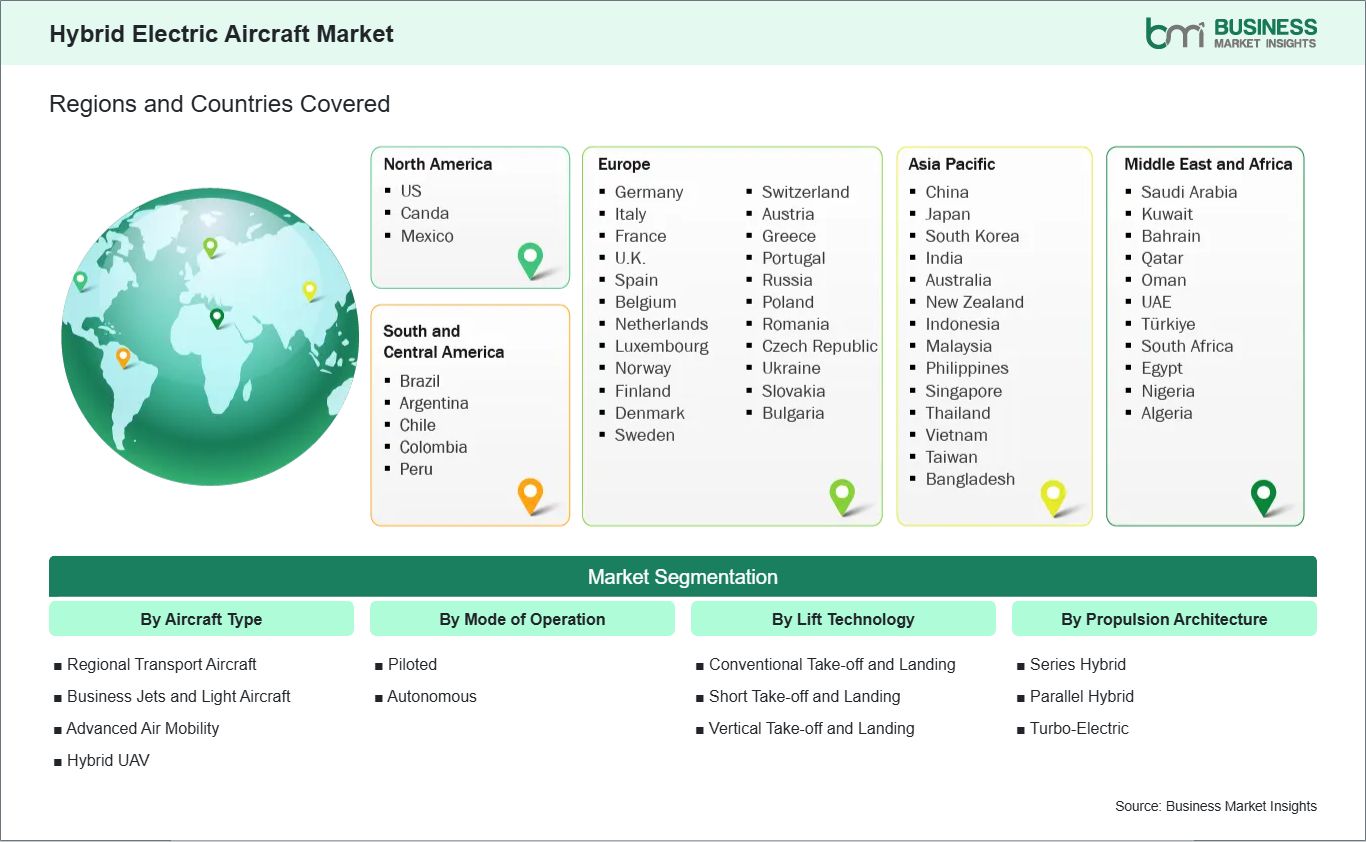
The market demonstrates diversified adoption across Aircraft Type, Mode of Operation, Lift Technology, and Propulsion Architecture.
By Aircraft Type
- Regional Transport Aircraft: Used for commercial passenger and cargo operations across short to medium distances
- Business Jets and Light Aircraft: Used for private travel, corporate aviation, and regional connectivity
- Advanced Air Mobility (eVTOL/Air Taxi): Electric vertical take-off and landing aircraft designed for urban air mobility and short-distance transport
- Hybrid UAV: Unmanned aerial systems combining multiple propulsion technologies for extended endurance and operational flexibility
By Mode of Operation
- Piloted: Aircraft operated by onboard human pilots for controlled flight missions
- Autonomous: Aircraft capable of self-navigation and operation with minimal or no human intervention
By Lift Technology
- Conventional Take-off and Landing (CTOL): Aircraft that require standard runways for take-off and landing operations
- Short Take-off and Landing (STOL): Aircraft designed to operate on shorter runways with reduced distance requirements
- Vertical Take-off and Landing (VTOL): Aircraft capable of taking off and landing vertically without the need for runways
By Propulsion Architecture
- Series Hybrid: Propulsion system where power generation and propulsion are decoupled for optimized efficiency
- Parallel Hybrid: System where both engine and electric motor directly contribute to propulsion
- Turbo-Electric: Uses turbine engines to generate electricity that powers electric propulsion systems.
Market Forces
Hybrid Electric Aircraft Market Drivers and Opportunities
Emission Reduction Mandates and Fuel Efficiency Improvements
Global aviation faces increasing pressure to reduce carbon emissions while maintaining operational reliability. Hybrid electric propulsion addresses this requirement by lowering fuel consumption and optimizing energy usage during flight. Airlines are evaluating retrofitting and new aircraft integration to align with sustainability goals while managing cost structures and improving efficiency across short-distance routes.
Regulatory frameworks emphasize cleaner aviation technologies and encourage alternative propulsion systems. Governments and aviation authorities are promoting research initiatives and setting emission benchmarks. These conditions reinforce the relevance of hybrid electric systems as a viable pathway toward compliance, supporting gradual transition without immediate reliance on fully electric aircraft infrastructure.
Advancement in Energy Storage and Electrification Technologies
Innovation in battery technology and energy management systems is enabling more practical implementation of hybrid aircraft. Improvements in energy density and weight reduction support longer flight durations and improved performance. Electric propulsion components are being refined to integrate seamlessly within existing aircraft systems, broadening potential applications across different aviation segments.
Future opportunities are linked to expanding energy capacities and enhanced system integration. Continued research is expected to support wider adoption across commercial and defense sectors. As technologies mature, hybrid electric aircraft could extend beyond short-haul applications, influencing fleet strategies and reshaping long-term aircraft development approaches.
Size and Share Analysis
Hybrid Electric Aircraft Market Size and Share Analysis
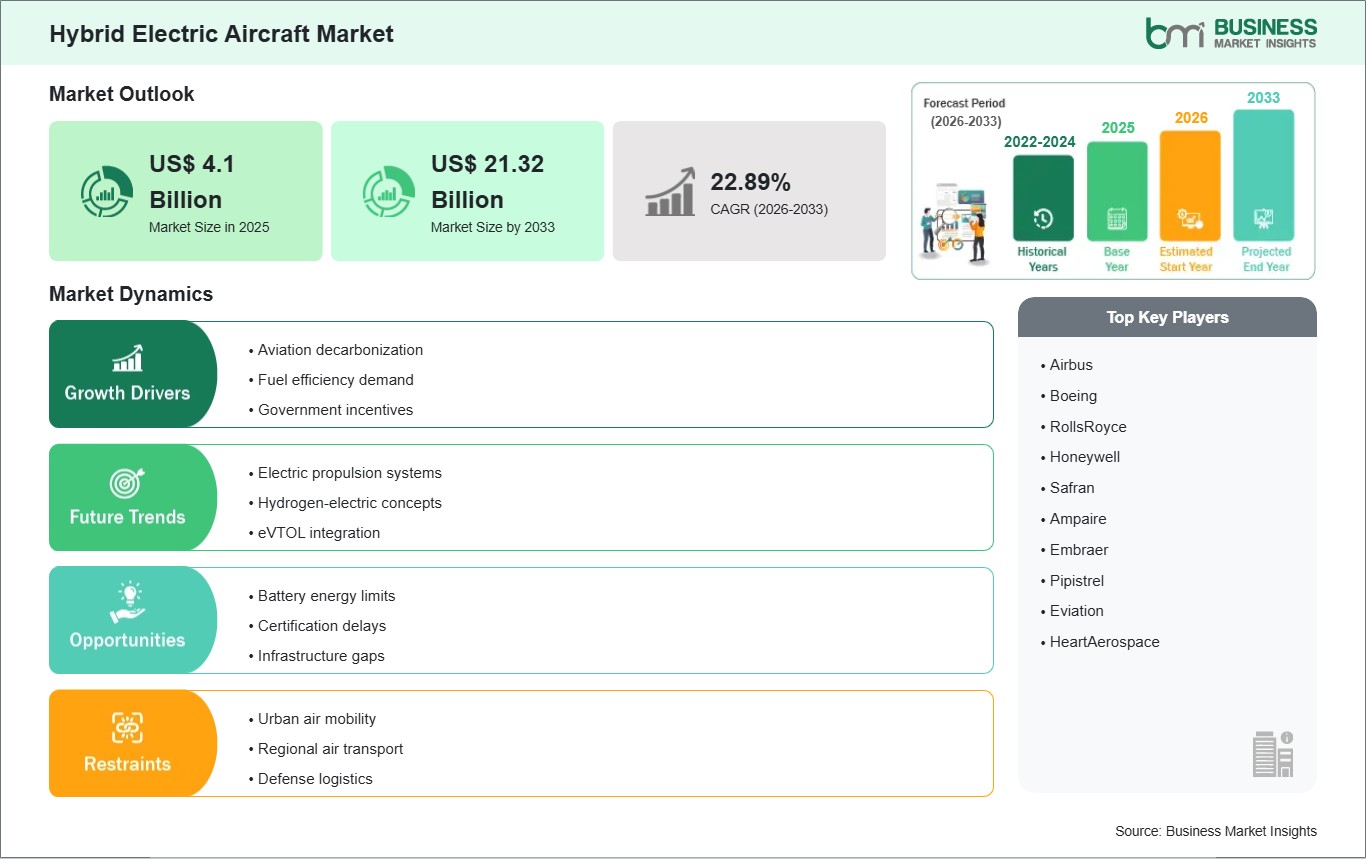
The Hybrid Electric Aircraft Market is projected to grow from US$ 4.1 Billion in 2025 to US$ 21.32 Billion by 2033 , registering a CAGR of 22.89% from 2026 to 2033.
Parallel hybrid systems currently hold a practical advantage due to compatibility with existing aircraft platforms. Their ability to integrate with traditional engines supports gradual implementation. Meanwhile, series hybrid configurations are progressing as long-term solutions, particularly for next-generation aircraft designs focused on higher electrification levels.
Commercial aviation represents a prominent application segment due to airline initiatives aimed at reducing operating costs and emissions. Military use cases emphasize stealth and endurance, while UAV deployment continues expanding across surveillance and logistics. Each application contributes differently to market evolution, shaping diverse adoption pathways.
Report Coverage
Hybrid Electric Aircraft Market Report Coverage and Deliverables
The "Hybrid Electric Aircraft Market Size and Forecast (2022–2033)" report provides a detailed analysis of the market covering below areas:
- Hybrid Electric Aircraft market size and forecast at global, regional, and country levels for all the key market segments covered under the scope
- Hybrid Electric Aircraft market trends, as well as market dynamics such as drivers, restraints, and key opportunities
- Hybrid Electric Aircraft market analysis covering key market trends, global and regional framework, major players, regulations, and recent market developments
- Industry landscape and competition analysis covering market concentration, heat map analysis, prominent players, and recent developments for the Hybrid Electric Aircraft market
- Detailed company profiles, including SWOT analysis
Hybrid Electric Aircraft Market Country and Regional Insights
The Hybrid Electric Aircraft market shows diverse regional adoption patterns influenced by regulatory priorities, technology readiness, and aviation infrastructure. Developed regions are leading early-stage adoption, while emerging economies are evaluating feasibility through pilot programs and partnerships.
North America demonstrates active development driven by aerospace innovation ecosystems and government-backed initiatives. The United States leads in research and prototype testing, with strong collaboration between defense organizations and technology developers. Canada also contributes through sustainability-focused aviation programs and regional aircraft advancements.
Asia Pacific reflects growing interest supported by expanding aviation demand and environmental considerations. Countries such as China and Japan are investing in advanced propulsion technologies, while India is exploring long-term electrification potential. Regional governments are gradually incorporating cleaner aviation strategies into policy frameworks.
Europe maintains a structured approach with strong regulatory support and environmental commitments. Countries including Germany, France, and the United Kingdom focus on collaborative research and sustainable aviation targets. Emerging markets in Latin America and the Middle East are observing developments and assessing future integration aligned with infrastructure readiness.
Geographic Insights
Hybrid Electric Aircraft Market Geographic Insights
The Hybrid Electric Aircraft market shows diverse regional adoption patterns influenced by regulatory priorities, technology readiness, and aviation infrastructure. Developed regions are leading early-stage adoption, while emerging economies are evaluating feasibility through pilot programs and partnerships.
North America demonstrates active development driven by aerospace innovation ecosystems and government-backed initiatives. The United States leads in research and prototype testing, with strong collaboration between defense organizations and technology developers. Canada also contributes through sustainability-focused aviation programs and regional aircraft advancements.
Asia Pacific reflects growing interest supported by expanding aviation demand and environmental considerations. Countries such as China and Japan are investing in advanced propulsion technologies, while India is exploring long-term electrification potential. Regional governments are gradually incorporating cleaner aviation strategies into policy frameworks.
Europe maintains a structured approach with strong regulatory support and environmental commitments. Countries including Germany, France, and the United Kingdom focus on collaborative research and sustainable aviation targets. Emerging markets in Latin America and the Middle East are observing developments and assessing future integration aligned with infrastructure readiness.
Industry Activity
Recent Developments
The Hybrid Electric Aircraft market is evaluated by gathering qualitative and quantitative data post primary and secondary research, which includes important corporate publications, association data, and databases. A few of the key developments in the Hybrid Electric Aircraft market are:
- In 2026: Northrop Grumman has successfully flown its XRQ-73 SHEPARD next-generation hybrid-electric uncrewed aircraft at Edwards Air Force Base, USA, as part of a DARPA flight test in April 2026. The aircraft demonstrates a series hybrid-electric propulsion system that combines fuel efficiency with reduced emissions and improved endurance for advanced autonomous and ISR missions. It is designed to support next-generation military unmanned aircraft development, enabling quieter, longer-range, and more flexible operations for defense applications.
- In 2026: RTX has advanced its hybrid-electric flight demonstrator by completing key ground testing of its propulsion system, marking progress toward flight readiness for a regional turboprop aircraft.
Trust & Transparency
Research Methodology
The market analysis combines proprietary research with secondary data from government agencies, company disclosures, regulatory filings, industry databases and expert interviews. Market estimates are validated through data triangulation, cross-market benchmarking and analyst
review.
View Full Research Methodology
Key Sources Referred:
Industry reports on sustainable tire manufacturing and automotive mobility Government transportation and environmental policy publications Automotive trade journals and tire technology periodicals Company annual reports and sustainability disclosures Academic studies on bio-based polymers and recycled materials International automotive production and mobility assessments Research publications covering tire material innovation and efficiency trends Company website Company annual reports Company investor presentations