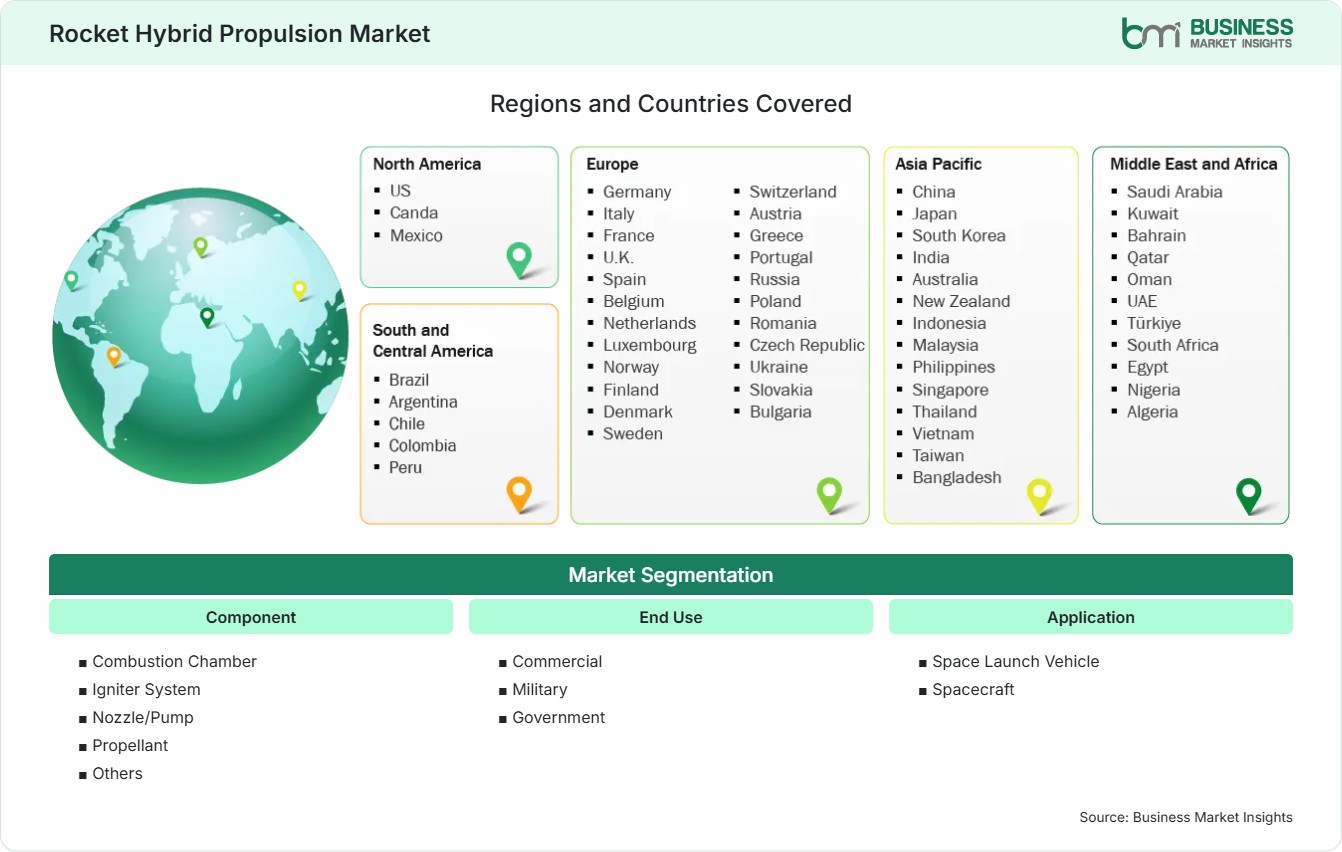
Rocket Hybrid Propulsion Market Regional Highlights
North America Rocket Hybrid Propulsion Market
North America accounted for 39%–42% of the Rocket Hybrid Propulsion Market share in 2025 and is projected to register a CAGR of 14.8%–15.6% during 2026–2033. The region benefits from a mature aerospace ecosystem, substantial government funding, and growing commercial launch demand. Defense modernization programs, reusable launch vehicle development, and increasing investments from private space companies continue accelerating propulsion innovation. Advanced manufacturing capabilities, established testing infrastructure, and collaboration between public agencies and commercial enterprises further reinforce regional leadership across both commercial and military applications.
- Government-funded lunar exploration and national security missions continue supporting propulsion research, while public-private partnerships strengthen commercialization of hybrid propulsion technologies for reusable launch systems, responsive space missions, and advanced defense applications.
- Expanding satellite constellations from commercial operators increase launch frequency, encouraging propulsion manufacturers to develop safer, cost-efficient systems with improved combustion efficiency, simplified storage, and enhanced operational flexibility for diverse mission profiles.
- Aerospace suppliers increasingly adopt additive manufacturing and digital engineering techniques to reduce production cycles, improve component precision, and optimize combustion chamber performance while lowering overall manufacturing costs and qualification timelines.
- Strategic investments by venture capital firms and defense contractors accelerate innovation across propulsion components, supporting domestic supply chain resilience and expanding opportunities for technology providers serving commercial launch operators and government agencies.
US Rocket Hybrid Propulsion Market
The United States represented approximately 78%–81% of the North American Rocket Hybrid Propulsion Market in 2025 and is expected to expand at a CAGR of 14.9%–15.7% through 2033. Strong federal space budgets, increasing Department of Defense procurement, and a thriving commercial aerospace industry sustain continuous propulsion technology development. The country remains a global center for launch vehicle innovation, supported by established testing facilities, advanced research institutions, and growing investments from private aerospace companies pursuing reusable launch capabilities.
- NASA-supported exploration initiatives and commercial launch partnerships continue creating demand for propulsion systems capable of delivering improved mission safety, operational flexibility, and lower lifecycle costs across orbital and suborbital applications.
- Defense procurement programs emphasize rapid-response launch capabilities, encouraging manufacturers to advance hybrid propulsion technologies that offer reliable ignition, simplified logistics, and enhanced storage safety for tactical deployment requirements.
- Private investment in small satellite launch providers accelerates propulsion innovation through rapid prototyping, advanced material development, and integrated manufacturing processes designed to improve launch frequency and reduce operational expenditures.
Europe Rocket Hybrid Propulsion Market
Europe captured 24%–27% of the Rocket Hybrid Propulsion Market in 2025 and is anticipated to grow at a CAGR of 15.1%–16.0% during the forecast period. Regional expansion is supported by collaborative space programs, increasing investments in sustainable propulsion technologies, and rising participation from private launch companies. Strong engineering capabilities, advanced research institutions, and regulatory support for domestic aerospace manufacturing encourage innovation while strengthening Europe's competitive position in commercial launch services and defense-related propulsion applications.
- France leads regional revenue generation through established aerospace manufacturing capabilities, government-backed research programs, and increasing commercial launch investments supporting next-generation propulsion technologies and reusable launch vehicle development.
- Germany is projected to record the highest regional growth with a CAGR of 15.8%–16.6%, supported by expanding private aerospace companies, propulsion research initiatives, and advanced manufacturing technologies enhancing commercialization opportunities.
- European collaboration through multinational space initiatives strengthens technology transfer, propulsion testing infrastructure, and supply chain integration, enabling manufacturers to accelerate product qualification while supporting future launch missions.
- Increasing emphasis on environmentally responsible launch technologies encourages research into cleaner propulsion architectures, advanced composite materials, and optimized oxidizer systems, improving operational efficiency while aligning with long-term sustainability objectives.
Asia Pacific Rocket Hybrid Propulsion Market
Asia Pacific accounted for 23%–26% of the Rocket Hybrid Propulsion Market share in 2025 and is forecast to register the fastest regional expansion with a CAGR of 16.8%–17.8% during 2026–2033. Rapid growth in national space programs, increasing commercialization of launch services, and expanding investments in satellite manufacturing continue strengthening the regional aerospace ecosystem. Governments are prioritizing indigenous propulsion technologies to reduce dependence on imported systems, while private launch companies accelerate innovation through advanced manufacturing, collaborative research, and cost-efficient propulsion solutions supporting commercial and government missions.
- China remains the largest regional contributor through sustained investments in launch infrastructure, satellite deployment, reusable vehicle research, and propulsion technology development supporting commercial, civil, and strategic aerospace programs.
- India is anticipated to emerge as the fastest-growing national market with a CAGR of 17.3%–18.1%, driven by expanding private space participation, favorable regulatory reforms, and increasing investments in launch vehicle technologies and satellite services.
- Japan and South Korea continue strengthening regional competitiveness through advanced materials research, precision engineering, and collaboration between government agencies, universities, and commercial aerospace companies developing next-generation propulsion systems.
- Growing venture capital funding and government-backed innovation initiatives encourage startups to commercialize hybrid propulsion technologies, supporting responsive launch capabilities for Earth observation, communications, scientific exploration, and emerging in-space service applications.
- Expanding regional manufacturing capacity for propulsion components, composite structures, and testing equipment enhances supply chain resilience while reducing production costs and improving delivery timelines for commercial launch providers.
Rest of World Rocket Hybrid Propulsion Market
The Rest of World region represented 10%–13% of the global Rocket Hybrid Propulsion Market in 2025 and is projected to grow at a CAGR of 14.5%–15.3% during 2026–2033. South & Central America are gradually expanding participation through satellite development initiatives and international aerospace collaborations. In parallel, ME&A persistently works on its own national space strategy and development of the infrastructure necessary for that along with developing its research capacities to ensure technological independence and private sector involvement.
Government strategies, technology cooperation among nations, and more funding for research centers create openings for manufacturers of spacecraft propulsion systems to enter this market. Given growing interest in space in the region, need for more reliable and relatively safe propulsion systems will only grow.
- Brazil leads South & Central America through established aerospace capabilities, satellite programs, and increasing collaboration with international partners to expand launch technologies and domestic propulsion research.
- United Arab Emirates is projected to register the highest growth within the Middle East & Africa with a CAGR of 15.4%–16.2%, supported by ambitious national space initiatives, research investments, and international aerospace partnerships.
- Increasing cooperation between regional governments and global aerospace companies accelerates technology transfer, workforce development, and testing capabilities, strengthening long-term industrial competitiveness within emerging launch ecosystems.
- Investments in satellite communications, Earth observation missions, and scientific exploration continue encouraging procurement of advanced propulsion systems that offer operational safety, manufacturing flexibility, and lower lifecycle costs.
- Development of aerospace innovation hubs and dedicated research centers improves engineering expertise while creating new opportunities for propulsion manufacturers, component suppliers, and launch service providers targeting expanding regional demand.