Counter Rocket Artillery And Mortar Market Regional Highlights
North America Counter Rocket Artillery And Mortar Market
North America represents a 25%–29% share of global demand in 2025 and is projected to grow at a 10.5%–12.0% CAGR through 2033. The region benefits from established defense-industrial capabilities, modernization programs, advanced sensing infrastructure, and demand for integrated force-protection technologies.
- Defense modernization programs are supporting demand for interoperable sensing, command, and defensive technologies.
- Existing military infrastructure provides opportunities for modernization and integration of newer digital architectures.
- Network-centric defense requirements are increasing emphasis on data exchange between sensors and command systems.
- Domestic defense manufacturing capabilities support development, testing, integration, and lifecycle sustainment.
- Increasing focus on infrastructure protection is broadening demand beyond conventional battlefield applications.
US Counter Rocket Artillery And Mortar Market
The United States accounts for 78%–84% of North American demand and is projected to grow at a 10.8%–12.2% CAGR through 2033. Demand is supported by modernization of defensive architectures, integration with broader air-defense networks, and requirements for protecting personnel and strategic assets.
- Modernization programs are increasing demand for networked sensors and integrated command architectures.
- Defense organizations are emphasizing interoperability between new systems and established military infrastructure.
- Software and data integration are becoming increasingly important components of defensive-system development.
- Lifecycle support and technology upgrades are strengthening long-term opportunities for defense suppliers.
Europe Counter Rocket Artillery And Mortar Market
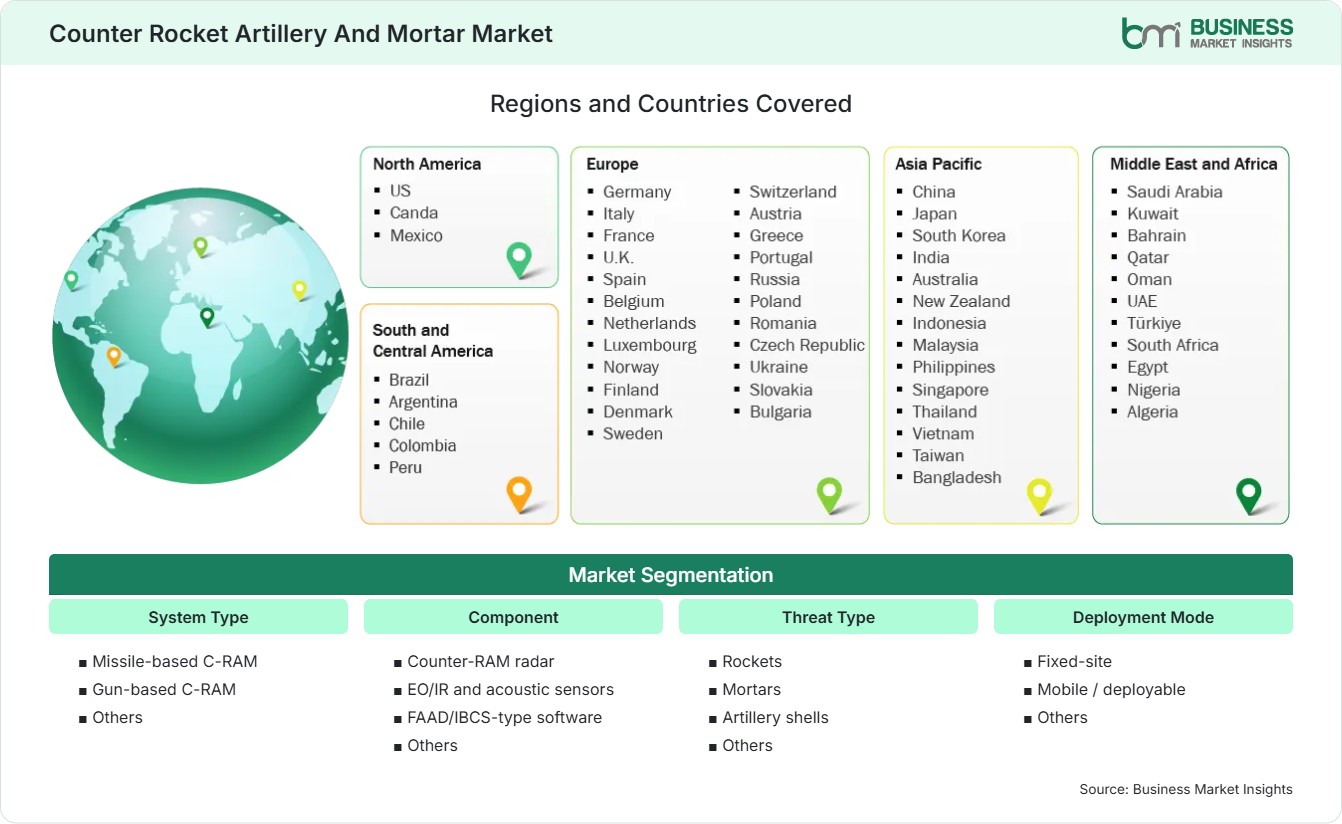
Europe holds a 20%–24% share in 2025 and is projected to grow at a 13.5%–15.0% CAGR through 2033. Germany, France, the United Kingdom, Italy, and Nordic defense markets provide important opportunities as governments strengthen air-defense capabilities and regional defense-industrial cooperation.
- Germany is strengthening air-defense capabilities and supporting broader European defense-industrial development.
- France and the United Kingdom are investing in integrated defensive architectures and advanced sensing technologies.
- Nordic countries are increasing defense cooperation and emphasizing interoperable military technologies.
- European procurement increasingly favors modular systems that can integrate with multinational defense architectures.
- Domestic industrial participation is becoming important in major defense technology programs.
Asia Pacific Counter Rocket Artillery And Mortar Market
Asia Pacific holds an 18%–22% Counter Rocket Artillery And Mortar Market share in 2025 and is projected to grow at a 14.5%–16.0% CAGR through 2033. China, India, Japan, South Korea, and Australia represent important markets because of defense modernization, regional security considerations, and increasing investment in integrated defensive infrastructure.
- India is strengthening domestic defense manufacturing and investing in modern sensing and air-defense capabilities.
- Japan continues to emphasize integrated defensive networks and advanced surveillance technologies.
- South Korea is expanding indigenous defense capabilities and networked air-defense infrastructure.
- Australia is increasing investment in integrated defense architectures and advanced surveillance capabilities.
- Regional governments are emphasizing interoperability and domestic technology development.
Rest of World Counter Rocket Artillery And Mortar Market
Rest of World represents a 27%–31% share in 2025 and is projected to grow at a 12.0%–14.0% CAGR through 2033. Middle Eastern markets represent an important demand center, while Latin America and Africa offer emerging opportunities linked to infrastructure protection and defense modernization.
Middle Eastern defense organizations continue to prioritize protection of strategic installations and integrated defensive infrastructure. Latin American and African markets generally present more selective opportunities influenced by budget availability, modernization priorities, and domestic industrial capabilities.
- Middle Eastern markets continue emphasizing protection of strategic military and infrastructure assets.
- Latin American governments are evaluating modernization programs within tighter defense-budget environments.
- African markets provide longer-term opportunities where defense infrastructure and surveillance capabilities are being upgraded.
- Regional suppliers and international integrators can benefit from demand for localized support and lifecycle services.