
Counter Hypersonic Defense Market Outlook: Size, Share, Trends, Growth Analysis, Competitive Landscape & Forecast, 2026-2033

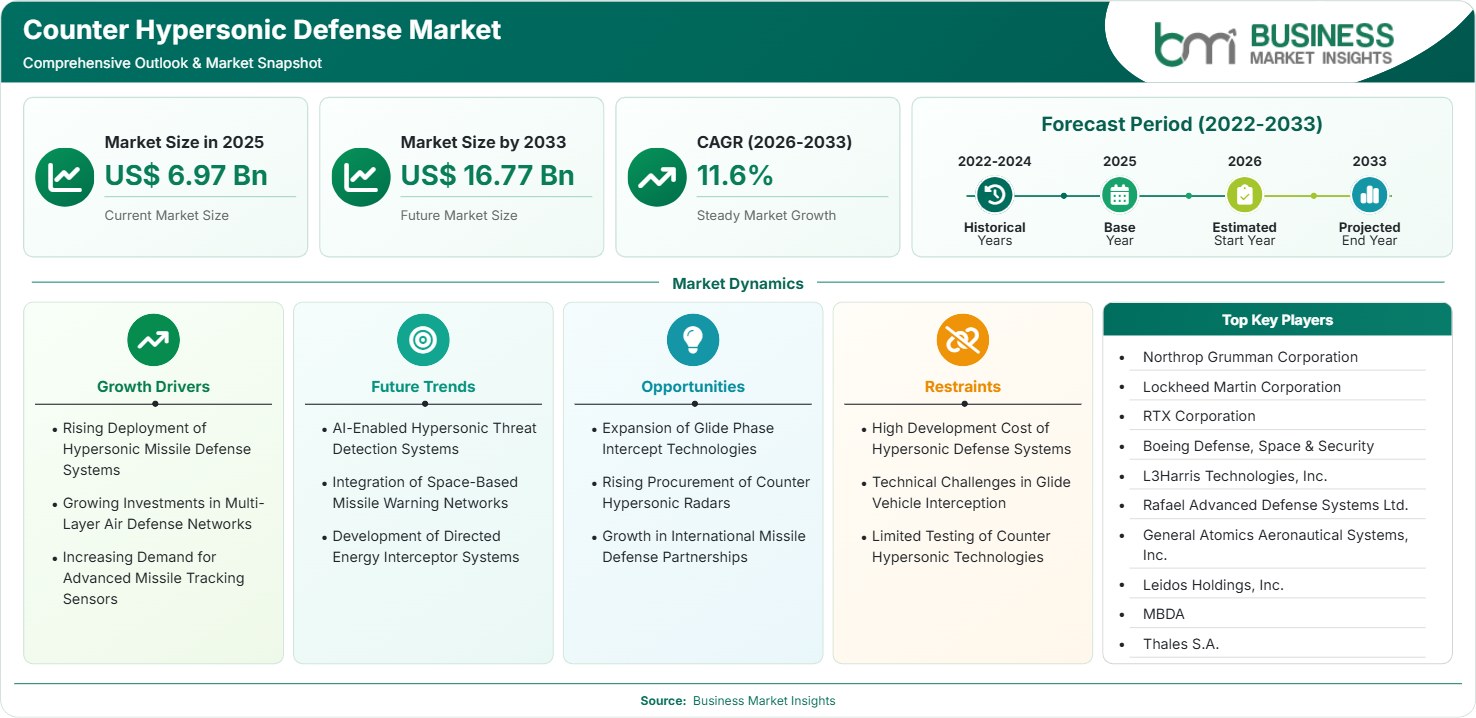
The Counter Hypersonic Defense Market size was valued at US$ 6.97 Billion in 2025 and is projected to reach US$ 16.77 Billion by 2033, growing at a CAGR of 11.6% during 2026–2033. Growth is driven by rising investments in missile defense modernization, increasing deployment of space-based tracking systems, growing hypersonic weapon proliferation, expansion of integrated air and missile defense architectures, and accelerating development of advanced intercept technologies.

Report Coverage
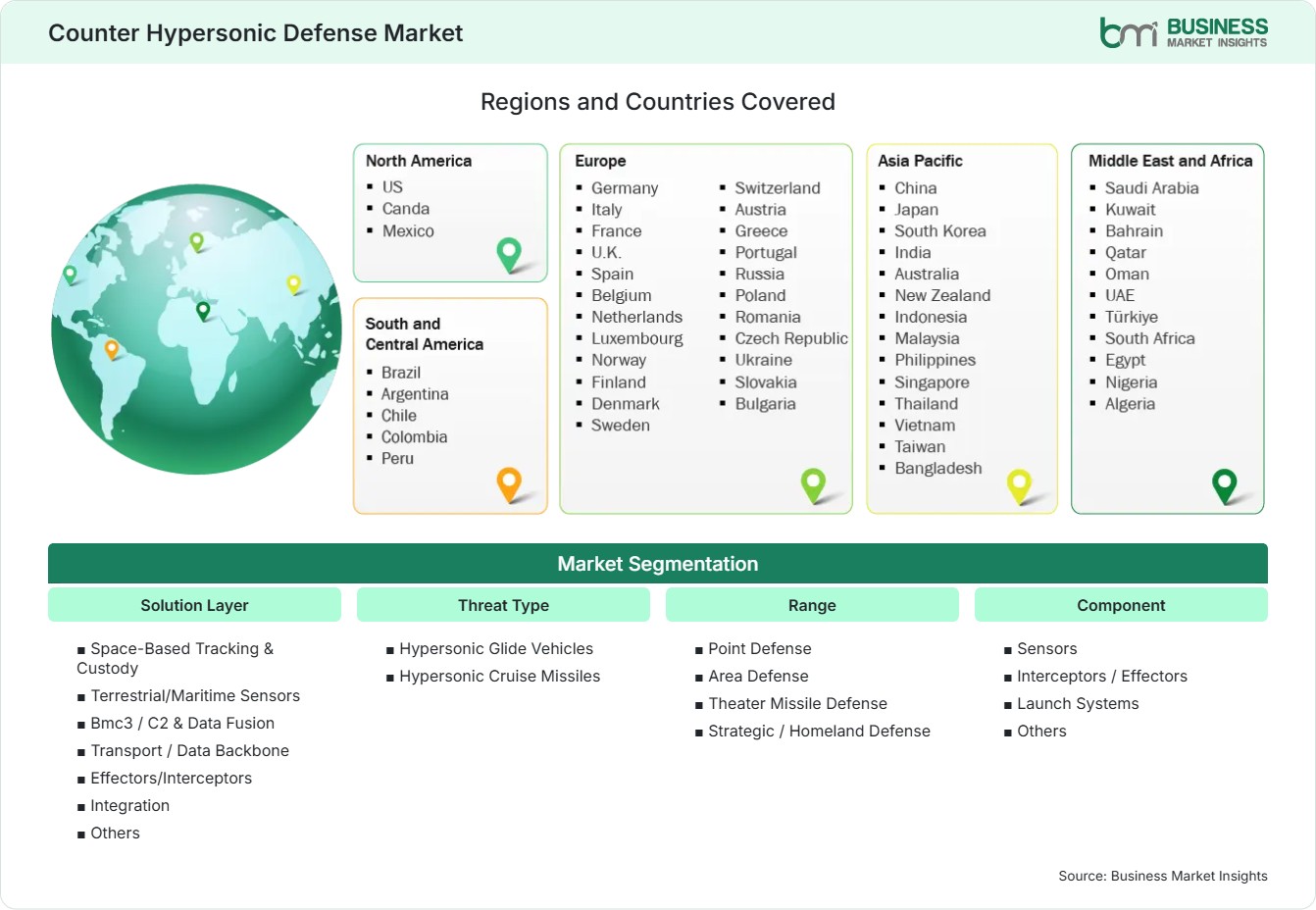
  • Solution Layer: Space-Based Tracking & Custody, Terrestrial/Maritime Sensors, Bmc3 / C2 & Data Fusion, Transport / Data Backbone, Effectors/Interceptors, Integration, Others
  • Threat Type: Hypersonic Glide Vehicles, Hypersonic Cruise Missiles
  • Range: Point Defense, Area Defense, Theater Missile Defense, Strategic / Homeland Defense
  • Component: Sensors, Interceptors / Effectors, Launch Systems, Others
  • Deployment Platform: Space, Land, Sea, Air
US$ 6.97 Bn Market size in 2025
US$ 16.77 Bn Market Size by 2033
11.6% CAGR, 2026 - 2033
2026-2033 Forecast Period

01 AI Overview

Counter Hypersonic Defense Market Summary

  • North America Region: North America holds a Counter Hypersonic Defense Market share of 41%–44% in 2025, growing at a CAGR of 10.8%–11.5% during 2026–2033. Demand is supported by significant defense budgets, hypersonic threat mitigation programs, and advanced missile defense initiatives. The U.S. remains the dominant market, advancing at a CAGR of 11.0%–11.7%.
  • Fastest Growing Region: Asia Pacific accounts for 24%–27% of revenue in 2025 and is projected to register a CAGR of 12.5%–13.3% through 2033. Regional growth is fueled by increasing missile modernization programs, strategic defense investments, and rising geopolitical tensions.
  • Leading Segment: Space-Based Tracking & Custody holds a market share of 22%–26% in 2025 and is expected to grow at a CAGR of 12.0%–12.8%. Demand is driven by the need for persistent tracking and early warning against maneuverable hypersonic threats.
  • High Growth Segment: Hypersonic Glide Vehicles account for 55%–59% of counter hypersonic defense market revenue in 2025 and are projected to register a CAGR of 12.8%–13.6% during the forecast period. Increasing deployment of glide vehicle capabilities by major military powers continues supporting growth.
  • Key Market Opportunity: Growing integration of space-based sensors, artificial intelligence-enabled command systems, and multi-domain missile defense architectures is creating significant opportunities.
  • Major Market Players: Northrop Grumman Corporation, Lockheed Martin Corporation, RTX Corporation, Boeing Defense, Space & Security, L3Harris Technologies, Inc., Rafael Advanced Defense Systems Ltd., General Atomics Aeronautical Systems, Inc., Leidos Holdings, Inc., MBDA, and Thales S.A.
02 Strategic Insights

Counter Hypersonic Defense Market: Strategic Insights

Counter Hypersonic Defense Market Strategic Framework
FREE PDF
Request your free sample
Request free sample
03 Stakeholder View

Key Takeaways

  • The counter hypersonic defense market analysis includes defense agencies, missile defense contractors, sensor developers, system integrators, aerospace manufacturers, and command-and-control technology providers.
  • Space-based tracking solutions remain among the most attractive opportunities due to increasing demand for early warning and persistent hypersonic threat monitoring.
  • Technology innovation increasingly focuses on AI-enabled battle management, space sensors, multi-domain integration, and advanced interceptor systems.
  • Asia Pacific provides the strongest growth potential supported by expanding defense budgets, regional security concerns, and ongoing military modernization initiatives.
  • Multi-layer defense architectures continue transforming market dynamics through integration of space, land, sea, and air defense capabilities.
  • Homeland security, strategic defense, and theater missile defense programs remain primary investment drivers across major defense-spending nations.
  • The market trend is advancing toward AI-enabled threat detection, space-based tracking systems, integrated missile defense networks, and next-generation interception technologies to address the increasing complexity of hypersonic threats.
04 Geographic Outlook

Counter Hypersonic Defense Market Regional Highlights

North America Counter Hypersonic Defense Market

North America accounted for 41%–44% of global revenue in 2025 and is projected to expand at a CAGR of 10.8%–11.5% through 2033. Growth is supported by extensive missile defense modernization programs, increasing hypersonic threat assessments, and substantial investments in next-generation tracking and interception capabilities. The Counter Hypersonic Defense Market share in the region continues benefiting from advanced defense technology ecosystems and strong government funding.

  • The United States continues leading global counter-hypersonic defense investments through advanced sensor, interceptor, and command system development programs.
  • Space-based tracking initiatives are expanding rapidly to provide persistent surveillance against maneuverable hypersonic threats.
  • Defense contractors continue developing integrated missile defense architectures capable of supporting multi-domain operations.
  • Artificial intelligence and data fusion technologies are increasingly incorporated into battle management and threat assessment systems.
  • Ongoing modernization of homeland missile defense programs continues supporting long-term procurement activities.

US Counter Hypersonic Defense Market

The United States represented 37%–40% of global revenue in 2025 and is anticipated to register a CAGR of 11.0%–11.7% during the forecast period. Demand is driven by strategic missile defense initiatives, hypersonic weapon countermeasure development, and growing investment in layered defense networks. Expanding deployment of advanced sensors and command-and-control platforms continues supporting Counter Hypersonic Defense Market growth.

  • Defense agencies continue funding advanced interception technologies designed for highly maneuverable hypersonic threats.
  • Space sensor programs are improving detection, tracking, and targeting capabilities across global operational environments.
  • Major defense contractors maintain significant investments in next-generation missile defense platforms.
  • Multi-domain operational concepts continue accelerating adoption of integrated defense architectures.

Europe Counter Hypersonic Defense Market

Europe held 22%–25% of global revenue in 2025 and is projected to grow at a CAGR of 11.0%–11.7% through 2033. The counter hypersonic defense market forecast suggests that increasing defense spending, growing concerns regarding advanced missile threats, and stronger regional defense cooperation will support long-term market growth. Germany remains the leading market with a CAGR of 11.1%–11.8%, while Poland is the fastest-growing country, expanding at a CAGR of 12.0%–12.7%.

  • European defense agencies are prioritizing advanced missile defense technologies as part of broader modernization initiatives.
  • Collaborative defense programs continue supporting development of integrated tracking and interception capabilities.
  • Germany maintains leadership through strong defense procurement activities and advanced aerospace capabilities.
  • Poland is accelerating investments in missile defense and strategic deterrence systems.
  • Demand for interoperable command-and-control networks continues increasing across NATO-aligned defense programs.

Asia Pacific Counter Hypersonic Defense Market

Asia Pacific accounted for 24%–27% of global revenue in 2025 and is expected to remain the fastest-growing region, registering a CAGR of 12.5%–13.3% through 2033. Rising geopolitical tensions, expanding missile programs, and increasing investments in advanced defense systems continue driving market growth. China remains the largest regional market with a CAGR of 12.2%–13.0%, while Japan records the highest growth at 13.0%–13.8%.

  • Regional governments continue increasing investments in missile early warning and defense modernization initiatives.
  • China benefits from large-scale defense technology programs and advanced missile system development activities.
  • Japan is strengthening missile interception and tracking capabilities to address evolving regional security requirements.
  • Expansion of indigenous defense manufacturing continues supporting procurement of advanced technologies.
  • Integration of space, air, and maritime defense systems is becoming a major strategic priority.

Rest of World Counter Hypersonic Defense Market

The Rest of World region accounted for 8%–11% of global revenue in 2025 and is expected to register a CAGR of 10.7%–11.4% through 2033. Market growth is supported by rising defense modernization programs, increasing procurement of missile defense technologies, and growing focus on strategic security capabilities. Demand remains particularly strong among nations seeking advanced air and missile defense architectures.

Saudi Arabia is the leading market in the Middle East and is forecast to grow at a CAGR of 11.0%–11.7%. In South & Central America, Brazil is expected to be the fastest-growing country with a CAGR of 10.8%–11.5%.

  • Saudi Arabia continues strengthening strategic missile defense capabilities through major defense procurement programs.
  • Brazil is expanding investments in defense technology modernization and surveillance infrastructure.
  • Regional governments are increasingly emphasizing integrated air and missile defense readiness.
  • Military modernization efforts continue generating opportunities for advanced defense system suppliers.
  • Growing focus on homeland security and critical infrastructure protection supports market development.
Global Market Geography
FREE PDF
Request your free sample
Request free sample
05 Segment Analysis

Counter Hypersonic Defense Market Segmentation

Solution Layer

Solution layers form the foundation of modern counter-hypersonic architectures by enabling detection, tracking, decision-making, communication, and interception of high-speed threats. Space-Based Tracking & Custody leads the segment with 22%–26% share in 2025 and is projected to grow at a CAGR of 12.0%–12.8% through 2033. The market scope continues expanding as defense agencies prioritize persistent tracking capabilities and multi-domain operational awareness.

  • Space-Based Tracking & Custody: Dominates demand due to its ability to provide persistent surveillance, early warning, and continuous custody of maneuverable hypersonic threats.
  • Terrestrial/Maritime Sensors: Support long-range detection, target discrimination, and tracking across land and maritime operational environments.
  • BMC3 / C2 & Data Fusion: Enables rapid decision-making by integrating data from multiple sensor layers and defense platforms.
  • Transport / Data Backbone: Facilitates secure, high-speed communication between sensors, command systems, and interceptor platforms.
  • Effectors/Interceptors: Play a critical role in neutralizing incoming threats through advanced kinetic and non-kinetic engagement capabilities.
  • Integration & Others: Support system interoperability, architecture optimization, testing, validation, and deployment activities.

Threat Type

Threat type segmentation reflects evolving global defense requirements driven by the development of advanced hypersonic weapons. Hypersonic Glide Vehicles account for 55%–59% share in 2025 and are expected to grow at a CAGR of 12.8%–13.6% through 2033. Growing deployment of maneuverable glide vehicle systems continues encouraging investments in advanced tracking and interception technologies.

  • Hypersonic Glide Vehicles: Represent the dominant threat category due to maneuverability, unpredictable flight trajectories, and increasing deployment by major military powers.
  • Hypersonic Cruise Missiles: Generate significant demand for advanced detection and interception systems due to sustained high-speed atmospheric flight capabilities.

Range

Range-based defense architectures remain essential for creating layered protection against increasingly sophisticated threats. Demand continues increasing across strategic and theater-level defense programs as governments strengthen defensive readiness against long-range missile systems. Counter Hypersonic Defense Market trends indicate growing emphasis on integrated multi-range engagement capabilities.

  • Point Defense: Protects critical facilities, military installations, and strategic assets against localized hypersonic threats.
  • Area Defense: Provides broader protection across military formations, key infrastructure, and regional operational zones.
  • Theater Missile Defense: Supports defense of deployed forces and regional assets against advanced missile threats.
  • Strategic / Homeland Defense: Focuses on protecting national territories and strategic infrastructure from long-range hypersonic attacks.

Component

Component demand is driven by continuous modernization of missile defense systems and increasing focus on layered defense architectures. Sensors remain a major procurement priority due to their importance in target detection and tracking. The market continues to witness significant investment across all hardware and software components required for effective hypersonic defense operations.

  • Sensors: Provide tracking, surveillance, target acquisition, and threat discrimination capabilities essential for defense missions.
  • Interceptors / Effectors: Support engagement and neutralization of hypersonic threats through advanced kinetic and directed-energy concepts.
  • Launch Systems: Enable rapid deployment and operational readiness of defensive missile systems across multiple platforms.
  • Others: Include communication systems, processing units, software platforms, and integration technologies supporting mission execution.

Deployment Platform

Deployment platforms continue evolving toward integrated multi-domain defense models capable of addressing complex threat environments. Space-based deployments are receiving increasing investment, while land, sea, and air platforms remain critical for layered operational coverage. The market share gains are increasingly supported by cross-domain interoperability and network-centric defense capabilities.

  • Space: Supports persistent surveillance, tracking, early warning, and global coverage capabilities.
  • Land: Remains the primary deployment platform for missile defense systems, command centers, and interceptor infrastructure.
  • Sea: Enhances mobility and operational flexibility through ship-based missile defense and radar capabilities.
  • Air: Supports airborne surveillance, command-and-control functions, and future interceptor deployment concepts.
06 Market Forces

Counter Hypersonic Defense Market Dynamics

Key Market Drivers

Rising Deployment of Hypersonic Missile Defense Systems

Growing proliferation of hypersonic weapons is driving demand for advanced missile defense systems capable of detecting, tracking, and intercepting high-speed maneuverable threats. Defense agencies are accelerating investments in dedicated counter-hypersonic programs to address emerging strategic risks. Governments are increasingly funding development of integrated sensor networks, advanced interceptors, and command systems designed specifically for hypersonic engagements. Rising deployment of these defense architectures across homeland security and military applications continues supporting robust market growth. As threat environments become more complex, procurement of specialized counter-hypersonic systems is expected to increase substantially throughout the forecast period.

Growing Investments in Multi-Layer Air Defense Networks

Military organizations are increasingly adopting layered defense strategies that combine space, land, sea, and air-based assets to counter advanced missile threats. Multi-layer defense architectures improve operational effectiveness by integrating early warning systems, tracking radars, battle management platforms, and interceptors within a unified framework. Growing geopolitical uncertainties and missile modernization programs continue encouraging defense agencies to strengthen defensive capabilities. Investment in integrated air and missile defense systems is accelerating across major defense-spending nations. These developments continue supporting demand for sophisticated technologies capable of addressing the unique challenges associated with hypersonic weapon interception.

Increasing Demand for Advanced Missile Tracking Sensors

Effective defense against hypersonic threats depends heavily on advanced sensing technologies capable of maintaining continuous target custody across long distances and complex flight paths. Defense organizations are prioritizing deployment of space-based sensors, over-the-horizon tracking systems, and next-generation radar capabilities to improve threat awareness and engagement success rates. Sensor modernization programs are receiving substantial funding due to the critical role they play in missile defense architectures. Growing emphasis on real-time situational awareness, rapid data processing, and multi-domain integration continues generating strong demand for advanced tracking solutions across the counter-hypersonic defense market.

Key Market Opportunities

Expansion of Glide Phase Intercept Technologies

Glide phase interception represents one of the most promising opportunities in the counter-hypersonic defense landscape. Defense agencies are investing heavily in technologies capable of engaging threats during the glide phase before they approach intended targets. Successful development of glide phase intercept capabilities can significantly improve defensive effectiveness while creating new procurement opportunities for contractors and technology providers. Ongoing research, testing programs, and prototype development activities continue attracting substantial government funding. As operational requirements evolve, demand for advanced glide phase engagement solutions is expected to create long-term commercial opportunities across the counter hypersonic defense market.

Rising Procurement of Counter Hypersonic Radars

Advanced radar systems capable of tracking maneuverable hypersonic threats are becoming a major procurement priority for military organizations worldwide. Existing radar networks often require modernization to address evolving operational requirements associated with high-speed weapons. Governments are increasingly investing in long-range radar systems, integrated sensor architectures, and enhanced target discrimination capabilities. These procurement activities are creating opportunities for defense electronics manufacturers, radar developers, and aerospace suppliers. Continued emphasis on improving detection accuracy and tracking persistence will likely sustain strong demand for advanced radar technologies throughout the forecast period.

Growth in International Missile Defense Partnerships

International collaboration is becoming increasingly important as governments seek to address rapidly evolving hypersonic threat environments. Joint development programs, defense technology partnerships, and multinational procurement initiatives are enabling participating nations to share resources, expertise, and operational capabilities. These collaborations support accelerated innovation while reducing development risks and costs. Defense contractors involved in multinational partnerships benefit from broader market access and long-term program opportunities. Growing demand for interoperable missile defense systems is expected to further strengthen international cooperation and create favorable conditions for sustained market expansion.

Market Restraints and Challenges

High Development Cost of Hypersonic Defense Systems

Factor: Counter-hypersonic defense systems require extensive investment in advanced sensors, interceptor technologies, space assets, command architectures, and testing infrastructure. Impact: High development costs can limit procurement scalability and place significant pressure on defense budgets. Long development cycles and technical complexity may increase program risks while delaying deployment schedules. Governments must balance funding priorities across multiple defense modernization initiatives, potentially affecting acquisition timelines and market growth rates.

Technical Challenges in Glide Vehicle Interception

Factor: Hypersonic glide vehicles operate at extremely high speeds while performing unpredictable maneuvers, creating significant targeting and interception challenges. Impact: These operational characteristics increase technical complexity for sensor networks, command-and-control systems, and interceptor platforms. Maintaining accurate tracking and successful engagement throughout flight trajectories remains difficult, requiring continuous technology advancements. Such challenges can lengthen development timelines, increase program costs, and complicate deployment of effective defense solutions.

07 Company Analysis

Competitive Landscape

The market remains highly concentrated among major defense contractors, aerospace manufacturers, missile defense specialists, and advanced sensor technology providers. Companies are emphasizing space-based tracking systems, interceptor development, integrated command-and-control platforms, and multi-domain defense architectures. Increasing investments in advanced missile defense capabilities continue shaping Counter Hypersonic Defense Market analysis and competitive strategies across global defense ecosystems.

Company Name

Overview

Products and Services Relevant to this Market

Northrop Grumman Corporation

Global aerospace and defense company focused on advanced missile defense technologies.

Space sensors, missile defense systems, command and control platforms.

Lockheed Martin Corporation

Leading defense contractor with extensive missile defense and aerospace capabilities.

Interceptors, missile defense systems, integrated battle management solutions.

RTX Corporation

Defense technology company specializing in missile defense and sensor solutions.

Missile interceptors, radar systems, tracking technologies, air defense solutions.

Boeing Defense, Space & Security

Aerospace and defense manufacturer supporting advanced defense programs globally.

Missile defense systems, space technologies, command and control solutions.

L3Harris Technologies, Inc.

Defense technology provider specializing in sensors, communications, and intelligence systems.

Tracking sensors, communications systems, defense data networks.

Rafael Advanced Defense Systems Ltd.

Defense company focused on advanced interception and air defense technologies.

Missile interceptors, air defense systems, tracking solutions.

General Atomics Aeronautical Systems, Inc.

Aerospace company providing advanced defense and surveillance technologies.

ISR systems, sensor technologies, defense integration solutions.

Leidos Holdings, Inc.

Technology and defense services provider supporting national security programs.

Command systems, defense software, sensor integration platforms.

MBDA

International missile systems manufacturer serving global defense customers.

Missile defense solutions, interceptor technologies, integrated weapon systems.

Thales S.A.

Global defense electronics and aerospace technology company.

Radar systems, defense sensors, command-and-control technologies.

08 Industry Activity

Recent Developments

July 2026

MBDA announced that the HYDIS (Hypersonic Defence Interceptor System) project had completed its Final Concept Review, with the participating nations (France, Germany, Italy, and the Netherlands) selecting a single interceptor concept for Europe's future counter-hypersonic and anti-ballistic missile defense system, marking a key milestone toward technology maturation and future development.

July 2026

The U.S. Army identified Anduril Industries as a potential supplier of hypersonic weapons, alongside existing defense contractors, as part of its strategy to expand the industrial base and develop a mix of high-end and lower-cost long-range missile capabilities for future operations.

May 2026

Lockheed Martin Corporation expanded development of next-generation hypersonic interception and integrated missile defense technologies to strengthen layered defense architectures. The initiative aims to enhance interception capabilities, improve response times, and address evolving hypersonic missile threats.

February 2026

Northrop Grumman Corporation strengthened space-based tracking capabilities through advanced sensor initiatives designed to improve hypersonic threat detection and target custody. The development enhances situational awareness and supports more effective missile defense and early warning operations.

10 Trust & Transparency

Research Methodology

The market analysis combines proprietary research with secondary data from government agencies, company disclosures, regulatory filings, industry databases and expert interviews. Market estimates are validated through data triangulation, cross-market benchmarking and analyst review.

View Full Research Methodology

11 Questions Answered

Frequently Asked Questions

What challenge has the greatest long-term impact on the industry?

Technical challenges associated with detecting, tracking, and intercepting highly maneuverable hypersonic glide vehicles remain a major obstacle affecting system development and deployment.

How do space-based tracking systems support hypersonic defense?

They provide persistent global surveillance, early threat detection, continuous tracking, and improved targeting information for interceptor and command systems.

Why is Asia Pacific the fastest-growing region?

The region benefits from increasing defense expenditures, ongoing military modernization initiatives, strategic security concerns, and growing investments in missile defense capabilities.

Which solution layer leads the market?

Space-Based Tracking & Custody represents the leading segment due to its role in providing persistent surveillance, early warning, and continuous tracking of hypersonic threats.

What is driving growth in the Counter Hypersonic Defense Market report?

Growing hypersonic weapon proliferation, increasing missile defense modernization programs, rising defense budgets, and expanding investments in advanced tracking and interception technologies are the primary growth drivers.

Access the Full Counter Hypersonic Defense Market Report

Get segment-level forecasts, regional estimates, competitive benchmarking, company profiles and downloadable Excel datasets.

Access the full Counter Hypersonic Defense Market Report
350 pages PDF & Excel | 2026-07-30