
IoT in Defense Market Outlook: Size, Share, Trends, Growth Analysis, Competitive Landscape & Forecast, 2026-2033

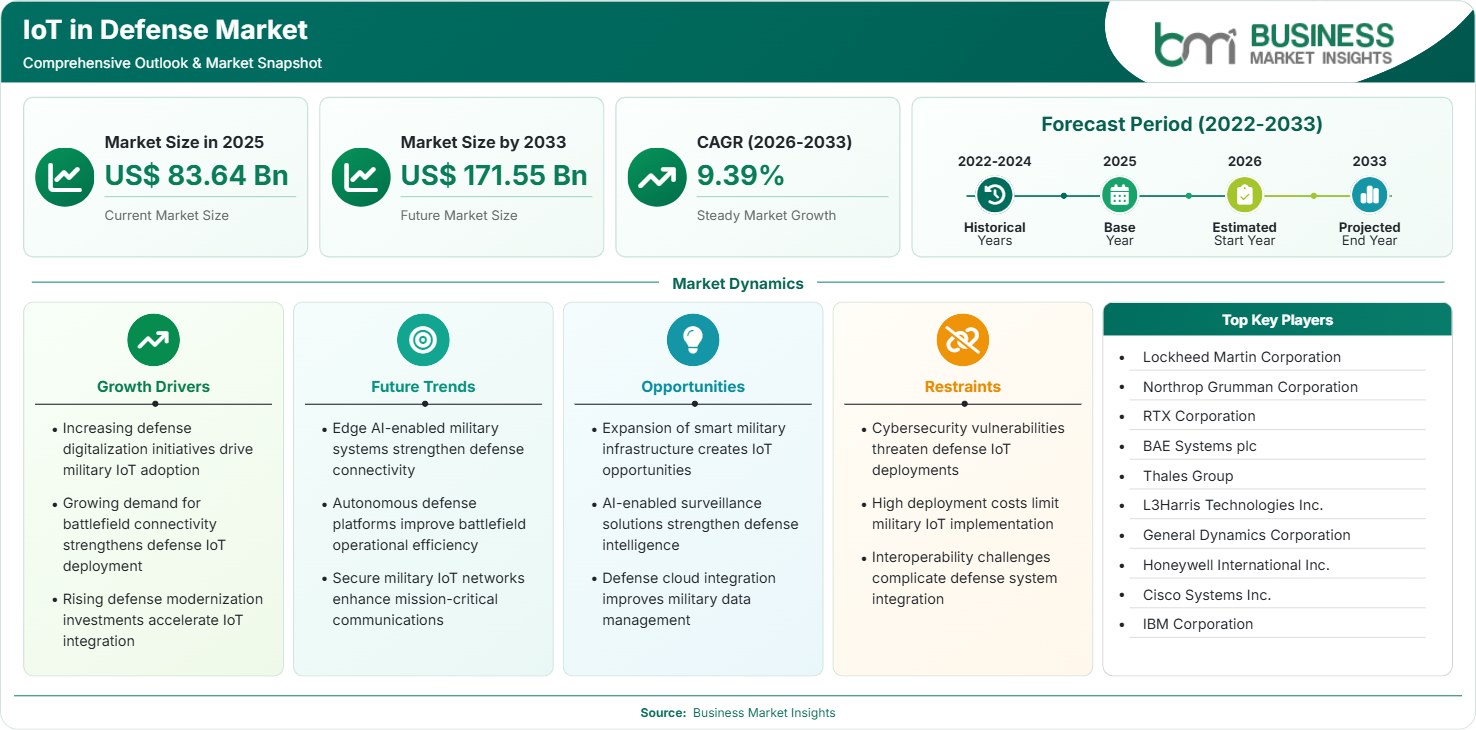
The IoT In Defense Market size was valued at US$ 83.64 billion in 2025 and is projected to reach US$ 171.55 billion by 2033, registering a CAGR of 9.39% during 2026–2033. The market is witnessing significant growth due to increasing defense digitalization initiatives, growing demand for battlefield connectivity, and rising investments in military modernization programs. Internet of Things (IoT) technologies are transforming defense operations by enabling real-time situational awareness, predictive maintenance, secure communications, intelligent surveillance, and connected battlefield ecosystems that enhance operational effectiveness and mission readiness.

Report Coverage
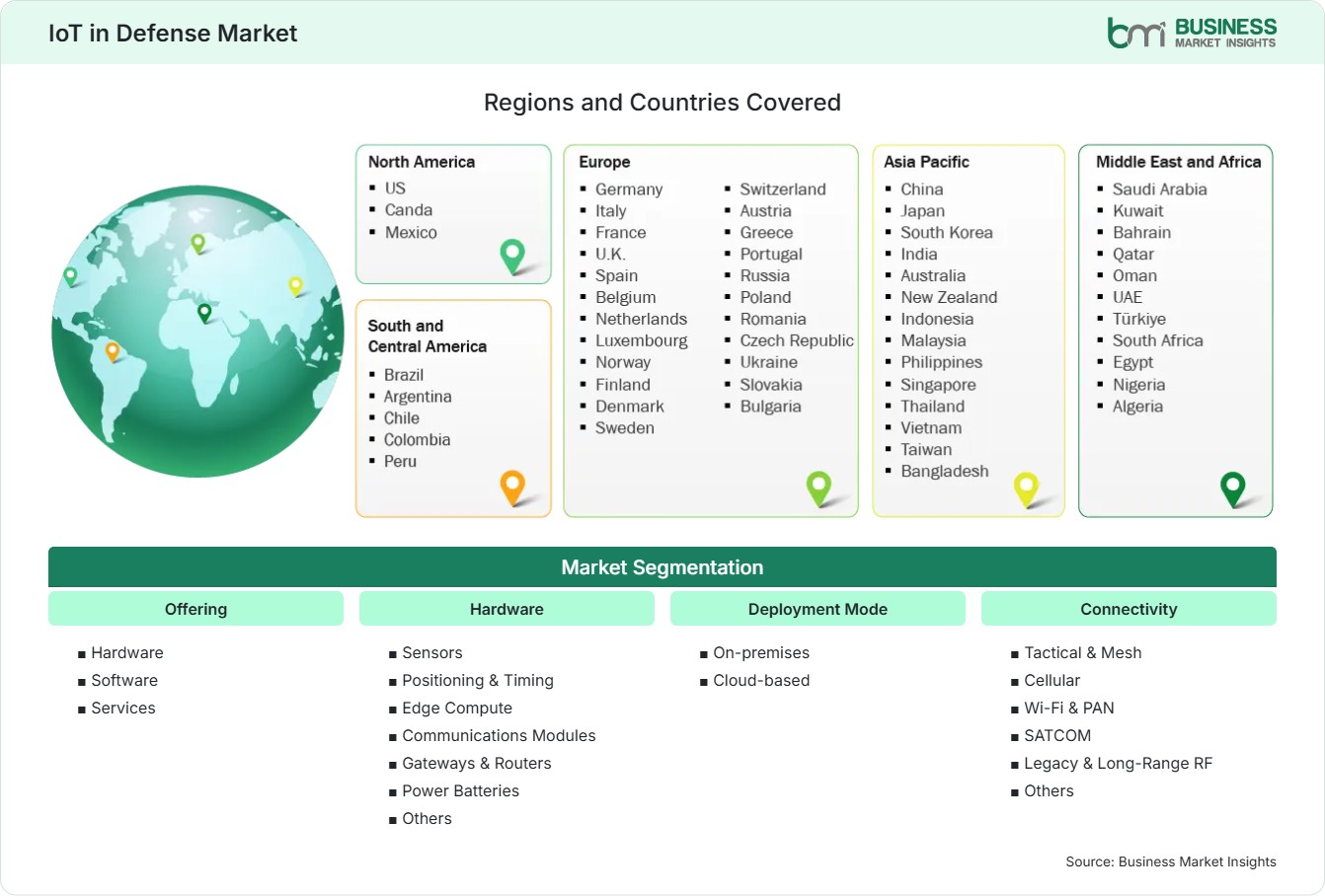
  • Offering: Hardware, Software, Services
  • Hardware: Sensors, Positioning & Timing, Edge Compute, Communications Modules, Gateways & Routers, Power Batteries, Others
  • Deployment Mode: On-premises, Cloud-based
  • Connectivity: Tactical & Mesh, Cellular, Wi-Fi & PAN, SATCOM, Legacy & Long-Range RF, Others
  • Platform: Dismounted Soldier/Warfighter, Ground Vehicles, Aircrafts, Naval Vessels, Unmanned Systems, Satellites & Ground Platform, Others
US$ 83.64 Bn Market size in 2025
US$ 171.55 Bn Market Size by 2033
9.39% CAGR, 2026 - 2033
2026-2033 Forecast Period

AI Overview

IoT in Defense Market Summary

  • North America Region: North America accounted for 37%–40% of global revenue in 2025 and is projected to register a CAGR of 9.0%–9.5% during 2026–2033. Strong defense spending, rapid adoption of digital military technologies, advanced defense communication infrastructure, and ongoing investments in connected battlefield systems continue supporting regional market leadership. The United States contributes approximately 89%–92% of regional revenue and is expected to register a CAGR of 9.1%–9.6% owing to continuous modernization of defense networks and increasing deployment of IoT-enabled military platforms.
  • Fastest Growing Region: Asia Pacific represented 25%–28% of global revenue in 2025 and is projected to register the highest CAGR of 10.2%–10.7% during the forecast period. Rising defense modernization initiatives, increasing military expenditures, expanding indigenous defense manufacturing, and growing adoption of smart defense technologies continue accelerating regional growth.
  • Leading Segment: Hardware accounted for 44%–47% of market revenue in 2025 and is projected to register a CAGR of 9.5%–10.0% during the assessment period owing to increasing deployment of sensors, communication modules, edge computing devices, and secure military networking equipment.
  • High Growth Segment: Cloud-based deployment represented 36%–39% of total market revenue in 2025 and is projected to expand at a CAGR of 10.1%–10.6% driven by increasing adoption of secure defense cloud infrastructure, real-time data sharing, and centralized military information management.
  • Key Market Opportunity: Smart military infrastructure, AI-enabled surveillance technologies, and defense cloud integration continue creating significant opportunities for IoT solution providers.
  • Major Market Players: Lockheed Martin Corporation, Northrop Grumman Corporation, RTX Corporation, BAE Systems plc, Thales Group, L3Harris Technologies Inc., General Dynamics Corporation, Honeywell International Inc., Cisco Systems Inc., IBM Corporation
Strategic Insights

IoT in Defense Market: Strategic Insights

IoT in Defense Market Strategic Framework
FREE PDF
Request your free sample
Request free sample
Stakeholder View

Key Takeaways

  • The market continues benefiting from defense digitalization initiatives, battlefield connectivity requirements, military modernization programs, and increasing deployment of connected defense technologies.
  • The strongest IoT In Defense Market Growth opportunities continue emerging from smart military infrastructure, AI-enabled surveillance, secure cloud platforms, and intelligent defense communication systems.
  • Hardware remains the leading offering segment due to widespread deployment of sensors, communication modules, edge computing devices, and connected military equipment.
  • Asia Pacific is projected to witness the fastest growth owing to rising defense expenditures, indigenous military technology development, and increasing adoption of connected defense platforms.
  • Defense organizations are increasingly investing in artificial intelligence, cybersecurity, satellite communications, edge computing, and secure IoT architectures to strengthen operational capabilities.
  • Companies focusing on secure defense networking, intelligent battlefield systems, cloud-enabled military operations, and advanced surveillance technologies are expected to strengthen their competitive positioning.
Geographic Outlook

IoT in Defense Market Regional Highlights

North America IoT In Defense Market

North America accounted for 37%–40% of global revenue in 2025 and is projected to register a CAGR of 9.0%–9.5% during 2026–2033. The region continues leading the market owing to high defense spending, rapid adoption of connected military technologies, strong cybersecurity capabilities, and continuous investments in battlefield digitalization. The IoT In Defense Market Share remains significant as defense agencies increasingly deploy IoT-enabled communication systems, intelligent surveillance platforms, and connected military assets to enhance operational readiness and mission effectiveness.

  • The United States remains the largest regional market due to extensive investments in defense modernization, network-centric warfare capabilities, and secure military communication systems.
  • Canada continues supporting regional growth through defense communication upgrades, cybersecurity initiatives, and increasing adoption of intelligent surveillance technologies.
  • Growing deployment of autonomous military platforms and connected battlefield equipment continues strengthening demand for defense IoT solutions.
  • Defense organizations are increasingly integrating artificial intelligence, edge computing, and secure cloud infrastructure to improve operational efficiency and real-time decision-making.

US IoT In Defense Market

The United States accounted for approximately 89%–92% of North American revenue in 2025 and is projected to register a CAGR of 9.1%–9.6% during the forecast period. The country's continued investments in advanced defense technologies, military digital transformation, and secure communication infrastructure remain key drivers of market expansion.

  • The Department of Defense continues investing in connected battlefield technologies to improve command, control, communications, intelligence, surveillance, and reconnaissance capabilities.
  • Increasing deployment of autonomous systems, intelligent sensors, and military edge computing platforms continues supporting operational modernization in IoT in defense market.
  • Rising adoption of secure defense cloud platforms continues enhancing military data management and mission coordination.
  • Defense contractors continue developing next-generation IoT-enabled military solutions to strengthen force protection and mission readiness.

Europe IoT In Defense Market

Europe represented 28%–31% of global revenue in 2025 and is expected to expand at a CAGR of 8.8%–9.3% during 2026–2033. Increasing defense cooperation, modernization of armed forces, and growing investments in secure military communication systems continue driving regional market growth. Germany remains the largest regional market, while the United Kingdom is projected to register the fastest growth with a CAGR of 9.4%–9.9% owing to increasing investments in intelligent defense technologies and military digital transformation.

  • Germany continues leading regional demand through advanced defense manufacturing capabilities and modernization of military communication networks.
  • The United Kingdom continues strengthening market growth through increasing investments in connected defense infrastructure, cyber defense, and intelligent surveillance systems.
  • France continues contributing through military modernization programs and deployment of secure IoT-enabled defense platforms in IoT in defense market.
  • European defense organizations continue expanding adoption of interoperable communication systems and digital battlefield technologies.
  • Collaborative defense initiatives across the region continue encouraging deployment of advanced IoT-enabled military solutions.

Asia Pacific IoT In Defense Market

Asia Pacific accounted for 25%–28% of global revenue in 2025 and is projected to register the highest CAGR of 10.2%–10.7% during the forecast period. Increasing geopolitical tensions, expanding defense budgets, indigenous defense manufacturing, and growing military digitalization initiatives continue accelerating regional market expansion. China remains the leading regional market, while India is projected to register the fastest growth with a CAGR of 10.8%–11.3% due to increasing defense modernization, smart military infrastructure development, and expanding indigenous technology capabilities.

  • China continues dominating regional demand through extensive investments in intelligent military systems, connected defense infrastructure, and advanced communication technologies.
  • India continues witnessing rapid growth through modernization of defense forces, increasing deployment of connected battlefield systems, and government support for indigenous defense technologies.
  • Japan continues investing in secure defense communications, surveillance technologies, and intelligent military platforms.
  • South Korea supports regional growth through advanced defense electronics, autonomous military systems, and integrated battlefield communication networks in IoT in defense market.
  • Regional governments continue strengthening defense capabilities through adoption of AI-enabled surveillance, IoT platforms, and secure cloud technologies.

Rest of World IoT In Defense Market

The Rest of World accounted for 6%–8% of global revenue in 2025 and is projected to register a CAGR of 9.2%–9.7% during 2026–2033. The Middle East, Latin America, and Africa continue increasing investments in military modernization, secure communication infrastructure, and defense surveillance technologies to strengthen national security capabilities.

Growing adoption of connected defense systems, expanding border security initiatives, and increasing investments in intelligent military platforms continue creating new opportunities for IoT solution providers across emerging defense markets.

  • Saudi Arabia continues strengthening market demand through defense modernization programs and investments in advanced military technologies.
  • The United Arab Emirates continues expanding deployment of connected surveillance systems, secure communication platforms, and smart defense infrastructure.
  • Brazil continues investing in defense communication modernization and intelligent border security technologies in IoT in defense market.
  • South Africa continues adopting connected defense solutions to improve surveillance, command operations, and military communications.
  • International defense technology partnerships continue supporting deployment of secure IoT-enabled military systems across developing regions.
Global Market Geography
FREE PDF
Request your free sample
Request free sample
Segment Analysis

IoT in Defense Market Segmentation

Offering

The Offering segment accounted for 44%–47% of market revenue in 2025 and is projected to register a CAGR of 9.5%–10.0% during the forecast period. Growing deployment of connected military platforms, intelligent battlefield systems, and secure communication networks continues driving demand across hardware, software, and services. The IoT In Defense Market Trends indicate increasing investments in integrated defense ecosystems that combine advanced sensing technologies, real-time analytics, and secure network infrastructure to enhance operational effectiveness.

  • Hardware: Hardware remains the leading segment owing to increasing deployment of military-grade sensors, communication modules, edge computing devices, gateways, and secure networking equipment across defense platforms. Continuous modernization of connected military infrastructure further supports segment growth.
  • Software: Defense software solutions continue witnessing strong adoption through increasing deployment of command-and-control platforms, AI-powered analytics, predictive maintenance systems, cybersecurity applications, and mission management software.
  • Services: Services continue expanding as defense organizations increasingly require system integration, maintenance, cybersecurity support, cloud migration, consulting, and lifecycle management for complex IoT deployments.

Hardware

The Hardware segment represented 39%–42% of total market revenue in 2025 and is expected to expand at a CAGR of 9.4%–9.9% throughout the assessment period. Increasing investments in connected battlefield infrastructure and intelligent defense systems continue driving adoption of advanced military hardware components. The IoT In Defense Market Scope continues expanding as armed forces deploy secure, ruggedized, and high-performance devices across multiple operational environments.

  • Sensors: Sensors account for the largest share owing to widespread deployment for surveillance, threat detection, asset monitoring, environmental sensing, and battlefield intelligence gathering.
  • Positioning & Timing: Positioning and timing technologies continue supporting accurate navigation, mission coordination, and synchronization of connected military assets.
  • Edge Compute: Edge computing platforms continue gaining importance by enabling low-latency data processing and real-time operational decision-making in battlefield environments.
  • Communications Modules: Secure communication modules continue facilitating reliable information exchange across connected military networks and operational units.
  • Gateways & Routers: Military-grade gateways and routers continue supporting secure data transmission, network interoperability, and resilient battlefield communications.
  • Power Batteries: Advanced power solutions continue ensuring uninterrupted operation of connected defense equipment deployed in remote and mission-critical environments.
  • Others: Additional hardware components including embedded processors, ruggedized controllers, antennas, and secure networking devices continue supporting military IoT deployments.

Deployment Mode

The Deployment Mode segment accounted for 36%–39% of market revenue in 2025 and is projected to register a CAGR of 10.1%–10.6% during 2026–2033. Increasing digital transformation initiatives and demand for secure military data management continue accelerating adoption of advanced deployment models.

  • On-premises: On-premises deployment continues maintaining a significant market position due to stringent military security requirements, sensitive operational data, and mission-critical infrastructure.
  • Cloud-based: Cloud-based deployment represents the fastest-growing segment owing to increasing adoption of secure defense cloud infrastructure, scalable data storage, centralized analytics, and enhanced operational collaboration across defense organizations.

Connectivity

The Connectivity segment represented 31%–34% of total market revenue in 2025 and is projected to expand at a CAGR of 9.7%–10.2% during the forecast period. Secure and reliable communication remains essential for modern defense operations across diverse mission environments.

  • Tactical & Mesh: Tactical and mesh networking continues leading the segment due to resilient battlefield communications, decentralized connectivity, and mission-critical information sharing.
  • Cellular (4G & 5G): Cellular connectivity continues expanding through deployment of secure private networks supporting military communications and intelligent battlefield operations.
  • Wi-Fi & PAN: Wi-Fi and PAN technologies continue supporting localized military communications, training environments, and base operations.
  • SATCOM: Satellite communications remain essential for long-range connectivity, global operations, and secure communications in remote operational environments.
  • Legacy & Long-Range RF: Legacy and long-range RF systems continue supporting interoperability with existing military communication infrastructure.
  • Others: Additional communication technologies continue strengthening secure defense networking across specialized military applications.

Platform

The Platform segment accounted for 34%–37% of market revenue in 2025 and is projected to register a CAGR of 9.8%–10.3% during the assessment period. Expanding deployment of connected military assets across land, air, sea, and space continues driving platform-level adoption.

  • Dismounted Soldier/Warfighter: Connected soldier systems continue supporting real-time situational awareness, health monitoring, navigation, and secure battlefield communications.
  • Ground Vehicles: Ground vehicles remain the leading platform owing to increasing deployment of connected combat vehicles, logistics fleets, and armored military systems.
  • Aircrafts: Military aircraft continue integrating IoT technologies for predictive maintenance, operational monitoring, and mission management.
  • Naval Vessels: Naval platforms continue adopting connected monitoring systems to improve fleet operations, maintenance, and maritime surveillance.
  • Unmanned Systems: Unmanned aerial, ground, and maritime systems continue witnessing rapid adoption through autonomous operations, reconnaissance, and intelligence gathering.
  • Satellites & Ground Platform: Satellite and ground infrastructure continue supporting secure communications, navigation, intelligence collection, and defense network connectivity.
  • Others: Additional defense platforms continue integrating IoT technologies to improve mission effectiveness and operational coordination.
Market Forces

IoT in Defense Market Dynamics

Key Market Drivers

Increasing defense digitalization initiatives drive military IoT adoption

Governments worldwide are accelerating defense digitalization programs to modernize military operations through connected technologies, intelligent communication networks, and real-time operational visibility. Integration of IoT platforms with command-and-control systems, predictive maintenance solutions, and battlefield management applications continues improving operational efficiency, mission readiness, and strategic decision-making across defense organizations. Connected sensors, wearable devices, unmanned platforms, and intelligent monitoring systems enable continuous collection and analysis of operational data, allowing military commanders to make faster and more informed decisions.

Growing demand for battlefield connectivity strengthens defense IoT deployment

Modern military operations increasingly depend on secure, uninterrupted, and real-time battlefield connectivity to enable effective communication among personnel, vehicles, aircraft, naval assets, and autonomous systems. Defense organizations are deploying advanced IoT-enabled communication networks that enhance situational awareness, support rapid information exchange, and improve coordinated mission execution across multiple operational environments. High-speed tactical communication systems, satellite connectivity, mesh networks, and software-defined networking technologies are enabling seamless data transmission even in complex and contested environments. Connected battlefield platforms improve coordination among command centers and frontline forces by providing real-time intelligence, surveillance, reconnaissance, and target tracking information.

Rising defense modernization investments accelerate IoT integration

Growing investments in military modernization programs are accelerating integration of IoT technologies across defense infrastructure worldwide. Armed forces are adopting connected sensors, edge computing platforms, intelligent surveillance systems, and secure communication technologies to strengthen operational capabilities, improve equipment reliability, and enhance force protection while supporting future-ready defense ecosystems. Modernization initiatives increasingly focus on integrating artificial intelligence, autonomous systems, robotics, advanced analytics, and cloud-enabled defense platforms with IoT networks to improve mission planning and operational efficiency. Predictive maintenance supported by connected equipment monitoring helps reduce maintenance costs, minimize equipment downtime, and improve availability of mission-critical assets.

Key Market Opportunities

Expansion of smart military infrastructure creates IoT opportunities

Development of smart military bases, intelligent logistics networks, connected command centers, and digitally integrated defense facilities is creating significant opportunities for IoT solution providers. Adoption of advanced sensing technologies, automated asset management, and real-time infrastructure monitoring continues supporting modernization of defense operations.

AI-enabled surveillance solutions strengthen defense intelligence

Increasing deployment of artificial intelligence with IoT-enabled surveillance systems is improving military intelligence, border security, threat detection, and battlefield monitoring capabilities. AI-powered analytics enable defense organizations to process vast volumes of operational data, identify potential threats, and enhance decision-making through real-time intelligence generation.

Defense cloud integration improves military data management

Growing adoption of secure defense cloud platforms is creating new opportunities for IoT deployment by enabling centralized data management, scalable computing resources, secure information sharing, and improved interoperability across military operations. Integration of cloud technologies with connected defense systems continues enhancing operational agility and mission coordination.

Market Restraints and Challenges

Cybersecurity vulnerabilities threaten defense IoT deployments

Factor: IoT defense ecosystems comprise critical platforms, communication channels, sensors, autonomous vehicles, and command centers, resulting in an increased attack surface for cyberattackers. Advanced forms of cyberattack on military communication channels and OT/IT devices persistently increase security risks in the defense environment.

Impact: Cybersecurity vulnerabilities could pose risks to classified military data, defense processes, and other military operations. Military organizations are building zero trust security frameworks and AI-enabled security capabilities to secure their connected military infrastructures.

High deployment costs limit military IoT implementation

Factor: The use of military-grade IoT infrastructure involves heavy expenses related to the creation of durable hardware, secure communications, edge computing technology, satellite connections, security systems, and integrations.

Impact: Expensive deployments of the solution may slow down the process of modernization, especially for nations that experience tight budget limits for their defense sector. Countries and defense contractors now tend to use flexible and gradual deployment models.

Company Analysis

Competitive Landscape

Competition within the defense IoT industry is driven by secure communication technologies, artificial intelligence integration, connected battlefield solutions, cybersecurity capabilities, cloud-enabled military platforms, and autonomous defense systems. The IoT In Defense Market Analysis indicates that leading companies continue investing in advanced sensing technologies, edge computing, satellite communications, intelligent surveillance, and secure digital defense ecosystems to strengthen their competitive positions.

Company Name

Overview

Products and Services relevant to this market

Lockheed Martin Corporation

Global defense contractor specializing in advanced military technologies and integrated defense systems.

Connected battlefield systems, military IoT platforms, command-and-control solutions, surveillance technologies, and defense communication systems.

Northrop Grumman Corporation

Aerospace and defense company providing advanced defense electronics and digital military solutions.

IoT-enabled defense platforms, autonomous systems, secure communications, surveillance systems, and military networking technologies.

RTX Corporation

Global aerospace and defense technology company serving military and government customers.

Connected defense systems, military sensors, secure communications, radar technologies, and integrated battlefield solutions.

BAE Systems plc

International defense company providing advanced military electronics and security technologies.

Military communication systems, IoT-enabled defense solutions, electronic warfare technologies, and connected combat platforms.

Thales Group

Global provider of aerospace, defense, cybersecurity, and digital security technologies.

Secure communication systems, military IoT platforms, defense cybersecurity solutions, surveillance systems, and digital battlefield technologies.

L3Harris Technologies Inc.

Defense technology company specializing in communication, surveillance, and intelligence solutions.

Tactical communication systems, connected defense platforms, ISR technologies, secure networking, and battlefield connectivity solutions.

General Dynamics Corporation

Global aerospace and defense company delivering integrated military technologies.

Connected combat vehicles, military communication systems, mission-critical networking, defense electronics, and IoT-enabled defense platforms.

Honeywell International Inc.

Technology company providing aerospace and defense automation solutions.

Defense sensors, avionics, connected military systems, industrial IoT technologies, and secure monitoring solutions.

Cisco Systems Inc.

Networking technology company supporting secure defense communications.

Secure networking infrastructure, defense communication systems, cybersecurity platforms, cloud networking, and military connectivity solutions.

IBM Corporation

Global technology company specializing in cloud computing, artificial intelligence, and cybersecurity.

Defense cloud platforms, AI-powered analytics, cybersecurity solutions, military data management, and secure IoT technologies.

Trust & Transparency

Research Methodology

The market analysis combines proprietary research with secondary data from government agencies, company disclosures, regulatory filings, industry databases and expert interviews. Market estimates are validated through data triangulation, cross-market benchmarking and analyst review.

View Full Research Methodology

Questions Answered

Frequently Asked Questions

How do market forecasts support strategic planning?

IoT In Defense Market Forecasts help defense contractors, military organizations, technology providers, investors, and government agencies evaluate future demand, identify emerging opportunities, optimize technology investments, and support long-term defense modernization strategies.

What does market report include?

The IoT In Defense Market Report provides comprehensive insights covering market size, competitive landscape, segmentation analysis, regional outlook, technology trends, investment opportunities, competitive benchmarking, and future growth prospects.

What factors are driving market expansion?

Increasing defense digitalization initiatives, growing battlefield connectivity requirements, rising defense modernization investments, smart military infrastructure development, and AI-enabled defense technologies continue driving market expansion.

Which deployment mode is expected to witness significant growth?

Cloud-based deployment is expected to register the fastest growth due to increasing adoption of secure defense cloud infrastructure, centralized military data management, scalable computing resources, and enhanced operational collaboration.

Which offering dominates market?

Hardware represents the leading offering segment owing to increasing deployment of military-grade sensors, communication modules, edge computing devices, gateways, and secure networking equipment across connected defense platforms.

Access the Full IoT in Defense Market Report

Get segment-level forecasts, regional estimates, competitive benchmarking, company profiles and downloadable Excel datasets.

Access the full IoT in Defense Market Report
350 pages PDF & Excel | 2026-08-07