Defense IT Spending Market Regional Highlights
North America Defense IT Spending Market
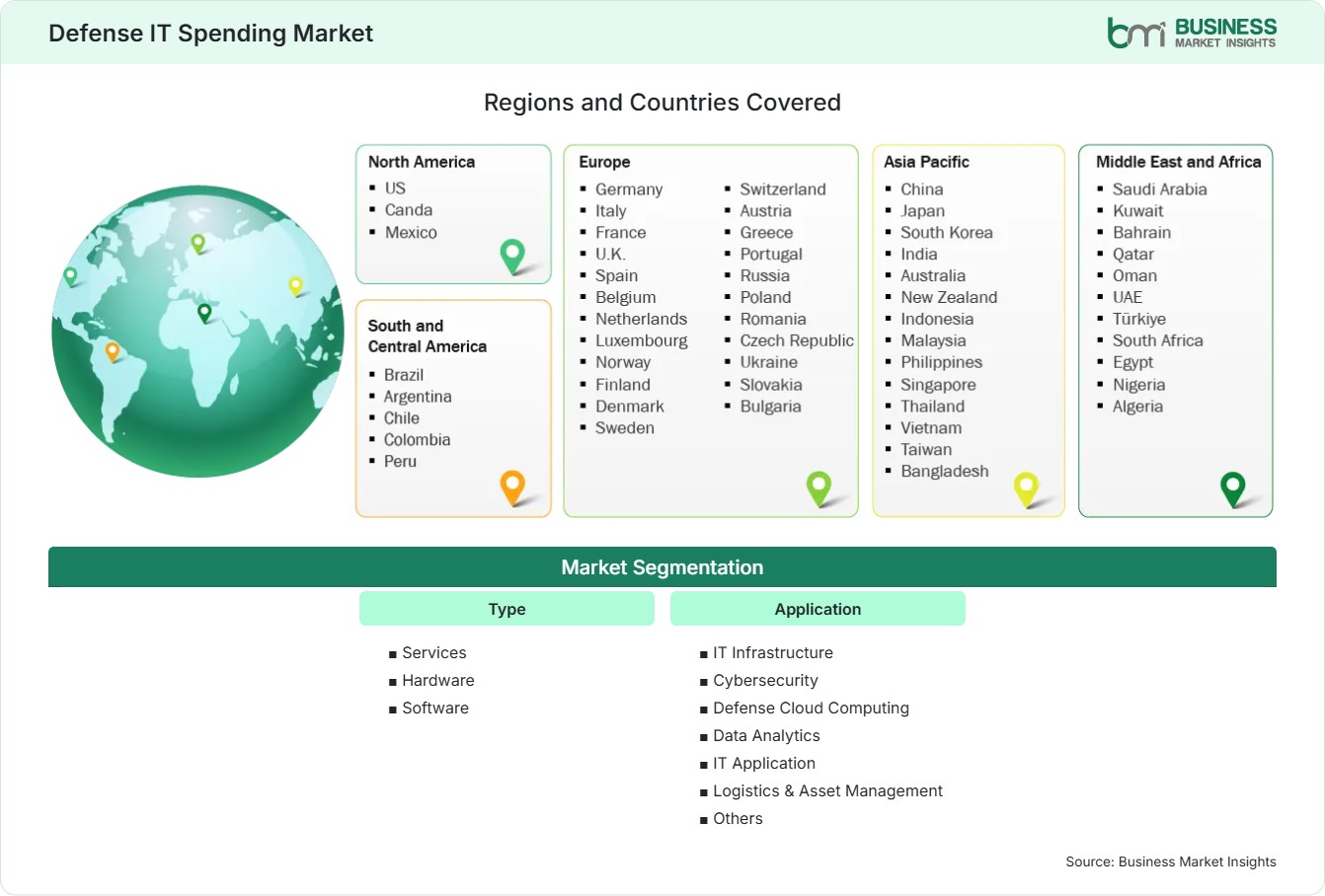
North America accounts for 41%–44% of global revenue in 2025 and is projected to expand at a CAGR of 2.8%–3.2% through 2033. The region benefits from extensive defense modernization programs, advanced cybersecurity infrastructure, military cloud adoption, and sustained investments in digital battlefield capabilities. The Defense IT Spending Market share remains concentrated among major defense technology suppliers supporting command-and-control systems, intelligence platforms, and secure communications.
- The United States Department of Defense continues prioritizing zero-trust cybersecurity frameworks, cloud modernization programs, and integrated digital command environments to improve operational resilience across military branches.
- Demand for AI-powered intelligence processing platforms is increasing as defense agencies seek faster threat identification, decision support capabilities, and enhanced situational awareness in complex operational environments.
- Defense contractors are expanding partnerships with hyperscale cloud providers to deploy secure classified cloud infrastructures supporting military workloads, logistics optimization, and mission-critical analytics.
- Military communications modernization programs continue driving procurement of secure networking technologies, edge computing solutions, and software-defined operational platforms throughout the defense ecosystem.
- Increasing cyber warfare preparedness initiatives are accelerating investments in advanced threat detection systems, secure data architectures, and resilient military information networks.
US Defense IT Spending Market
The United States represents 74%–78% of North American demand and is expected to grow at a CAGR of 2.9%–3.3% during 2026–2033. Strong defense appropriations, advanced technology procurement programs, and leadership in military cloud adoption support market expansion. The country remains a primary center for defense software development, cybersecurity innovation, and AI-enabled command systems.
- The Joint All-Domain Command and Control initiative is encouraging broader deployment of interoperable data platforms and real-time information-sharing capabilities across military operations.
- Federal investments in cybersecurity modernization continue supporting secure network architectures, identity management solutions, and advanced cyber defense capabilities across defense agencies.
- Expansion of military cloud environments is enhancing operational flexibility while enabling secure storage, processing, and distribution of mission-critical defense information.
- Growing adoption of predictive analytics and artificial intelligence technologies is improving maintenance planning, asset utilization, and operational decision-making capabilities.
Europe Defense IT Spending Market
Europe holds 24%–27% of global revenue in 2025 and is projected to expand at a CAGR of 3.0%–3.5% through 2033. Defense digitization initiatives, NATO interoperability requirements, and rising cybersecurity investments are strengthening regional demand. Germany and the United Kingdom remain leading contributors, while Poland demonstrates one of the fastest growth trajectories at approximately 4.1%–4.5% CAGR.
- NATO-driven digital interoperability initiatives are encouraging adoption of standardized platforms capable of supporting collaborative defense operations among member nations.
- The United Kingdom continues investing in advanced cyber defense programs, secure cloud environments, and AI-enabled operational technologies supporting military transformation.
- Germany is expanding spending on defense infrastructure modernization, intelligence systems, and mission-critical software platforms to strengthen operational capabilities.
- Poland's accelerated defense modernization strategy is increasing procurement of cybersecurity solutions, secure communications technologies, and battlefield information management systems.
- Growing emphasis on cyber resilience is encouraging broader deployment of threat intelligence, monitoring, and incident response technologies across defense organizations.
Asia Pacific Defense IT Spending Market
Asia Pacific accounts for 22%–25% of global revenue in 2025 and records the fastest regional CAGR of 4.4%–4.9% through 2033. China, India, Japan, South Korea, and Australia continue increasing investments in digital military capabilities. Defense IT Spending Market growth across the region is supported by cybersecurity upgrades, secure communications deployments, and expanding use of advanced analytics within defense operations.
- India is accelerating military digitization initiatives focused on indigenous software development, cybersecurity enhancement, and secure defense communications infrastructure.
- Japan continues strengthening investments in cyber defense readiness, intelligence modernization, and advanced command-and-control technologies amid evolving security priorities.
- Australia is expanding spending on cloud-enabled defense systems, secure operational networks, and integrated intelligence platforms supporting strategic defense objectives.
- South Korea remains focused on AI-enabled military capabilities, autonomous operational technologies, and next-generation defense communications solutions.
- Regional governments increasingly prioritize domestic defense technology ecosystems to reduce external dependencies and strengthen sovereign digital capabilities.
Rest of World Defense IT Spending Market
The Rest of World region accounts for 10%–13% of global revenue in 2025 and is projected to grow at a CAGR of 3.3%–3.8% through 2033. South & Central American countries continue modernizing defense communications and cybersecurity capabilities, while Middle East and African nations invest in advanced military digital infrastructure. Saudi Arabia and the United Arab Emirates remain leading regional markets, whereas South Africa demonstrates notable modernization momentum through targeted defense technology investments.
- Gulf countries are investing heavily in secure defense communications, cybersecurity architectures, and advanced intelligence platforms supporting national security objectives.
- Saudi Arabia continues expanding military technology modernization programs aligned with broader digital transformation and defense localization initiatives.
- The United Arab Emirates is increasing adoption of AI-enabled defense systems, secure cloud technologies, and integrated operational command platforms.
- South Africa is pursuing selective modernization investments focused on cyber resilience, intelligence management, and digital communications infrastructure.
- Defense agencies across emerging economies are strengthening procurement of scalable software platforms that improve operational efficiency and strategic coordination.