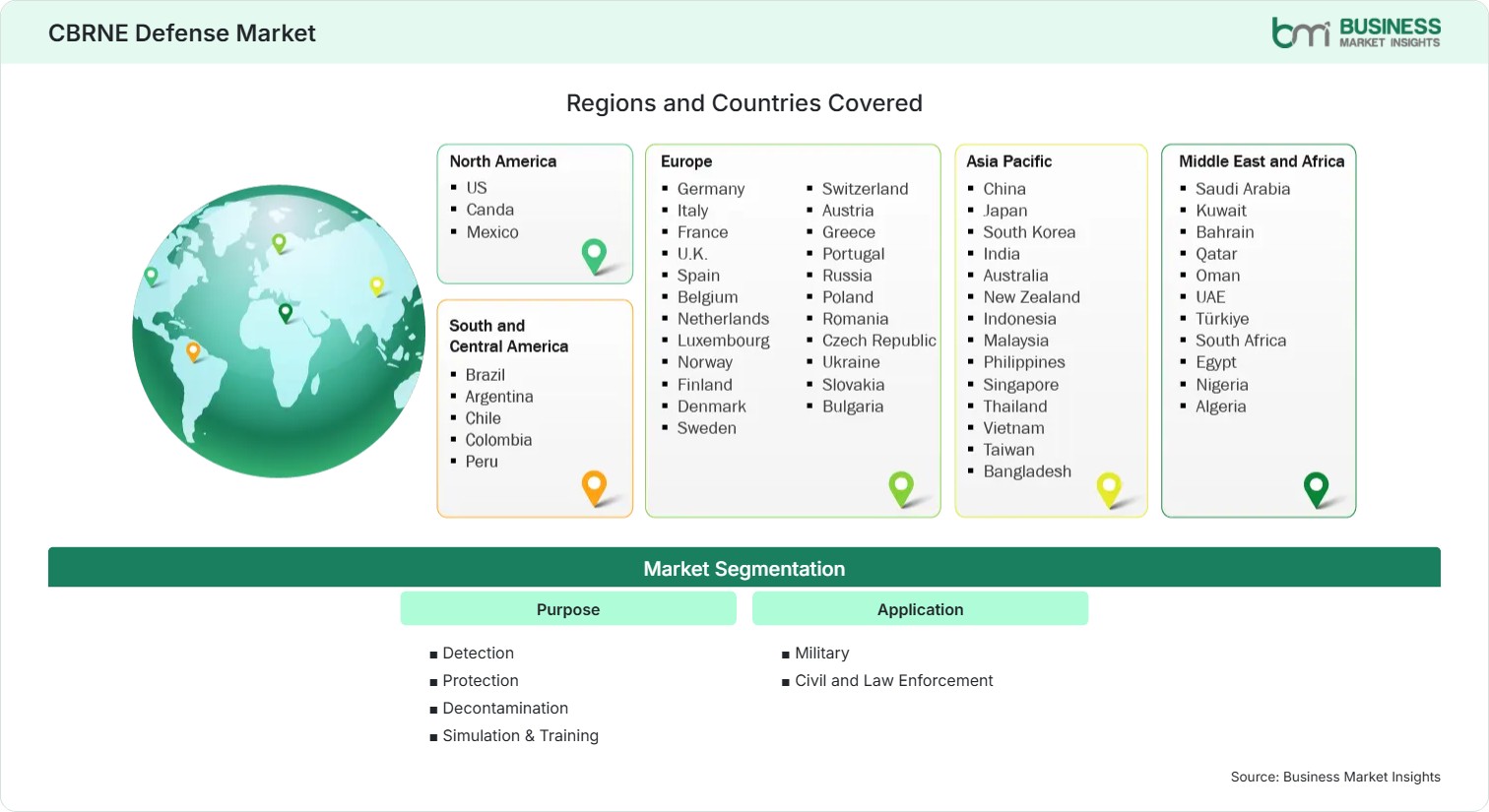
CBRNE Defense Market Regional Highlights
North America CBRNE Defense Market
North America accounts for an estimated 34%–38% share in 2025 and is projected to grow at a 5.8%–6.3% CAGR through 2033. The region benefits from mature defense procurement systems, extensive homeland security infrastructure, established research capabilities, and strong demand for advanced detection technologies. The US represents the dominant regional market, supported by military modernization and protection of critical infrastructure. Canada contributes through emergency preparedness and national security programs. Demand is increasingly shifting toward integrated systems combining detection, protection, decontamination, communications, and training.
- The US remains the regional leader as defense agencies and homeland security organizations invest in advanced sensors, mobile detection platforms, protective systems, and integrated emergency response capabilities.
- Critical infrastructure protection is supporting demand for continuous monitoring technologies capable of identifying chemical, biological, radiological, and nuclear threats across sensitive facilities.
- Defense modernization programs increasingly prioritize interoperable systems that connect frontline detection equipment with command centers, analytical laboratories, and emergency response networks.
- Specialized training and simulation are gaining importance as agencies seek to improve operational readiness without relying exclusively on expensive live-agent exercises.
US CBRNE Defense Market
The US represents approximately 87%–91% of North America's 2025 revenue and is projected to grow at a 5.9%–6.4% CAGR through 2033. Demand is supported by defense modernization, homeland security priorities, counterterrorism preparedness, and protection of critical infrastructure.
- Federal defense and homeland security procurement continues to support advanced detection, identification, protection, and decontamination capabilities for military and civilian response organizations.
- Critical infrastructure operators are increasing interest in distributed monitoring systems that can provide early warning across transportation, energy, industrial, healthcare, and public facilities.
- Training and simulation solutions are becoming increasingly valuable as agencies seek repeatable exercises that evaluate operational coordination, equipment readiness, and emergency decision-making.
Europe CBRNE Defense Market
Europe represents an estimated 26%–30% share in 2025 and is expected to grow at a 6.0%–6.6% CAGR through 2033. Germany, France, and the UK remain leading markets, supported by defense capabilities, industrial expertise, and established emergency response systems. Poland is a high-growth market at approximately 7.2%–7.9% CAGR, reflecting heightened security requirements and regional preparedness priorities.
- Germany maintains strong demand through defense modernization, industrial safety requirements, advanced analytical capabilities, and established emergency response infrastructure.
- France remains a significant market because of its defense capabilities, nuclear industry, specialized security requirements, and emphasis on national preparedness for complex emergencies.
- Poland offers strong growth potential as regional security concerns increase demand for detection, protection, training, and emergency preparedness capabilities.
Asia Pacific CBRNE Defense Market
Asia Pacific accounts for an estimated 24%–28% share in 2025 and Asia Pacific CBRNE defense market forecast to grow at a 7.2%–8.0% CAGR, making it the fastest-growing region. China, Japan, South Korea, India, and Australia represent major markets, while India is a high-growth country at approximately 8.0%–8.8% CAGR.
- China remains a major market because of its defense modernization programs, extensive industrial infrastructure, and requirements for advanced chemical, biological, radiological, and nuclear preparedness.
- India provides strong growth potential as defense modernization and national security priorities encourage investment in specialized detection, protection, decontamination, and training systems.
- Japan maintains demand through advanced disaster preparedness, nuclear safety requirements, sophisticated analytical capabilities, and established emergency response infrastructure.
- Southeast Asian countries are strengthening preparedness as urbanization, industrial development, terrorism concerns, and cross-border security requirements increase demand for specialized response capabilities.
Rest of World CBRNE Defense Market
South and Central America offer developing opportunities led by Brazil, Mexico, and Colombia, where public security requirements, industrial safety, and emergency response modernization support demand. Brazil remains the leading market, while Colombia is a high-growth country at approximately 7.0%–7.7% CAGR. The Middle East and Africa provide additional opportunities as governments modernize national security capabilities and protect critical energy, transportation, and public infrastructure. The combined Rest of World region represents approximately 12%–16% share in 2025 and is projected to grow at a 6.3%–7.0% CAGR through 2033. Specialized training and integrated response capabilities are becoming increasingly important.
- Brazil benefits from established defense capabilities and large industrial infrastructure, supporting demand for detection, emergency response, and hazardous material management technologies.
- Colombia offers growth potential as security modernization and preparedness initiatives increase requirements for specialized detection and response capabilities.
- Saudi Arabia and the UAE are investing in sophisticated security infrastructure, creating opportunities for advanced detection, protection, decontamination, and command systems.
- African markets increasingly require scalable and cost-efficient solutions that can support emergency responders, border security agencies, healthcare facilities, and industrial operations.