Market Summary
Executive Summary and Global Market Analysis
Protection systems designed for chemical, biological, radiological, nuclear, and explosive hazards form integrated CBRN defense solutions. These systems comprise of components such as detectors, protective gear, and response systems. Such systems are employed in military, government, and civilian safety infrastructure in order to minimize any potential threat.
Geopolitical tension in the region has led to an increase in the installation of these systems. The government defense agency is working to increase the readiness infrastructure to tackle multiple domain threats. The civil protection infrastructure is also being improved in preparation for any hazards that could occur.
The segregation pattern reveals that there is a high usage of detectors as well as protective wear. This sector comprises of the highest usage of these technologies because of their critical security functions. Simulation systems are improving training effectiveness in military organizations.
Software integration is providing centralized command information in response to complicated incidents. Competition continues to be centered on integrated solution vendors specializing in modular security systems. Innovations revolve around fast deployment and flexibility in multiple threat scenarios. Strategy in development involves emphasis on interoperability and mission customizability.
Segment Analysis
CBRN Defense Market Segmentation
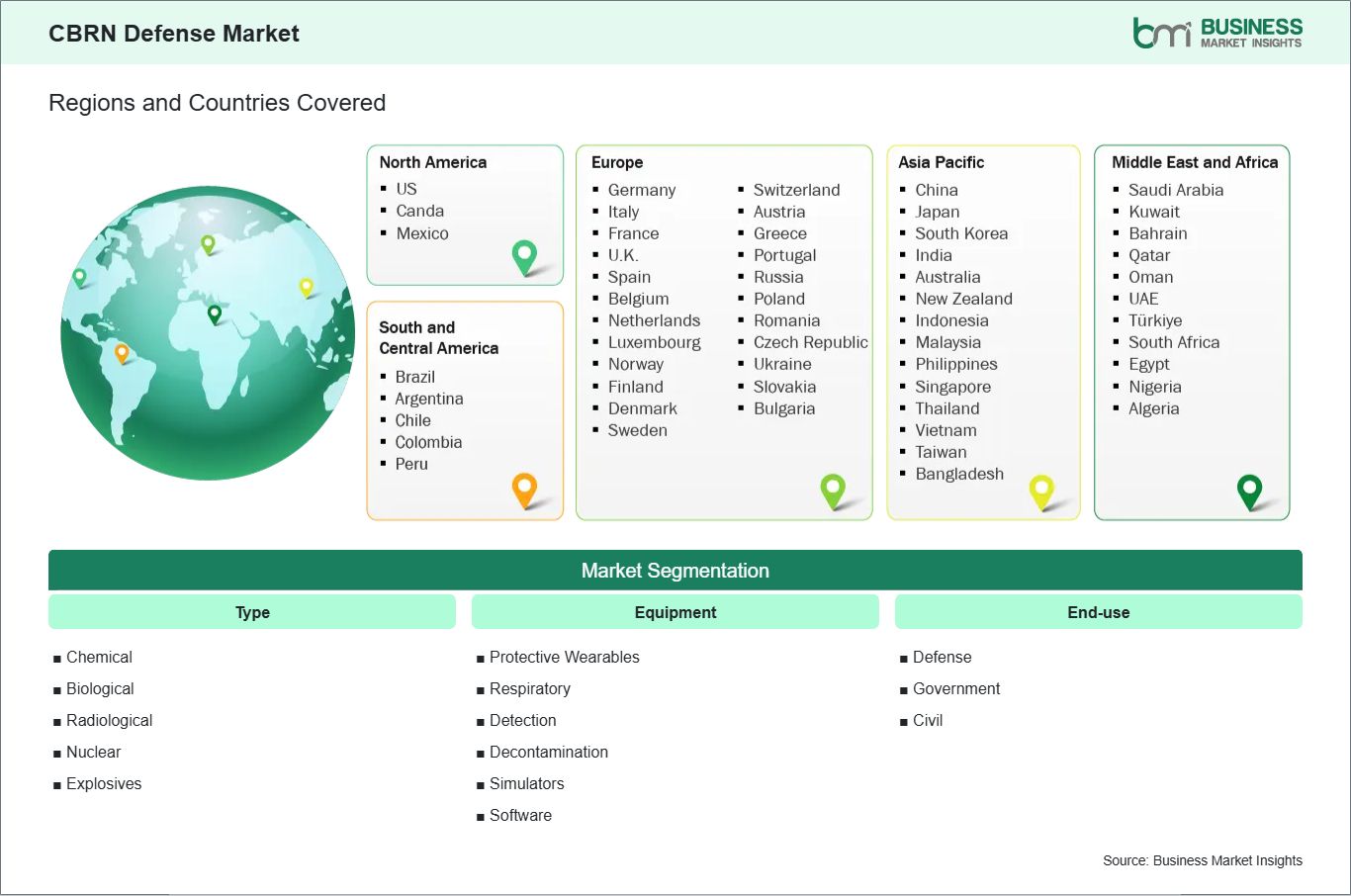
The CBRN defense market is segmented based on, type, equipment, end use, reflecting operational readiness across defense and civil protection environments.
By Type
- Chemical - Industrial toxin and battlefield exposure containment systems
- Biological - Pathogen detection and biohazard containment mechanisms
- Radiological - Radiation monitoring and exposure control frameworks
- Nuclear - High-risk radiation shielding and detection architectures
- Explosives - Blast identification and mitigation support systems
By Equipment
- Protective Wearables - Full-body barrier protection for hazardous exposure
- Respiratory - Air purification systems ensuring safe breathing environments
- Detection - Early hazard identification through multi-sensor platforms
- Decontamination - Contaminant neutralization and surface restoration systems
- Simulators - Training modules replicating real-world CBRN scenarios
- Software - Integrated command systems enabling situational coordination
By End-Use
- Defense - Military-grade deployment across strategic and tactical missions
- Government - National emergency preparedness and coordination frameworks
- Civil - Public safety systems supporting disaster and hazard response
Market Forces
CBRN Defense Market Drivers and Opportunities
Geopolitical tensions increasing demand
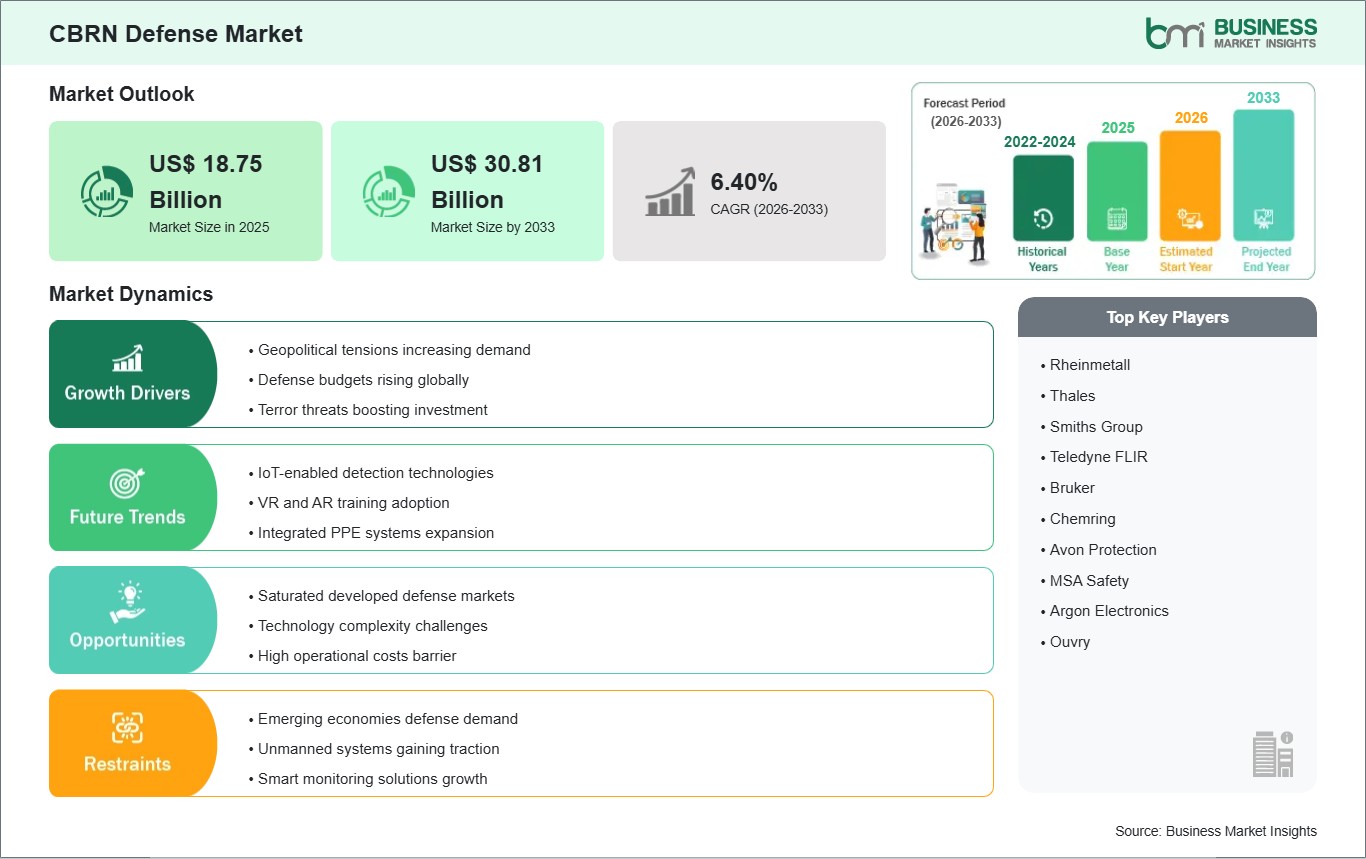
Escalating geopolitical instability, regional conflicts, and the persistent threat of terrorism have intensified the urgency for advanced CBRN defense solutions. The governments will be pushed towards improving their defensive mechanisms and making sure that all the military soldiers, government institutions, and civilians are secure from any form of attack through unconventional means. This has led to the rapid adoption of procurement programs whereby ministries of defense are focused on ensuring detection, protection equipment, and decontamination devices as a result of the unstable environment.
Impact on national security planning is felt in the form of investment in defense planning and infrastructure construction. In addition to securing protective equipment for the near future, governments are also focusing on integrating technology such as detection technologies, simulations, and artificial intelligence into their security operations. In this regard, the importance of CBRN defense technologies comes into picture by being an essential component of national security. This will ensure that states secure themselves not just from any other state but also non-state actors as well.
Emerging economies defense demand
Emerging economies are expanding deployment of CBRN defense technologies as part of broader military modernization programs. Asian, Middle Eastern, and African nations have taken a growing interest in protective gear, respiration systems, and modules designed specifically for their unique environment. This development has motivated manufacturers to develop affordable designs that help those nations enhance their defense capacities while avoiding any over-extension of their budgets. The application of such technology would be best suited for civil defense and emergencies.
Future opportunities in terms of CBRN defense within emerging economies hold great promise. With their participation in international security measures and collaborative defense efforts on the global front, there will be an increasing demand for simulators, computer software, and efficient decontamination tools. There are two benefits of this increased demand, improved operational efficiency on one hand and improved resilience of infrastructure on the other. Ultimately, this ensures that emerging economies make their contribution to the overall growth trend of the industry worldwide.
Size and Share Analysis
CBRN Defense Market Size and Share Analysis
The CBRN Defense Market is projected to grow from US$ 18.75 Billion in 2025 to US$ 30.81 Billion by 2033 , registering a CAGR of 6.40% from 2026 to 2033. The market expansion is supported by increasing procurement of integrated chemical, biological, radiological, and nuclear protection systems across defense modernization programs, alongside rising emphasis on rapid threat detection and response readiness in high-risk operational environments.
By type, chemical protection systems account for a significant share due to continuous exposure risks in industrial and battlefield scenarios requiring immediate containment. Biological defense solutions are expanding steadily with heightened focus on pathogen detection and outbreak containment capabilities. Radiological systems maintain strong adoption driven by monitoring requirements in critical infrastructure and emergency response operations. Nuclear protection solutions remain essential for high-intensity risk environments, while explosive detection systems are gaining traction in urban security and perimeter defense applications.
By equipment, detection systems hold a major share owing to their critical role in early threat identification and situational awareness. Protective wearables maintain strong utilization across military and civil personnel safety operations. Respiratory protection systems are widely deployed in contaminated environments requiring air filtration and survival support. Decontamination solutions are expanding with increasing demand for post-exposure recovery systems. Simulation platforms and software-based command systems are gaining relevance through training modernization and integrated response coordination requirements.
By end-use, defense organizations dominate market utilization due to structured procurement of mission-critical protection systems and tactical readiness requirements. Government agencies maintain significant deployment across homeland security and emergency preparedness frameworks. Civil applications are expanding steadily with increasing investment in disaster response infrastructure and industrial safety programs.
Report Coverage
CBRN Defense Market Report Coverage and Deliverables
The "CBRN Defense Market Size and Forecast (2022 - 2033)" report provides a detailed analysis of the market covering below areas:
- The market size and forecast at global, regional, and country levels for all market segments covered under the scope
- The market trends, as well as drivers, restraints, and opportunities
- The market analysis covering key trends, global and regional framework, major players, regulations, and recent developments
- Industry landscape and competition analysis covering market concentration, heat map analysis, prominent players, and recent developments for the market
- Detailed company profiles, including SWOT analysis
Geographic Insights
CBRN Defense Market Geographic Insights
The CBRN Defense Market shows diverse regional adoption patterns influenced by regulatory frameworks, industrial activity, and technological readiness. Global demand for CBRN defense reflects a balance between established defense markets with advanced procurement capabilities and emerging economies seeking scalable solutions. The industry’s global footprint is shaped by both military modernization programs and civil protection initiatives, ensuring that adoption patterns vary significantly across regions.
In North America, defense agencies remain focused on enhancing their resilience to unconventional threats with adequate budget support and modern procurement processes. The region places much emphasis on the integration of detection systems, body protection equipment, and decontamination systems in military and civil applications. Preparedness is ensured via civil protection efforts, where government programs ensure that the first responders are supplied with up-to-date respiratory and detection systems.
Asia Pacific demonstrates expanding deployment, with countries such as China, India, and South Korea investing heavily in protective technologies. The region’s focus extends beyond military applications, incorporating civil defense and emergency response systems to address urban vulnerabilities. Industrial sectors, including mining and construction, also contribute to demand for protective wearables and detection equipment. The emphasis on scalable, cost-effective solutions ensures that Asia Pacific remains a dynamic growth hub for the industry, balancing modernization with affordability.
Europe maintains leadership in innovation, emphasizing sustainability and advanced protective technologies. Nations within the European Union continue to align defense strategies with international security standards, ensuring that both military and civilian infrastructures are equipped with modern CBRN systems. Emerging markets in Latin America and Africa show rising utilization, driven by defense modernization programs and alignment with global preparedness frameworks. These regions are increasingly adopting simulators and software platforms to enhance training, signaling a gradual but steady expansion of CBRN defense capabilities worldwide.
Industry Activity
Recent Developments
The CBRN defense market is evaluated by gathering qualitative and quantitative data post primary and secondary research, which includes important corporate publications, association data, and databases. A few of the key developments in the CBRN defense market are:
- In April 2025, Teledyne FLIR Defense, announced that it received a US$74.2 million U.S. Army contract to develop next-generation nuclear, biological, and chemical reconnaissance vehicle sensor systems under the NBCRV modernization program.
- In November 2024, Teledyne FLIR Defense, announced that it secured a US$168 million IDIQ contract for continued development and production of the U.S. Army’s CBRN reconnaissance vehicle sensor suite upgrade program.
Trust & Transparency
Research Methodology
The market analysis combines proprietary research with secondary data from government agencies, company disclosures, regulatory filings, industry databases and expert interviews. Market estimates are validated through data triangulation, cross-market benchmarking and analyst
review.
View Full Research Methodology
Key Sources Referred:
World Bank - Global Trade Indicators World Trade Organization (WTO) International Monetary Fund (IMF) International Trade Administration (ITA) Company Websites Company Annual Reports Company Investor Presentations