Market Summary
Executive Summary and Global Market Analysis
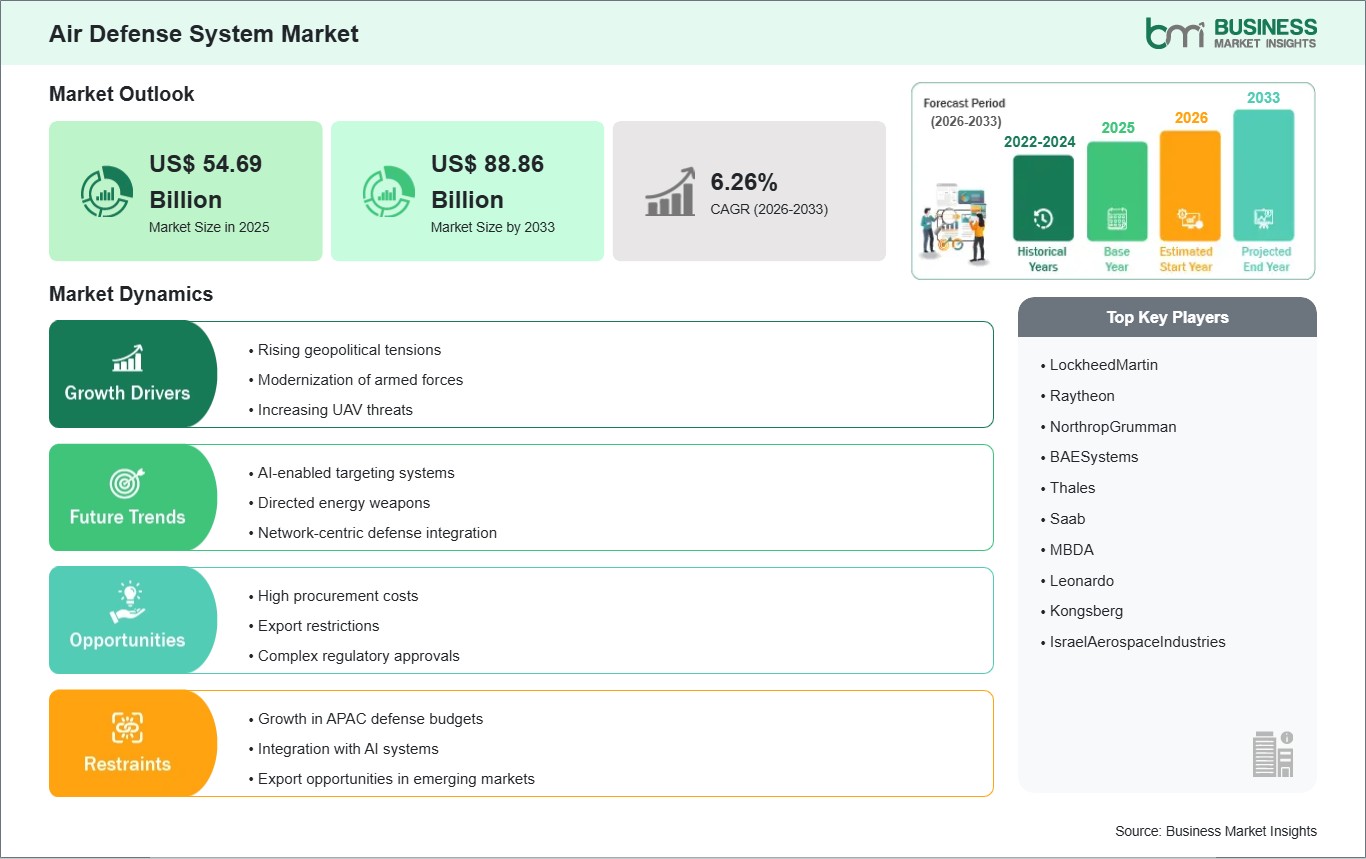
Air defense systems are military technologies designed to detect, track, intercept, and neutralize airborne threats such as missiles, aircraft, drones, and unmanned aerial vehicles. These systems are widely used by military forces and homeland security agencies to strengthen national defense capabilities and protect critical infrastructure. The market is growing due to rising geopolitical tensions, increasing cross-border security concerns, and modernization of defense infrastructure across several countries. Governments are increasingly investing in advanced radar systems, missile interception technologies, and integrated command and control platforms to improve airspace security. The growing use of unmanned aerial vehicles and evolving aerial warfare technologies are also encouraging the adoption of advanced counter-UAV and multi-layered defense systems.
There are several challenges that could affect market growth during the forecast period. Air defense systems require high initial investment and continuous maintenance, which can limit procurement among countries with restricted defense budgets. Integration of advanced defense technologies with existing military infrastructure can also be technically complex and time-consuming. In addition, rapidly evolving missile and drone technologies require continuous upgrades in radar, tracking, and interception systems to maintain operational effectiveness. Export regulations, international defense compliance requirements, and long procurement cycles may further slow the deployment of advanced systems in some regions.
Despite these challenges, the market is expected to grow steadily as countries continue to strengthen their defense preparedness and invest in modern security infrastructure. Opportunities are emerging from the development of artificial intelligence-enabled surveillance systems, directed energy weapons, and advanced sensor technologies that improve detection accuracy and response time. Increasing focus on autonomous defense platforms and network-centric warfare is also creating demand for integrated and mobile air defense systems. Growing investments in next-generation military technologies and smart defense solutions are expected to support long-term market expansion.
Segment Analysis
Air Defense System Market Segmentation
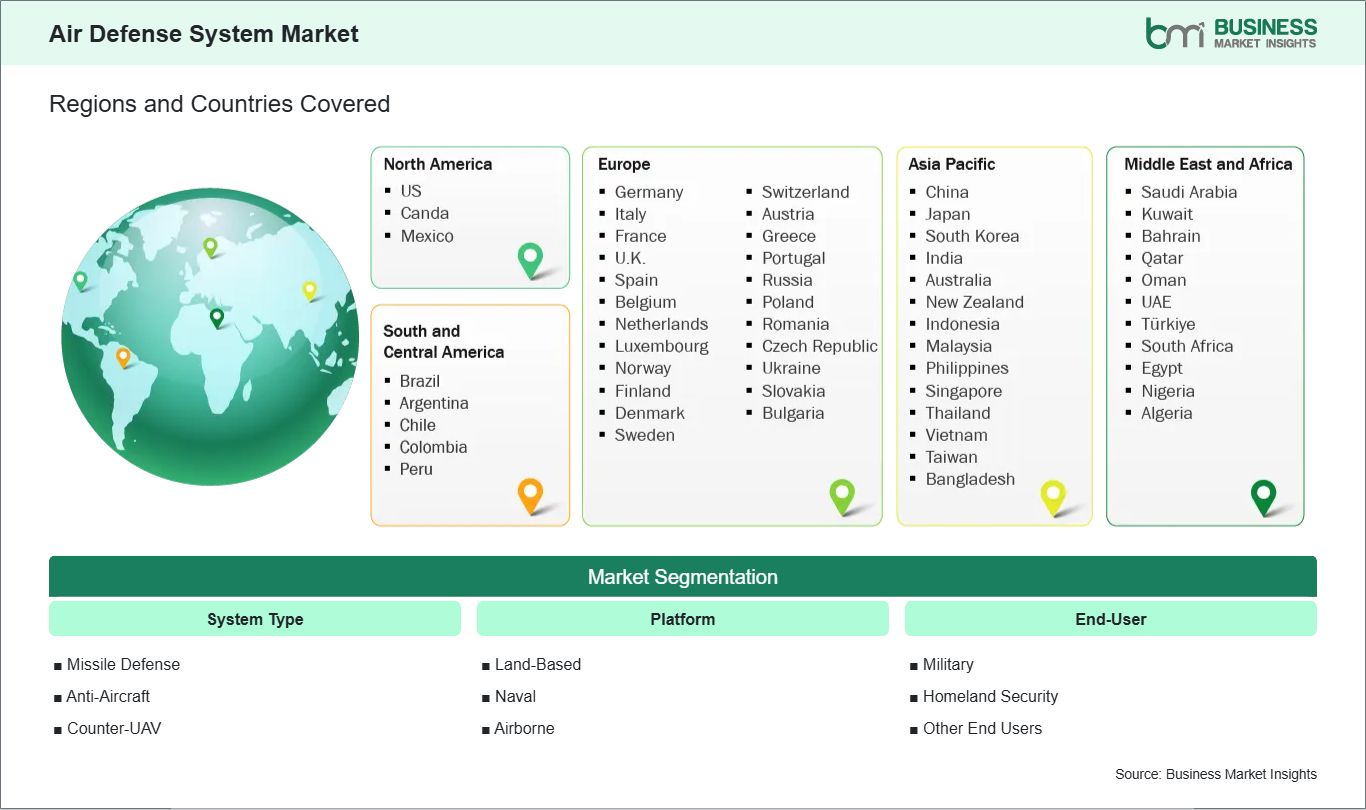
The Air Defense System market is segmented based on system type, platform, and end-user. Different defense organizations adopt these systems according to operational requirements, threat detection capabilities, and deployment environments.
By System Type
- Missile Defense: Missile defense systems are designed to detect and intercept incoming ballistic and cruise missiles to protect strategic assets and military infrastructure.
- Anti-Aircraft: Anti-aircraft systems are used to target hostile aircraft and airborne threats through radar-guided weapons and tracking technologies.
- Counter-UAV: Counter-UAV systems are increasingly adopted to detect, monitor, and neutralize unauthorized drones and unmanned aerial threats.
By Platform
- Land-Based: Land-based systems are widely deployed for border protection, military bases, and critical infrastructure defense operations.
- Naval: Naval air defense systems are integrated into warships and maritime defense platforms to protect naval assets from aerial attacks.
- Airborne: Airborne defense platforms support aerial surveillance, threat detection, and rapid-response military operations.
By End-User
- Military: Military organizations account for major adoption due to rising investments in national defense modernization and combat preparedness.
- Homeland Security: Homeland security agencies use air defense systems to secure airports, government facilities, and public infrastructure from aerial threats.
- Other End Users: Other end users include strategic defense organizations and specialized security agencies.
Market Forces
Air Defense System Market Drivers and Opportunities
Rising Geopolitical Tensions and Military Modernization Programs
Increasing geopolitical conflicts and cross-border security threats are major factors driving the growth of the Air Defense System market. Several countries are strengthening their defense capabilities to address evolving airborne threats, including advanced missiles, fighter aircraft, and unmanned aerial vehicles. Governments are increasingly focusing on improving their national security and defense capabilities through investments in new-age radar systems, command centers, and interceptors. Defense modernization is prompting nations to upgrade their outdated air defense systems to advanced and multi-layered air defense systems capable of handling advanced aerial attacks.
The growing use of drones and precision-guided weapons in modern warfare has increased the importance of advanced detection and response systems. Countries are focusing on improving surveillance accuracy, response speed, and threat interception capabilities through the integration of artificial intelligence and automated defense technologies. Moreover, increased defense cooperation and collaboration through joint military exercises will help the procurement of advanced air defense systems. The continued development of defense infrastructure will result in consistent demand for air defense technologies in the coming years.
Growing Demand for Counter-UAV and Smart Defense Technologies
The increasing use of unmanned aerial vehicles in military and security operations is creating significant growth opportunities for the Air Defense System market. Modern defense strategies are focusing on counter-UAV technologies capable of detecting and neutralizing small drones that can bypass traditional defense systems. This trend is encouraging the development of advanced radar systems, electronic warfare technologies, and directed energy weapons designed specifically for drone defense operations.
Artificial intelligence and machine learning technologies are also transforming air defense capabilities by improving threat identification, real-time decision-making, and automated response mechanisms. Defense organizations are increasingly adopting network-centric warfare systems that connect surveillance, communication, and interception platforms into a unified operational structure. The mobile air defense solutions segment is witnessing growing interest as they offer flexibility in deployment options in difficult operational zones. The rising trend toward building intelligent defense infrastructure and autonomous military equipment is anticipated to open up new avenues of growth for vendors of defense systems. Rising concerns related to the protection of infrastructure facilities against aerial threats are further aiding market growth.
Size and Share Analysis
Air Defense System Market Size and Share Analysis
The Air Defense System Market is projected to grow from US$ 54.69 Billion in 2025 to US$ 88.86 Billion by 2033 , registering a CAGR of 6.26% from 2026 to 2033.
By system type, missile defense systems account for a significant share due to rising investments in ballistic missile interception and national security modernization programs. Anti-aircraft systems continue to maintain strong adoption because of their importance in protecting military bases and strategic infrastructure from airborne threats. Counter-UAV systems are witnessing increasing demand as governments and defense agencies focus on addressing the growing risks associated with drone-based surveillance and attacks.
By platform, land-based systems dominate the market owing to their widespread deployment across border security operations and military defense networks. Naval platforms are expanding steadily with increasing investments in maritime defense and naval modernization programs. Airborne platforms are also gaining importance due to growing demand for aerial surveillance, rapid response operations, and integrated combat systems. By end-user, the military segment accounts for the largest market share because of continuous investments in defense preparedness, advanced warfare technologies, and modernization of national security infrastructure.
Report Coverage
Air Defense System Market Report Coverage and Deliverables
The "Air Defense System Size and Forecast (2022-2033)" report provides a detailed analysis of the market covering below areas:
- Market size and forecast at global, regional, and country levels for all the key market segments covered under the scope
- Market trends, as well as market dynamics such as drivers, restraints, and key opportunities
- Market analysis covering key market trends, global and regional framework, major players, regulations, and recent market developments
- Industry landscape and competition analysis covering market concentration, heat map analysis, prominent players, and recent developments for the market
- Detailed company profiles, including SWOT analysis
Geographic Insights
Air Defense System Market Geographic Insights
The Air Defense System Market shows diverse regional adoption patterns influenced by military modernization programs, geopolitical tensions, and increasing investments in national security infrastructure.
North America, being a developed region, has a well-established defense infrastructure and a high adoption rate of advanced air defense technologies. The region comprises the United States and Canada, where governments continue to invest in missile defense systems, radar technologies, and integrated surveillance networks. The region focuses on strengthening homeland security and improving military preparedness against evolving aerial threats. It possesses modern defense manufacturing facilities along with research and development facilities, enabling the introduction of cutting-edge air defense systems in all three domains.
Asia Pacific is growing significantly, driven by rising regional security concerns, border disputes, and increasing defense expenditure. The region comprises countries such as China, India, Japan, and South Korea, where governments are modernizing military infrastructure and expanding defense procurement activities. Surveillance technology improvements, increased airspace security, and better rapid response defenses are key priorities in this region. Rising spending in counter-drone technologies, missile interceptors, and command-and-control infrastructure is one of the factors driving market growth in the Air Defense System Market in this region.
Both regions are contributing significantly to the growth of the Air Defense System Market, focusing on defense modernization, advanced surveillance technologies, and increasing investments in integrated security infrastructure.
Industry Activity
Recent Developments
The Air Defense System Market is analyzed using a mix of primary and secondary research sources, including corporate publications, industry associations, and verified databases. This approach ensures accurate tracking of innovation trends and strategic developments influencing the market.
- In July 2025, Lockheed Martin was awarded a $2.06 billion contract modification by the U.S. Missile Defense Agency to scale the production of Terminal High Altitude Area Defense (THAAD) interceptors. This contract modification, in combination with the international sustainment modification made in December 2025, reflects the aggressive expansion of the markets and fast-paced production process due to increasing global threats.
- In April 2024, RTX Corporation announced the successful testing of its Patriot air and missile defense system integrated with advanced command-and-control capabilities. The development focused on improving target tracking accuracy and interception efficiency against evolving airborne threats. The upgrade highlights the increasing emphasis on integrated and multi-layered air defense infrastructure across global defense programs.
Trust & Transparency
Research Methodology
The market analysis combines proprietary research with secondary data from government agencies, company disclosures, regulatory filings, industry databases and expert interviews. Market estimates are validated through data triangulation, cross-market benchmarking and analyst
review.
View Full Research Methodology
Key Sources Referred:
World Bank - Global Trade Indicators World Trade Organization (WTO) International Monetary Fund (IMF) International Trade Administration (ITA) Company Websites Company Annual Reports Company Investor Presentations