
Air To Air Missiles Market Outlook: Size, Share, Trends, Growth Analysis, Competitive Landscape & Forecast, 2026-2033

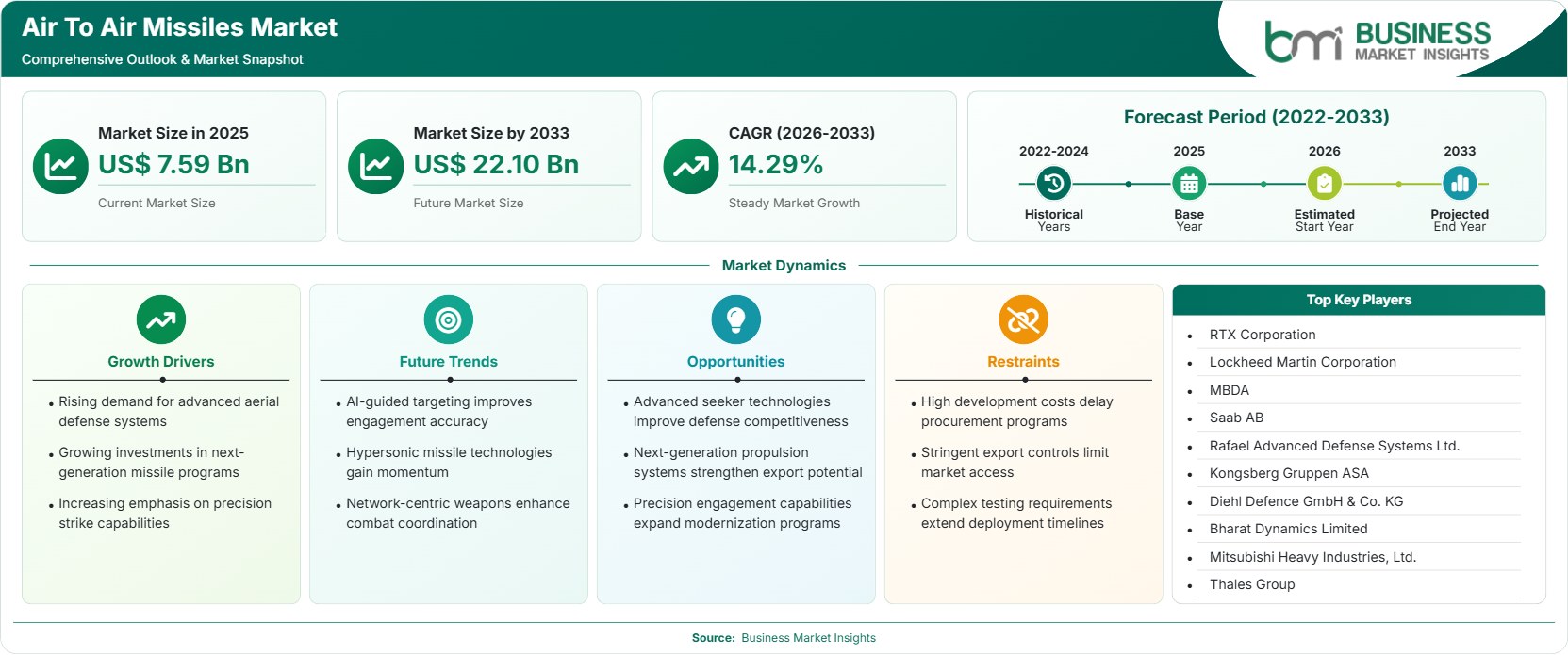
The Air To Air Missiles Market size was valued at US$ 7.59 billion in 2025 and is projected to reach US$ 22.10 billion by 2033, growing at a CAGR of 14.29% during 2026–2033. Rising demand for advanced aerial defense systems, increasing investments in next-generation missile programs, and growing emphasis on precision strike capabilities continue to strengthen long-term market prospects.

Report Coverage
  • Missile Range Type: Short, Medium, Beyond Visual, Very Long, Training/Captive Missile
  • Range Capacity: 10 km, 20 km, 50 km, 100 km, Above 300 km
  • Guidance Technology: Infrared Homing, AI/Autonomy-Enabled Guidance, GPS/GNSS-Aided Guidance, Inertial Guidance
  • Seeker Type: Active Radar Seeker, Semi-Active Radar Seeker, Passive Seeker, and Dual/Multi-Mode Seeker
  • Propulsion System: Solid Rocket Motor, Ramjet Propulsion, Dual-Pulse Rocket Motor
US$ 7.59 Bn Market size in 2025
US$ 22.10 Bn Market Size by 2033
14.29% CAGR, 2026 - 2033
2026-2033 Forecast Period

01 AI Overview

Air To Air Missiles Market Summary

  • North America Region: North America accounts for 36%–39% market share in 2025 and is projected to expand at a CAGR of 13.5%–14.0% during 2026–2033. Sustained defense modernization, advanced fighter aircraft programs, and strong investments in missile technology continue supporting regional demand. The U.S. remains the largest contributor with a CAGR of 13.6%–14.1%, driven by continuous procurement and modernization initiatives.
  • Fastest Growing Region: Asia Pacific represents 27%–30% market share in 2025 and is expected to register a CAGR of 15.2%–15.8%, supported by rising defense budgets, indigenous missile development, regional security concerns, and expanding combat aircraft fleets.
  • Leading Segment: Beyond Visual missile range type accounts for 32%–35% market share in 2025 and is anticipated to grow at a CAGR of 14.7%–15.2%, owing to increasing demand for long-range engagement capabilities and network-centric warfare.
  • High Growth Segment: AI/Autonomy-Enabled Guidance captures 18%–21% market share in 2025 and is projected to record a CAGR of 16.8%–17.5%, supported by advances in autonomous targeting, electronic warfare resilience, and multi-target engagement capabilities.
  • Key Market Opportunity: Continued investment in intelligent guidance systems, advanced propulsion technologies, and export-oriented defense programs is creating opportunities for manufacturers developing next-generation air combat missile solutions.
  • Major Market Players: RTX Corporation, Lockheed Martin Corporation, MBDA, Saab AB, Rafael Advanced Defense Systems Ltd., Kongsberg Gruppen ASA, Diehl Defence GmbH & Co. KG, Bharat Dynamics Limited, Mitsubishi Heavy Industries, Ltd., and Thales Group.
02 Strategic Insights

Air To Air Missiles Market: Strategic Insights

Air To Air Missiles Market Strategic Framework
FREE PDF
Request your free sample
Request free sample
03 Stakeholder View

Key Takeaways

  • Growing defense modernization programs are increasingly leading to purchases of new missile systems that can be employed in long-distance air superiority operations and battlefield operations.
  • Artificial Intelligence, multi-mode seeker technologies, and digital navigation systems have become vital competitive elements between top missile manufacturers.
  • Defense partnerships and missile manufacturing programs within nations are resulting in nations boosting their aerospace and defense manufacturing industries.
  • The Asia Pacific region emerges as having the best long-term investment potential as governments develop their combat aircraft forces and focus on air defense modernization.
  • Defense contractors keep working on developing their partnerships with aerospace manufactures, government organizations, and technology companies for developing advanced missile systems.
04 Geographic Outlook

Air To Air Missiles Market Regional Highlights

North America Air To Air Missiles Market

North America accounts for 36%–39% Air To Air Missiles Market share in 2025 and is projected to register a CAGR of 13.5%–14.0% during 2026–2033. Regional growth is supported by sustained defense expenditure, modernization of fighter aircraft fleets, and continued procurement of advanced missile systems.

  • Defense modernization programs continue supporting procurement of advanced beyond-visual-range missile systems for next-generation combat aircraft.
  • Investments in electronic warfare capabilities encourage development of intelligent missile guidance technologies.
  • Defense contractors continue expanding production capacity to support domestic and allied military requirements.

US Air To Air Missiles Market

The United States contributes 84%–87% of North American revenue and is forecast to expand at a CAGR of 13.6%–14.1% through 2026–2033. Strong defense budgets, advanced aerospace manufacturing capabilities, and continuous research investments support sustained procurement of sophisticated missile technologies.

  • Advanced missile integration programs continue supporting modernization of combat aircraft fleets.
  • Defense agencies increasingly prioritize AI-enabled guidance and electronic warfare resilience.
  • Investments in domestic production strengthen long-term missile manufacturing capabilities.

Europe Air To Air Missiles Market

Europe represents 25%–28% market share in 2025 and is expected to register a CAGR of 13.8%–14.4% during the forecast period. Regional demand is supported by NATO modernization initiatives, collaborative missile development programs, and increasing defense budgets. France leads procurement activities, while Poland records the fastest growth through expanding military modernization investments.

  • Collaborative European missile programs strengthen regional technological capabilities.
  • NATO defense modernization initiatives encourage procurement of advanced missile systems.
  • Indigenous manufacturing investments improve long-term defense supply chain resilience.

Asia Pacific Air To Air Missiles Market

Asia Pacific holds 27%–30% market share in 2025 and is projected to record the fastest 15.2%–15.8% CAGR through 2026–2033. Regional governments continue expanding combat aircraft fleets, increasing defense budgets, and investing in indigenous missile technologies. China remains the largest market, while India records the fastest growth through domestic missile development and defense modernization programs.

  • Indigenous missile development receives increasing government investment across major regional economies.
  • Procurement of advanced fighter aircraft strengthens long-term missile demand.
  • Regional defense partnerships encourage technology transfer and joint manufacturing initiatives.

Rest of World Air To Air Missiles Market

The Rest of World region accounts for 7%–10% market share in 2025 and is expected to grow at a CAGR of 14.0%–14.6% during 2026–2033. Military modernization, defense procurement, and expanding regional security cooperation continue supporting demand across the Middle East, Latin America, and selected African countries.

  • Saudi Arabia continues investing in advanced aerial defense capabilities and fighter aircraft modernization.
  • Brazil strengthens regional defense capabilities through aerospace and missile procurement programs.
  • Defense partnerships increase access to advanced missile technologies and training.
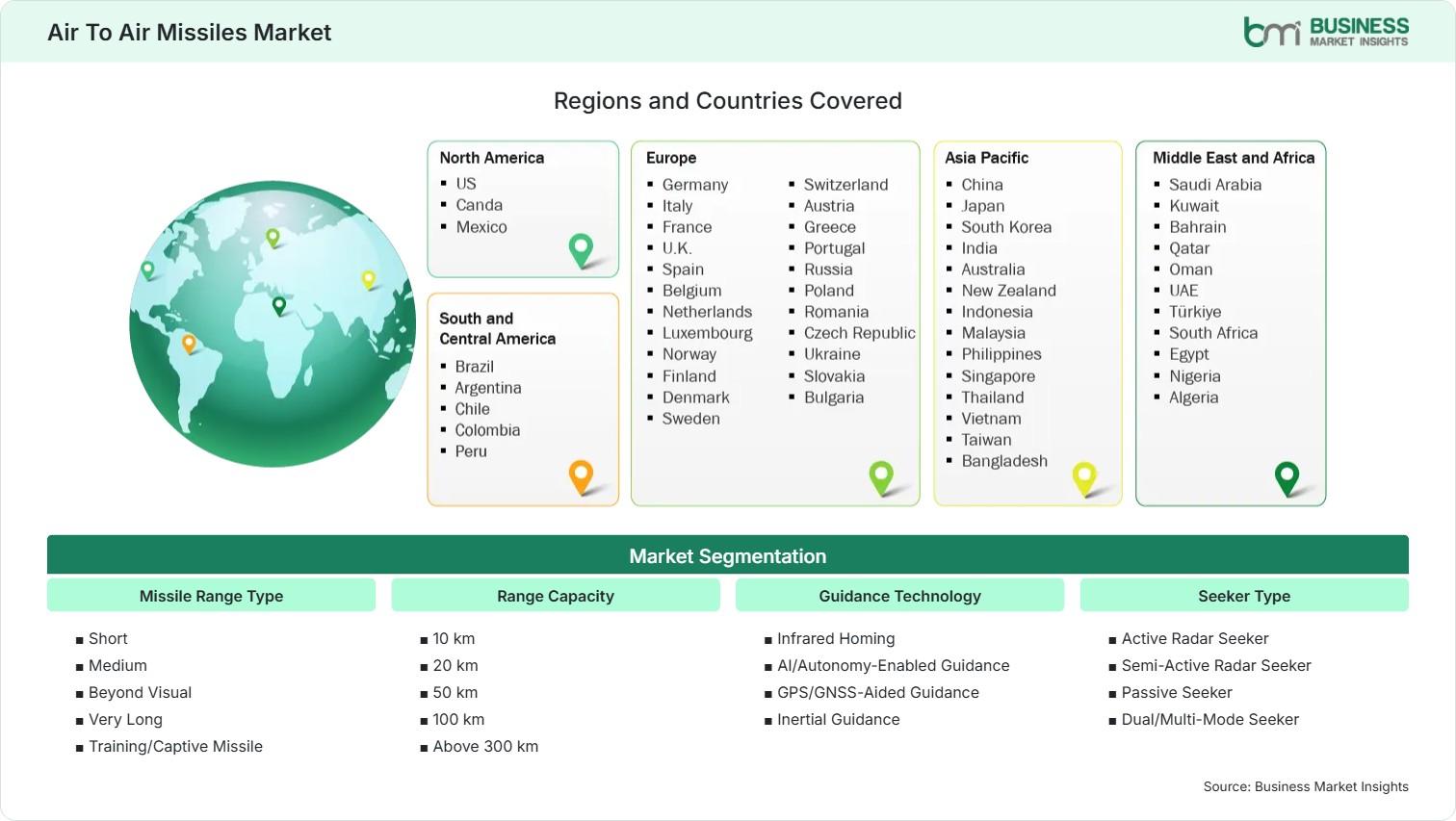
Global Market Geography
FREE PDF
Request your free sample
Request free sample
05 Segment Analysis

Air To Air Missiles Market Segmentation

Missile Range Type

The missile range type segment remains central to operational effectiveness, enabling air forces to address varying combat scenarios ranging from close-range interception to long-distance aerial engagements. It accounted for 32%–35% market share in 2025 and is projected to expand at a CAGR of 14.7%–15.2% during 2026–2033. Increasing investment in multi-role fighter aircraft and long-range engagement capabilities continues broadening the Air To Air Missiles Market scope across global defense modernization programs.

  • Short: Primarily deployed for close-combat aerial engagements where rapid target acquisition, high maneuverability, and quick response provide tactical superiority during dogfight operations.
  • Medium: Widely adopted by modern fighter aircraft because they balance engagement distance, operational flexibility, and interception capability across multiple combat missions.
  • Beyond Visual: Represents the largest category owing to increasing demand for long-range target engagement, advanced radar integration, and superior electronic warfare resistance.
  • Very Long: Gaining strategic importance for engaging high-value airborne assets including surveillance aircraft, aerial refueling platforms, and long-range airborne command systems.
  • Training/Captive Missile: Supports pilot training, weapons integration, and mission readiness by replicating operational missile characteristics without live warheads or combat deployment.

Range Capacity

Range capacity directly influences mission flexibility and engagement effectiveness across modern aerial combat environments. This segment represented 35%–38% market share in 2025 and is anticipated to register a CAGR of 14.2%–14.8% through 2026–2033. Continuous improvements in propulsion technologies and guidance precision are enabling longer operational ranges while maintaining high interception accuracy.

  • 10 km: Primarily utilized for close-range interception missions requiring rapid response and high maneuverability during tactical air combat operations.
  • 20 km: Supports short-to-medium range engagements where operational flexibility and quick target acquisition remain essential for mission success.
  • 50 km: Frequently integrated into multi-role combat aircraft for medium-range interception missions with improved engagement reliability and operational effectiveness.
  • 100 km: Increasingly adopted for beyond-visual-range combat scenarios supported by advanced radar systems and network-centric warfare capabilities.
  • Above 300 km: Represents emerging long-range missile capabilities designed for strategic aerial engagements, extended interception missions, and enhanced operational deterrence.

Guidance Technology

Guidance technologies continue evolving as defense organizations prioritize greater targeting precision, resistance to electronic interference, and autonomous operational capabilities. The segment accounted for 30%–33% market share in 2025 and is projected to grow at a CAGR of 15.0%–15.6% throughout the forecast period. Current Air To Air Missiles Market trends indicate rising adoption of intelligent guidance architectures supporting multi-target engagement and complex battlefield environments.

  • Infrared Homing: Remains widely deployed because of passive target tracking, high accuracy, and effectiveness against maneuvering aircraft under diverse operational conditions.
  • AI/Autonomy-Enabled Guidance: Experiences the fastest expansion through autonomous target recognition, adaptive flight control, electronic warfare resilience, and intelligent mission execution capabilities.
  • GPS/GNSS-Aided Guidance: Improves navigation accuracy by combining satellite positioning with onboard guidance systems for enhanced long-range operational effectiveness.
  • Inertial Guidance: Provides reliable navigation where satellite signals are unavailable or intentionally disrupted, improving operational continuity during electronic warfare scenarios.

Seeker Type

The seeker type segment plays an essential role in target acquisition, tracking accuracy, and engagement performance under diverse combat conditions. It represented 29%–32% market share in 2025 and is forecast to register a CAGR of 14.5%–15.0% through 2026–2033 as manufacturers continue developing multi-mode and highly resilient seeker technologies.

  • Active Radar Seeker: Enables independent terminal target tracking while improving engagement flexibility against highly maneuverable airborne threats.
  • Semi-Active Radar Seeker: Continues serving military inventories where continuous target illumination provides reliable interception performance.
  • Passive Seeker: Supports stealth-oriented operations through passive target detection without actively emitting detectable radar signals.
  • Dual/Multi-Mode Seeker: Combines multiple sensing technologies to improve target discrimination, survivability, and resistance against electronic countermeasures.

Propulsion System

Propulsion technologies significantly influence missile speed, operational range, maneuverability, and interception capability across evolving combat environments. This segment accounted for 33%–36% market share in 2025 and is anticipated to expand at a CAGR of 14.8%–15.3% during the forecast period as next-generation propulsion systems continue advancing missile performance.

  • Solid Rocket Motor: Dominates deployment owing to operational reliability, high thrust generation, simple storage requirements, and proven combat performance.
  • Ramjet Propulsion: Expands rapidly by providing sustained high-speed flight and extended engagement range during beyond-visual-range missions.
  • Dual-Pulse Rocket Motor: Enhances terminal maneuverability through controlled thrust delivery during different stages of missile flight.

Speed

Missile speed remains a decisive operational factor determining interception effectiveness against high-performance aerial threats. The segment held 31%–34% market share in 2025 and is projected to grow at a CAGR of 14.6%–15.1% through 2026–2033 as armed forces prioritize rapid-response interception capabilities.

  • Subsonic: Primarily utilized in specialized training and selected tactical applications requiring controlled flight characteristics.
  • Supersonic: Continues representing the largest operational category because of its balance between interception speed, maneuverability, and deployment flexibility.
  • Hypersonic: Receives increasing research investment to strengthen future aerial superiority through extremely high-speed engagement capabilities.

Airframe

Airframe design directly affects missile aerodynamics, storage efficiency, maneuverability, and compatibility with advanced fighter aircraft. The segment represented 34%–37% market share in 2025 and is expected to expand at a CAGR of 14.4%–15.0% during the forecast period.

  • Conventional Tail-Control Missile: Maintains widespread adoption through proven aerodynamic stability, reliable control performance, and operational maturity.
  • Folding-Fin Missile: Increasingly preferred for internal weapon bays because folding fin mechanisms improve aircraft stealth compatibility and storage efficiency.

Component

Component innovation remains fundamental to improving missile reliability, operational effectiveness, and lifecycle performance. The segment accounted for 30%–33% market share in 2025 and is forecast to register a CAGR of 14.3%–14.9% through 2026–2033.

  • Guidance & Navigation: Supports precision targeting through advanced sensors, onboard processors, and navigation technologies.
  • Warhead: Provides optimized lethality while meeting mission-specific engagement requirements across multiple combat environments.
  • Propulsion Unit: Continues evolving through improvements in efficiency, thrust performance, and extended operational range.
  • Control System: Enhances flight stability, maneuverability, and interception accuracy under demanding operational conditions.

Procurement Type

Defense procurement strategies continue evolving as governments balance modernization requirements with long-term military readiness. This segment represented 36%–39% market share in 2025 and is projected to register a CAGR of 14.6%–15.2% through 2026–2033.

  • New Missile Production: Accounts for the largest procurement activity as countries strengthen aerial defense capabilities through modern missile acquisitions.
  • Replacement Stockpile: Supports replenishment of operational inventories while maintaining long-term military preparedness and readiness.
  • Development Programs: Receive increasing investment for indigenous missile technologies, advanced propulsion systems, and intelligent guidance solutions.
06 Market Forces

Air To Air Missiles Market Dynamics

Key Market Drivers

Rising demand for advanced aerial defense systems

Increased geopolitical risks and changing aerial risks are compelling nations to invest more in enhancing their air defense capacity with the help of advanced missile technology. Militaries are equipping their fighter aircraft squadrons with missiles that provide increased range and precision in target acquisition. Major economies are constantly increasing spending on aerospace modernization and combat readiness, as indicated by budget analyses of defense agencies. These initiatives are supporting Air To Air Missiles Market growth as defense agencies prioritize reliable interception systems.

Growing investments in next-generation missile programs

Military organizations are making more investments in the development of advanced missiles with a strong emphasis on long-range, autonomous, and better battlefield performance. Nations are working together with aerospace companies to develop weapons that can perform effectively in environments of high competition with electronic warfare and sophisticated aircrafts. The research is being carried out with an emphasis on AI integration, multi-mode seekers, and enhancements in the propulsion of missiles.

Increasing emphasis on precision strike capabilities

Modern air forces are emphasizing the development of engagement systems which have low impact and high mission accomplishment ratios. Highly advanced missile systems having smart guidance systems allow pilots to engage their targets more accurately under difficult operating conditions. The development of defense is moving towards network centric warfare where missiles will work together with aircraft, command, and intelligence systems. The integration of advanced seekers, digital electronics, and real-time targeting information is improving overall combat effectiveness. These developments are strengthening Air To Air Missiles Market trends as nations seek highly capable systems that support strategic air superiority objectives.

Key Market Opportunities

Advanced seeker technologies improve defense competitiveness

The development of advanced seeker technology presents a huge chance for missile manufacturers who seek to enhance their capabilities in detecting, tracking and engagement. Seekers that are capable of combining both infrared and radar together with the abilities of artificial intelligence have enabled missiles to function efficiently against complex aerial targets.

Next-generation propulsion systems strengthen export potential

The advancement in missile propulsion is opening up possibilities for the development of missiles that have a greater range, faster speeds, and better maneuvering capabilities. Ramjet technology, dual pulse motor systems, and the use of lighter propulsion materials are making such weapons possible. Nations that aim at improving their self-defense systems are becoming more interested in advanced missile technology.

Precision engagement capabilities expand modernization programs

Growing emphasis on precision warfare has resulted in increased investments to modernize current missile arsenal and launch systems. Improvements to modernization efforts include the development of superior guidance systems, increased communication capability, and greater aircraft compatibility. Military forces are looking for missiles that allow for more flexibility of operations and decreased reaction times during aerial operations. Firms that offer upgrading programs, technological advancements, and superior missile designs can profit from the long-term cycles of military spending. These opportunities are expected to support Air To Air Missiles Market Forecasts as governments continue strengthening aerial combat capabilities.

Market Restraints and Challenges

High development costs delay procurement programs

Factor: Developing advanced air-to-air missile systems requires significant investment in research, testing, specialized materials, propulsion technologies, and electronic components. Complex validation procedures and extensive flight testing further increase program expenses. Impact: High development costs can delay procurement timelines, increase project complexity, and limit participation among smaller defense manufacturers. Governments may extend existing missile lifecycles instead of immediately adopting new systems when budget constraints arise.

Stringent export controls limit market access

Factor: There are restrictions in place through international rules concerning the transfer of defense technology regarding the export of high-end missile systems and associated technology. There will be different compliance requirements in other nations, and this may result in lengthy clearance processes when exporting internationally. Impact: The restrictions on exports will limit the possibility to expand into other markets and will hinder business deals made between defense organizations and their foreign customers.

07 Company Analysis

Competitive Landscape

Competition is shaped by continuous investments in advanced guidance systems, long-range engagement capabilities, propulsion technologies, and integrated defense platforms. Air To Air Missiles Market analysis indicates that leading defense contractors are strengthening strategic partnerships, expanding indigenous manufacturing capabilities, and investing in next-generation missile technologies to address evolving aerial warfare requirements and export opportunities.

Company Name

Overview

Products and Services Relevant to this Market

RTX Corporation

Global aerospace and defense company specializing in advanced missile systems, sensors, and integrated air defense technologies.

AIM-9X Sidewinder, AIM-120 AMRAAM, missile guidance technologies, propulsion systems, lifecycle support, and defense integration services.

Lockheed Martin Corporation

Leading defense contractor delivering advanced missile systems, aerospace technologies, and integrated combat solutions worldwide.

Air-to-air missile technologies, advanced seeker systems, missile integration, combat system engineering, and defense modernization services.

MBDA

European missile manufacturer developing advanced tactical and strategic missile systems for international defense forces.

Meteor beyond-visual-range missile, ASRAAM, missile integration, advanced propulsion, seeker technologies, and sustainment services.

Saab AB

Swedish defense company providing advanced combat systems, surveillance technologies, and aerospace solutions.

Missile integration solutions, combat management systems, radar technologies, electronic warfare support, and defense engineering services.

Rafael Advanced Defense Systems Ltd.

Israeli defense technology company recognized for precision-guided weapon systems and advanced missile development.

Python and Derby missile families, guidance technologies, air defense systems, electronic warfare solutions, and lifecycle support.

Kongsberg Gruppen ASA

Norwegian defense manufacturer focused on precision strike systems, missile technologies, and integrated defense capabilities.

Missile subsystems, command and control solutions, precision guidance technologies, and defense integration services.

Diehl Defence GmbH & Co. KG

German defense company specializing in guided missile technologies and advanced air defense systems.

IRIS-T air-to-air missile, guidance systems, propulsion technologies, missile upgrades, and support services.

Bharat Dynamics Limited

Indian defense manufacturer producing guided missile systems and strategic defense equipment for domestic and export markets.

Air-to-air missile production, missile assembly, maintenance support, defense manufacturing, and indigenous missile programs.

Mitsubishi Heavy Industries, Ltd.

Japanese industrial and defense company engaged in aerospace manufacturing and missile technology development.

Missile manufacturing, aerospace engineering, propulsion technologies, defense electronics, and combat system integration.

Thales Group

Global defense technology provider specializing in advanced sensors, avionics, electronic warfare, and missile technologies.

Missile electronics, radar seekers, guidance systems, avionics integration, and mission-critical defense technologies.

10 Trust & Transparency

Research Methodology

The market analysis combines proprietary research with secondary data from government agencies, company disclosures, regulatory filings, industry databases and expert interviews. Market estimates are validated through data triangulation, cross-market benchmarking and analyst review.

View Full Research Methodology

11 Questions Answered

Frequently Asked Questions

What does the Air To Air Missiles Market Report include?

The Air To Air Missiles Market Report provides comprehensive analysis of market dynamics, regional outlook, technology trends, competitive landscape, procurement strategies, segmentation, investment opportunities, and long-term industry forecasts.

Which region offers the highest growth potential?

Asia Pacific is expected to record the fastest expansion due to rising defense budgets, indigenous missile development programs, combat aircraft procurement, and growing investments in advanced aerospace manufacturing capabilities.

Why is AI-enabled guidance becoming important?

Artificial intelligence improves autonomous target recognition, flight path optimization, electronic countermeasure resistance, and multi-target engagement, enabling higher mission success rates in increasingly complex combat environments.

Which missile range category leads the market?

Beyond Visual Range missiles hold the leading position because modern air forces increasingly prioritize long-distance target engagement, improved survivability, and network-centric combat operations over traditional short-range aerial engagements.

What factors are driving the Air To Air Missiles Market?

The market is driven by rising defense modernization programs, increasing procurement of advanced fighter aircraft, growing geopolitical tensions, and continuous investments in precision-guided missile technologies with enhanced operational capabilities.

Access the Full Air To Air Missiles Market Report

Get segment-level forecasts, regional estimates, competitive benchmarking, company profiles and downloadable Excel datasets.

Access the full Air To Air Missiles Market Report
350 pages PDF & Excel | 2026-08-12