
Ballistic Missiles Market Outlook: Size, Share, Trends, Growth Analysis, Competitive Landscape & Forecast, 2026-2033

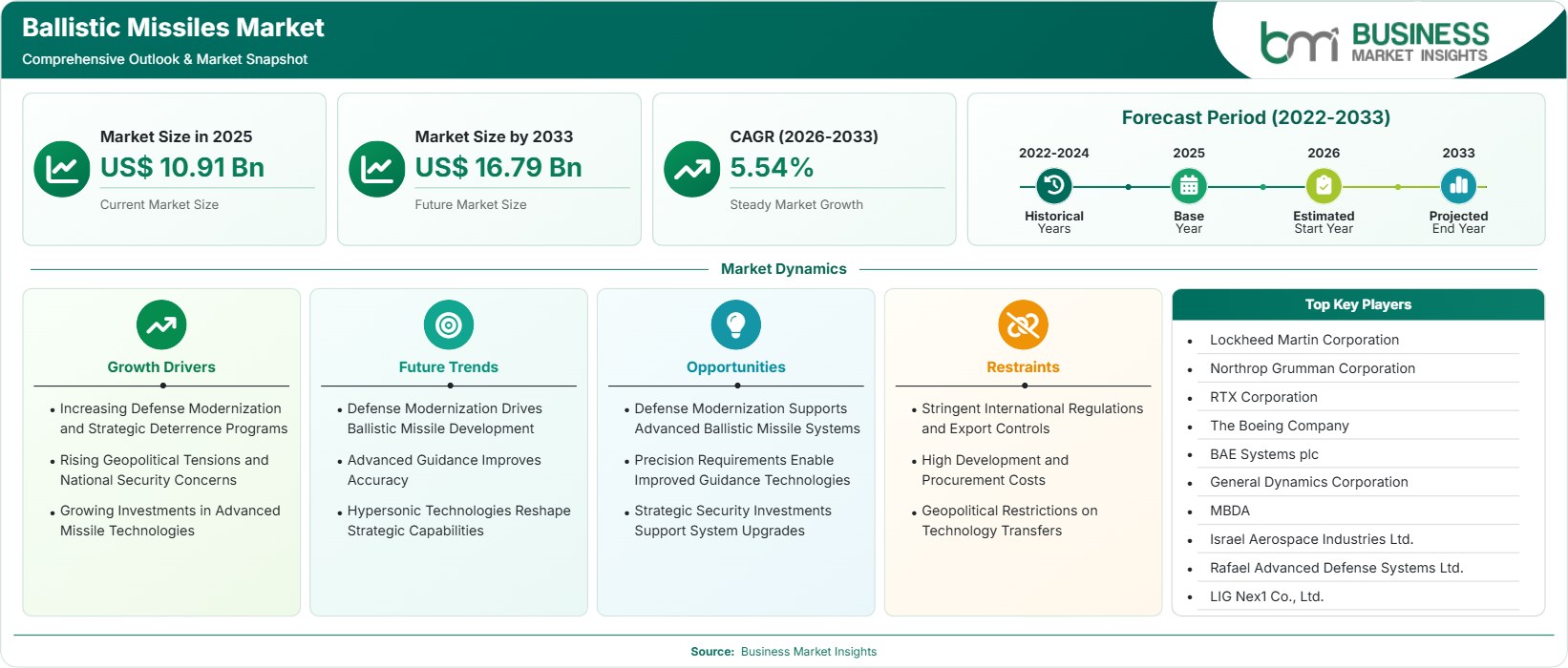
The Ballistic Missiles Market size was valued at US$ 10.91 Billion in 2025 and is projected to reach US$ 16.79 Billion by 2033, growing at a CAGR of 5.54% during 2026–2033. Key growth drivers include defense modernization, strategic deterrence investments, hypersonic weapon development, and missile survivability enhancements, while opportunities arise from advanced guidance systems, regional security programs, and indigenous missile manufacturing capabilities.

Report Coverage
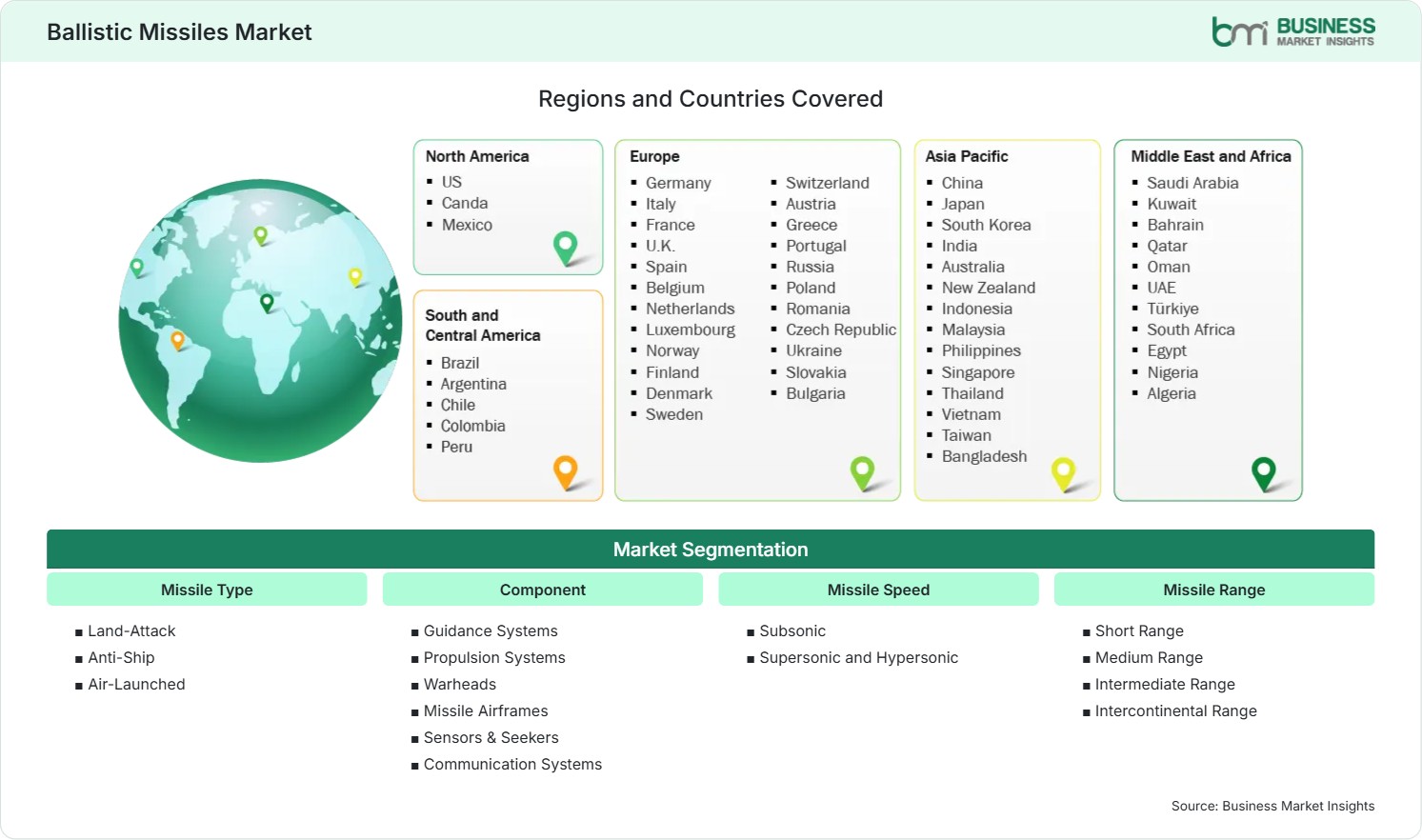
  • Missile Type: Land-Attack , Anti-Ship , Air-Launched
  • Component: Guidance Systems, Propulsion Systems, Warheads, Missile Airframes, Sensors & Seekers, Communication Systems
  • Missile Speed: Subsonic ,Supersonic and Hypersonic
  • Missile Range: Short Range, Medium Range ,Intermediate Range , Intercontinental Range
  • Propulsion System: Solid Propellant, Liquid Propellant
US$ 10.91 Bn Market size in 2025
US$ 16.79 Bn Market Size by 2033
5.54% CAGR, 2026 - 2033
2026-2033 Forecast Period

AI Overview

Ballistic Missiles Market Summary

  • North America Region: North America holds a Ballistic Missiles Market share of 35%–38% in 2025, expanding at a 4.8%–5.2% CAGR during 2026–2033. Growth is supported by nuclear deterrence modernization, hypersonic weapons programs, missile defense integration, strategic procurement budgets, advanced propulsion investments, long-range strike requirements, alliance interoperability initiatives, industrial base expansion, resilient supply chains, and digital engineering adoption. The U.S. dominates regional demand through strategic modernization programs and is expected to grow at 4.9%–5.3% CAGR.
  • Fastest Growing Region: Asia Pacific accounts for 28%–31% share in 2025 and records a 6.8%–7.4% CAGR. Rising geopolitical competition, indigenous missile development, expanding defense budgets, naval deterrence requirements, advanced testing programs, regional security concerns, technology localization initiatives, manufacturing investments, and strategic force enhancement continue fueling demand.
  • Leading Segment: Solid Propellant represents 58%–62% share in 2025 and advances at 5.2%–5.8% CAGR. Demand benefits from rapid launch readiness, simplified logistics, higher storage stability, operational flexibility, military preference for mobile deployment, reduced maintenance requirements, improved safety characteristics, and ongoing propulsion material innovations.
  • High Growth Segment: Hypersonic (Above Mach 5) commands 12%–15% share of the Ballistic Missiles Market in 2025 with an anticipated 8.5%–9.2% CAGR. Investment momentum stems from maneuverability advantages, advanced penetration capabilities, evolving countermeasure requirements, strategic deterrence priorities, accelerated testing programs, next-generation guidance technologies, and defense modernization initiatives worldwide.
  • Key Market Opportunity: Expanding investments in hypersonic glide vehicles, precision navigation technologies, indigenous production ecosystems, and mobile launch platforms are creating long-term procurement avenues across established and emerging defense powers globally.
  • Major Market Players: Lockheed Martin Corporation, Northrop Grumman Corporation, RTX Corporation, The Boeing Company, BAE Systems plc, General Dynamics Corporation, MBDA, Israel Aerospace Industries Ltd., Rafael Advanced Defense Systems Ltd., and LIG Nex1 Co., Ltd.
Strategic Insights

Ballistic Missiles Market: Strategic Insights

Ballistic Missiles Market Strategic Framework
FREE PDF
Request your free sample
Request free sample
Stakeholder View

Key Takeaways

  • The industry value chain increasingly integrates propulsion developers, guidance specialists, defense electronics suppliers, platform integrators, and government laboratories, creating long-term collaboration requirements across strategic weapons programs.
  • Hypersonic systems, advanced guidance technologies, and indigenous missile manufacturing initiatives offer the strongest medium-term expansion potential due to accelerating modernization cycles.
  • Innovation priorities are shifting toward AI-assisted targeting support, resistant navigation architectures, maneuverable re-entry vehicles, and digital engineering-based development methodologies.
  • Asia Pacific presents a compelling investment case as regional powers expand deterrence capabilities, increase local production capacity, and strengthen strategic force modernization programs.
  • Defense primes continue pursuing technology partnerships and capability consolidation to secure long-duration contracts associated with strategic missile modernization efforts.
  • Supply-chain resilience and secure sourcing of critical materials are becoming central competitive differentiators in national missile procurement frameworks.
Geographic Outlook

Ballistic Missiles Market Regional Highlights

North America Ballistic Missiles Market

North America accounted for 35%–38% of the Ballistic Missiles Market share in 2025 and is projected to grow at a 4.8%–5.2% CAGR through 2033. Regional demand is driven by strategic deterrence programs, nuclear force modernization, missile-defense network integration, and hypersonic weapons development. The United States remains the dominant procurement center, supported by sustained defense budgets and ongoing investments in guidance technologies, propulsion systems, and next-generation launch capabilities. Military readiness priorities and advanced research programs continue reinforcing long-term regional demand.

  • Nuclear modernization programs support procurement of advanced strategic systems and related technologies.
  • Hypersonic research funding accelerates development and testing activities across defense agencies.
  • Missile-defense interoperability requirements stimulate investments in secure communication architectures.
  • Industrial base expansion strengthens production capacity and supply-chain resilience.
  • Long-range precision-strike initiatives continue supporting capability upgrades.

US Ballistic Missiles Market

The U.S. represents approximately 82%–86% share within North America and is expected to expand at a 4.9%–5.3% CAGR. Demand is supported by strategic force recapitalization, deterrence enhancement, advanced testing activities, and expanded investments in next-generation missile technologies. Government funding enables modernization across propulsion, warhead integration, and guidance capabilities. Strong domestic manufacturing infrastructure and technology leadership continue positioning the country as a core participant in global missile development activities.

  • Strategic deterrence modernization remains a long-term driver of procurement programs.
  • Hypersonic weapon development continues receiving substantial defense investment support.
  • Integration of advanced sensors improves precision and mission effectiveness.
  • Secure command-and-control technologies strengthen operational survivability.

Europe Ballistic Missiles Market

Europe held a 22%–25% share in 2025 and is forecast to grow at a 5.3%–5.9% CAGR. Regional defense spending increases, NATO capability enhancement goals, and long-range deterrence requirements are supporting investments. France leads regional activity, while Poland and selected Eastern European nations exhibit accelerated procurement momentum. Collaborative defense programs and indigenous technology development initiatives continue supporting market expansion. Increased emphasis on strategic readiness is encouraging modernization across missile-related industrial ecosystems.

  • France remains a leading contributor through established strategic missile programs.
  • Poland records one of the strongest procurement trajectories with growing defense investment.
  • NATO interoperability requirements encourage technology modernization efforts.
  • Domestic manufacturing initiatives strengthen supply-chain security across Europe.
  • Advanced propulsion and seeker development remain important innovation priorities.

Asia Pacific Ballistic Missiles Market

Asia Pacific accounted for 28%–31% share in 2025 and is projected to achieve the fastest 6.8%–7.4% CAGR of the Ballistic Missiles Market through 2033. Heightened regional security concerns, indigenous defense manufacturing policies, and strategic deterrence investments are supporting sustained demand. China represents the largest regional market, while India demonstrates strong growth through missile modernization and local production programs. Research investments in hypersonic technologies and long-range strike capabilities continue expanding regional opportunities.

  • China leads regional procurement activity and technological advancement initiatives.
  • India demonstrates robust expansion supported by self-reliance programs.
  • Rising defense budgets strengthen missile development ecosystems.
  • Naval deterrence requirements encourage anti-ship ballistic missile capabilities.
  • Testing infrastructure investments accelerate deployment readiness.

Rest of World Ballistic Missiles Market

Rest of World held 10%–13% share in 2025 and is expected to grow at a 5.8%–6.4% CAGR. In the Middle East, strategic deterrence and regional security priorities support investment activity. South and Central American demand remains comparatively limited but benefits from defense modernization efforts.

Countries including Saudi Arabia and the United Arab Emirates remain significant regional participants, while Brazil demonstrates emerging capability-development activity. Procurement strategies increasingly emphasize sovereign defense capabilities and technology partnerships.

  • Middle Eastern governments prioritize strategic deterrence and force modernization.
  • Saudi Arabia represents a leading regional investment destination.
  • UAE advances domestic defense manufacturing capabilities.
  • Brazil shows gradual momentum in technology-development initiatives.
  • International partnerships remain important for capability acquisition.
Global Market Geography
FREE PDF
Request your free sample
Request free sample
Segment Analysis

Ballistic Missiles Market Segmentation

Missile Type

The market shares for this segment are estimated at 29%–32% in 2025, with a forecast CAGR of 5.5%–6.1%. The Ballistic Missiles Market scope will continue growing due to a focus on strategic range, deterrence capabilities, and deployment flexibility among armed forces. Procurement trends depend on the nature of missions, doctrines, and security needs.

  • Land-Attack (LABM): Widely deployed for strategic deterrence missions, benefiting from enhanced accuracy, survivability improvements, and long-range strike capability requirements among military operators.
  • Anti-Ship (AShBM): Adoption rises through maritime security requirements, naval deterrence priorities, and expanding focus on anti-access and area-denial operational concepts.
  • Air-Launched (ALBM): Gains traction through operational flexibility advantages, airborne launch integration, and rapid-response mission requirements within advanced military forces.

Component

The component section accounts for 24%-27% of market share and grows at a CAGR of 5.6-6.2 percent. There is an emphasis on technology spending on precision navigation, robust communication, sophisticated sensors, and propulsion integration. Modern missile design calls for synergy in performance to maximize mission effectiveness.

  • Guidance Systems: Improved navigation accuracy and anti-jamming capabilities strengthen operational performance across advanced missile deployments.
  • Propulsion Systems: Innovation concentrates on efficiency, reliability, maneuverability enhancement, and extended operational range objectives.
  • Warheads: Development efforts prioritize effectiveness, survivability, and mission-specific operational requirements.
  • Missile Airframes: Lightweight materials and structural optimization improve performance and deployment flexibility.
  • Sensors & Seekers: Precision targeting capabilities benefit from evolving detection and tracking technologies.
  • Communication Systems: Secure connectivity supports mission coordination and operational reliability in contested environments.

Missile Speed

This category accounts for 19%-22% market share and is projected to grow at a CAGR of 6.1%-6.7%. Growing operational needs are demanding faster strike operations and greater penetrative capability. Ballistic Missiles Market trends indicate greater emphasis on developing hypersonic and maneuverable missiles.

  • Subsonic: Maintains niche relevance for specific mission profiles emphasizing endurance and controlled flight characteristics.
  • Supersonic: Continues benefiting from balanced performance, affordability, and operational versatility across military applications.
  • Hypersonic (Above Mach 5): Experiences strong adoption through strategic deterrence initiatives and advanced defense modernization programs.

Launch Platform

The launch platform category holds 14%-17% market share and is expanding at a 5.4%-6.0% CAGR. Operational survivability and mobility remain key purchase criteria. Diversified platforms provide operational flexibility and mission effectiveness.

Missile Range

This segment accounts for 21%-24% share and grows at a 5.8%-6.4% CAGR in the Ballistic Missiles Market. Governments are becoming more responsive in their procurement policies to their national deterrence policies and emerging threats.

  • Short Range: Deployed for tactical missions requiring rapid-response capability and localized strike effectiveness.
  • Medium Range: Supports regional deterrence objectives and operational flexibility requirements.
  • Intermediate Range (3,500-5,500 km): Gains relevance through strategic reach requirements and evolving defense postures.
  • Intercontinental Range (Above 5,500 km): Remains central to long-term strategic deterrence frameworks.

Propulsion System

The largest market, with a 58%-62% share, is projected to register a CAGR of 5.2%-5.8%. Stability, availability, reliability, and flexibility are the important factors affecting procurement decisions. Solid-fuel rockets have a major presence in existing stock; however, liquid rockets continue to gain demand in special cases.

  • Solid Propellant: Preferred for rapid deployment, storage efficiency, operational simplicity, and military readiness requirements.
  • Liquid Propellant: Retains importance in selected strategic systems requiring performance customization and mission-specific operational characteristics.
Market Forces

Ballistic Missiles Market Dynamics

Key Market Drivers

Rising strategic deterrence modernization programs

Governments are investing significant sums in upgrading their strategic missile, delivery, and control systems. Nuclear nations keep upgrading old missile systems while incorporating more advanced systems. Increased government expenditure among NATO member nations and major Asian nations means continued purchase of systems. An increased focus on precision strikes also means greater investment momentum. The process of modernization entails longer development timelines and upgrade opportunities for system integrators, subsystem suppliers, and technology developers.

Advances in hypersonic weapon technologies

The advent of hypersonic missiles has changed the military procurement agenda due to their high speed and penetration capabilities. Military agencies have begun developing hypersonic gliders, improved thermal protection systems, and navigation architectures. Innovation ecosystems created by such developments provide new business opportunities for propulsion firms, sensing firms, and system integrators. Growing test activity and prototype validation efforts highlight the strategic importance of next-generation missile capabilities.

Expansion of indigenous defense manufacturing initiatives

Most governments have been trying to increase domestic production capacity to reduce their reliance on external suppliers and ensure a resilient value chain, in addition to their national security goals. This includes technology transfers, local manufacturing, and strategic industrial partnerships. Indigenous programs help increase innovation and foster research collaborations, component localization, and advanced system integration.

Key Market Opportunities

Emerging demand for maneuverable hypersonic systems

Future defense procurements will be based on maneuverable hypersonic attack systems capable of defeating complex air and missile defenses. As the modernization of defense continues at a rapid pace, the Ballistic Missiles Market Forecasts indicate an increased need for thermal protection, advanced seeker technology, and high-precision navigation capabilities, among other capabilities. Hypersonic technology is vital in ensuring speed, accuracy, and survival of missiles in contested environments. Defense companies with proven experience in hypersonic technologies have a better chance of winning contracts from various defense departments worldwide.

Integration of AI-enabled guidance and sensing technologies

Artificial intelligence and advanced analytics are transforming modern guidance and sensing technologies by significantly improving navigation accuracy, target identification, mission planning, and real-time decision-making. AI-based solutions can process large volumes of data from various sensors, resulting in faster, more reliable actions under complex conditions. The increasing demand for intelligent sensing solutions, autonomous platforms, and decision support systems is opening many prospects for electronics suppliers, software developers, and defense technologists. These solutions will improve the efficiency and effectiveness across defense and security applications.

Growth of mobile and survivable launch platforms

Military strategists have come to place greater emphasis on mobile and survivable launch systems to ensure operations remain flexible and less vulnerable to enemy preemptive strikes. The procurement of transport-erector-launchers (TELs), shelters, underground sites, and a distributed military force structure has become very important for contemporary defense policies. These capabilities enable rapid mobility, concealment, and sustained mission readiness during conflict scenarios. As military doctrines evolve toward greater survivability and responsiveness, suppliers that can provide integrated, technologically advanced launch platform solutions are well positioned to benefit from rising procurement demand and long-term modernization programs.

Market Restraints and Challenges

High development costs and extended procurement cycles

Missile development programs necessitate considerable expenditure on research and development, testing and certification, specialized materials, and skilled engineers. All these demands result in prolonged development time, with the system usually taking several years to be operational. As expenditures increase throughout the program life cycle, the defense budget comes under greater pressure, limiting opportunities for buying. The government needs to consider missile development alongside other important defense matters, and suppliers remain under threat of financial instability and dependence on large-scale, long-term procurement commitments.

Export controls and geopolitical restrictions

The production, use, and marketing of missile technology are heavily regulated by international law, export control policies, and other forms of government regulation. These regulations may adversely affect the market range by limiting opportunities for international sales and technology transfer agreements. Businesses will have to comply with complex licensing and other regulations, increasing costs and complicating their processes. Political conflicts may also interfere with business dealings and procurement activities. This is likely to negatively influence the processes involved in supply chain management and project implementation, and, whichmay also negatively affect revenue projections, creating uncertainty for investors and industry participants.

Company Analysis

Competitive Landscape

The competitive environment is characterized by strategic contracts, advanced R&D investments, and defense modernization programs. Current Ballistic Missiles Market analysis indicates strong participation from established defense primes and specialized missile technology providers.

Company Name

Overview

Products and Services relevant to this market

Lockheed Martin Corporation

Major defense contractor with extensive missile-development and strategic systems expertise.

Strategic missiles, guidance solutions, propulsion integration, defense systems.

Northrop Grumman Corporation

Advanced aerospace and defense company supporting strategic modernization programs.

Missile systems, propulsion technologies, command architectures, integration services.

RTX Corporation

Global defense technology leader with significant missile and defense capabilities.

Missile guidance, sensors, communications, defense solutions.

The Boeing Company

Aerospace manufacturer involved in strategic defense and missile-related programs.

Missile platforms, aerospace engineering, systems integration solutions.

BAE Systems plc

International defense supplier supporting advanced weapons technologies.

Defense electronics, subsystem integration, mission solutions.

General Dynamics Corporation

Diversified defense company serving strategic military requirements.

Defense systems engineering and support capabilities.

MBDA

European missile specialist serving multiple allied defense programs.

Strategic missile technologies and integrated weapons systems.

Israel Aerospace Industries Ltd.

Aerospace and defense enterprise with advanced missile expertise.

Strike systems, guidance technologies, defense platforms.

Rafael Advanced Defense Systems Ltd.

Defense technology company focusing on advanced weapon solutions.

Precision guidance and missile-related technologies.

LIG Nex1 Co., Ltd.

South Korean defense manufacturer expanding missile capabilities.

Missile electronics, guidance, sensing, and integration solutions.

Trust & Transparency

Research Methodology

The market analysis combines proprietary research with secondary data from government agencies, company disclosures, regulatory filings, industry databases and expert interviews. Market estimates are validated through data triangulation, cross-market benchmarking and analyst review.

View Full Research Methodology

Questions Answered

Frequently Asked Questions

What does this Ballistic Missiles Market Report indicate about competition?

Competition remains centered on technological capability, production capacity, strategic partnerships, subsystem innovation, and the ability to secure long-duration defense modernization contracts.

How are governments supporting industry development?

Many countries promote domestic production through technology-transfer agreements, defense industrial policies, collaborative research initiatives, and long-term procurement commitments.

What differentiates solid-propellant systems from liquid-propellant systems?

Solid propellants provide greater readiness, storage stability, and operational simplicity, while liquid systems can offer mission-specific performance advantages in selected strategic applications.

Which region presents the highest growth potential?

Asia Pacific offers the strongest expansion outlook due to rising defense budgets, indigenous manufacturing initiatives, and strategic deterrence modernization programs.

Which technology area is creating the strongest innovation momentum?

Hypersonic propulsion, advanced seekers, resilient navigation systems, and AI-assisted guidance architectures are attracting the highest research and procurement investment globally.

Access the Full Ballistic Missiles Market Report

Get segment-level forecasts, regional estimates, competitive benchmarking, company profiles and downloadable Excel datasets.

Access the full Ballistic Missiles Market Report
350 pages PDF & Excel | 2026-09-21
Similar Research

Related Market Reports