
Rocket and Missiles Market Outlook: Size, Share, Trends, Growth Analysis, Competitive Landscape & Forecast, 2026-2033

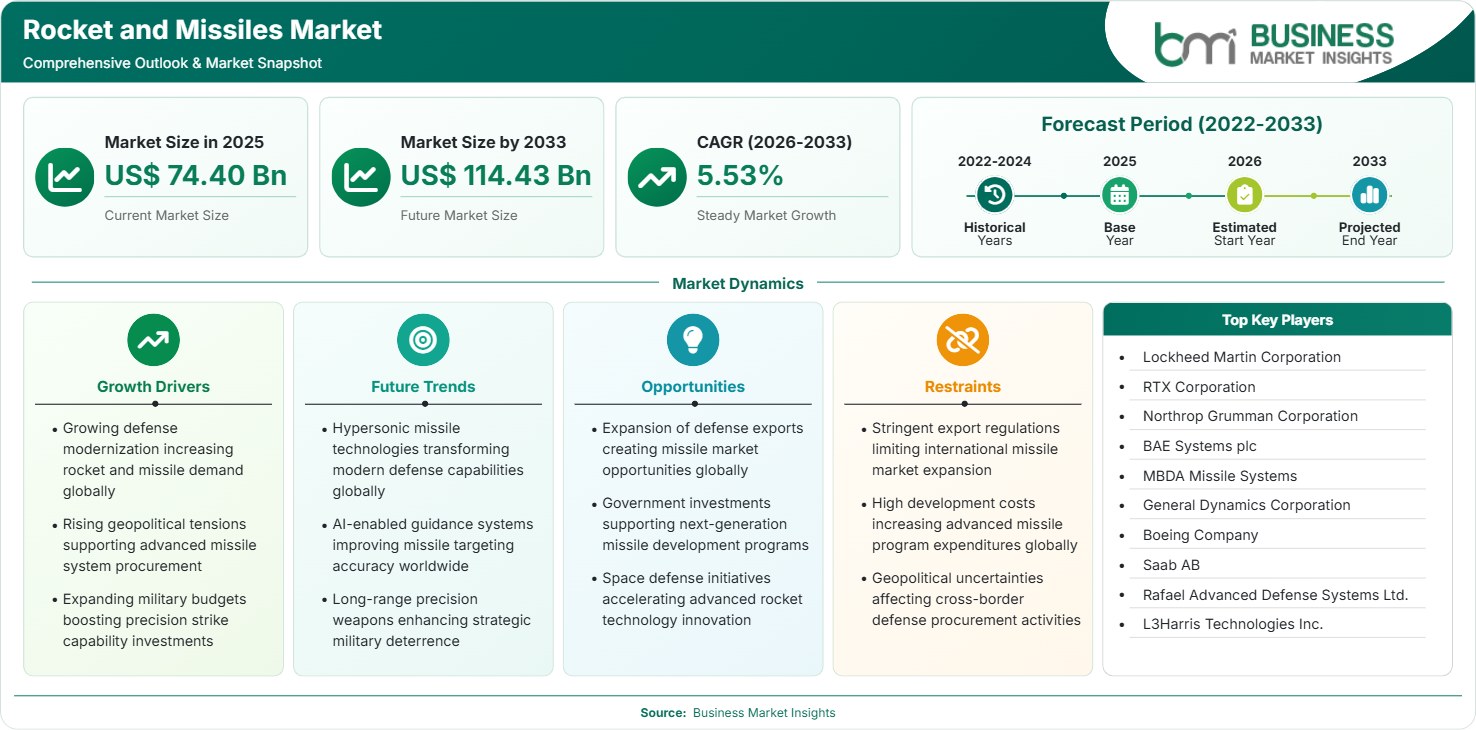
The Rocket And Missiles Market size was valued at US$ 74.4 billion in 2025 and is projected to reach US$ 114.43 billion by 2033, growing at a CAGR of 5.53% during 2026–2033. Growing defense modernization, rising geopolitical tensions, and expanding military budgets continue driving demand, while defense exports, next-generation systems, and space defense initiatives create strategic opportunities.

Report Coverage
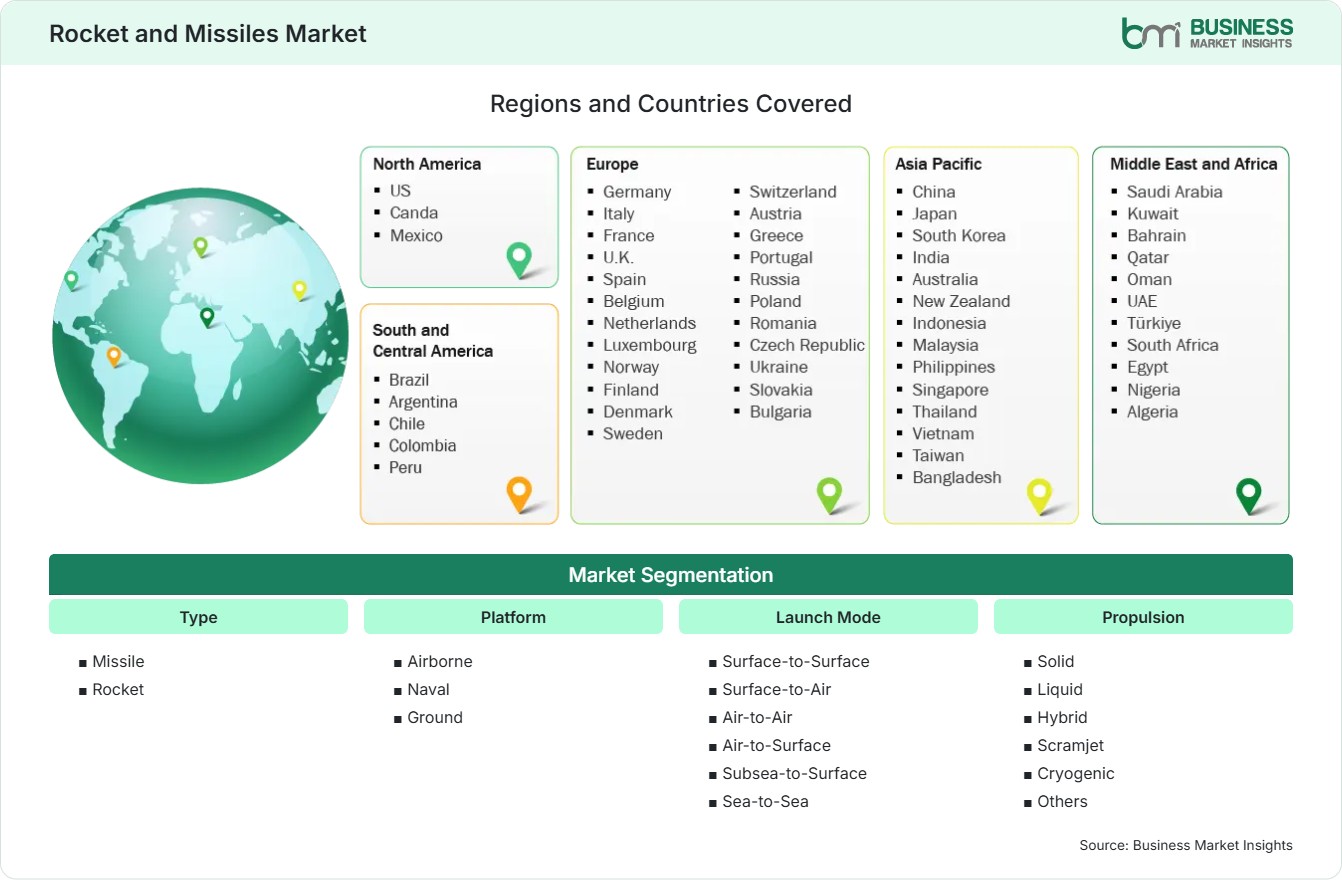
  • Type: Missile, Rocket
  • Platform: Airborne, Naval, Ground
  • Launch Mode: Surface-to-Surface, Surface-to-Air, Air-to-Air, Air-to-Surface, Subsea-to-Surface, Sea-to-Sea
  • Propulsion: Solid, Liquid, Hybrid, Scramjet, Cryogenic, Others
US$ 74.40 Bn Market size in 2025
US$ 114.43 Bn Market Size by 2033
5.53% CAGR, 2026 - 2033
2026-2033 Forecast Period

AI Overview

Rocket and Missiles Market Summary

  • North America Region: North America accounts for 36%–39% market share in 2025 and is projected to expand at a 5.1%–5.5% CAGR during 2026–2033. Advanced defense programs, modernization initiatives, and precision strike capability investments support regional demand. The United States dominates regional activity with a 5.2%–5.6% CAGR, supported by missile defense programs, military procurement, and continued investment in advanced aerospace technologies.
  • Fastest Growing Region: Asia Pacific represents 27%–30% market share in 2025 while registering a 6.2%–6.7% CAGR through 2033. Increasing defense spending, regional security concerns, indigenous manufacturing programs, and advanced weapon system development accelerate market expansion.
  • Leading Segment: Missile systems account for 72%–75% market share in 2025 and are expected to grow at a 5.6%–6.0% CAGR. Rising demand for precision-guided weapons, air defense systems, and long-range strike capabilities supports segment leadership.
  • High Growth Segment: Airborne platforms represent 38%–41% market share in 2025 and are forecast to expand at a 6.0%–6.4% CAGR. Increasing fighter aircraft modernization, unmanned systems integration, and advanced aerial combat capabilities drive growth.
  • Key Market Opportunity: Development of hypersonic systems, missile defense technologies, space-based security solutions, and expanding international defense partnerships create significant opportunities for manufacturers and technology providers.
  • Major Market Players: Lockheed Martin Corporation, RTX Corporation, Northrop Grumman Corporation, BAE Systems plc, MBDA Missile Systems, General Dynamics Corporation, Boeing Company, Saab AB, Rafael Advanced Defense Systems Ltd., and L3Harris Technologies Inc.
Strategic Insights

Rocket and Missiles Market: Strategic Insights

Rocket and Missiles Market Strategic Framework
FREE PDF
Request your free sample
Request free sample
Stakeholder View

Key Takeaways

  • Defense supply chains are becoming increasingly integrated through collaboration between missile manufacturers, aerospace suppliers, electronics providers, propulsion developers, and government defense agencies focused on secure and reliable production capabilities.
  • Precision-guided missiles, airborne launch platforms, hypersonic technologies, and advanced propulsion systems represent major opportunity areas as military forces prioritize improved accuracy, range, and operational flexibility.
  • Innovation in artificial intelligence-based targeting, autonomous guidance systems, advanced materials, propulsion efficiency, and network-centric warfare capabilities is transforming future missile and rocket development strategies.
  • Asia Pacific presents a strong investment opportunity due to rising defense budgets, regional security challenges, indigenous weapons programs, and increasing focus on domestic aerospace manufacturing capabilities.
  • Strategic partnerships, defense contracts, international collaborations, and investments in next-generation missile technologies continue driving competitive positioning among major global defense companies.
Geographic Outlook

Rocket and Missiles Market Regional Highlights

North America Rocket And Missiles Market

North America accounts for 36%–39% of global revenue in 2025 and is projected to expand at a 5.1%–5.5% CAGR through 2033. The Rocket And Missiles Market share remains dominant due to extensive defense spending, advanced military infrastructure, and large-scale modernization programs. The United States continues leading regional demand through missile defense initiatives, aerospace innovation, and procurement of advanced precision strike systems.

  • The United States maintains regional leadership through significant defense investments, advanced missile programs, and continuous military modernization initiatives.
  • Government focus on integrated air and missile defense systems continues increasing demand for advanced interception and tracking technologies.
  • Defense contractors are expanding production capacity to support long-term procurement programs and strengthen supply chain resilience.
  • Increasing adoption of hypersonic weapons research and advanced propulsion technologies supports future regional capability development.

US Rocket And Missiles Market

The United States contributes approximately 88%–91% of North American demand and is projected to grow at a 5.2%–5.6% CAGR through 2033. Strong military expenditure, advanced aerospace capabilities, and extensive defense procurement programs continue supporting market expansion. Increasing investments in missile defense, strategic weapons, and next-generation combat systems strengthen domestic demand.

  • Defense modernization programs continue increasing procurement of advanced missiles, precision strike systems, and integrated defense solutions in rocket and missiles market.
  • Aerospace manufacturers are investing in advanced production technologies to improve manufacturing efficiency and delivery capabilities.
  • Growing focus on multi-domain warfare capabilities encourages development of adaptable missile and rocket systems.

Europe Rocket And Missiles Market

Europe represents 20%–23% of global revenue in 2025 and is expected to register a 5.0%–5.4% CAGR through 2033. Rising regional security concerns, defense modernization efforts, and multinational procurement programs continue supporting demand. France, Germany, and the United Kingdom remain leading markets, while Poland records comparatively faster growth due to increasing defense investments and military capability expansion.

  • France maintains strong market presence through advanced missile development programs and domestic defense manufacturing capabilities.
  • Germany and the United Kingdom continue increasing defense investments to strengthen strategic and tactical military capabilities in rocket and missiles market.
  • Poland demonstrates faster growth through expanded military modernization programs and procurement of advanced defense systems.
  • European defense collaborations continue supporting joint missile development initiatives and technology-sharing programs.

Asia Pacific Rocket And Missiles Market

Asia Pacific accounts for 27%–30% of global revenue in 2025 and is projected to expand at a 6.2%–6.7% CAGR through 2033. Rising geopolitical tensions, increasing defense budgets, and indigenous weapons development programs continue accelerating regional demand. China remains the leading market because of extensive military modernization, while India demonstrates faster growth through domestic defense manufacturing and strategic missile development programs.

  • China continues expanding missile capabilities through investments in advanced weapons systems and military modernization initiatives.
  • India is experiencing faster growth through indigenous defense programs, missile development projects, and increasing aerospace manufacturing capabilities in rocket and missiles market.
  • Japan and South Korea are strengthening defense capabilities through advanced missile systems and regional security investments.
  • Regional governments continue prioritizing precision strike technologies, air defense systems, and strategic deterrence capabilities.

Rest of World Rocket And Missiles Market

Rest of World represents 11%–14% of global revenue in 2025 and is anticipated to register a 5.4%–5.8% CAGR through 2033. South & Central America continues developing defense capabilities through military modernization programs, while the Middle East & Africa experiences demand growth from security concerns and strategic defense investments. Brazil leads regional demand, whereas Saudi Arabia and the United Arab Emirates demonstrate stronger growth through advanced defense procurement initiatives.

  • Brazil maintains regional leadership through military modernization programs, defense procurement activities, and investments in aerospace and security capabilities.
  • Saudi Arabia and the United Arab Emirates continue expanding advanced defense systems through strategic acquisitions and technology partnerships in rocket and missiles market.
  • African countries are gradually increasing defense investments to strengthen border security, surveillance capabilities, and operational readiness.
  • Regional governments are focusing on defense cooperation agreements and technology transfers to improve domestic military capabilities.
Global Market Geography
FREE PDF
Request your free sample
Request free sample
Segment Analysis

Rocket and Missiles Market Segmentation

Type

The Type segment accounted for 72%–75% of global revenue in 2025 and is projected to grow at a 5.6%–6.0% CAGR through 2033. Rising demand for precision-guided systems, strategic deterrence capabilities, and advanced combat technologies continues supporting segment expansion. The Rocket And Missiles Market scope is widening through investments in long-range systems, improved accuracy, and multi-domain defense applications.

  • Missile: Missiles remain the dominant category due to increasing demand for precision strike capabilities, air defense systems, tactical weapons, and strategic military applications.
  • Rocket: Rockets continue supporting defense operations through artillery systems, launch platforms, battlefield applications, and emerging space-related missions requiring reliable propulsion technologies.

Platform

The Platform segment represented 38%–41% of global revenue in 2025 and is expected to expand at a 6.0%–6.4% CAGR through 2033. Military modernization programs increasingly emphasize flexible deployment capabilities across aerial, naval, and ground environments. Advanced platforms integrating network connectivity, precision targeting, and improved mobility continue influencing procurement decisions among defense organizations.

  • Airborne: Airborne platforms experience strong demand through fighter aircraft modernization, unmanned systems integration, and advanced aerial strike capabilities.
  • Naval: Naval platforms continue expanding through investments in ship-based missile systems, maritime security capabilities, and advanced defense technologies for naval forces.
  • Ground: Ground platforms support military operations through tactical missile systems, mobile launchers, and battlefield defense applications requiring enhanced operational flexibility.

Launch Mode

The Launch Mode segment accounted for 44%–47% of global revenue in 2025 and is projected to grow at a 5.7%–6.1% CAGR through 2033. Increasing focus on multi-domain warfare and integrated defense networks is driving demand for diverse launch capabilities. Advanced targeting systems and improved interoperability continue enhancing operational effectiveness across military platforms.

  • Surface-to-Surface: Surface-to-surface systems remain important for tactical and strategic operations requiring accurate land-based strike capabilities.
  • Surface-to-Air: Surface-to-air systems continue gaining importance due to increasing demand for air defense and protection against aerial threats.
  • Air-to-Air: Air-to-air systems support modern aerial warfare through improved targeting, range enhancement, and fighter aircraft capability upgrades.
  • Air-to-Surface: Air-to-surface systems are expanding through demand for precision strike missions and advanced airborne combat capabilities.
  • Subsea-to-Surface: Subsea-to-surface systems support naval operations through submarine-launched capabilities and strategic maritime defense requirements.
  • Sea-to-Sea: Sea-to-sea systems contribute to maritime security through advanced naval warfare capabilities and ship-based missile technologies.

Propulsion

The Propulsion segment continues evolving through investments in higher-performance engines, improved fuel efficiency, and advanced propulsion technologies. The segment is projected to maintain steady expansion as defense organizations prioritize longer range, faster response, and enhanced operational capabilities. Research into advanced propulsion systems supports future missile and rocket development programs.

  • Solid: Solid propulsion remains widely adopted because of reliability, storage advantages, rapid deployment capability, and suitability for tactical and strategic missile applications.
  • Liquid: Liquid propulsion systems continue supporting applications requiring controllable thrust, extended operational flexibility, and advanced launch performance.
  • Hybrid: Hybrid propulsion gains attention through research initiatives focused on improved efficiency, reduced complexity, and next-generation defense applications.
  • Scramjet: Scramjet technology supports hypersonic weapons development by enabling high-speed flight capabilities and advanced long-range strike potential.
  • Cryogenic: Cryogenic propulsion contributes to specialized applications requiring high-performance engines and advanced aerospace launch capabilities.
  • Others: Other propulsion technologies support specialized defense requirements through continuous innovation in performance, efficiency, and operational flexibility.
Market Forces

Rocket and Missiles Market Dynamics

Key Market Drivers

Growing defense modernization increasing rocket and missile demand globally

Worldwide defense modernization is rapidly advancing the procurement of modern rocket and missile systems as armed forces are upgrading their legacy weapon systems and increasing their operational abilities. Rocket And Missiles Market trends include increased investment in precision guided weapons, defensive network integration, propulsion advancements and autonomous targeting systems. The need for improvements in range, precision and survivability has become the primary consideration due to evolving security requirements. Defense modernization efforts in the most prominent economies have forced defense contractors not only to increase their production capacities but also develop new systems. The constantly increasing demand for multi-domain warfare capabilities that cover land, naval, air and space elements continues improving the opportunities for defense contractors.

Rising geopolitical tensions supporting advanced missile system procurement

Greater political uncertainties and security threats are making countries enhance their military power through missile purchase programs. Countries are emphasizing strategic deterrence, air defense systems, and precision strikes in order to increase their military preparedness. Greater spending on long range missiles, hypersonic weapons, and command systems is providing lucrative opportunities for leading defense companies. Interoperability between various defense platforms is another major aspect that military organizations are emphasizing upon. All such trends are accelerating R&D operations while boosting the demand for missile systems.

Expanding military budgets boosting precision strike capability investments

Higher spending on military expenditure in both developed and emerging nations will encourage investments in precision strike weaponry, which includes guided missiles and complex rockets. There will be more money available for defense organizations in order to enhance accuracy and range. Higher budgets for research and development in aircraft and weapons, as well as for defense infrastructures, allow manufacturers to create new solutions. Higher military spending in those countries that enhance their strategic capabilities will provide a constant demand for advanced weapon systems. The contracts and development programs supported by governments will continue to support the growth of the industry.

Key Market Opportunities

Expansion of defense exports creating missile market opportunities globally

Growing international defense cooperation and increasing demand for advanced military equipment are creating new opportunities through defense exports. Countries seeking to strengthen national security capabilities are investing in imported missile systems, tactical weapons, and integrated defense solutions. Export partnerships allow manufacturers to expand global presence while supporting technology collaboration between defense organizations. Rocket And Missiles Market Forecasts indicate continued opportunities as emerging economies modernize military capabilities and seek advanced systems from established defense suppliers. Expanding defense trade agreements, strategic partnerships, and government-to-government contracts are expected to support broader market penetration across multiple regions.

Government investments supporting next-generation missile development programs

Government-sponsored research programs related to hypersonic weaponry, propulsion technology, autonomy, and enhanced guidance systems are presenting ample opportunities for defense manufacturers. Military bodies are investing heavily in future-oriented platforms aimed at enhancing speed, accuracy, and maneuverability. Research programs related to advanced materials, artificial intelligence, and network-centric warfare systems are fostering innovation within the defense industry. Government research organizations are partnering with private defense firms for enhancing their technological capabilities. Future growth opportunities for companies working on advanced missile programs are anticipated because of continued funding in this area.

Space defense initiatives accelerating advanced rocket technology innovation

Increasing interest in space security and defense is boosting the rate of innovations in rockets and aerospace technology. The governments are funding space defense technologies and satellites’ defense, launch vehicles, and aerospace programs. These investments are contributing to innovations in propulsion, launches, and high-tech materials. Increased interest in protection of space assets against new threats will create new opportunities for rocket companies developing innovative rockets. Cooperation between defense institutions, aerospace manufacturers, and technology companies is driving innovation and finding application beyond military purposes into space security contexts.

Market Restraints and Challenges

Stringent export regulations limiting international missile market expansion

Factor: Compliance becomes difficult due to the complex nature of arms control regulations, the need for obtaining licenses, technology transfer limitations, and geopolitical approvals, especially when engaging in global missile trade. Impact: The process of purchasing has become lengthy for corporations, there is limited availability to certain markets, additional costs associated with administration and limited options for international expansion. There may be a delay in implementing military agreements, as well as lack of flexibility in providing sophisticated equipment to foreign clients. Defense manufacturers have to focus on compliance and regional cooperation to stay competitive in this market.

High development costs increasing advanced missile program expenditures globally

Factor: Highly developed missile and rocket systems demand considerable research investments, extensive testing and simulations, advanced materials and propulsion systems, and highly accurate guidance systems. Impact: Higher costs of development lead to higher budgets, delays in project implementation, and financial pressure on the contractors and military organizations. High costs of development arise because of the complex nature of engineering and the need for a lot of tests to be done. The contractors are finding ways of dealing with high costs by collaborating in development, digital engineering, modularity, and manufacturing.

Company Analysis

Competitive Landscape

The Rocket And Missiles Market analysis indicates that there is intense competition in the defense sector because of weapon development, government contracts, strategic partnerships, and precision strike systems technology. Key defense firms are working on hypersonics, missile defense, propulsion, and warfare capabilities to improve their market presence.

Company Name

Overview

Products and Services relevant to this market

Lockheed Martin Corporation

Global aerospace and defense company specializing in advanced military systems and strategic defense solutions.

Missiles, missile defense systems, tactical weapons, precision strike solutions, and aerospace technologies.

RTX Corporation

Defense technology company providing advanced systems for military and aerospace applications worldwide.

Missile systems, air defense technologies, precision weapons, sensors, and defense electronics.

Northrop Grumman Corporation

Aerospace and defense company focused on advanced military technologies and strategic systems.

Missile systems, propulsion technologies, launch systems, autonomous defense solutions, and aerospace platforms.

BAE Systems plc

International defense company developing advanced military equipment and security technologies.

Missile technologies, electronic warfare systems, defense platforms, and military solutions.

MBDA Missile Systems

European missile manufacturer specializing in advanced guided weapon systems.

Tactical missiles, air defense systems, naval missiles, precision strike solutions, and missile technologies.

General Dynamics Corporation

Defense manufacturer providing military systems and aerospace solutions for global customers.

Missile-related systems, defense platforms, military technologies, and advanced weapons solutions.

Boeing Company

Aerospace company developing defense technologies and advanced military systems.

Missile systems, strategic weapons, aerospace defense solutions, and military platforms.

Saab AB

Defense and security company providing advanced military and aerospace technologies.

Missile systems, defense electronics, combat solutions, and aerospace technologies.

Rafael Advanced Defense Systems Ltd.

Defense technology company specializing in advanced weapons and security solutions.

Missile systems, air defense technologies, precision weapons, and advanced defense electronics.

L3Harris Technologies Inc.

Technology company providing defense communication and mission systems.

Missile electronics, guidance technologies, sensors, defense systems, and aerospace solutions.

Trust & Transparency

Research Methodology

The market analysis combines proprietary research with secondary data from government agencies, company disclosures, regulatory filings, industry databases and expert interviews. Market estimates are validated through data triangulation, cross-market benchmarking and analyst review.

View Full Research Methodology

Questions Answered

Frequently Asked Questions

How are defense companies improving missile system capabilities?

Defense companies are investing in hypersonic technologies, artificial intelligence-enabled guidance systems, advanced propulsion, network-centric warfare solutions, digital engineering, and next-generation materials to improve missile performance and operational effectiveness.

What does the market report provide?

The Rocket And Missiles Market Report provides insights into market size, segmentation, regional analysis, competitive landscape, company profiles, market dynamics, opportunities, restraints, recent developments, and future industry outlook through 2033.

Which segment dominates the market by type?

Missile systems represent the leading segment because of increasing adoption of precision-guided weapons, air defense solutions, strategic deterrence systems, and advanced military platforms across global defense forces.

Which region is expected to witness the fastest growth in the market?

Asia Pacific is expected to register the fastest growth through 2033 due to rising defense expenditures, regional security concerns, indigenous weapons development programs, and increasing investments in advanced military technologies.

What factors are driving demand for rocket and missile systems globally?

Growing defense modernization programs, increasing geopolitical tensions, rising military budgets, precision strike requirements, and investments in advanced aerospace technologies are driving demand for next-generation rocket and missile systems worldwide.

Access the Full Rocket and Missiles Market Report

Get segment-level forecasts, regional estimates, competitive benchmarking, company profiles and downloadable Excel datasets.

Access the full Rocket and Missiles Market Report
350 pages PDF & Excel | 2026-08-31