Market Summary
Executive Summary and Global Market Analysis
Rocket propulsion systems generate thrust by expelling high-velocity gases through controlled combustion or propellant acceleration mechanisms. These systems form the operational foundation of launch vehicles, missile platforms, orbital missions, and deep-space transportation technologies. Propulsion architectures differ according to mission duration, payload requirements, maneuverability demands, and thermal performance conditions.
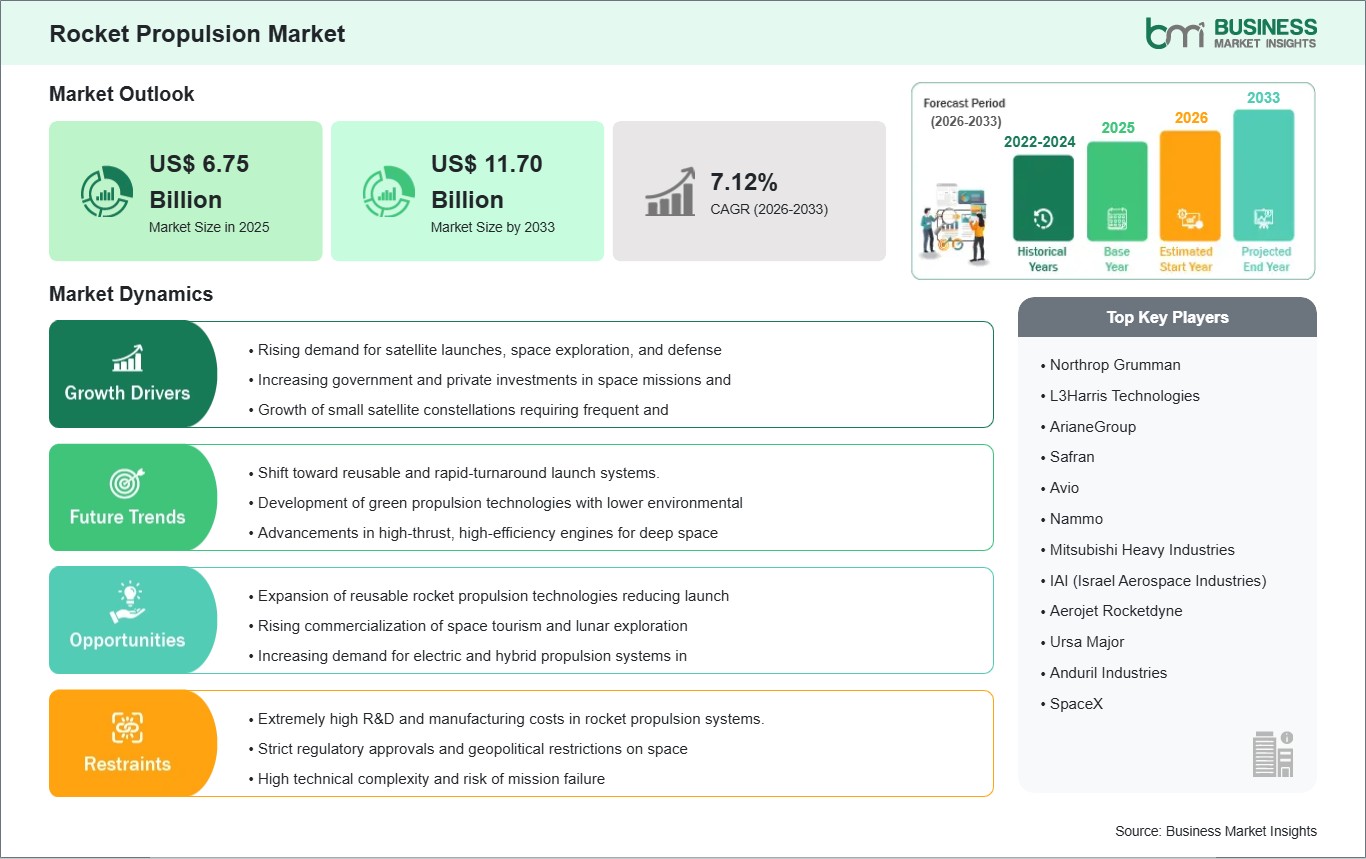
Expanding satellite deployment activity and heightened defense modernization programs continue strengthening procurement across propulsion technologies. Governments and commercial launch providers increasingly emphasize reusable systems, mission reliability, and propulsion efficiency to support evolving aerospace objectives. Strategic investments in hypersonic technologies and orbital mobility programs also reinforce long-term development initiatives throughout the sector.
Liquid propulsion systems maintain substantial utilization because controlled thrust modulation supports advanced launch and spacecraft maneuvering operations. Solid propulsion technologies remain central within tactical missile systems due to structural simplicity and operational readiness advantages. Hybrid propulsion concepts are attracting engineering interest for balancing safety characteristics with performance adaptability across emerging aerospace applications.
Technological progress increasingly centers on additive manufacturing, lightweight thermal-resistant materials, and reusable propulsion mechanisms. Advanced nozzle configurations, improved propellant chemistry, and precision combustion management systems are enhancing operational performance while reducing manufacturing complexity. Engineering attention additionally focuses on modular engine platforms capable of supporting both commercial launch programs and national security applications.
Competitive conditions within the market continue evolving through long-term aerospace contracts, propulsion testing programs, and integration partnerships. Industry participants concentrate on scalable manufacturing capability, rapid prototype validation, and propulsion reliability under demanding mission environments. Expanding commercialization of space activities and defense-oriented propulsion development continues shaping innovation priorities across the global rocket propulsion market.
Segment Analysis
Rocket Propulsion Market Segmentation
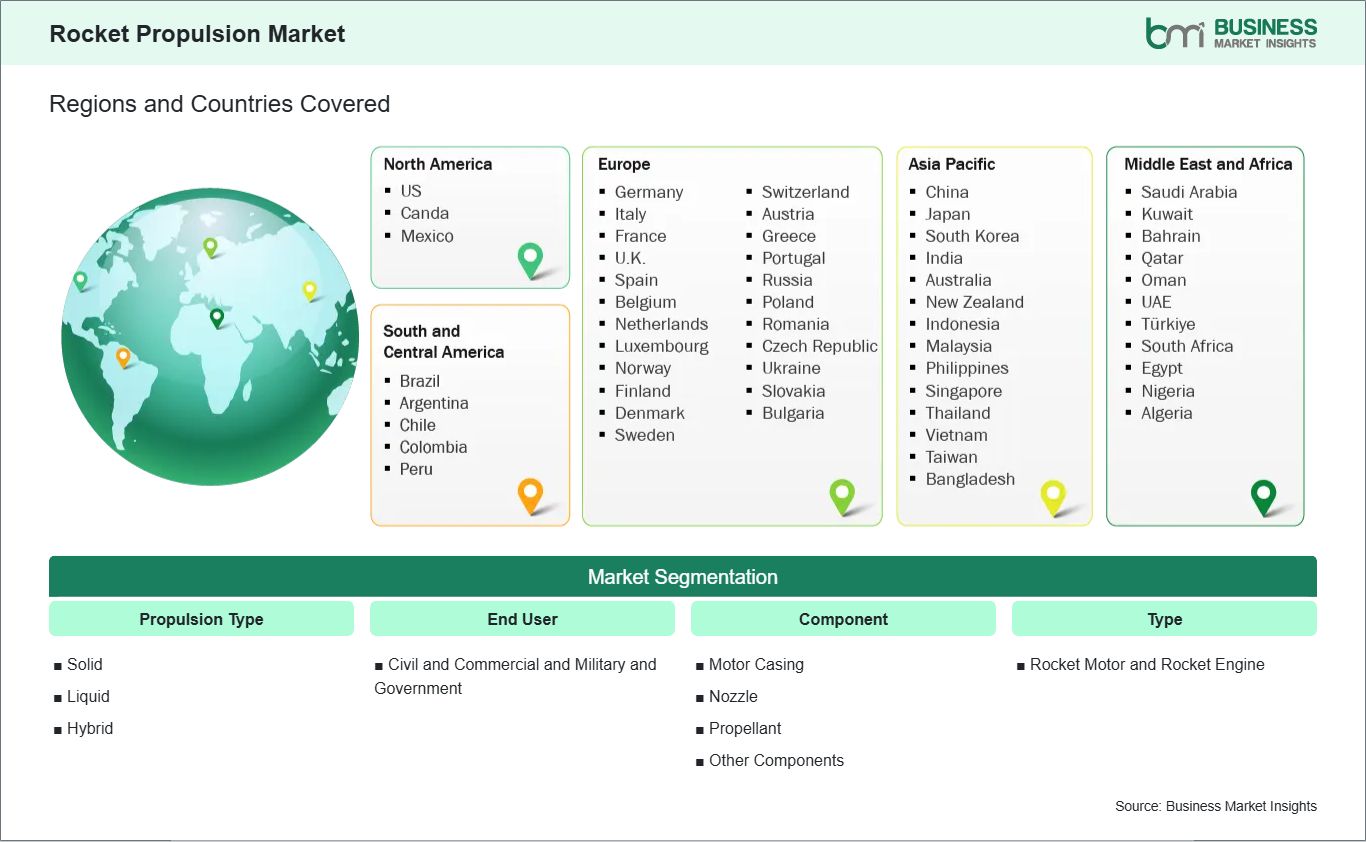
The rocket propulsion market is segmented based on propulsion type, end user, component and type-
By Propulsion Type
- Solid – Supports rapid-launch military systems with simplified storage and operational durability.
- Liquid – Enables controlled thrust regulation during orbital insertion and spacecraft maneuvering.
- Hybrid – Combines operational flexibility with comparatively safer propellant handling characteristics.
By End User
- Civil and Commercial – Expands utilization for satellite launches and commercial space transportation missions.
- Military and Government – Prioritizes propulsion capability for missile systems and strategic aerospace operations.
By Component
- Motor Casing – Protects propulsion assemblies under extreme thermal and pressure environments.
- Nozzle – Optimizes exhaust flow efficiency to maximize directional thrust output.
- Propellant – Determines combustion behavior, mission endurance, and propulsion stability conditions.
- Other Components – Supports ignition, cooling, structural integration, and propulsion control functions.
By Type
- Rocket Motor – Maintains suitability for tactical and short-duration propulsion applications.
- Rocket Engine – Facilitates sustained propulsion control during complex aerospace missions.
Market Forces
Rocket Propulsion Market Drivers and Opportunities
Expansion of Space Launch and Defense Programs
National space initiatives and orbital infrastructure projects continue accelerating propulsion system procurement worldwide. Launch providers and defense agencies require reliable propulsion technologies capable of supporting reusable vehicles, tactical missions, and satellite deployment operations. This requirement has increased engineering activity surrounding advanced rocket engines, improved propellant efficiency, and scalable propulsion manufacturing systems.
The broader impact extends across military modernization strategies and commercial aerospace investment planning. Governments increasingly prioritize propulsion independence and domestic manufacturing capability for strategic mission readiness. The relevance of high-performance propulsion systems has therefore intensified within national security programs, private launch services, and space exploration initiatives.
Emergence of Reusable and Advanced Propulsion Architectures
Propulsion innovation increasingly emphasizes reusable systems, additive manufacturing, and high-efficiency combustion technologies. Advanced engineering techniques are enabling lighter propulsion assemblies with improved thermal resilience and lower operational turnaround times. Hybrid configurations and electric-assisted propulsion concepts are additionally gaining technical attention for future orbital and interplanetary mission applications.
Future opportunities are linked with deep-space transportation, hypersonic systems, and responsive launch infrastructure. Aerospace organizations continue evaluating propulsion technologies capable of supporting frequent launches and long-duration missions with improved operational economics. Expanding commercial participation in lunar programs and satellite deployment activity is anticipated to strengthen industry potential over the forecast period
Size and Share Analysis
Rocket Propulsion Market Size and Share Analysis
The Rocket Propulsion Market was valued at USD 6.75 Billion in 2025 and is projected to reach USD 11.70 Billion by 2033, expanding at a CAGR of 7.12% during 2026–2033. Market progression reflects sustained investment in launch vehicle technologies, missile propulsion systems, and advanced aerospace engineering infrastructure supporting commercial and defense-oriented missions.
Liquid propulsion technologies maintain notable industry presence because advanced aerospace missions require controlled thrust management and precision maneuverability. Rocket engines also hold considerable market positioning owing to their suitability for orbital transportation and reusable aerospace platforms.
Military and government applications represent a leading contribution area due to strategic demand for missile readiness and national defense modernization initiatives. Civil and commercial aerospace programs are also strengthening propulsion deployment through satellite launches, exploration missions, and private space transportation developments.
Report Coverage
Rocket Propulsion Market Report Coverage and Deliverables
The Rocket Propulsion report provides a detailed analysis of the market covering the below areas:
- Market size and forecast at global, regional, and country levels for all the key market segments covered under the scope
- Market trends, as well as market dynamics such as drivers, restraints, and key opportunities
- Market analysis covering key market trends, global and regional framework, major players, regulations, and recent market developments
- Industry landscape and competition analysis covering market concentration, heat map analysis, prominent players, and recent developments for the market
- Detailed company profiles, including SWOT analysis
Geographic Insights
Rocket Propulsion Market Geographic Insights
The Rocket Propulsion market shows diverse regional adoption patterns influenced by defense expenditure priorities, commercial launch activity, technological capabilities, and national space exploration agendas. Aerospace organizations worldwide continue allocating resources toward propulsion modernization programs supporting orbital transportation, missile readiness, and future deep-space mission capabilities.
North America demonstrates strong propulsion sector maturity supported by advanced aerospace manufacturing infrastructure and extensive government-backed space initiatives. Commercial launch providers and defense contractors across the region continue advancing reusable propulsion systems, hypersonic technologies, and strategic missile development programs. Research collaboration between public agencies and private aerospace enterprises also contributes to continuous propulsion technology refinement.
Asia Pacific reflects expanding propulsion development activity due to accelerating satellite deployment initiatives and indigenous aerospace manufacturing expansion. Regional governments continue strengthening launch vehicle programs and tactical missile capabilities to enhance strategic autonomy within aerospace operations. Commercial space ventures and state-backed propulsion research institutions are further contributing to broader technological advancement throughout the region.
Europe maintains a technologically specialized propulsion ecosystem emphasizing sustainable launch systems, precision engineering, and collaborative aerospace projects. Research institutions and aerospace manufacturers within the region continue focusing on advanced cryogenic engines and next-generation propulsion architectures for scientific and orbital applications. Emerging markets across the Middle East, Africa, and South and Central America are additionally exploring propulsion investments through defense partnerships and expanding space technology ambitions.
Industry Activity
Recent Developments
The Rocket Propulsion market is evaluated by gathering qualitative and quantitative data post primary and secondary research, which includes important corporate publications, association data, and databases. Recent developments and news in the market include:
- In June 2026, Private equity firm EQT acquired Exolaunch, a major satellite launch integrator supporting SpaceX rideshare missions.
- In March2026, GE Aerospace announced a $1 billion investment in US manufacturing, including propulsion engine components for aerospace and defense applications.
Trust & Transparency
Research Methodology
The market analysis combines proprietary research with secondary data from government agencies, company disclosures, regulatory filings, industry databases and expert interviews. Market estimates are validated through data triangulation, cross-market benchmarking and analyst
review.
View Full Research Methodology
Key Sources Referred:
Aerospace propulsion industry reports Government aerospace and defense databases Space technology academic journals Aerospace engineering research publications Company annual reports and technical filings Defense modernization policy documents Satellite launch and propulsion development studies Advanced manufacturing and propulsion materials research papers