
Solid Rocket Motors Market Outlook: Size, Share, Trends, Growth Analysis, Competitive Landscape & Forecast, 2026-2033

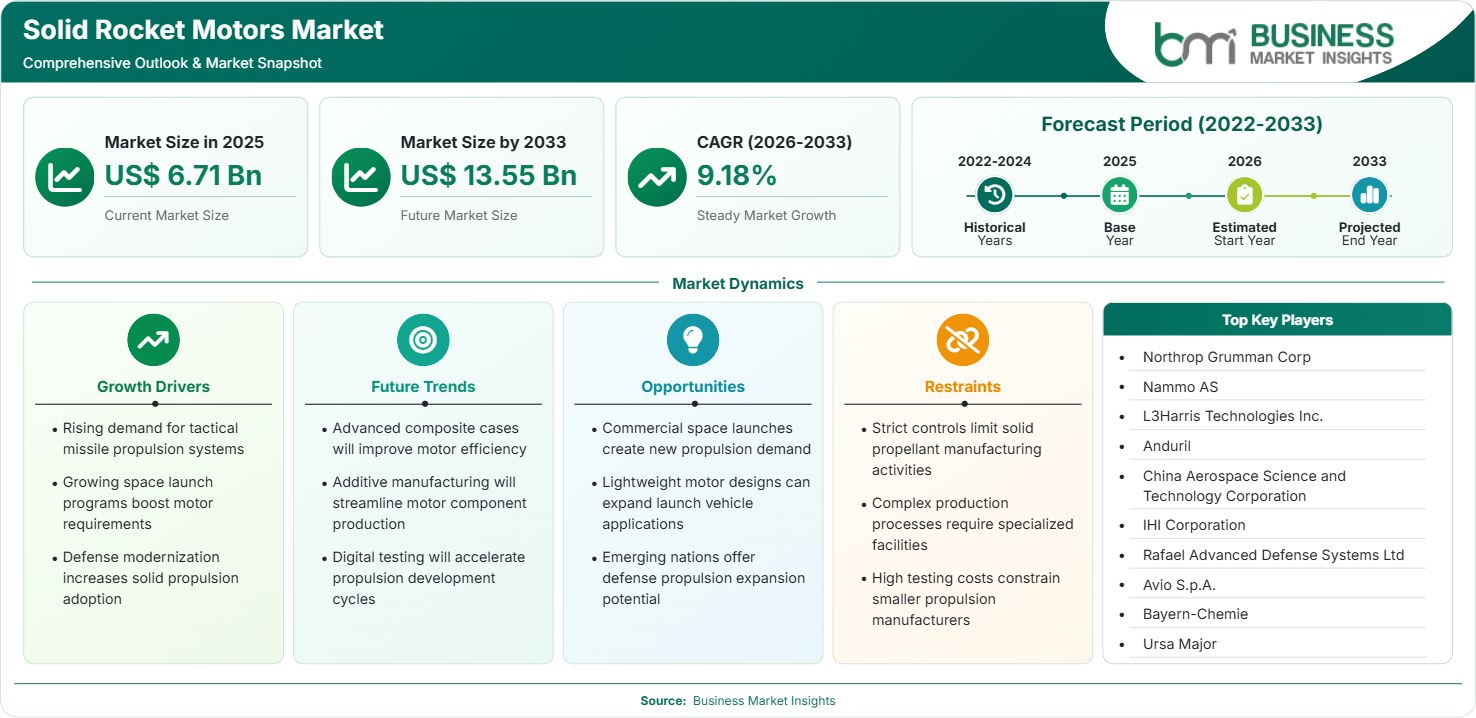
The Solid Rocket Motors Market size was valued at 6.71 billion in 2025 and is projected to reach 13.55 billion by 2033, growing at a CAGR of 9.18% during 2026–2033, supported by missile modernization, space-launch programs, propulsion localization, production capacity expansion, and demand for responsive defense systems.

Report Coverage
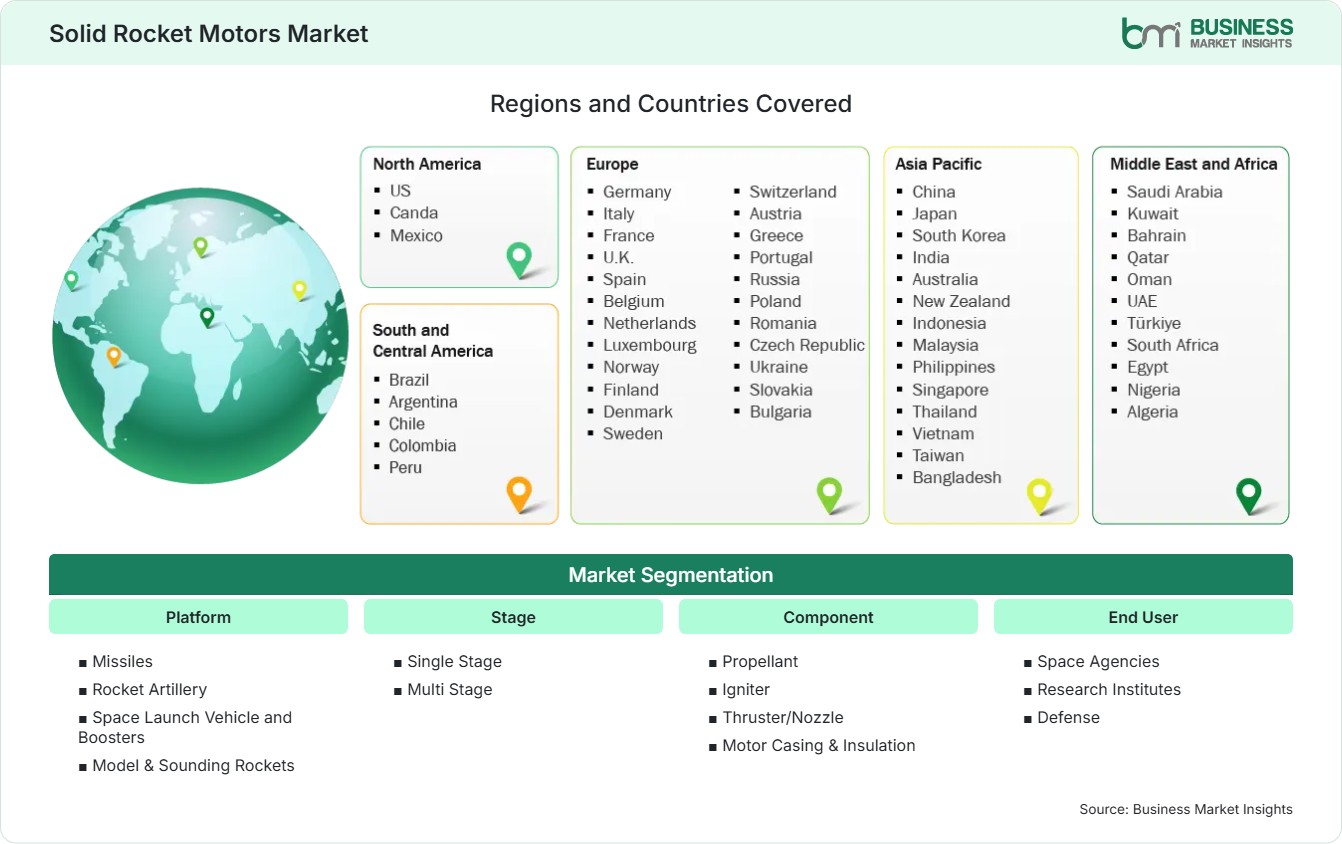
  • Platform: Missiles, Rocket Artillery, Space Launch Vehicle and Boosters, Model & Sounding Rockets
  • Stage: Single Stage, Multi Stage
  • Component: Propellant, Igniter, Thruster/Nozzle, Motor Casing & Insulation
  • End User: Space Agencies, Research Institutes, Defense
US$ 6.71 Bn Market size in 2025
US$ 13.55 Bn Market Size by 2033
9.18% CAGR, 2026 - 2033
2026-2033 Forecast Period

AI Overview

Solid Rocket Motors Market Summary

  • North America Region: North America holds a 41%–43% share in 2025 and is projected to grow at an 8.5%–9.0% CAGR through 2033, driven by missile replenishment, defense modernization, space-launch programs, propulsion capacity expansion, domestic supply security, advanced manufacturing, and strategic weapons development. The U.S. remains the regional demand center, with an 8.6%–9.2% CAGR through 2033, supported by missile procurement, launch programs, interceptor requirements, and propulsion manufacturing investment.
  • Fastest Growing Region: Asia Pacific accounts for a 21%–23% share in 2025 and is projected to expand at a 10.0%–10.8% CAGR through 2033, supported by indigenous missile development, national space programs, satellite deployment, defense localization, strategic deterrence requirements, and expanding domestic propulsion capabilities.
  • Leading Segment: Missiles represent a 55%–59% share in 2025 and are projected to grow at an 8.8%–9.2% CAGR through 2033, supported by tactical weapons, interceptors, precision-strike systems, replenishment programs, extended-range architectures, and sustained defense procurement.
  • High Growth Segment: Space Launch Vehicle and Boosters account for a 20%–24% share in 2025 and are projected to expand at a 10.5%–11.3% CAGR through 2033, supported by commercial launches, institutional missions, constellation deployment, responsive launch requirements, and diversified booster architectures.
  • Key Market Opportunity: Scalable propulsion manufacturing, lightweight motor structures, automated production, modular architectures, domestic supply chains, and flexible qualification capabilities provide opportunities across defense, commercial space, research, and emerging national programs.
  • Major Market Players: Northrop Grumman Corporation; Nammo AS; L3Harris Technologies, Inc.; Anduril Industries, Inc.; China Aerospace Science and Technology Corporation; IHI Corporation; Rafael Advanced Defense Systems Ltd.; Avio S.p.A.; Bayern-Chemie GmbH; Ursa Major Technologies, Inc.
Strategic Insights

Solid Rocket Motors Market: Strategic Insights

Solid Rocket Motors Market Strategic Framework
FREE PDF
Request your free sample
Request free sample
Stakeholder View

Key Takeaways

  • Competitive advantage increasingly depends on control over propellant processing, motor assembly, casing production, nozzle integration, testing, and qualification rather than isolated motor design capabilities.
  • Missiles provide the largest application opportunity, while Space Launch Vehicle and Boosters offer a higher-growth pathway as launch programs diversify and require recurring booster production.
  • Lightweight composite casings, improved insulation, advanced nozzle materials, automated processing, digital quality monitoring, and modular motor architectures are becoming central development priorities.
  • Asia Pacific provides the strongest expansion case because defense modernization and space-launch development are progressing simultaneously across several national markets.
  • Capacity expansion is becoming a strategic priority as procurement programs increasingly require repeatable production rather than limited development quantities.
  • Qualification heritage remains important, but future competitiveness will increasingly depend on production scalability, supply security, localization capability, manufacturing flexibility, and long-term program support.
Geographic Outlook

Solid Rocket Motors Market Regional Highlights

North America Solid Rocket Motors Market

North America held a 41%–43% Solid Rocket Motors Market share in 2025 and is projected to expand at an 8.5%–9.0% CAGR through 2033. The region benefits from mature aerospace infrastructure, extensive defense procurement, established propulsion expertise, and strategic launch programs. The U.S. represents the dominant demand center, while Canada provides a smaller aerospace opportunity. Regional demand is supported by missile replenishment, interceptor development, launch vehicles, hypersonic programs, production modernization, and emphasis on secure domestic supply chains for strategically important propulsion technologies.

  • Missile replenishment programs are driving higher production capacity, faster manufacturing, secure materials, and reliable component integration.
  • Space-launch programs add demand for solid boosters, enabling shared manufacturing capabilities across defense and space applications.
  • Composite structures are gaining importance for reducing weight, improving efficiency, and supporting adaptable propulsion designs.
  • Domestic production is strategically important due to specialized facilities, controlled processes, technical expertise, testing, and qualification needs.

US Solid Rocket Motors Market

The U.S. represented approximately 78%–83% of North American demand in 2025 and is projected to grow at an 8.6%–9.2% CAGR through 2033. Demand is supported by missile inventories, defense modernization, launch programs, strategic systems, interceptors, and advanced weapon development. The country also presents strong opportunities for manufacturing automation and capacity expansion because procurement increasingly requires sustained production. Applications span tactical missiles, strategic systems, launch vehicles, rocket artillery, and advanced defense architectures, creating a diversified demand base for propulsion manufacturers and specialized suppliers.

  • U.S. demand is driven by inventory replenishment and next-generation propulsion development.
  • Procurement priorities favor scalable facilities, automation, secure materials, flexible production, and qualified suppliers.
  • The space sector adds demand for solid boosters and launch propulsion requiring high thrust, reliability, and proven designs.

Europe Solid Rocket Motors Market

Europe represented a 30%–32% Solid Rocket Motors Market share in 2025 and is projected to grow at a 9.0%–9.6% CAGR through 2033. France, Italy, and Germany are the dominant propulsion powerhouses, whereas the United Kingdom represents an increasingly attractive defense market. The launch and defense propulsion capabilities exist in France, solid-booster manufacturing in Italy, and missile propulsion know-how in Germany. The fastest-growing areas are in Germany, Italy, and the United Kingdom, owing to regional governments’ increased focus on defense production, industry robustness, and technological availability.

  • France benefits from mature launch infrastructure, defense propulsion capabilities, and European launcher programs.
  • Italy offers growth potential through aerospace manufacturing, launcher activities, and solid-booster expertise.
  • Germany presents opportunities in missile propulsion and advanced defense systems amid stronger European industrial priorities.
  • The UK offers expanding potential through defense modernization and increased focus on sovereign manufacturing capacity.

Asia Pacific Solid Rocket Motors Market

Asia Pacific accounted for a 21%–23% Solid Rocket Motors Market share in 2025 and is projected to expand at a 10.0%–10.8% CAGR through 2033. China, India, and Japan are examples of established markets, whereas South Korea and Australia offer greater growth opportunities. The combination of missile modernization and space-launch capabilities ensures that the region has extensive propulsion requirements. Indigenization of production is becoming more relevant for governments as they want to have better control over certain technologies that are strategically important.

  • China is a major propulsion market, supported by missile programs, launch vehicles, satellites, and aerospace manufacturing.
  • India offers strong growth through missile development, space infrastructure, launch vehicles, and domestic propulsion capabilities.
  • Japan has an advanced aerospace ecosystem, creating demand for reliable solid motors, specialized materials, and launch systems.
  • South Korea and Australia offer growing opportunities through defense modernization, space programs, and localized industrial development.

Rest of World Solid Rocket Motors Market

Rest of World represented a 4%–6% Solid Rocket Motors Market share in 2025 and is projected to grow at a 7.0%–7.8% CAGR through 2033. South and Central America provide selective opportunities linked to aerospace development, defense modernization, and national space ambitions. Brazil represents the leading opportunity, while Mexico provides a smaller defense-industrial prospect. Middle Eastern demand is stronger, particularly across Saudi Arabia and the United Arab Emirates, where defense procurement, localization objectives, precision systems, and strategic technology partnerships support propulsion requirements.

South and Central American markets remain comparatively smaller but can benefit from greater emphasis on domestic aerospace capabilities and precision defense systems. Middle Eastern opportunities are stronger because procurement increasingly incorporates industrial participation and localization. Brazil, Saudi Arabia, and the United Arab Emirates provide the clearest expansion pathways across these markets.

  • Gulf markets offer opportunities through local manufacturing partnerships, technical training, engineering support, and long-term supply agreements.
  • Saudi Arabia and the UAE present strong opportunities due to defense localization and strategic technology initiatives.
  • Brazil offers strong potential through aerospace development, space ambitions, defense modernization, and domestic technology goals.
  • Local suppliers face strict qualification barriers, making partnerships, licensing, and phased manufacturing practical entry strategies.
Global Market Geography
FREE PDF
Request your free sample
Request free sample
Segment Analysis

Solid Rocket Motors Market Segmentation

Platform

The Platform segment is led by Missiles, representing a 55%–59% share in 2025 and projected to grow at an 8.8%–9.2% CAGR through 2033. Demand is shaped by missile modernization, rocket artillery procurement, launch expansion, and research applications. The Solid Rocket Motors Market scope spans defense, launch, and research applications, with space boosters providing incremental demand as launch programs diversify and production requirements become recurring.

  • Missiles: Tactical, strategic, air-defense, and precision missiles require compact, storable propulsion with predictable thrust, supporting recurring demand as defense organizations replenish inventories and introduce longer-range architectures.
  • Rocket Artillery: Guided rocket artillery systems require consistent propulsion performance and scalable production, while manufacturing efficiency remains important because procurement programs emphasize volume, reliability, and affordability.
  • Space Launch Vehicle and Boosters: Solid boosters provide high initial thrust and established propulsion characteristics, supporting launch vehicles where dependable performance, rapid production, and established qualification are important.
  • Model & Sounding Rockets: Educational, research, atmospheric, and technology-demonstration applications create smaller-volume demand, supported by experimentation, university programs, testing activities, and accessible propulsion platforms.

Stage

The Stage segment includes Single Stage and Multi Stage configurations. Single Stage systems remain important for compact tactical applications, while Multi Stage architectures provide greater flexibility for launch vehicles and advanced missions. Demand depends on payload requirements, desired velocity, range, separation complexity, and vehicle architecture. Multi Stage systems provide stronger expansion potential because space-launch applications increasingly require optimized energy management across sequential propulsion stages.

  • Single Stage: Single-stage motors simplify vehicle architecture and support tactical systems where compact design, readiness, reliability, manufacturing simplicity, and rapid deployment are prioritized.
  • Multi Stage: Multi-stage systems enable sequential energy delivery and higher final velocities, making them relevant to space-launch vehicles, research missions, advanced launch architectures, and specialized long-range applications.

Component

The Component segment comprises Propellant, Igniter, Thruster/Nozzle, and Motor Casing & Insulation. Propellant remains the principal technical determinant because formulation affects energy output, burn characteristics, stability, and processing requirements. Component demand is also influenced by lightweight structures, thermal management, nozzle durability, ignition reliability, and manufacturing consistency. Engineering priorities increasingly focus on improving performance while maintaining safe, repeatable, scalable production.

  • Propellant: Propellant determines energy density, burn rate, impulse, stability, and thermal behavior, making formulation expertise and controlled processing important to motor performance and production scalability.
  • Igniter: Igniters initiate controlled combustion and require dependable activation across storage and operating conditions, creating demand for robust designs, compatibility testing, environmental resistance, and reliable ignition.
  • Thruster/Nozzle: Nozzles convert combustion energy into controlled thrust and require erosion resistance, thermal protection, dimensional precision, and materials capable of maintaining performance during operation.
  • Motor Casing & Insulation: Composite casings and insulation reduce structural mass and manage pressure and heat, supporting higher propellant fractions, improved efficiency, and reliable operation.

End User

The End User segment includes Space Agencies, Research Institutes, and Defense. Defense remains the leading end user because missile inventories, interceptors, tactical weapons, and strategic systems require sustained propulsion procurement. Space Agencies provide a significant secondary demand pool through launch vehicles and boosters, while Research Institutes support specialized applications. Diversification across institutional and defense customers can reduce dependence on individual application cycles while creating opportunities for manufacturers with flexible propulsion platforms.

  • Space Agencies: Space agencies use solid propulsion for launch vehicles, boosters, specialized stages, and mission-support systems, with demand influenced by launch cadence, payload requirements, and national access-to-space objectives.
  • Research Institutes: Research institutes use propulsion systems for sounding rockets, atmospheric experiments, technology demonstrations, and experimental platforms, emphasizing repeatability, affordability, safety, and adaptable configurations.
  • Defense: Defense remains the largest end-user category because missiles, interceptors, guided rockets, strategic systems, and tactical weapons require reliable propulsion across recurring procurement and replenishment programs.
Market Forces

Solid Rocket Motors Market Dynamics

Key Market Drivers

Rising demand for tactical missile propulsion systems

Increasing demands for space launch missions include solid boosters and propulsion stages. The reasons behind this are the high thrust levels achieved by solid propulsion, as well as the reliable engineering features it includes. As demand for launch missions increases, there may be an ongoing need for motor architectures across various vehicles. The manufacturers focus on scalable production, light weight construction, and thermal protection systems. The Solid Rocket Motors Market Forecast – Space Launch Programs is therefore expected to benefit from sustained launch activity and recurring propulsion requirements.

Growing space launch programs boost motor requirements

There is an increased demand for solid rocket motors and propulsion stages in space-launch endeavors. Solid rocket propulsion ensures a lot of thrust and proven technical properties, which makes it a good choice when there is a need for reliability and proven technologies. With increased demand for launches, there may be a recurring need for standard motor designs applicable to various vehicle configurations. Solid Rocket Motors Market Growth – Space Launch Programs is driven by expanding orbital missions, rising propulsion-stage production, and greater demand for dependable launch systems.

Defense modernization increases solid propulsion adoption

Modernization initiatives are driving greater demand for sophisticated propulsion systems in missiles, interceptors, guided rockets, and strategic systems. The need for operational readiness, replenishment of inventories, domestically available strategic technology, and resilient manufacturing capability is gaining prominence. This is fueling investment in facilities, testing equipment, component integration, and manufacturing automation. Solid propulsion is one such technology that continues to receive importance owing to its suitability for storage, reliability, and performance during deployment.

Key Market Opportunities

Commercial space launches create new propulsion demand

Space launch programs present a chance to grow propulsion needs beyond those seen in traditional military applications. Continuous space launch operations can create demand for solid rocket boosters, auxiliary propulsion systems, and even customized launch stages. The use of motor series may improve efficiency by reducing manufacturing costs, as manufacturers can serve different vehicle designs with a common manufacturing structure.

Lightweight motor designs can expand launch vehicle applications

Lightweight motors can be developed to help leverage opportunities to make propulsion systems more efficient by reducing structural mass. Composite motors, insulation, materials, and structural efficiencies may lead to a larger percentage of the vehicle mass being used for propellant or payload. This can happen in the context of efficient launch system design and still deliver adequate structural and thermal capabilities.

Emerging nations offer defense propulsion expansion potential

The emerging defense markets provide an opportunity for governments to exert more control on key propulsion technology. Localizing initiatives will motivate investment in domestic manufacturing, technical collaborations, qualifying facilities, and specialized production facilities. Suppliers can participate through engineering services, licensing, component manufacturing, collaboration, and localization strategy. Demand will result from modernization of missiles, air-defense system, guided rockets, and national aerospace programs.

Market Restraints and Challenges

Strict controls limit solid propellant manufacturing activities

Factor: Production of solid propellants involves careful handling of energetic materials, special facilities, robust safety measures, skilled personnel, and thorough processes. Impact: This results in a higher capital expenditure and high entry barriers for new suppliers looking to manufacture propulsion separately. It may take time for the facility to qualify and validate itself for continued production. Regulatory restrictions may further limit cross-border movement of some technologies and materials.

Complex production processes require specialized facilities

Factor: Efficient production of solid motors involves the integrated processes of propellant manufacturing, casting, curing, casings, insulation, nozzles, ignition system, testing, and performance check. Impact: Increasing production capacity necessitates investment in all these specialized areas simultaneously as opposed to mere addition of assembly line. This is because consistency of the process is very important because any difference in manufacturing could lead to different performance results and qualification.

Company Analysis

Competitive Landscape

The Solid Rocket Motors Market analysis indicates a competitive environment combining aerospace primes, specialist propulsion manufacturers, defense technology companies, national aerospace organizations, and emerging propulsion specialists. Competitive positioning depends on qualification heritage, manufacturing capacity, component integration, technology depth, safety systems, production flexibility, and access to long-term programs.

Company Name

Overview

Products and Services relevant to this market

Northrop Grumman Corporation

Aerospace and defense company with extensive propulsion engineering, manufacturing, integration, and qualification capabilities.

Solid rocket motors, boosters, missile propulsion, launch propulsion, engineering, testing, integration, and production support.

Nammo AS

Specialist aerospace and defense company with established rocket propulsion and energetic technology capabilities.

Solid rocket motors, missile propulsion, rocket systems, propulsion components, energetic materials, development, and production.

L3Harris Technologies, Inc.

Defense technology company with propulsion expertise spanning development, manufacturing, integration, and testing.

Tactical missile motors, solid propulsion systems, igniters, nozzles, propulsion components, testing, and qualification.

Anduril Industries, Inc.

Defense technology company focused on advanced autonomous systems, manufacturing, propulsion, and next-generation capabilities.

Solid rocket motors, tactical propulsion, advanced manufacturing, propulsion development, testing, and integration.

China Aerospace Science and Technology Corporation

National aerospace organization supporting launch vehicles, strategic systems, satellites, and space engineering programs.

Solid propulsion systems, launch stages, boosters, missile propulsion, aerospace engineering, manufacturing, and integration.

IHI Corporation

Japanese industrial group with aerospace manufacturing and specialized solid-propulsion capabilities.

Solid rocket propulsion, launch stages, boosters, missile propulsion, aerospace manufacturing, engineering, and integration.

Rafael Advanced Defense Systems Ltd.

Defense technology company developing missiles, interceptors, precision weapons, and propulsion technologies.

Missile propulsion, interceptor propulsion, guided weapons, propulsion integration, development, testing, and support.

Avio S.p.A.

European aerospace company with launch-vehicle and solid-booster manufacturing capabilities.

Solid rocket motors, launch boosters, propulsion systems, engineering, manufacturing, qualification, and integration.

Bayern-Chemie GmbH

Specialist propulsion company serving advanced missile and defense-system applications.

Rocket motors, missile propulsion, propulsion subsystems, energetic technologies, development, testing, and production.

Ursa Major Technologies, Inc.

Emerging aerospace and defense propulsion company emphasizing advanced and scalable manufacturing.

Solid rocket motors, propulsion systems, motor manufacturing, testing, qualification, and defense propulsion development.

Trust & Transparency

Research Methodology

The market analysis combines proprietary research with secondary data from government agencies, company disclosures, regulatory filings, industry databases and expert interviews. Market estimates are validated through data triangulation, cross-market benchmarking and analyst review.

View Full Research Methodology

Questions Answered

Frequently Asked Questions

What does the Solid Rocket Motors Market Report cover?

The Market Report covers missiles, rocket artillery, space launch vehicles and boosters, and model and sounding rockets across stage, component, and end-user categories.

Which regional Solid Rocket Motors Market offers the highest growth potential?

Asia Pacific represents the fastest-growing region in the modeled market framework, supported by simultaneous missile modernization, space-launch development, satellite programs, defense localization, and national propulsion manufacturing initiatives.

Why are lightweight motor casings important?

Reducing casing mass can increase the proportion of vehicle mass available for propellant or payload. Composite structures can therefore support propulsion efficiency while maintaining required structural and thermal characteristics.

Why are solid motors important for missile systems?

Solid motors provide compact propulsion and can support storage-ready weapon architectures. Their characteristics make them suitable for tactical missiles, interceptors, guided rockets, and strategic systems requiring dependable propulsion during deployment.

What applications use solid rocket motors?

Major applications include missiles, rocket artillery, space launch vehicles and boosters, and model and sounding rockets. These applications differ in thrust requirements, motor size, storage conditions, qualification requirements, and production volumes.

Access the Full Solid Rocket Motors Market Report

Get segment-level forecasts, regional estimates, competitive benchmarking, company profiles and downloadable Excel datasets.

Access the full Solid Rocket Motors Market Report
350 pages PDF & Excel | 2026-08-19