
Air Crane Helicopter Market Outlook: Size, Share, Trends, Growth Analysis, Competitive Landscape & Forecast, 2026-2033

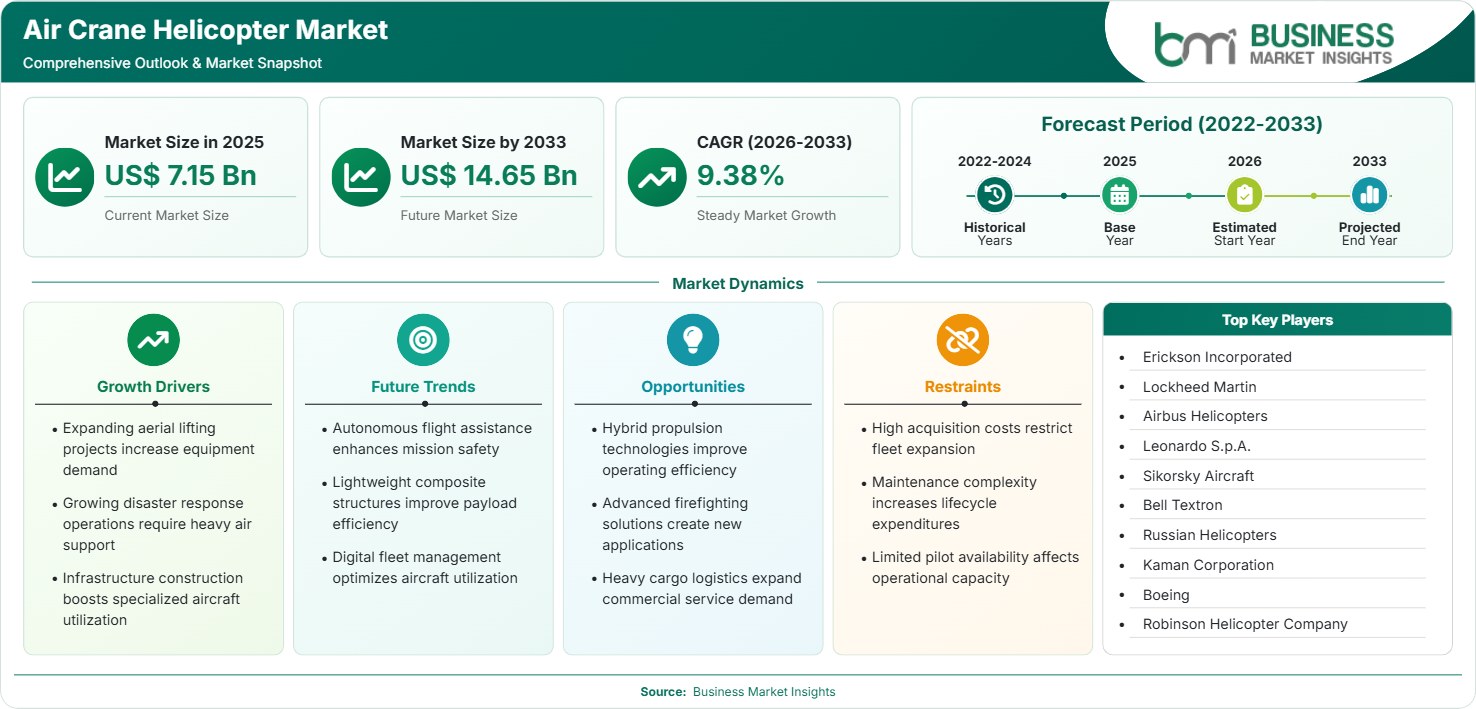
The Air Crane Helicopter Market size was valued at US$ 7.15 billion in 2025 and is projected to reach US$ 14.65 billion by 2033, growing at a CAGR of 9.38% during 2026–2033. Rising aerial lifting requirements, increasing disaster management operations, and infrastructure development activities are accelerating demand for heavy-lift helicopter solutions across commercial and defense applications.

Report Coverage
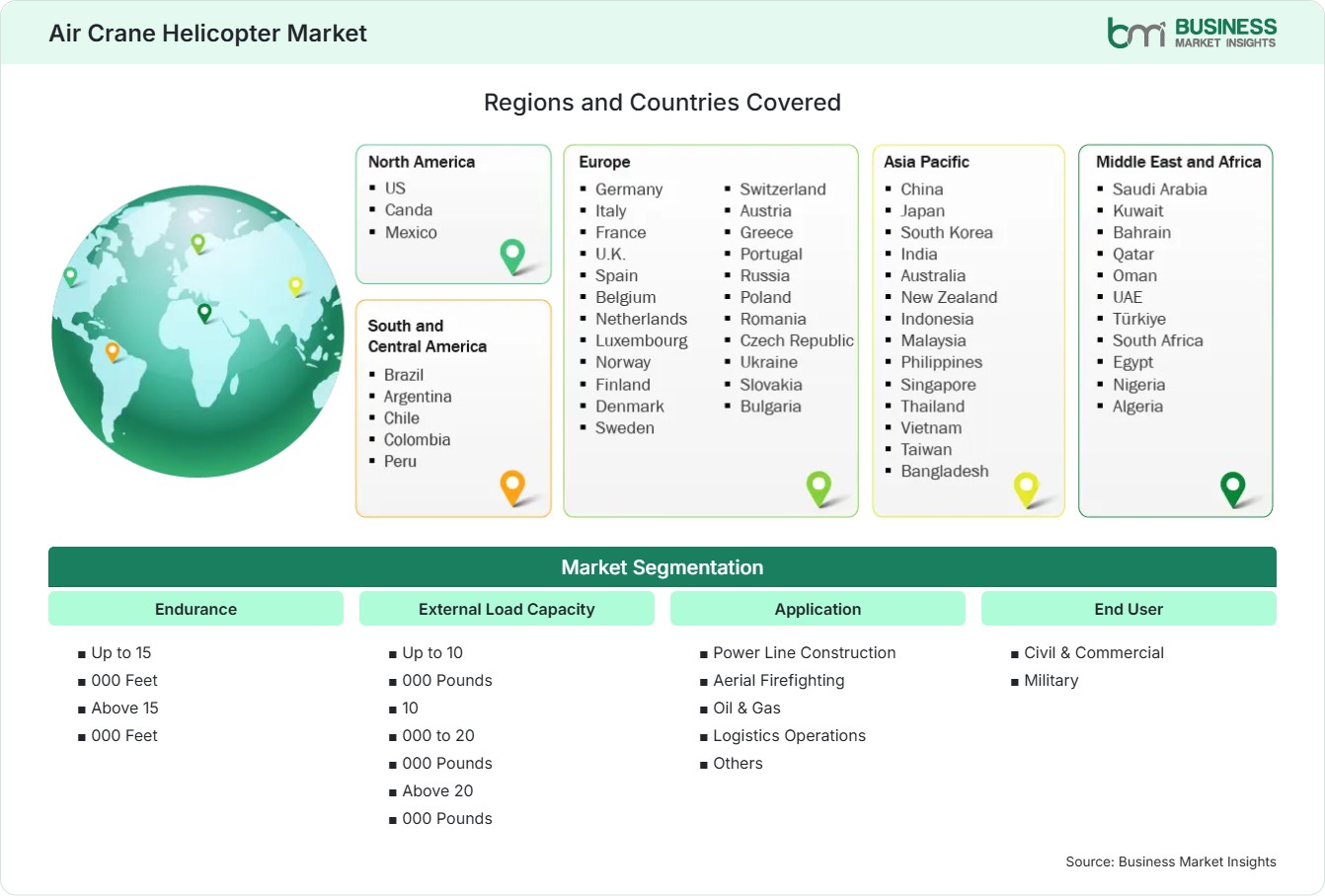
  • Endurance: Up to 15,000 Feet, Above 15,000 Feet
  • External Load Capacity: Up to 10,000 Pounds, 10,000 to 20,000 Pounds, Above 20,000 Pounds
  • Application: Power Line Construction, Aerial Firefighting, Oil & Gas, Logistics Operations, Others
  • End User: Civil & Commercial, Military
US$ 7.15 Bn Market size in 2025
US$ 14.65 Bn Market Size by 2033
9.38% CAGR, 2026 - 2033
2026-2033 Forecast Period

AI Overview

Air Crane Helicopter Market Summary

  • North America Region: North America holds 36%–39% market share in 2025 and is projected to grow at a CAGR of 8.8%–9.3% during 2026–2033. Strong utility infrastructure projects, wildfire management programs, and fleet modernization initiatives support regional demand. The U.S. represents the dominant contributor with a CAGR of 9.0%–9.5%, supported by aerial firefighting contracts, energy infrastructure maintenance, and defense-related heavy-lift requirements.
  • Fastest Growing Region: Asia Pacific represents 28%–31% market share in 2025 and is expected to expand at a CAGR of 10.1%–10.7%, driven by rapid infrastructure development, power transmission expansion, disaster response investments, and increasing demand for specialized aviation services.
  • Leading Segment: Civil & Commercial End-User accounts for 62%–65% market share in 2025 and is expected to grow at a CAGR of 9.5%–10.0%, supported by utility construction, logistics operations, firefighting services, and industrial lifting applications.
  • High Growth Segment: Above 20,000 Pounds External Load Capacity captures 31%–34% market share in 2025 and is projected to grow at a CAGR of 10.0%–10.6%, driven by demand for heavy infrastructure projects, large equipment transportation, and complex lifting operations.
  • Key Market Opportunity: Rising investments in hybrid propulsion, advanced aerial firefighting systems, and heavy cargo transportation services are creating new commercial opportunities for air crane helicopter operators and manufacturers.
  • Major Market Players: Erickson Incorporated, Lockheed Martin Corporation, Airbus Helicopters SAS, Leonardo S.p.A., Sikorsky Aircraft Corporation, Bell Textron Inc., Russian Helicopters JSC, Kaman Corporation, The Boeing Company, and Robinson Helicopter Company.
Strategic Insights

Air Crane Helicopter Market: Strategic Insights

Air Crane Helicopter Market Strategic Framework
FREE PDF
Request your free sample
Request free sample
Stakeholder View

Key Takeaways

  • Heavy-lift helicopter demand is closely connected with infrastructure expansion, utility modernization, and specialized construction activities requiring high-capacity aerial transportation.
  • Commercial operators represent a major growth opportunity as energy companies, firefighting agencies, and logistics providers increasingly outsource specialized helicopter services.
  • Technological advancements in propulsion systems, avionics, automation, and lightweight materials are improving aircraft efficiency and operational capabilities.
  • Asia Pacific provides strong investment potential due to expanding power infrastructure, urban development, and increasing disaster management requirements.
  • Strategic fleet acquisitions, service partnerships, and modernization programs are shaping competitive positioning among helicopter manufacturers and operators.
  • Defense agencies and emergency organizations continue evaluating heavy-lift platforms to strengthen rapid response and mission flexibility.
Geographic Outlook

Air Crane Helicopter Market Regional Highlights

North America Air Crane Helicopter Market

North America accounted for 36%–39% Air Crane Helicopter Market share in 2025 and is expected to expand at a CAGR of 8.8%–9.3% during 2026–2033. The region benefits from extensive utility networks, wildfire response requirements, and established helicopter service providers. The United States remains the leading market due to recurring aerial firefighting contracts, transmission line construction projects, and government-supported aviation programs. Canada also contributes through forestry operations and remote infrastructure activities.

  • Growing wildfire frequency increases demand for specialized aerial firefighting helicopters with high water-carrying capacity.
  • Utility companies continue adopting helicopter lifting services for transmission infrastructure installation and maintenance.
  • Fleet modernization programs improve operational efficiency among commercial helicopter operators.
  • Defense and emergency agencies continue evaluating advanced heavy-lift aviation capabilities.

US Air Crane Helicopter Market

The United States represents 78%–82% of North American demand and is projected to grow at a CAGR of 9.0%–9.5% during 2026–2033. Strong aviation infrastructure, government firefighting programs, and extensive utility networks continue supporting market expansion. Commercial operators are investing in fleet upgrades to address increasing demand from energy, construction, and emergency response sectors.

  • Wildfire management agencies increasingly rely on heavy-lift helicopters for rapid emergency response operations.
  • Power transmission expansion projects create consistent demand for aerial construction support services.
  • Commercial operators are upgrading aging fleets with improved operational capabilities.
  • Oil and gas projects continue requiring specialized helicopter transportation solutions.

Europe Air Crane Helicopter Market

Europe represents 19%–22% air crane helicopter market share in 2025 and is expected to register a CAGR of 8.5%–9.0% during 2026–2033. Demand is supported by renewable energy infrastructure, emergency response capabilities, and modernization of specialized aviation fleets. Germany, France, and the United Kingdom remain important markets due to infrastructure investment and advanced helicopter service networks. Southern European countries are increasing aerial firefighting capabilities due to rising wildfire risks.

  • Renewable energy projects increase demand for helicopter-assisted infrastructure installation services.
  • European operators invest in modernization programs to improve fleet reliability and efficiency.
  • Government firefighting initiatives support specialized helicopter procurement and service contracts.
  • Defense modernization programs encourage adoption of advanced aviation platforms.

Asia Pacific Air Crane Helicopter Market

Asia Pacific holds 28%–31% air crane helicopter market share in 2025 and is projected to achieve the fastest CAGR of 10.1%–10.7% during 2026–2033. Rapid urbanization, infrastructure development, and energy expansion are increasing demand for heavy-lift helicopter services. China, India, Japan, and Australia are key markets, with India showing strong growth due to power transmission expansion, construction activities, and disaster management requirements.

  • Large infrastructure projects increase demand for aerial lifting and construction support operations.
  • Expanding electricity networks create opportunities for utility helicopter applications.
  • Government disaster response investments strengthen demand for specialized aircraft capabilities.
  • Mining and remote logistics activities support commercial helicopter service growth.

Rest of World Air Crane Helicopter Market

Rest of World accounts for 7%–10% market share in 2025 and is expected to grow at a CAGR of 8.7%–9.3% during 2026–2033. Latin America, the Middle East, and Africa are increasing adoption through oil and gas operations, mining projects, infrastructure development, and emergency response programs. Brazil, Saudi Arabia, and South Africa represent important markets due to industrial activity and remote operational requirements.

  • Oil and gas exploration activities support heavy-lift helicopter demand in remote regions.
  • Mining operations utilize specialized aircraft for equipment transportation and site logistics.
  • Middle Eastern infrastructure projects create new opportunities for aerial lifting services.
  • African disaster response programs increase requirements for reliable aviation support.
Global Market Geography
FREE PDF
Request your free sample
Request free sample
Segment Analysis

Air Crane Helicopter Market Segmentation

Endurance

The endurance segment influences operational flexibility, mission range, and deployment capability for heavy-lift helicopter operations. Aircraft with higher endurance support extended missions across remote infrastructure sites, disaster zones, and industrial locations. This segment accounted for 39%–42% market share in 2025 and is expected to grow at a CAGR of 9.4%–9.9% during 2026–2033. Increasing demand for long-duration aerial operations and remote logistics support continues strengthening segment adoption.

  • Up to 15,000 Feet: This category serves low-to-medium altitude operations, including construction, utility maintenance, and firefighting missions requiring efficient lifting performance in accessible environments.
  • Above 15,000 Feet: Higher-altitude capable helicopters support challenging terrains, mountainous regions, and remote infrastructure projects where extended operational capability and performance reliability are essential.

External Load Capacity

External load capacity remains a critical factor determining helicopter suitability for construction, firefighting, and industrial lifting applications. The segment accounted for 31%–34% market share in 2025 and is projected to grow at a CAGR of 10.0%–10.6% during 2026–2033. Growing demand for transporting heavy equipment, infrastructure components, and emergency supplies is increasing adoption of high-capacity air crane helicopters.

  • Up to 10,000 Pounds: These helicopters support lighter lifting requirements such as utility maintenance, small construction projects, and equipment transportation across commercial applications.
  • 10,000 to 20,000 Pounds: Medium-capacity helicopters are widely used for infrastructure projects, power line installation, and industrial operations requiring balanced payload capability and operational flexibility.
  • Above 20,000 Pounds: Heavy-capacity helicopters address complex lifting requirements involving large structures, turbines, construction equipment, and disaster response operations requiring maximum payload performance.

Application

The application segment represents diverse operational requirements across infrastructure, emergency response, energy, and logistics sectors. Increasing reliance on specialized aerial lifting solutions is supporting market expansion across multiple industries. The segment accounted for 45%–48% market share in 2025 and is expected to register a CAGR of 9.5%–10.0% during 2026–2033. Rising infrastructure investments and growing emergency response requirements continue influencing Air Crane Helicopter Market trends across commercial applications.

  • Power Line Construction: Demand increases as utilities expand transmission networks and require precise helicopter-based installation and maintenance solutions for remote and challenging locations.
  • Aerial Firefighting: Growing wildfire incidents are increasing adoption of heavy-lift helicopters equipped for water transport, rapid deployment, and emergency suppression operations.
  • Oil & Gas: Offshore and remote energy projects utilize air crane helicopters for equipment transportation, infrastructure support, and operational activities in difficult environments.
  • Logistics Operations: Specialized helicopter logistics services support remote industries, disaster relief activities, and transportation requirements where conventional methods face limitations.

End-User

The end-user segment is divided between commercial operators and military organizations with different mission priorities and procurement strategies. It accounted for 62%–65% market share in 2025 and is expected to expand at a CAGR of 9.5%–10.0% during 2026–2033. Commercial applications continue dominating due to infrastructure, firefighting, and logistics demand, while military users focus on strategic transport capabilities.

  • Civil & Commercial: This segment leads adoption through construction, utility services, firefighting operations, energy projects, and specialized transportation activities requiring heavy-lift aviation support.
  • Military: Defense organizations utilize heavy-lift helicopters for tactical logistics, disaster assistance, equipment movement, and mission support operations requiring enhanced payload capability and operational reliability.
Market Forces

Air Crane Helicopter Market Dynamics

Key Market Drivers

Expanding aerial lifting projects increase equipment demand

The growing number of infrastructure construction projects, utilities, and industrial construction is leading to the regular need for heavy-lift helicopter operations. Air crane helicopters are beneficial for moving heavy cargo, installing transmission machinery, and carrying out projects in hard-to-reach areas where other means of transportation are not available. Energy companies, construction firms, and infrastructure developers are increasingly relying on air lifts. Growing requirements for efficient equipment transportation and precision lifting capabilities continue supporting the Air Crane Helicopter Market growth as operators expand service capacity and manufacturers focus on improving payload performance, operational reliability, and aircraft efficiency.

Growing disaster response operations require heavy air support

The increasing frequency of natural disasters, including wildfires, floods, and other emergencies, is strengthening demand for helicopters capable of rapid deployment and heavy-lift transport. Air Crane helicopters are significant in firefighting, rescue support, and disaster recovery operations through their heavy-lifting and airborne delivery capabilities. Various governments and emergency management authorities are allocating more funds towards aviation assets that would make the response process more efficient when such emergencies arise. Disaster preparedness is driving helicopter operators to maintain up-to-date fleets with higher performance and greater flexibility for emergency response missions.

Infrastructure construction boosts specialized aircraft utilization

The development of infrastructure projects in the transport, energy, and urban development sectors is leading to increased use of helicopters designed for such tasks. Air cranes play an important role in construction projects in which there are bridges, transmission lines, factories, and wind farms. There is also increased investor interest in developing remote infrastructure projects. This has led to increased use of aerial solutions in order to overcome logistical challenges. These advancements are influencing Air Crane Helicopter Market trends as industries increasingly integrate specialized aviation services into large-scale construction and maintenance activities.

Key Market Opportunities

Hybrid propulsion technologies improve operating efficiency

The development of hybrid propulsion systems provides an opportunity for helicopter manufacturers who want to improve their fuel economy, lower emissions, and achieve better performance. Propulsion system advancements, lightweight materials, and energy management systems are some of the areas being considered to advance next-generation heavy-lift helicopters. With sustainability gaining importance in the aviation industry, solutions are being developed that will lower operating costs but retain the lifting capability. Air Crane Helicopter Market Forecasts indicate that technological improvements in propulsion systems could create new investment opportunities for manufacturers developing efficient and environmentally responsible aircraft platforms.

Advanced firefighting solutions create new applications

Growing wildfire risks across multiple regions are creating opportunities for advanced aerial firefighting solutions equipped with improved water delivery systems, digital monitoring capabilities, and rapid deployment features. Helicopter air cranes are now more often being regarded as an important asset for government departments, commercial firms, and emergency bodies that deal with major fire incidents. The use of sophisticated navigation, communications, and firefighting equipment has expanded the role of such aircraft to areas other than lifting loads. This is providing commercial benefits for helicopter manufacturers and service suppliers involved in firefighting services.

Heavy cargo logistics expand commercial service demand

Expansion of remote industrial activities, mining operations, renewable energy projects, and offshore developments is increasing demand for heavy cargo transportation solutions. Air crane helicopters provide flexible logistics capabilities in regions where road infrastructure is limited or unavailable. Commercial operators are exploring new service models to support industries requiring rapid movement of equipment, materials, and specialized components. Growing demand for efficient remote logistics solutions is encouraging fleet expansion and service partnerships between helicopter operators and industrial companies. These opportunities are expected to strengthen market adoption as businesses seek reliable transportation alternatives for challenging operational environments.

Market Restraints and Challenges

High acquisition costs restrict fleet expansion

Factor: Air crane helicopters require significant capital investment due to advanced engineering, specialized components, and complex manufacturing processes, creating high initial acquisition costs for operators. Impact: Expensive aircraft procurement can limit fleet expansion opportunities, particularly for smaller commercial operators and service providers with restricted investment capacity. Additional financing requirements and longer return periods may delay replacement programs or new fleet additions. Although demand for heavy-lift aviation services continues increasing, high ownership costs remain a major challenge affecting purchasing decisions and market accessibility across developing regions.

Maintenance complexity increases lifecycle expenditures

Factor: Heavy-lift helicopters require specialized maintenance procedures, skilled technicians, and regular inspections to ensure operational safety and performance reliability. Impact: Complex maintenance requirements increase lifecycle expenses and can affect aircraft availability, especially for operators managing older fleets or operating in remote locations. The need for specialized spare parts, technical expertise, and maintenance infrastructure adds operational challenges. Manufacturers and service providers are focusing on predictive maintenance technologies and improved support networks to reduce downtime and enhance long-term cost efficiency for air crane helicopter operators.

Company Analysis

Competitive Landscape

The competitive environment includes global helicopter manufacturers, defense aviation companies, and specialized heavy-lift aircraft operators focusing on advanced lifting capabilities, fleet modernization, and mission-specific solutions. Air Crane Helicopter Market analysis indicates that companies are investing in aircraft upgrades, digital aviation technologies, maintenance support services, and strategic partnerships to address rising demand from infrastructure, firefighting, logistics, and defense applications.

Company Name

Overview

Products and Services relevant to this market

Erickson Incorporated

Specialized heavy-lift helicopter operator providing aerial services for infrastructure, firefighting, defense, and industrial applications worldwide.

S-64 Air Crane helicopters, aerial firefighting services, heavy lifting operations, logging support, and infrastructure construction solutions.

Lockheed Martin Corporation

Global aerospace and defense company developing advanced rotorcraft solutions through its Sikorsky business operations.

Heavy-lift helicopter platforms, military rotorcraft, aircraft modernization, sustainment services, and advanced aviation technologies.

Airbus Helicopters SAS

Leading helicopter manufacturer offering civil and military rotorcraft with global service capabilities.

Heavy utility helicopters, commercial rotorcraft, maintenance services, upgrades, and aviation support solutions.

Leonardo S.p.A.

Aerospace company developing advanced helicopters for commercial, government, and defense applications.

Medium and heavy helicopter platforms, mission systems, training solutions, maintenance services, and specialized aviation technologies.

Sikorsky Aircraft Corporation

Helicopter manufacturer specializing in advanced military and commercial rotorcraft solutions.

Heavy-lift helicopters, transport platforms, aircraft upgrades, maintenance programs, and operational support services.

Bell Textron Inc.

Aerospace manufacturer producing helicopters and advanced aviation systems for multiple end-use industries.

Commercial helicopters, military rotorcraft, support services, digital aviation solutions, and aircraft modernization programs.

Russian Helicopters JSC

Helicopter manufacturer producing utility, transport, and specialized rotorcraft platforms.

Heavy transport helicopters, utility aircraft, maintenance services, modernization programs, and operational support solutions.

Kaman Corporation

Aerospace company involved in helicopter manufacturing, components, and aviation support services.

Heavy-lift helicopter technologies, aerospace components, aircraft services, and maintenance solutions.

The Boeing Company

Global aerospace company supplying advanced defense aviation systems and rotorcraft platforms.

Military heavy-lift helicopters, aircraft systems, modernization services, and defense aviation support solutions.

Robinson Helicopter Company

Helicopter manufacturer known for lightweight commercial rotorcraft and aviation training solutions.

Commercial helicopters, flight training aircraft, replacement components, and aftermarket support services.

Trust & Transparency

Research Methodology

The market analysis combines proprietary research with secondary data from government agencies, company disclosures, regulatory filings, industry databases and expert interviews. Market estimates are validated through data triangulation, cross-market benchmarking and analyst review.

View Full Research Methodology

Questions Answered

Frequently Asked Questions

What does the Air Crane Helicopter Market Report cover?

The Market Report covers industry dynamics, segmentation analysis, competitive developments, regional insights, technology trends, growth opportunities, and factors influencing future market expansion.

What technologies are shaping future helicopter development?

Manufacturers are focusing on hybrid propulsion, lightweight materials, digital avionics, predictive maintenance systems, and improved automation technologies to enhance efficiency, reduce operating costs, and improve mission performance.

Which factors influence air crane helicopter adoption?

Infrastructure expansion, disaster response requirements, remote industrial operations, aircraft modernization programs, and increasing demand for specialized lifting services are key factors influencing adoption among commercial and government operators.

How do air crane helicopters support firefighting operations?

These helicopters support firefighting by transporting large volumes of water or fire retardant, reaching difficult locations quickly, and providing aerial support during large-scale wildfire response missions.

What industries use air crane helicopters the most?

Air crane helicopters are widely used in infrastructure construction, utility maintenance, aerial firefighting, oil and gas operations, mining activities, and remote logistics because of their high lifting capacity and operational flexibility.

Access the Full Air Crane Helicopter Market Report

Get segment-level forecasts, regional estimates, competitive benchmarking, company profiles and downloadable Excel datasets.

Access the full Air Crane Helicopter Market Report
350 pages PDF & Excel | 2026-08-24