
Offshore Helicopter Services Market Outlook: Size, Share, Trends, Growth Analysis, Competitive Landscape & Forecast, 2026-2033

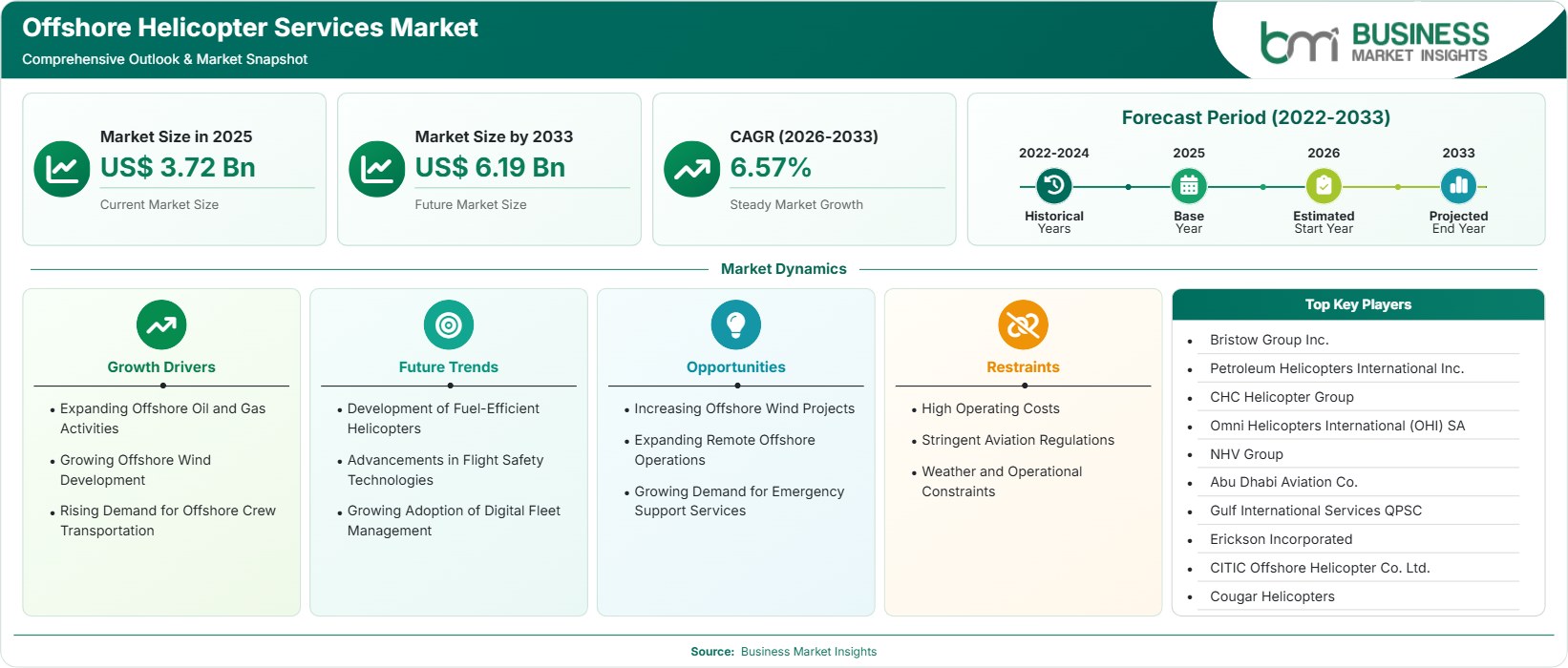
The Offshore Helicopter Services Market size was valued at US$ 3.72 Billion in 2025 and is projected to reach US$ 6.19 Billion by 2033, growing at a CAGR of 6.57% during 2026–2033, driven by offshore energy activity, crew transportation, emergency response, remote inspection, logistics requirements, and expanding offshore wind operations.

Report Coverage
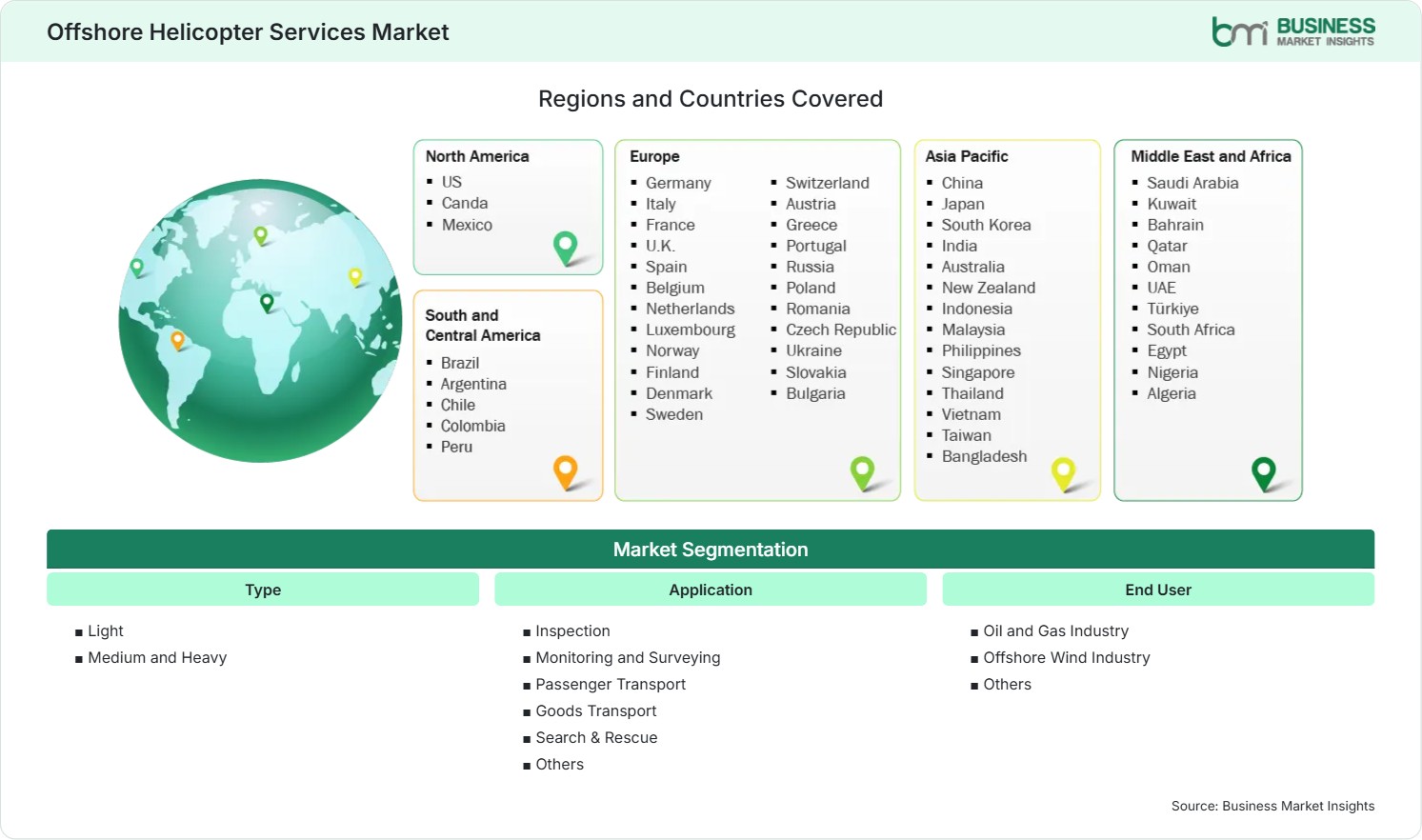
  • Type: Light, Medium and Heavy
  • Application: Inspection, Monitoring and Surveying, Passenger Transport, Goods Transport, Search & Rescue, Others
  • End User: Oil and Gas Industry, Offshore Wind Industry, Others
US$ 3.72 Bn Market size in 2025
US$ 6.19 Bn Market Size by 2033
6.57% CAGR, 2026 - 2033
2026-2033 Forecast Period

01 AI Overview

Offshore Helicopter Services Market Summary

  • North America Region: North America holds an estimated 30%–34% share in 2025, growing at a 6.2%–6.8% CAGR during 2026–2033, supported by established offshore energy infrastructure, recurring crew movements, mature aviation bases, fleet modernization, emergency-response requirements, and continued investment in remote operational support. The U.S. represents the principal demand center, supported by established offshore logistics and crew transportation requirements, with a 6.3%–6.9% CAGR through 2033.
  • Fastest Growing Region: Asia Pacific holds an estimated 17%–21% share in 2025, expanding at a 7.4%–8.2% CAGR during 2026–2033, supported by offshore energy development, emerging wind projects, expanding maritime infrastructure, increased remote-site logistics requirements, fleet deployment, and demand for specialized aviation support.
  • Leading Segment: Medium helicopters account for an estimated 45%–49% share in 2025, with a 6.6%–7.2% CAGR during 2026–2033, reflecting their balanced payload, range, passenger capacity, operating economics, suitability for crew transfers, logistical missions, offshore inspection, and broad deployment across recurring operations.
  • High Growth Segment: Offshore Wind Industry represents an estimated 15%–19% share in 2025, advancing at a 8.4%–9.2% CAGR during 2026–2033, supported by technician transfers, turbine inspection, maintenance access, emergency response, remote asset servicing, and increasing requirements for dependable aviation support around offshore renewable infrastructure.
  • Key Market Opportunity: Offshore wind, digitally coordinated fleet operations, specialized inspection missions, emergency response contracts, and long-duration service agreements can improve fleet utilization while creating recurring revenue opportunities for established operators.
  • Major Market Players: Bristow Group Inc., Petroleum Helicopters International Inc., CHC Helicopter Group, Omni Helicopters International (OHI) SA, NHV Group, Abu Dhabi Aviation Co., Gulf International Services QPSC, Erickson Incorporated, CITIC Offshore Helicopter Co. Ltd., and Cougar Helicopters.
02 Strategic Insights

Offshore Helicopter Services Market: Strategic Insights

Offshore Helicopter Services Market Strategic Framework
FREE PDF
Request your free sample
Request free sample
03 Stakeholder View

Key Takeaways

  • The ecosystem of the industry is highly connected, bringing together manufacturers of helicopters, aviation service providers, maintenance service providers, offshore energy producers, and regulatory authorities to form a chain of safety.
  • Transportation services for offshore wind farms are one of the most promising directions for development due to the need to go farther from the shore to build turbines.
  • Technology adoption is increasingly focused on predictive maintenance, digital fleet management, advanced flight monitoring systems, and operational efficiency improvements that reduce downtime.
  • Asia Pacific represents a compelling regional opportunity due to growing offshore exploration activities, expanding offshore wind installations, and increasing investment in maritime energy infrastructure.
  • Long-term service agreements and strategic partnerships between aviation operators and energy companies are becoming more important for revenue stability and fleet-utilization optimization.
04 Geographic Outlook

Offshore Helicopter Services Market Regional Highlights

North America Offshore Helicopter Services Market

North America represents an estimated 30%–34% share in 2025, with a 6.2%–6.8% CAGR during 2026–2033. The regional Offshore Helicopter Services Market share benefits from experienced operators, mature maintenance networks, and concentrated offshore assets. Fleet renewal and operational digitization should strengthen productivity, especially where operators manage long-distance routes, high utilization rates, and demanding weather conditions across offshore environments.

  • Established offshore bases support recurring crew transfers and logistics, allowing operators to maintain relatively high aircraft utilization while serving concentrated offshore installations and geographically connected operating corridors.
  • Energy-related aviation remains commercially important because offshore facilities require dependable personnel movement, equipment delivery, inspection access, and emergency readiness throughout operating cycles.
  • Fleet modernization provides opportunities for improved reliability, lower downtime, and better mission planning, particularly for operators managing mixed aircraft fleets across multiple offshore customer contracts.
  • Offshore renewable development introduces additional aviation requirements for technicians, inspection teams, maintenance crews, and emergency support, broadening demand beyond conventional offshore energy activities.

US Offshore Helicopter Services Market

The U.S. accounts for an estimated 24%–28% of the global Offshore Helicopter Services Market in 2025, equivalent to roughly 78%–84% of North American demand, and is projected to expand at a 6.3%–6.9% CAGR through 2033. Its established offshore aviation ecosystem supports crew transportation, inspection, cargo movement, and emergency services.

  • Established offshore operating corridors create consistent demand for crew transportation, logistical support, and emergency-response capabilities, supporting specialized operators with dedicated aircraft and experienced offshore personnel.
  • The U.S. provides opportunities for technology-enabled operations, including digital flight planning, maintenance scheduling, aircraft monitoring, and centralized dispatch across geographically dispersed offshore assets.
  • Offshore renewable development can gradually broaden aviation requirements by introducing turbine inspection, technician transportation, maintenance support, and emergency-response missions alongside conventional offshore activities.

Europe Offshore Helicopter Services Market

Europe represents an estimated 24%–28% share in 2025, expanding at a 6.5%–7.1% CAGR through 2033. The United Kingdom and Norway represent leading demand centers, while Germany and the Netherlands provide high-growth opportunities linked with offshore renewable infrastructure. Europe’s Offshore Helicopter Services Market is shaped by safety expectations, specialized crews, long-distance operations, and demand for reliable technician access.

  • The United Kingdom remains an important offshore aviation market because established energy assets require recurring passenger transport, inspection, logistics, and emergency support services.
  • Norway provides strong opportunities through offshore energy and renewable development, with specialized aviation requirements created by geographically dispersed installations and demanding operating conditions.
  • Germany and the Netherlands offer higher-growth potential as offshore wind infrastructure expands, increasing requirements for technician transfers, inspection missions, and emergency preparedness.
  • European customers increasingly value dependable aircraft availability, operational transparency, and integrated support because offshore projects require tightly coordinated maintenance and personnel schedules.

Asia Pacific Offshore Helicopter Services Market

Asia Pacific holds an estimated 17%–21% share in 2025 and is projected to record a 7.4%–8.2% CAGR through 2033. Australia, China, India, and Southeast Asian markets create diverse demand across offshore energy, maritime operations, and emerging wind infrastructure. The Offshore Helicopter Services Market can benefit from new bases, regional fleet deployment, local partnerships, and specialist aviation capabilities designed for passenger transportation, inspection, logistics, and emergency support.

  • Australia provides an established offshore operating environment where crew transportation, logistics, inspection, and emergency services require dependable aviation capabilities across remote maritime locations.
  • China represents a high-potential market as offshore energy and renewable infrastructure create additional requirements for aircraft supporting personnel movement, inspection, and specialized offshore activities.
  • India offers expansion opportunities through offshore energy development and the gradual emergence of offshore renewable requirements, encouraging investment in aircraft availability and operational support infrastructure.
  • Southeast Asian markets can support incremental demand through offshore energy assets, maritime infrastructure, and remote operations requiring dependable personnel and equipment transportation.

Rest of World Offshore Helicopter Services Market

Rest of World represents an estimated 15%–19% share in 2025, with a 6.8%–7.6% CAGR through 2033. South and Central America benefit from offshore energy activity and remote maritime infrastructure, while Middle Eastern and African markets require aviation access to dispersed offshore assets. Brazil provides a leading South American opportunity, while Saudi Arabia, the United Arab Emirates, and selected African offshore markets offer higher-growth potential.

  • Brazil can support sustained aviation requirements through geographically dispersed offshore operations, creating demand for recurring crew transportation, logistics, inspection, and emergency-response services.
  • Middle Eastern offshore developments create opportunities for providers capable of operating in demanding environments while maintaining aircraft readiness, specialized crews, and dependable maintenance support.
  • African offshore markets can generate new service requirements as remote energy assets expand, particularly where marine transportation alone cannot provide rapid personnel access.
  • Regional partnerships and localized maintenance infrastructure can reduce response times, improve aircraft availability, and strengthen the commercial viability of long-term offshore aviation contracts.
Global Market Geography
FREE PDF
Request your free sample
Request free sample
05 Segment Analysis

Offshore Helicopter Services Market Segmentation

Type

The Type segment is led by medium helicopters, estimated at 45%–49% Offshore Helicopter Services Market share in 2025, with a 6.6%–7.2% CAGR during 2026–2033. Their balanced payload, range, passenger capacity, and operating flexibility support recurring offshore missions, while Light and Heavy aircraft serve specialized requirements across shorter inspection routes and demanding logistics operations.

  • Light: Light helicopters support inspection, monitoring, surveying, short-distance transfers, and specialized offshore missions where lower operating requirements and maneuverability provide practical advantages for operators.
  • Medium: Medium aircraft provide balanced passenger capacity, range, payload, and operating economics, making them suitable for recurring crew transportation, inspection missions, logistics support, and emergency operations.
  • Heavy: Heavy helicopters address missions requiring greater payload, longer range, substantial equipment movement, and demanding offshore logistics, supporting specialized contracts where aircraft capability outweighs higher operating requirements.

Application

Application demand is diversified across transportation, inspection, logistics, and emergency activities. Passenger Transport represents an estimated 28%–32% share in 2025, while Search & Rescue provides one of the fastest-growing applications at a 7.6%–8.4% CAGR during 2026–2033. Digital coordination and integrated contracts increasingly connect multiple missions.

  • Inspection, Monitoring and Surveying: These activities require aircraft capable of repeated offshore access, visual assessment, monitoring, and surveying, supporting preventive maintenance and operational visibility across remote assets.
  • Passenger Transport: Passenger movement remains a core application because offshore personnel require dependable transfers between onshore bases, vessels, platforms, and other remote operational locations.
  • Goods Transport: Goods transportation supports equipment, supplies, maintenance materials, and specialized cargo movements where marine logistics cannot satisfy urgent delivery requirements or remote access constraints.
  • Search & Rescue: Search and rescue requires aircraft readiness, trained crews, specialized equipment, rapid deployment, and dependable operational coordination, creating demand for providers with strong emergency-response capabilities.

End User

Oil and Gas Industry remains the largest end-user segment, estimated at 62%–67% share in 2025, with a 6.0%–6.6% CAGR during 2026–2033. Offshore Wind Industry is the higher-growth segment, supported by recurring technician transportation, inspection, maintenance, and emergency missions as offshore renewable infrastructure expands across multiple geographies.

  • Oil and Gas Industry: Offshore energy operators require recurring crew transportation, logistics, inspection, emergency response, and equipment movement, making aviation support integral to remote platform operations.
  • Offshore Wind Industry: Offshore wind projects require technician access, turbine inspection, maintenance transportation, emergency support, and rapid movement between marine bases and dispersed renewable assets.
06 Market Forces

Offshore Helicopter Services Market Dynamics

Key Market Drivers

Expanding Offshore Oil and Gas Activities

Global offshore oil and gas investment continues to support demand for aviation services that ensure safe and reliable transportation to offshore production assets. The energy sector is increasing its activities in deep and ultra-deep waters, thereby increasing the use of helicopters as a means of transport. In the Offshore Helicopter Services Market trends, there is an increase in demand for longer-range helicopters and better navigation and safety features. These offshore structures usually operate hundreds of kilometers from the coastline, which makes the use of helicopters imperative for the transport of crew members. Offshore production objectives, maintenance needs, and continued investments in hydrocarbon deposits are driving up the demand for transportation services.

Growing Offshore Wind Development

The expansion of offshore wind energy projects is creating a new source of demand for specialized helicopter services. The government and energy developers keep investing in big wind farms at sea in order to fulfill their energy transition goals and electricity generation goals. The use of helicopters has increased in the transfer of personnel, inspection, maintenance, and emergency response activities. With the increased distance from the coastline to the wind farms, the efficiency of aviation services becomes more necessary. The combination of hydrocarbon and renewable-energy transportation requirements is broadening the industry’s customer base and creating more diversified revenue opportunities.

Rising Demand for Offshore Crew Transportation

Efficient crew transportation remains one of the most critical functions within offshore operations. Energy infrastructure will always have a need for personnel, whose work schedules can be planned through efficient transport arrangements. The Offshore Helicopter Services Market growth is related to the increasing amount of personnel transportation from shore to offshore oil platforms, floating production infrastructure, offshore wind farms, and marine construction sites. Reduction of flight time and increasing passenger comfort have become major priorities for operators, who strive to meet safety regulations and enhance the efficiency of operations through fleet upgrades and scheduling. With the expansion of offshore investments, personnel transport remains a key growth driver in the market.

Key Market Opportunities

Increasing Offshore Wind Projects

Offshore wind deployment represents one of the most attractive long-term opportunities for aviation service providers. Renewable-energy developers increasingly require transportation and maintenance support for turbines located in remote marine environments. The favorable Offshore Helicopter Services Market Forecasts for offshore wind-related services are driven by increasing installed capacity, larger turbine projects, and expanding investment commitments from governments and private developers. Opportunities exist for helicopter providers to implement special renewable energy transportation services, long-term maintenance contracts, and technician transfer programs. As wind farm installations become increasingly widespread geographically, aircraft providers able to offer reliable and frequent access to offshore installations will be well-positioned for ongoing demand.

Expanding Remote Offshore Operations

Offshore operations being carried out in remote and difficult environments pose significant opportunities for helicopter companies. Projects in deep water, floating production facilities, and remote renewable energy plants need an efficient means of transportation through the air that will reduce downtime and increase efficiency. Advanced helicopters with increased range and payload are being used to service these increasingly difficult environments. Long-term agreements with offshore plant operators ensure regular income and proper usage of helicopters. The need to transport personnel and cargo to remote offshore plants ensures continued growth opportunities in various offshore businesses.

Growing Demand for Emergency Support Services

Emergency-response capabilities remain essential across offshore energy sectors due to the operational risks associated with remote marine environments. Safety protocols include quick evacuation, medical transport, search and rescue, and disaster relief capabilities. The aviation firms that can sustain a fleet for special rescue and staff accordingly can take advantage of this situation. Offshore Helicopter Services Market workforce increases and bigger infrastructure networks make it even more crucial to have emergency planning measures in place. Increased focus on resilience and worker protection can result in the continued development of specialized aviation services for the offshore sector.

Market Restraints and Challenges

High Operating Costs

Factor: Offshore helicopter operations involve substantial expenditures related to aircraft acquisition, maintenance programs, fuel consumption, crew training, insurance requirements, spare-parts inventory, and regulatory compliance.

Impact: Higher operating expenses may affect profit margins and raise the price of services offered to clients. Operators of aircrafts may be faced with low usage of their aircraft when offshore operations are not active but incur a lot of fixed costs. Cost issues may affect growth strategies for fleets and hamper competition among small operators. Profitability will depend on efficient use of assets and contracts that ensure steady income flows irrespective of cyclical energy market conditions.

Stringent Aviation Regulations

Factor: Offshore aviation providers must comply with rigorous safety regulations, certification requirements, maintenance standards, crew-training obligations, and operational oversight frameworks established by aviation authorities and offshore operators.

Impact: The compliance requirements may lead to extended implementation periods, increased operational costs, and may pose a challenge to newcomers. The operators have to make continuous efforts to ensure their compliance through audit exercises, training sessions, safety measures, and upgrading of their fleets. Any failure to achieve this compliance requirement may lead to service disruptions, reputation risks, and contract problems. Though these regulations help improve the level of safety performance, they also add to operational complications and influence market expansion strategies.

07 Company Analysis

Competitive Landscape

The competitive structure combines global offshore aviation operators, regional specialists, and companies with capabilities spanning passenger transportation, logistics, emergency response, inspection, and specialized offshore support. The Offshore Helicopter Services Market analysis indicates that differentiation depends on fleet suitability, operational reliability, geographic coverage, maintenance capability, safety systems, and long-term customer relationships.

Company Name

Overview

Products and Services relevant to this market

Bristow Group Inc.

Offshore aviation specialist serving demanding remote operations with extensive operational expertise and diversified customer relationships.

Offshore passenger transportation, search and rescue, emergency response, logistics, aircraft operations, and specialized aviation support.

Petroleum Helicopters International Inc.

Established helicopter operator with capabilities across offshore transportation and specialized aviation missions.

Crew transportation, offshore logistics, aircraft charter, emergency support, maintenance, and related helicopter services.

CHC Helicopter Group

Offshore helicopter services provider focused on complex aviation requirements and operationally demanding environments.

Offshore crew transport, emergency response, aircraft operations, maintenance support, and specialized aviation services.

Omni Helicopters International (OHI) SA

International helicopter services organization supporting offshore and specialized aviation requirements across multiple operating environments.

Offshore transportation, aviation support, aircraft operations, logistics, and specialized helicopter missions.

NHV Group

Offshore-focused helicopter operator providing aviation solutions for energy and remote operational customers.

Passenger transport, offshore logistics, emergency services, helicopter operations, and aviation support.

Abu Dhabi Aviation Co.

Regional aviation company serving offshore requirements and specialized helicopter operations in demanding environments.

Offshore crew transportation, aviation support, logistics, emergency operations, and helicopter services.

Gulf International Services QPSC

Energy-services organization with aviation capabilities supporting offshore and related operational requirements.

Helicopter transportation, offshore support, aviation logistics, and services for energy-sector operations.

Erickson Incorporated

Specialized aviation company with experience in demanding helicopter operations and mission-specific requirements.

Heavy-lift helicopter services, transportation, emergency support, specialized operations, and aircraft services.

CITIC Offshore Helicopter Co. Ltd.

Offshore aviation specialist supporting helicopter transportation and operational requirements in offshore environments.

Offshore passenger transportation, logistics, aviation operations, and specialized helicopter support.

Cougar Helicopters

Offshore helicopter operator focused on dependable transportation and aviation support for remote offshore activities.

Offshore crew transportation, passenger services, logistics, emergency support, and helicopter operations.

10 Trust & Transparency

Research Methodology

The market analysis combines proprietary research with secondary data from government agencies, company disclosures, regulatory filings, industry databases and expert interviews. Market estimates are validated through data triangulation, cross-market benchmarking and analyst review.

View Full Research Methodology

11 Questions Answered

Frequently Asked Questions

What insights are covered in an Offshore Helicopter Services Market Report?

A comprehensive report typically covers market size, competitive dynamics, fleet developments, regional demand patterns, application analysis, end-user trends, regulatory factors, and future growth opportunities.

Which region is expected to grow the fastest?

Asia Pacific is anticipated to register the highest growth due to rising offshore exploration projects, increasing offshore workforce deployment, expanding renewable-energy infrastructure, and growing energy-security investments.

How is offshore wind influencing industry development?

Offshore wind farms require technician transportation, maintenance support, emergency-response readiness, and logistical services, creating an important demand channel beyond traditional hydrocarbon activities.

Why are heavy helicopters widely used in offshore operations?

Heavy helicopters provide greater range, larger passenger capacity, and stronger payload capabilities, making them suitable for deepwater energy installations and distant offshore infrastructure projects.

What is driving demand in the Offshore Helicopter Services Market?

Growing offshore oil and gas exploration, expanding offshore wind developments, rising workforce transportation requirements, and increasing focus on safety and emergency-response capabilities are supporting industry demand.

Access the Full Offshore Helicopter Services Market Report

Get segment-level forecasts, regional estimates, competitive benchmarking, company profiles and downloadable Excel datasets.

Access the full Offshore Helicopter Services Market Report
350 pages PDF & Excel | 2026-08-24