
Offshore AUV and ROV Market Outlook: Size, Share, Trends, Growth Analysis, Competitive Landscape & Forecast, 2026-2033

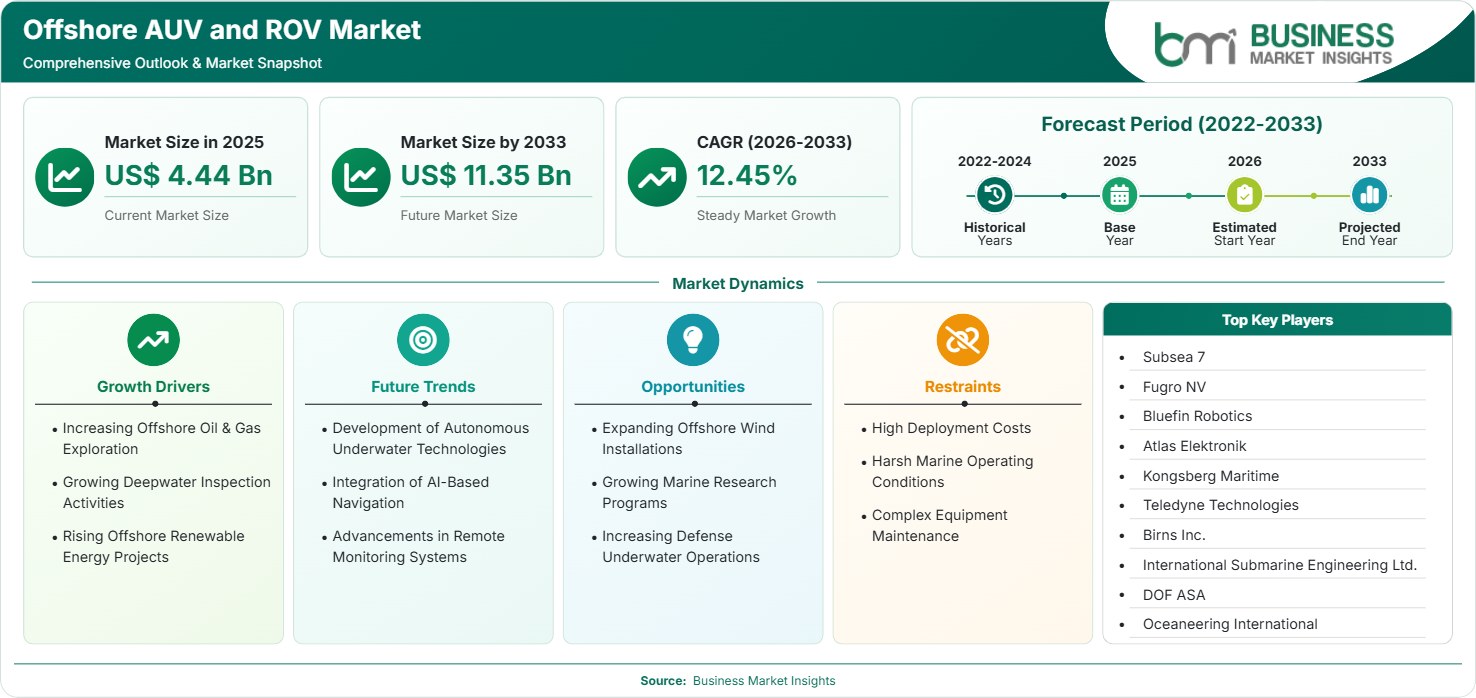
The Offshore AUV and ROV Market size was valued at US$ 4.44 Billion in 2025 and is projected to reach US$ 11.35 Billion by 2033, growing at a CAGR of 12.45% during 2026–2033. Rising offshore exploration, deepwater inspection requirements, marine research expansion, and offshore renewable energy investments are accelerating demand, while autonomous technologies create new operational opportunities.

Report Coverage
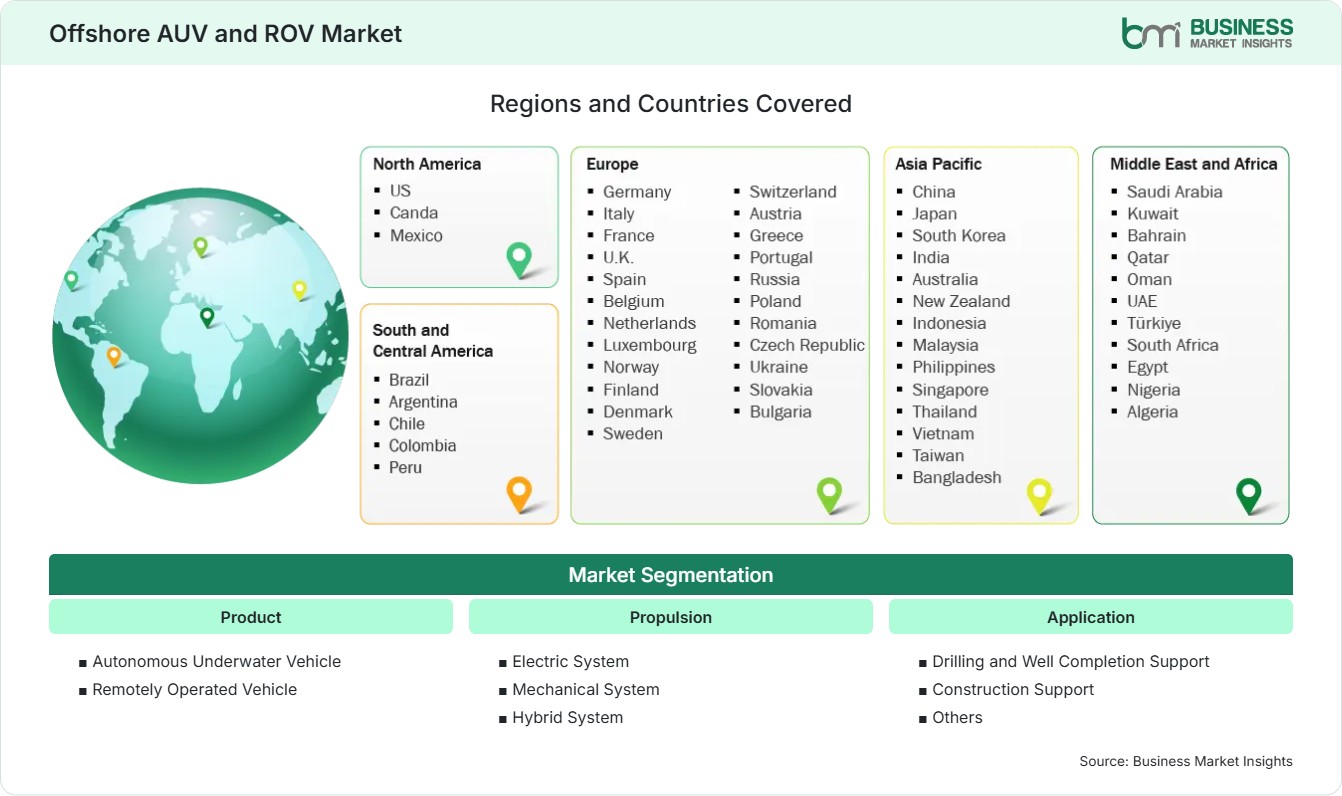
  • Product: Autonomous Underwater Vehicle, Remotely Operated Vehicle
  • Propulsion: Electric System, Mechanical System, Hybrid System
  • Application: Drilling and Well Completion Support, Construction Support, Others
US$ 4.44 Bn Market size in 2025
US$ 11.35 Bn Market Size by 2033
12.45% CAGR, 2026 - 2033
2026-2033 Forecast Period

AI Overview

Offshore AUV and ROV Market Summary

  • North America Region: North America holds 32%–35% share in 2025, growing at a 10.8%–11.6% CAGR during 2026–2033, supported by offshore oil and gas activities, subsea infrastructure monitoring, marine research programs, defense applications, and renewable energy development. The U.S. market demonstrates strong adoption due to Gulf of Mexico operations, offshore wind projects, and advanced subsea technology investments, expanding at a 11.0%–11.8% CAGR through 2033.
  • Fastest Growing Region: Asia Pacific represents 27%–30% share in 2025 and is expanding at a 14.1%–14.9% CAGR during 2026–2033, driven by offshore energy investments, deepwater exploration, marine infrastructure development, regional defense modernization, and increasing adoption of autonomous underwater technologies.
  • Leading Segment: Remotely Operated Vehicle holds 55%–58% share in 2025 with a 11.8%–12.5% CAGR through 2033, supported by established offshore operations, inspection demand, subsea construction activities, and reliability requirements in complex marine environments.
  • High Growth Segment: Autonomous Underwater Vehicle demonstrates 14.8%–15.6% CAGR between 2026–2033, supported by autonomous navigation, reduced operational dependency, advanced marine mapping, offshore wind monitoring, and increasing demand for long-duration underwater missions.
  • Key Market Opportunity: Expansion of offshore wind farms, deep-sea exploration, marine robotics, defense surveillance, and autonomous inspection technologies is creating opportunities for advanced underwater systems with improved endurance, efficiency, and data capabilities.
  • Major Market Players: Subsea 7, Fugro N.V., Bluefin Robotics, Atlas Elektronik GmbH, Kongsberg Maritime AS, Teledyne Technologies Incorporated, Birns Inc., International Submarine Engineering Ltd., DOF ASA, and Oceaneering International Inc.
Strategic Insights

Offshore AUV and ROV Market: Strategic Insights

Offshore AUV and ROV Market Strategic Framework
FREE PDF
Request your free sample
Request free sample
Stakeholder View

Key Takeaways

  • The offshore robotics ecosystem is evolving through collaboration between vehicle manufacturers, subsea service providers, sensor developers, and energy companies, creating an integrated value chain focused on operational efficiency and data-driven marine activities.
  • Offshore renewable energy and deepwater exploration represent high-potential application areas as operators require reliable underwater systems for inspection, construction support, and infrastructure maintenance across complex marine environments.
  • Autonomous capabilities, artificial intelligence, improved battery technologies, and advanced sensing systems are shaping product development strategies as manufacturers aim to extend mission duration and reduce human intervention.
  • Asia Pacific provides significant investment opportunities due to expanding offshore energy projects, growing maritime infrastructure, and increasing adoption of underwater robotics across China, Japan, South Korea, and Southeast Asia.
  • Strategic collaborations and acquisitions are increasing as established marine technology companies seek expertise in autonomous navigation, subsea analytics, and advanced robotic platforms to strengthen competitive positioning.
  • Defense and scientific research applications are creating additional demand by requiring advanced underwater platforms capable of long-range monitoring, environmental assessment, and specialized marine operations.
Geographic Outlook

Offshore AUV and ROV Market Regional Highlights

North America Offshore AUV and ROV Market

North America accounted for 32%–35% share in 2025 and is projected to grow at a 10.8%–11.6% CAGR during 2026–2033. The region benefits from established offshore oil and gas operations, subsea infrastructure networks, marine research capabilities, and increasing offshore wind investments. The Offshore AUV and ROV Market share in North America is supported by demand for inspection, maintenance, and exploration solutions. The U.S. remains the largest contributor due to advanced offshore technology adoption and energy sector investments.

  • Offshore oil and gas operators are increasing deployment of underwater robotic systems for inspection, maintenance, and repair activities across complex subsea assets and deepwater environments.
  • Growing offshore wind development along coastal regions is creating demand for autonomous systems used in seabed mapping, cable inspection, and infrastructure monitoring.
  • Defense organizations are adopting advanced underwater platforms for surveillance, research, and maritime security applications requiring improved operational endurance.
  • Technology providers are investing in autonomous navigation, sensors, and data analytics capabilities to enhance underwater mission efficiency.

US Offshore AUV and ROV Market

The United States represents 80%–84% of North American demand and is expected to expand at a 11.0%–11.8% CAGR from 2026 to 2033. Strong offshore energy activity, marine research programs, defense investments, and offshore renewable initiatives support adoption. The Gulf of Mexico remains a significant operational area, while emerging offshore wind projects are creating additional requirements for underwater inspection and monitoring technologies. The country continues developing advanced subsea capabilities through technology innovation and industrial partnerships.

  • Offshore energy companies are deploying remotely operated systems to improve inspection accuracy and reduce human exposure during subsea operations.
  • Expansion of offshore wind projects is increasing demand for autonomous underwater vehicles supporting environmental surveys and infrastructure assessment.
  • Government and defense investments are encouraging development of advanced underwater robotics for surveillance and strategic marine applications.

Europe Offshore AUV and ROV Market

Europe held 25%–28% share in 2025 and is forecast to grow at a 11.7%–12.5% CAGR through 2033. The region benefits from extensive offshore wind development, mature marine engineering capabilities, and strong environmental monitoring requirements. The United Kingdom, Norway, Germany, and France are leading adoption due to offshore energy expansion and subsea technology expertise. The Offshore AUV and ROV Market growth in Europe is supported by increasing underwater inspection requirements and renewable energy infrastructure investments.

  • Norway continues supporting adoption through offshore energy operations, subsea engineering expertise, and advanced marine technology development.
  • The United Kingdom is expanding underwater robotics demand through offshore wind installations and marine infrastructure monitoring programs.
  • Germany and France are investing in offshore renewable projects requiring reliable seabed surveys and underwater inspection capabilities.
  • European environmental regulations are increasing demand for autonomous monitoring systems supporting marine ecosystem assessment and compliance activities.

Asia Pacific Offshore AUV and ROV Market

Asia Pacific represented 27%–30% Offshore AUV and ROV Market share in 2025 and is estimated to register the fastest growth of 14.1%–14.9% CAGR between 2026 and 2033. The region benefits from offshore energy investments, expanding maritime infrastructure, and increasing marine technology adoption. China, Japan, South Korea, India, and Southeast Asian countries are strengthening underwater capabilities through energy exploration, renewable projects, and defense modernization. Regional demand is supported by increasing offshore operations and technology localization initiatives.

  • China is accelerating adoption through offshore energy projects, marine research programs, and domestic development of underwater robotic technologies.
  • Japan is investing in advanced marine exploration systems supported by strong engineering capabilities and offshore research activities.
  • South Korea’s shipbuilding industry is creating opportunities for underwater robotics used in offshore construction and inspection applications.
  • India is expanding offshore technology adoption through energy exploration initiatives and increasing focus on maritime infrastructure development.

Rest of World Offshore AUV and ROV Market

Rest of World accounted for 10%–13% Offshore AUV and ROV Market share in 2025 and is projected to grow at a 9.5%–10.4% CAGR through 2033. South and Central America are witnessing gradual adoption due to offshore energy activities and subsea infrastructure requirements. Brazil and Mexico represent important markets with growing offshore exploration programs. Middle East and Africa are expanding adoption through oil and gas operations, maritime security initiatives, and offshore infrastructure development.

  • Brazil’s offshore oil production activities are increasing demand for remotely operated systems used in inspection, maintenance, and subsea construction support.
  • Mexico is developing offshore energy capabilities, creating opportunities for underwater robotics across exploration and operational activities.
  • Middle Eastern countries are adopting advanced subsea technologies to improve offshore asset management and operational efficiency.
  • African coastal regions are exploring marine technology investments for energy, research, and environmental monitoring applications.
Global Market Geography
FREE PDF
Request your free sample
Request free sample
Segment Analysis

Offshore AUV and ROV Market Segmentation

Product

Product segmentation reflects increasing adoption of underwater robotic platforms for offshore exploration, inspection, and construction activities. The segment accounted for the complete technology base in 2025 and is projected to expand at a 12.45% CAGR during 2026–2033. The Offshore AUV and ROV Market scope is expanding as operators require efficient solutions for deepwater operations, asset monitoring, environmental assessment, and complex subsea missions. Autonomous and remotely controlled platforms are becoming essential tools for offshore industries.

  • Autonomous Underwater Vehicle (AUV): AUVs provide self-guided underwater operations without continuous human control. They support seabed mapping, marine research, environmental monitoring, and offshore survey activities requiring extended operational endurance.
  • Remotely Operated Vehicle: ROVs remain widely used for offshore inspection, drilling support, construction activities, and maintenance operations. Their real-time operator control enables accurate intervention in challenging subsea environments.

Propulsion

Propulsion segmentation is influenced by requirements for longer underwater missions, improved energy efficiency, and operational reliability. Advancements in battery technologies, hybrid power systems, and mechanical propulsion are improving vehicle performance across offshore applications. The segment benefits from increasing demand for advanced underwater mobility solutions. The Offshore AUV and ROV Market trends indicate rising investment in propulsion innovations that enhance endurance, speed, and mission flexibility for commercial and defense applications.

  • Electric System: Electric propulsion systems are widely adopted due to low emissions, operational efficiency, and suitability for autonomous underwater missions requiring quiet and reliable performance.
  • Mechanical System: Mechanical propulsion systems provide durability and power for demanding offshore applications. They are commonly integrated into larger underwater vehicles requiring strong operational capabilities.
  • Hybrid System: Hybrid propulsion combines multiple energy sources to improve endurance and flexibility. It supports longer missions, reduced energy consumption, and advanced offshore exploration requirements.

Application

Application segmentation demonstrates expanding utilization across offshore energy, marine infrastructure, and specialized underwater operations. Increasing subsea asset complexity and rising requirements for inspection accuracy are supporting adoption across multiple industries. Offshore operators are deploying robotic systems to improve safety, reduce operational costs, and enhance data collection. The segment growth is supported by increasing offshore projects, infrastructure monitoring requirements, and demand for reliable underwater technologies.

  • Drilling and Well Completion Support: Underwater robotic systems support drilling operations through inspection, monitoring, and intervention activities. They improve safety, operational efficiency, and accuracy during offshore well development processes.
  • Construction Support: Construction support applications utilize underwater vehicles for pipeline installation, structural inspection, cable placement, and subsea infrastructure development activities in offshore environments.
Market Forces

Offshore AUV and ROV Market Dynamics

Key Market Drivers

Increasing Offshore Oil & Gas Exploration

Growing offshore exploration is increasing the demand for robotic systems that can perform their functions in deeper and more complicated conditions. The International Energy Agency emphasizes the importance of offshore sources for world energy supplies, and calls for investments in technologies of this area. The market growth is facilitated by the desire of companies to implement safer and more effective inspections, maintenance, and interventions. The Offshore AUV and ROV Market trends include greater use of autonomous devices, high resolution sensors, and navigational technologies.

Growing Deepwater Inspection Activities

Growing subsea infrastructure complexity is increasing demand for robotic inspection solutions across offshore facilities, pipelines, and underwater assets. ROVs and AUVs enable operators to monitor structural conditions, detect failures, and perform surveys without exposing personnel to hazardous environments. For offshore assets, the focus now is on implementing predictive maintenance techniques with the aid of sophisticated imagery, sensors, and analytics tools. The growing instances of aging structures in mature offshore areas will continue to drive the need for underwater inspection solutions. Better communication facilities and autonomy will help in conducting longer operations with greater precision.

Rising Offshore Renewable Energy Projects

Expansion of offshore renewable energy projects is creating new demand for underwater robotic systems used in seabed surveys, cable inspection, and environmental monitoring. Offshore wind installations require continuous assessment of foundations, transmission infrastructure, and marine conditions. As the shift to renewable energy grows, there are investments in technologies that will ensure the reliability of projects and minimize maintenance problems. Nations developing offshore wind energy require increased amounts of unmanned and remotely operated equipment that can facilitate marine construction on a big scale. This opens up new avenues of development other than in oil and gas industry.

Key Market Opportunities

Expanding Offshore Wind Installations

Increasing offshore wind capacity worldwide is creating significant opportunities for underwater robotics providers. Developers require AUVs and ROVs for seabed mapping, cable route assessment, foundation inspection, and maintenance activities. The Offshore AUV and ROV Market Forecasts indicate strong potential as renewable energy investments expand across Europe, Asia Pacific, and North America. Growth in offshore wind projects is encouraging technology providers to develop specialized platforms with improved endurance, precision navigation, and environmental monitoring capabilities. These solutions help reduce project risks and improve lifecycle management of offshore renewable assets.

Growing Marine Research Programs

Marine research initiatives are creating opportunities for advanced underwater vehicles used in ocean exploration, biodiversity studies, climate monitoring, and scientific data collection. Research institutions and government agencies are increasing investment in autonomous platforms capable of operating in remote marine environments. Improvements in sensors, communication systems, and data processing are enhancing research capabilities. AUVs are particularly valuable for long-duration missions requiring minimal human intervention. Expanding oceanographic studies and environmental monitoring requirements are expected to encourage further adoption of underwater robotic technologies across scientific applications.

Increasing Defense Underwater Operations

Defense modernization programs are increasing demand for underwater robotic systems used in surveillance, reconnaissance, mine detection, and maritime security operations. Autonomous and remotely operated platforms provide strategic advantages by enabling extended missions while reducing personnel risks. Governments are investing in advanced underwater capabilities to strengthen maritime awareness and security. Development of sophisticated navigation, communication, and sensing technologies is improving defense applications. Increasing geopolitical focus on maritime domains is expected to create additional opportunities for specialized underwater vehicle manufacturers and technology providers.

Market Restraints and Challenges

High Deployment Costs

Factor: Advanced underwater robotic systems require significant investment in vehicle development, specialized sensors, communication equipment, support vessels, and skilled operational teams. Impact: High capital requirements can limit adoption among smaller offshore operators and research organizations with restricted budgets. Complex manufacturing processes and expensive maintenance requirements further increase lifecycle costs. Although technological advancements are improving efficiency, operators must balance investment decisions with operational benefits. The need for specialized infrastructure, data processing capabilities, and trained personnel creates additional financial barriers. These cost factors can slow adoption in emerging markets where offshore activities are expanding but technology investments remain constrained.

Harsh Marine Operating Conditions

Factor: Extreme underwater environments, including high pressure, low temperatures, strong currents, and limited communication availability, create operational challenges. Impact: Harsh conditions can affect vehicle reliability, mission duration, maintenance requirements, and deployment efficiency. Underwater systems require durable materials, advanced navigation technologies, and robust engineering to operate effectively in deepwater locations. Equipment failures or communication disruptions can increase project delays and operational expenses. Manufacturers must continuously improve vehicle designs to withstand demanding marine conditions while maintaining performance. These environmental challenges remain significant considerations for offshore operators evaluating robotic solutions for complex underwater applications.

Company Analysis

Competitive Landscape

The Offshore AUV and ROV Market analysis highlights increasing competition among marine technology providers focusing on autonomous capabilities, subsea engineering, offshore services, and advanced underwater robotics. Companies are investing in vehicle performance improvements, sensor integration, navigation systems, and specialized offshore solutions to support energy, defense, research, and infrastructure applications. Strategic collaborations and technology development initiatives are strengthening competitive positioning across global underwater robotics markets.

Company Name

Overview

Products and Services relevant to this market

Subsea 7

Subsea 7 is a global subsea engineering and offshore services company providing integrated solutions for energy and marine industries.

Provides subsea robotics services, remotely operated vehicle operations, offshore inspection, and construction support solutions.

Fugro N.V.

Fugro N.V. specializes in geo-data solutions, marine surveys, and integrated offshore services for infrastructure and energy projects.

Offers autonomous underwater vehicles, marine surveys, seabed mapping, and offshore inspection technologies.

Bluefin Robotics

Bluefin Robotics develops autonomous underwater vehicles designed for defense, research, and commercial marine applications.

Provides AUV platforms, underwater navigation systems, sensors, and autonomous mission technologies.

Atlas Elektronik GmbH

Atlas Elektronik GmbH develops marine electronics, underwater systems, and naval technology solutions for global customers.

Supplies autonomous underwater vehicles, sonar systems, underwater communication technologies, and defense solutions.

Kongsberg Maritime AS

Kongsberg Maritime AS provides marine technology solutions including underwater systems, automation, and digital maritime technologies.

Offers AUVs, underwater sensors, navigation systems, and subsea monitoring solutions for offshore applications.

Teledyne Technologies Incorporated

Teledyne Technologies Incorporated develops advanced instrumentation, imaging, and marine technology solutions for multiple industries.

Provides underwater vehicles, sensors, imaging systems, and data acquisition technologies supporting marine operations.

Birns Inc.

Birns Inc. specializes in underwater equipment, marine imaging systems, and technology solutions for professional applications.

Supplies underwater cameras, lighting systems, imaging equipment, and marine technology components.

International Submarine Engineering Ltd.

International Submarine Engineering Ltd. develops advanced underwater robotics and autonomous systems for commercial and defense applications.

Provides AUVs, underwater robotic platforms, control systems, and specialized marine engineering solutions.

DOF ASA

DOF ASA provides offshore vessel services and subsea solutions for energy and marine industries.

Offers subsea support services, remotely operated vehicle operations, and offshore project solutions.

Oceaneering International Inc.

Oceaneering International Inc. provides subsea engineering, robotics, and offshore technology services globally.

Supplies ROV systems, subsea inspection services, robotic technologies, and offshore asset management solutions.

Trust & Transparency

Research Methodology

The market analysis combines proprietary research with secondary data from government agencies, company disclosures, regulatory filings, industry databases and expert interviews. Market estimates are validated through data triangulation, cross-market benchmarking and analyst review.

View Full Research Methodology

Questions Answered

Frequently Asked Questions

What is included in an Offshore AUV and ROV Market Report?

An report provides insights into market size, growth trends, competitive developments, segmentation, regional dynamics, and key factors influencing adoption across offshore industries.

Why is offshore wind increasing demand for underwater vehicles?

Offshore wind projects require seabed surveys, cable inspections, foundation monitoring, and environmental assessments. Underwater robotic systems provide efficient solutions for managing these activities while improving safety and reducing operational costs.

How does artificial intelligence improve underwater vehicle performance?

Artificial intelligence enables better navigation, autonomous decision-making, object recognition, and mission optimization. AI integration helps underwater vehicles collect accurate data while reducing operator dependence and improving efficiency during complex offshore operations.

What industries use offshore underwater robotic systems?

Offshore robotics are used in oil and gas, renewable energy, defense, marine research, and subsea infrastructure sectors. These systems support inspection, construction, environmental monitoring, and data collection activities in challenging underwater environments.

How do AUVs differ from ROVs in offshore applications?

AUVs operate independently using onboard navigation and control systems, making them suitable for surveys, mapping, and monitoring. ROVs remain connected to surface vessels and provide real-time operator control for inspection, maintenance, and intervention activities.

Access the Full Offshore AUV and ROV Market Report

Get segment-level forecasts, regional estimates, competitive benchmarking, company profiles and downloadable Excel datasets.

Access the full Offshore AUV and ROV Market Report
350 pages PDF & Excel | 2026-08-31
Similar Research

Related Market Reports