
Helicopter Aeronautical Software Market Outlook: Size, Share, Trends, Growth Analysis, Competitive Landscape & Forecast, 2022-2033

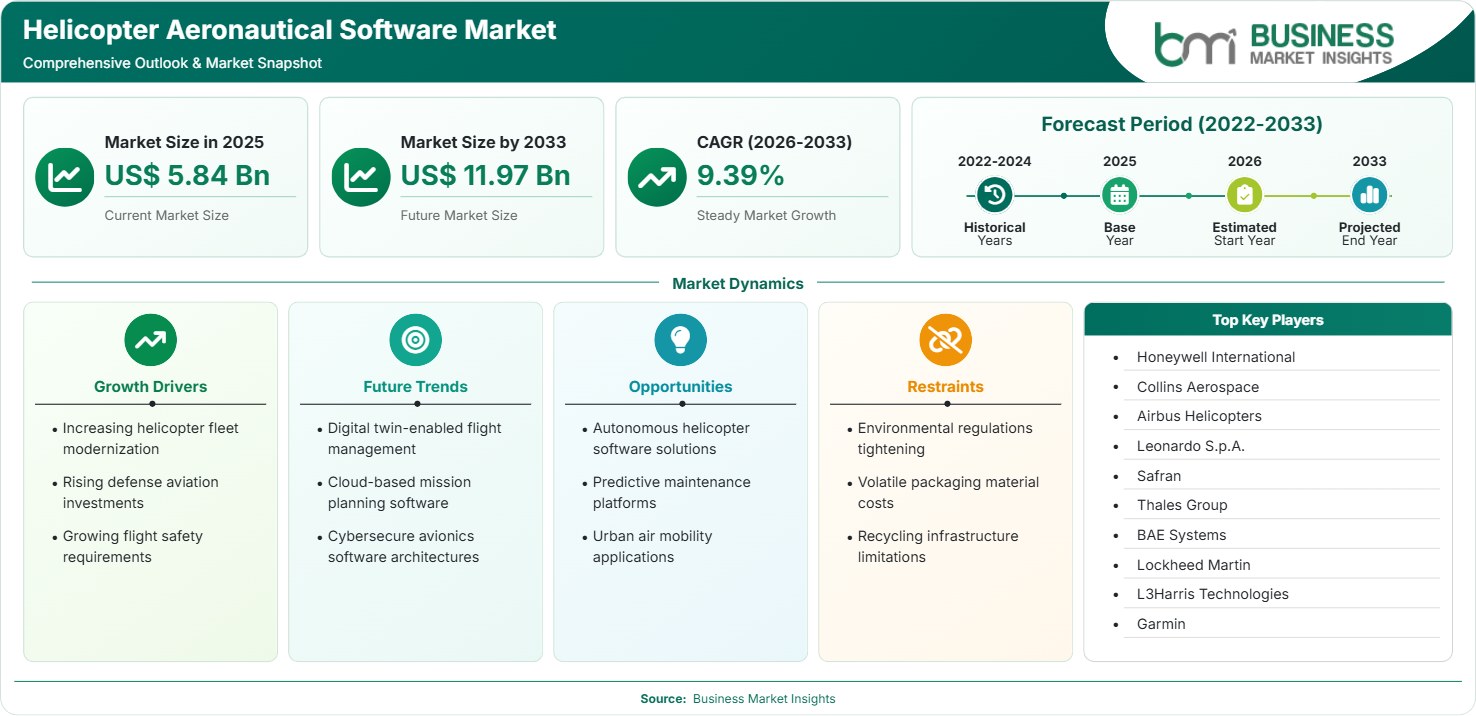
The Helicopter Aeronautical Software Market size was valued at US$ 5.84 billion in 2025 and is projected to reach US$ 11.97 billion by 2033, growing at a CAGR of 9.39% during 2026–2033. Increasing helicopter fleet modernization, rising defense aviation investments, and growing flight safety requirements continue driving demand, while autonomous flight software, predictive maintenance platforms, and urban air mobility create long-term growth opportunities.

Report Coverage
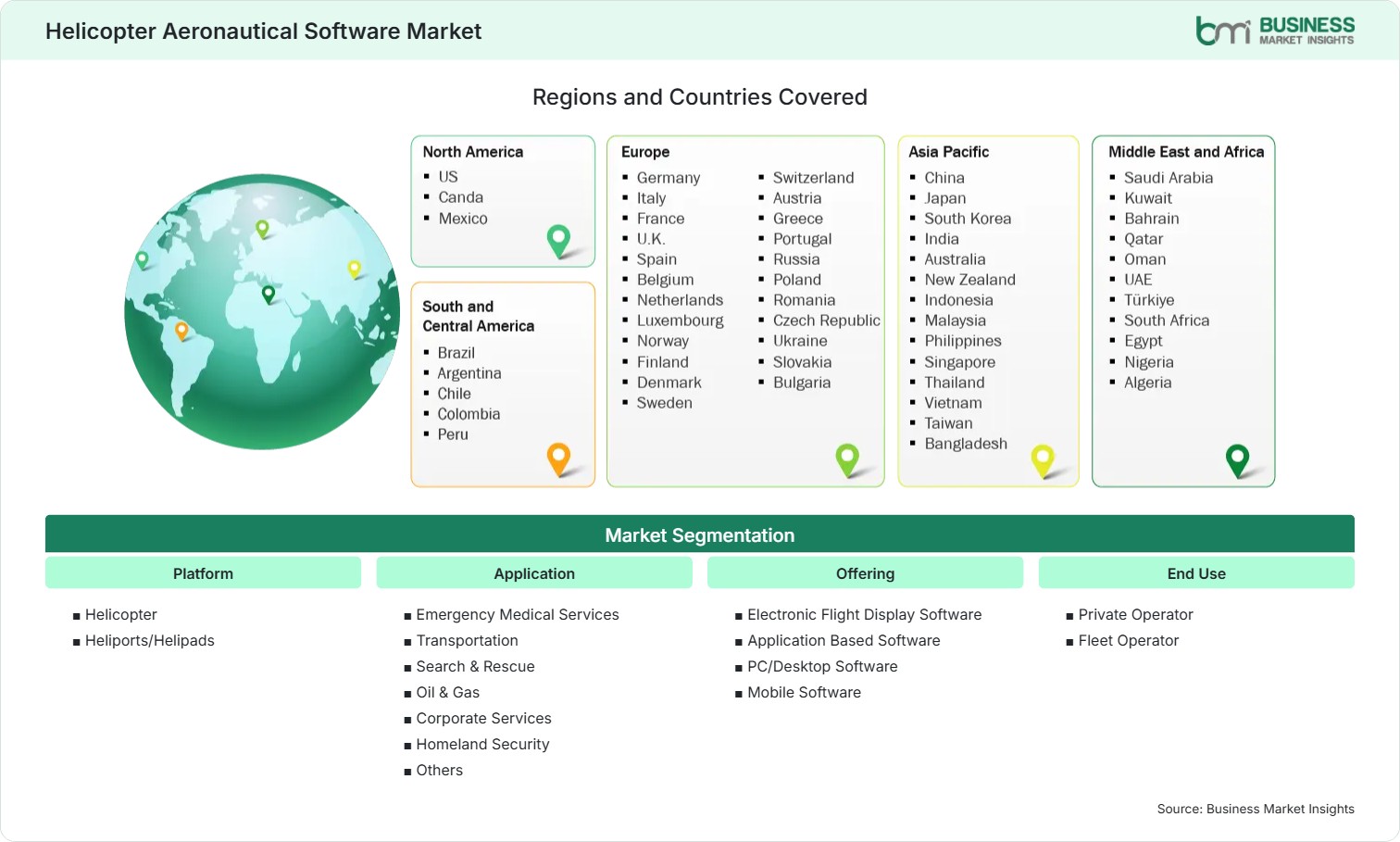
  • Platform: Helicopter, Heliports/Helipads
  • Application: Emergency Medical Services, Transportation, Search & Rescue, Oil & Gas, Corporate Services, Homeland Security, Others
  • Offering: Electronic Flight Display (EFD) Software, Application Based Software, PC/Desktop Software, Mobile Software
  • End Use: Private Operator, Fleet Operator
US$ 5.84 Bn Market size in 2025
US$ 11.97 Bn Market Size by 2033
9.39% CAGR, 2026 - 2033
2026-2033 Forecast Period

01 AI Overview

Helicopter Aeronautical Software Market Summary

  • North America Region: North America holds 36%–39% market share in 2025 and is projected to grow at a CAGR of 8.9%–9.6% during 2026–2033, supported by defense modernization, commercial helicopter fleet upgrades, and advanced avionics software integration. The United States remains the largest regional market, expanding at a CAGR of 9.0%–9.7% through increasing investments in military rotorcraft, emergency medical services, and digital flight management technologies.
  • Fastest Growing Region: Asia Pacific accounts for 24%–27% of market revenue in 2025 and is expected to register a CAGR of 10.3%–11.0% during 2026–2033. Fleet expansion, increasing defense procurement, smart aviation infrastructure, and urban air mobility initiatives continue strengthening regional demand.
  • Leading Segment: Helicopter represents 78%–81% of market revenue in 2025 and is anticipated to expand at a CAGR of 9.2%–9.9% through 2033. Fleet modernization, digital cockpit integration, and advanced mission management software continue supporting segment leadership.
  • High Growth Segment: Emergency Medical Services accounts for 24%–27% of market revenue in 2025 and is projected to grow at a CAGR of 10.5%–11.2% during 2026–2033. Growing demand for rapid emergency response, digital navigation, and real-time mission planning solutions continues accelerating software adoption.
  • Key Market Opportunity: Increasing adoption of AI-enabled flight management, predictive maintenance software, autonomous rotorcraft technologies, and digital mission planning platforms creates substantial opportunities across civil and defense aviation.
  • Major Market Players: Honeywell International Inc., Collins Aerospace (RTX Corporation), Airbus Helicopters SAS, Leonardo S.p.A., Safran Electronics & Defense, Thales S.A., BAE Systems plc, Lockheed Martin Corporation, L3Harris Technologies, Inc., and Garmin Ltd.
02 Strategic Insights

Helicopter Aeronautical Software Market: Strategic Insights

helicopter-aeronautical-software-market-market-strategic-framework
FREE PDF
Request your free sample
Request free sample
03 Stakeholder View

Key Takeaways

  • Software developers, avionics suppliers, aircraft OEMs, and fleet operators are increasingly collaborating to deliver integrated digital ecosystems supporting safer, more efficient helicopter operations.
  • Emergency medical services, military modernization programs, offshore transportation, and corporate aviation continue presenting the strongest commercial opportunities for advanced aeronautical software providers.
  • Artificial intelligence, predictive maintenance analytics, digital twin platforms, and cloud-connected avionics software are reshaping product development and competitive differentiation.
  • Asia Pacific offers the strongest long-term investment potential through expanding defense budgets, commercial helicopter procurement, and increasing aviation digitalization initiatives.
  • Strategic partnerships between aircraft manufacturers and avionics software providers are accelerating certification, deployment, and lifecycle support for next-generation digital cockpit technologies.
04 Geographic Outlook

Helicopter Aeronautical Software Market Regional Highlights

North America Helicopter Aeronautical Software Market

North America accounted for 36%–39% of the Helicopter Aeronautical Software Market share in 2025 and is expected to expand at a CAGR of 8.9%–9.6% through 2033. The region benefits from advanced defense aviation programs, large commercial helicopter fleets, mature avionics industries, and increasing investments in digital mission management software for civil and military aviation.

  • Defense modernization programs continue driving investments in digital cockpit upgrades, mission software, and integrated flight management systems across military helicopter fleets.
  • Emergency medical aviation operators increasingly deploy advanced navigation, flight planning, and aircraft health monitoring software to improve mission effectiveness.
  • Growing adoption of predictive maintenance software reduces aircraft downtime while improving operational readiness across commercial and government helicopter fleets.
  • FAA-supported modernization initiatives encourage integration of advanced avionics software and enhanced flight safety technologies.
  • Increasing cybersecurity investments strengthen protection of connected avionics systems and mission-critical aviation software.

US Helicopter Aeronautical Software Market

The United States represented 30%–33% of global revenue in 2025 and is forecast to register a CAGR of 9.0%–9.7% during 2026–2033. Strong military procurement, commercial helicopter operations, and rapid deployment of advanced avionics software continue supporting sustained market expansion.

  • U.S. defense rotorcraft modernization programs continue integrating next-generation mission management and digital flight control software.
  • Commercial helicopter operators increasingly implement predictive maintenance platforms to improve fleet availability and reduce maintenance costs.
  • EMS operators continue adopting connected cockpit technologies supporting real-time navigation and emergency response coordination.
  • Software-defined avionics architectures strengthen operational efficiency across military and civil helicopter fleets.

Europe Helicopter Aeronautical Software Market

Europe accounted for 28%–31% of global revenue in 2025 and is projected to grow at a CAGR of 9.1%–9.8% during 2026–2033. France remains the leading regional market, while Poland is expected to record the fastest growth with a CAGR of 10.0%–10.7%, supported by defense modernization and aviation software investments.

  • France leads through strong aerospace manufacturing capabilities and continuous investments in helicopter avionics innovation.
  • Poland records rapid expansion owing to increasing defense procurement and modernization of military aviation capabilities.
  • European aviation safety regulations continue accelerating deployment of certified flight software solutions.
  • Increasing offshore wind and emergency medical aviation operations support wider software adoption.
  • Collaborative aerospace research programs encourage development of AI-enabled helicopter software technologies.

Asia Pacific Helicopter Aeronautical Software Market

Asia Pacific represented 24%–27% of market revenue in 2025 and is projected to achieve the highest CAGR of 10.3%–11.0% through 2033. China leads regional demand, while India is expected to record the fastest growth at 11.1%–11.8%, driven by expanding defense aviation programs, civil helicopter procurement, and digital aviation infrastructure.

  • China continues expanding military and commercial helicopter fleets supported by domestic aerospace manufacturing initiatives.
  • India strengthens investments in indigenous defense aviation software and helicopter modernization programs.
  • Japan and South Korea continue adopting advanced avionics and digital flight management technologies.
  • Regional governments increasingly invest in urban air mobility and intelligent airspace management initiatives.
  • Growing offshore energy and disaster response operations increase demand for advanced helicopter software platforms.

Rest of World Helicopter Aeronautical Software Market

The Rest of World accounted for 7%–10% of market revenue in 2025 and is expected to register a CAGR of 9.4%–10.1% during 2026–2033. Brazil represents the leading South American market, while the United Arab Emirates records the fastest regional growth at 10.2%–10.9%, supported by expanding defense aviation, offshore operations, and smart aviation investments.

Increasing investments in border security, offshore oil and gas transportation, emergency medical aviation, and public safety operations continue encouraging deployment of advanced helicopter software across emerging aviation markets.

  • Brazil continues modernizing helicopter fleets supporting public security, offshore energy, and emergency response operations.
  • The United Arab Emirates expands smart aviation initiatives through investments in digital flight technologies.
  • Middle Eastern defense procurement programs increase demand for mission planning and avionics software.
  • Latin American fleet operators continue implementing predictive maintenance solutions to improve operational efficiency.
  • Offshore helicopter services increasingly adopt advanced flight planning and monitoring software for enhanced mission safety.
global-market-geography
FREE PDF
Request your free sample
Request free sample
05 Segment Analysis

Helicopter Aeronautical Software Market Segmentation

Platform

The platform segment is led by Helicopter, reflecting the widespread deployment of digital avionics, flight management systems, navigation software, and aircraft health monitoring platforms across commercial and military rotorcraft. The segment accounted for 78%–81% of market revenue in 2025 and is projected to grow at a CAGR of 9.2%–9.9% during 2026–2033. The Helicopter Aeronautical Software Market scope continues expanding as operators prioritize software-enabled flight safety, predictive maintenance, mission planning, and operational efficiency.

  • Helicopter: Helicopter platforms dominate demand through increasing deployment of integrated avionics software, digital cockpit systems, mission planning applications, and real-time aircraft health monitoring technologies.
  • Heliports/Helipads: Digital software supporting heliport operations continues expanding through automated scheduling, traffic coordination, landing management, safety monitoring, and infrastructure optimization for commercial and emergency aviation.

Application

Application diversity continues expanding with growing adoption across emergency response, defense, commercial transportation, and offshore aviation. Emergency Medical Services remains the leading application, accounting for 24%–27% of market revenue in 2025 while registering a CAGR of 10.5%–11.2% during 2026–2033. Increasing fleet modernization, digital mission management, and advanced navigation capabilities continue strengthening Helicopter Aeronautical Software Market trends.

  • Emergency Medical Services: EMS operators increasingly deploy advanced flight planning, navigation, patient transport coordination, and aircraft monitoring software to improve emergency response efficiency and operational safety.
  • Transportation: Commercial transportation operators utilize digital fleet management, route optimization, flight planning, and operational analytics software to improve scheduling efficiency and reduce operating costs.
  • Search & Rescue: Search and rescue organizations implement advanced mapping, mission planning, geospatial analytics, and communication software to improve mission effectiveness during critical emergency operations.
  • Oil & Gas: Offshore helicopter operators increasingly adopt predictive maintenance, navigation, and flight safety software supporting reliable transportation to offshore production facilities.
  • Corporate Services: Corporate aviation operators continue investing in flight management software, maintenance planning, and digital cockpit technologies to enhance operational productivity and passenger safety.
  • Homeland Security: Government agencies utilize secure mission planning, surveillance integration, and operational command software supporting border security, law enforcement, and disaster response missions.
  • Others: Additional applications include tourism, utility operations, firefighting, military logistics, environmental monitoring, and humanitarian missions requiring advanced aeronautical software solutions.

Offering

Software offerings continue evolving toward connected, cloud-enabled, and mobile-enabled aviation platforms. Electronic Flight Display (EFD) Software accounted for 34%–37% of market revenue in 2025 and is expected to register a CAGR of 9.6%–10.3% during 2026–2033. Growing adoption of integrated cockpit displays, digital navigation systems, and flight visualization technologies continues supporting market expansion.

  • Electronic Flight Display (EFD) Software: EFD software enhances pilot situational awareness through integrated navigation, weather visualization, aircraft performance monitoring, and real-time operational information.
  • Application Based Software: Application-based platforms support mission planning, maintenance scheduling, fleet management, safety reporting, operational analytics, and regulatory compliance across helicopter operations.
  • PC/Desktop Software: Desktop software remains widely utilized for engineering analysis, maintenance management, flight planning, simulation, and operational data processing within aviation organizations.
  • Mobile Software: Mobile aviation applications enable pilots, maintenance personnel, and fleet operators to access navigation data, maintenance records, operational dashboards, and mission updates remotely.

End Use

Fleet digitization continues driving software adoption among commercial and government operators. Fleet Operator remains the leading end-use segment, accounting for 61%–64% of market revenue in 2025 while expanding at a CAGR of 9.7%–10.4% through 2033. Increasing fleet size, centralized operations, predictive maintenance, and digital asset management continue supporting long-term adoption.

  • Private Operator: Private helicopter owners increasingly implement navigation software, maintenance tracking applications, and electronic flight planning systems to improve operational safety and regulatory compliance.
  • Fleet Operator: Commercial fleet operators continue investing in integrated operational software, predictive maintenance platforms, mission planning systems, and centralized fleet analytics to maximize aircraft utilization and reduce operating costs.
06 Market Forces

Helicopter Aeronautical Software Market Dynamics

Key Market Drivers

Increasing helicopter fleet modernization

Military forces, medical emergency response teams, offshore aviation firms, and commercial airliners are retrofitting their older helicopter fleets with modern avionics, flight management systems, aircraft health-monitoring systems, and mission-management software. This helps boost operational efficiency, reduce maintenance costs, and improve flight safety while meeting new aviation standards. Helicopter Aeronautical Software Market growth continues to benefit from growing investments in software-defined cockpit technologies and connected aircraft ecosystems.

Rising defense aviation investments

Governments around the world continue to raise their defense spending to upgrade the fleet of rotary-wing aircraft, using sophisticated technologies such as advanced mission planning software, digital avionics, cybersecurity systems, and command-and-control systems. Modern military helicopter programs require software for navigation, reconnaissance, communications, and situational awareness on the battlefield.

Growing flight safety requirements

The regulators and aircraft operators still focus on advanced software tools aimed at enhancing situational awareness, reducing pilot workloads, and improving operational safety. Electronic flight displays, terrain awareness technology, synthetic vision systems, collision avoidance software, and predictive maintenance solutions have made helicopter operations much safer. Helicopter Aeronautical Software Market trends increasingly reflect demand for intelligent software platforms supporting real-time operational decision-making and regulatory compliance.

Key Market Opportunities

Autonomous helicopter software solutions

Advancements in artificial intelligence, autonomous navigation, sensor fusion, and digital flight control technologies are creating new opportunities for autonomous and optionally piloted helicopter operations. Manufacturers continue investing in intelligent flight software capable of supporting cargo transport, surveillance, disaster response, and military missions with reduced pilot workload and improved operational efficiency.

Predictive maintenance platforms

The use of aircraft health monitoring systems, digital twins, and artificial intelligence enables predictive maintenance solutions that will minimize unplanned downtime and maintenance expenses. Software systems capable of performing real-time analysis of aircraft performance data offer aviation software companies promising business opportunities.

Urban air mobility applications

Rapid development of urban air mobility ecosystems is increasing demand for advanced flight management software, autonomous navigation systems, airspace integration platforms, and digital traffic management technologies. Helicopter Aeronautical Software Market Forecasts indicate significant long-term growth opportunities as software developers support future eVTOL operations and integrated low-altitude air mobility networks.

Market Restraints and Challenges

Stringent aviation certifications

Factor: Aviation software must comply with rigorous certification requirements established by authorities such as the FAA, EASA, and military airworthiness organizations before commercial deployment. Impact: Certification processes make product development take a longer period of time and cost much more money, delaying the commercialization of software and erecting huge barriers for small software providers of the aviation industry.

High software development costs

Factor: Developing aviation-grade software requires extensive verification, cybersecurity testing, systems integration, redundancy validation, and continuous regulatory compliance throughout the software lifecycle. Impact: High cost of research and development, along with constant costs of certification and maintenance, may hinder the innovation process among smaller companies and lengthen the development cycle of products.

07 Company Analysis

Competitive Landscape

The competitive environment is shaped by increasing investment in digital avionics, mission management software, autonomous flight technologies, predictive maintenance platforms, and connected cockpit solutions. Helicopter Aeronautical Software Market analysis indicates that leading aerospace companies are focusing on AI-enabled flight management, certified avionics software, cybersecurity, and software-defined helicopter architectures for both civil and defense applications.

Company Name

Overview

Products and Services Relevant to this Market

Honeywell International Inc.

Global aerospace technology company delivering advanced avionics, navigation, flight management, and connected aircraft solutions.

Flight management systems, avionics software, weather radar, health monitoring, navigation systems, and autonomous flight technologies.

Collins Aerospace (RTX Corporation)

Leading aerospace supplier specializing in digital avionics, mission systems, and flight management technologies.

Flight management software, integrated avionics, mission computers, cockpit displays, navigation systems, and communication software.

Airbus Helicopters SAS

World's leading helicopter OEM focused on digital flight systems and connected helicopter solutions.

Helionix avionics suite, flight management software, mission systems, health monitoring, and helicopter digital services.

Leonardo S.p.A.

Global helicopter manufacturer providing advanced avionics and mission software for civil and military rotorcraft.

Integrated avionics, digital cockpit software, mission management systems, flight control software, and maintenance platforms.

Safran Electronics & Defense

Aerospace electronics company developing navigation, flight control, and avionics software technologies.

Flight control systems, navigation software, inertial navigation, mission electronics, and helicopter avionics solutions.

Thales S.A.

Global aerospace and defense company providing certified avionics, cockpit systems, and mission software.

Flight management systems, avionics software, digital cockpit solutions, mission planning, and cybersecurity platforms.

BAE Systems plc

Defense technology leader delivering mission systems and software for military aviation platforms.

Mission computers, avionics software, electronic warfare systems, and military helicopter software solutions.

Lockheed Martin Corporation

Defense contractor supporting military rotorcraft through integrated mission and digital avionics systems.

Mission software, digital avionics, flight management systems, command-and-control solutions, and helicopter modernization technologies.

L3Harris Technologies, Inc.

Aerospace company specializing in integrated avionics, communication, and mission management technologies.

Mission software, cockpit displays, navigation systems, surveillance software, and secure communications.

Garmin Ltd.

Aviation electronics company providing advanced integrated flight deck and helicopter autopilot solutions.

Helicopter flight control systems, avionics software, electronic flight displays, navigation systems, and autopilot technologies.

08 Industry Activity

Recent Developments

July 2025

Garmin Ltd. received FAA Supplemental Type Certificate (STC) approval for the GFC 600H Helicopter Flight Control System for retrofit installations on Airbus H130 helicopters. The system adds advanced software-enabled safety features including Hover Assist, Helicopter Electronic Stability and Protection (H-ESP™), and Return-to-Level mode.

June 2025

Honeywell International Inc., together with Near Earth Autonomy and Leonardo S.p.A., successfully completed the first autonomous flight of a Leonardo AW139 helicopter under the U.S. Marine Corps Aerial Logistics Connector (ALC) program, validating autonomous flight software integrated with Honeywell avionics.

March 2025

Collins Aerospace (RTX Corporation) secured a contract to upgrade the U.S. Army H-60M Black Hawk fleet with a Modular Open Systems Architecture (MOSA)-based avionics suite, enabling enhanced cockpit software capabilities, faster software integration, and future mission-system upgrades.

March 2025

Airbus Helicopters SAS launched the H140 light twin-engine helicopter featuring the latest Helionix digital avionics suite with a four-axis autopilot, advanced flight management software, and enhanced cockpit automation designed primarily for helicopter emergency medical services (HEMS).

10 Trust & Transparency

Research Methodology

The market analysis combines proprietary research with secondary data from government agencies, company disclosures, regulatory filings, industry databases and expert interviews. Market estimates are validated through data triangulation, cross-market benchmarking and analyst review.

View Full Research Methodology

11 Questions Answered

Frequently Asked Questions

Which region leads the Helicopter Aeronautical Software Market?

North America remains the leading regional market due to its extensive military helicopter fleet, mature aerospace industry, advanced avionics ecosystem, and continuous investments in next-generation aviation software technologies.

What are the major future opportunities?

Significant opportunities include autonomous helicopter software, AI-based predictive maintenance, urban air mobility platforms, cloud-connected fleet management, and software-defined avionics supporting next-generation rotorcraft operations.

Which application is expected to witness the fastest growth?

Emergency Medical Services (EMS) is projected to record the fastest growth owing to increasing demand for real-time navigation, mission planning, aircraft tracking, and digital communication systems supporting critical emergency response operations.

Which platform dominates the market?

Helicopter platforms account for the largest market share due to continuous investments in integrated avionics, mission management software, flight planning systems, and aircraft health monitoring technologies across military and commercial fleets.

What factors are driving the market?

The Helicopter Aeronautical Software Market report highlights that the market is driven by helicopter fleet modernization, increasing defense aviation expenditure, stricter flight safety regulations, digital cockpit adoption, and growing implementation of predictive maintenance and connected aircraft technologies.

Access the Full Helicopter Aeronautical Software Market Report

Get segment-level forecasts, regional estimates, competitive benchmarking, company profiles and downloadable Excel datasets.

Access the full Helicopter Aeronautical Software Market Report
350 pages PDF & Excel | 2026-07-27