
Air Defense Systems Market Outlook: Size, Share, Trends, Growth Analysis, Competitive Landscape & Forecast, 2026-2033

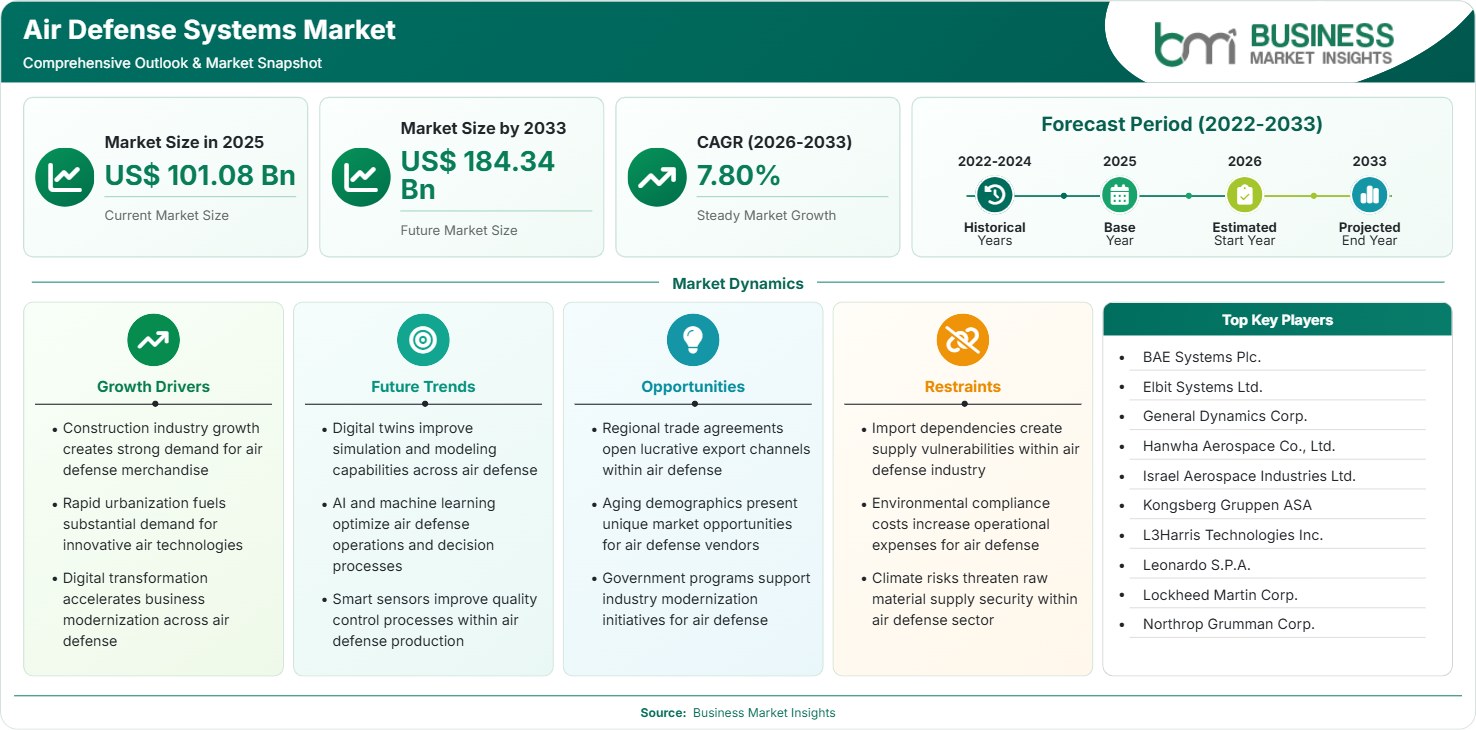
The Air Defense Systems Market size was valued at US$ 101.08 Billion in 2025 and is projected to reach US$ 184.34 Billion by 2033, growing at a CAGR of 7.80% during 2026–2033. Rising geopolitical tensions, accelerated missile modernization programs, increasing drone threats, integrated battlefield networking, and growing investments in layered air defense architectures continue creating substantial procurement opportunities globally.

Report Coverage
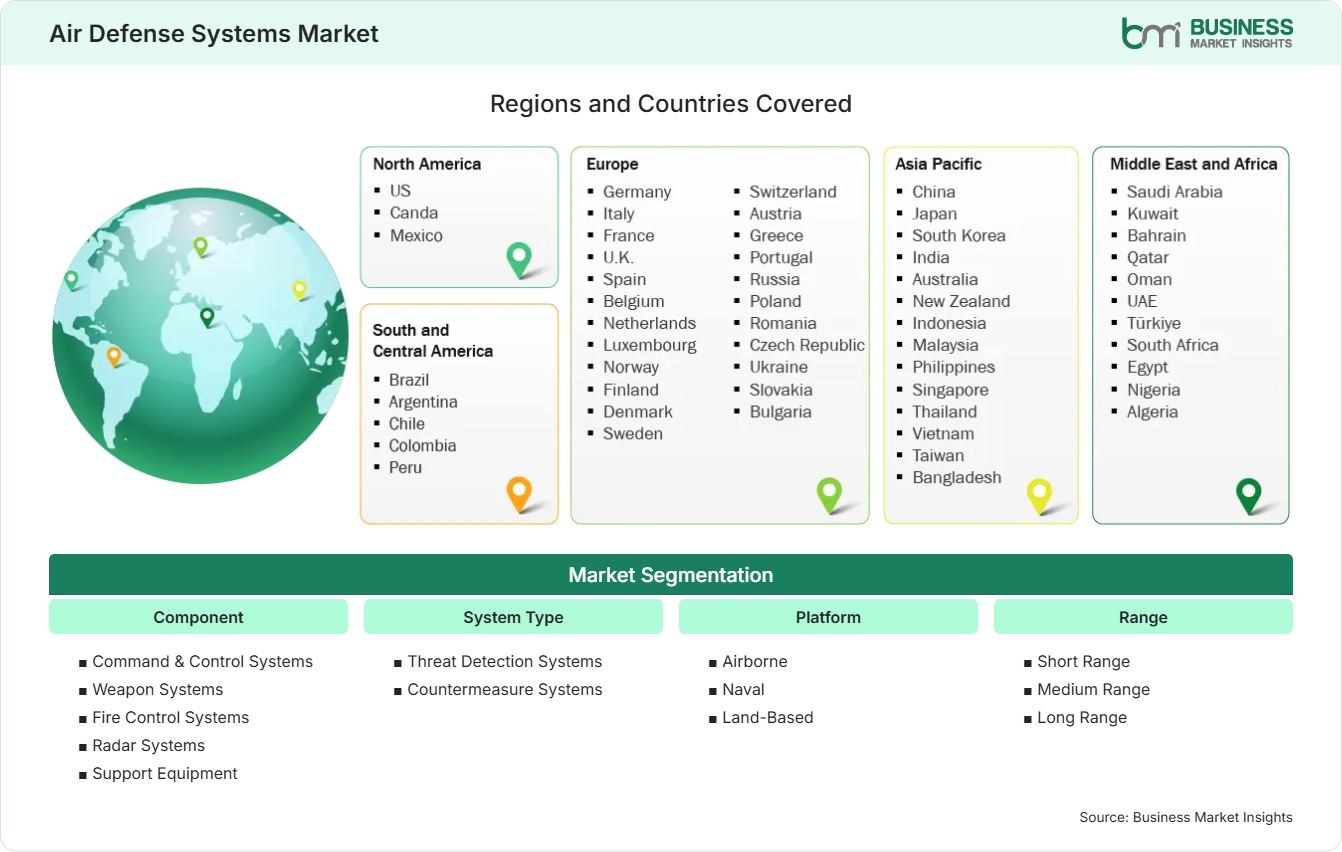
  • Component: Command & Control Systems, Weapon Systems, Fire Control Systems, Radar Systems, Support Equipment
  • System Type: Threat Detection Systems, Countermeasure Systems
  • Platform: Airborne, Naval, Land-Based
  • Range: Short Range , Medium Range , Long Range
  • Technology: Radar & Tracking, Guidance Systems, Directed Energy Weapons
US$ 101.08 Bn Market size in 2025
US$ 184.34 Bn Market Size by 2033
7.80% CAGR, 2026 - 2033
2026-2033 Forecast Period

AI Overview

Air Defense Systems Market Summary

  • North America Region: North America holds a market share of 34%–37% in 2025, growing with a CAGR of 6.8%–7.4% during 2026–2033. Defense modernization, hypersonic threat preparedness, integrated command networks, radar upgrades, and homeland security investments support procurement opportunities across military agencies and allied defense programs. The U.S. market benefits from advanced missile defense initiatives and is expected to grow at a CAGR of 6.9%–7.5% through 2033.
  • Fastest Growing Region: Asia Pacific holds a market share of 26%–29% in 2025, growing with a CAGR of 8.9%–9.8% during 2026–2033. Rising defense budgets, territorial security concerns, indigenous weapons development, military modernization, and cross-border threat monitoring continue accelerating deployment of advanced defense infrastructure.
  • Leading Segment: Radar Systems hold a market share of 28%–31% in 2025, growing with a CAGR of 7.4%–8.1% during 2026–2033. Multi-domain surveillance requirements, ballistic missile tracking, network-centric warfare capabilities, and long-range detection performance strengthen procurement across defense modernization programs worldwide.
  • High Growth Segment: Directed Energy Weapons hold a market share of 7%–10% in 2025, growing with a CAGR of 11.5%–12.8% during 2026–2033. Counter-drone requirements, lower engagement costs, technological breakthroughs, military research funding, and operational flexibility support expanding deployment prospects.
  • Key Market Opportunity: Expansion of integrated air and missile defense ecosystems combining artificial intelligence, advanced sensors, command networks, and autonomous interception capabilities creates strong long-term procurement opportunities across developed and emerging defense markets.
  • Major Market Players: Kongsberg Gruppen ASA, L3Harris Technologies Inc., Leonardo S.p.A., Lockheed Martin Corporation, Northrop Grumman Corporation, Rafael Advanced Defense Systems Ltd., RTX Corporation, Rheinmetall AG, Saab AB, Thales Group, The Boeing Company, MBDA, ASELSAN A.Ş., Bharat Dynamics Limited.
Strategic Insights

Air Defense Systems Market: Strategic Insights

Air Defense Systems Market Strategic Framework
FREE PDF
Request your free sample
Request free sample
Stakeholder View

Key Takeaways

  • The defense value chain is increasingly shifting toward integrated ecosystems where radar, command-and-control, sensors, interceptors, and communication networks operate as unified operational architectures.
  • Counter-drone and counter-loitering munition applications represent some of the strongest opportunities as military organizations address emerging asymmetric aerial threats.
  • Artificial intelligence-enabled threat classification, predictive tracking, and autonomous engagement capabilities are becoming core innovation priorities across leading defense contractors.
  • Asia Pacific offers a compelling investment case due to expanding military budgets, territorial security concerns, indigenous manufacturing initiatives, and procurement diversification programs.
  • Strategic collaborations, government-backed defense funding, and industrial partnerships continue driving technology transfers, capability enhancement, and industry consolidation.
  • Long-term demand is increasingly linked to integrated air and missile defense networks capable of addressing conventional, hypersonic, and autonomous aerial threats simultaneously.
Geographic Outlook

Air Defense Systems Market Regional Highlights

North America Air Defense Systems Market

North America accounted for approximately 34%–37% of global revenue in 2025 and is projected to expand at a CAGR of 6.8%–7.4% through 2033. The region benefits from substantial defense budgets, advanced military infrastructure, missile defense modernization initiatives, and strong domestic manufacturing capabilities. Air Defense Systems Market share remains highest in this region due to continuous investments in integrated air and missile defense architectures. Increasing focus on homeland security, hypersonic threat response, and next-generation radar deployment supports sustained procurement momentum across military agencies.

  • Missile defense modernization programs continue supporting deployment of advanced interceptors, command systems, and multi-domain surveillance capabilities across military installations and strategic defense networks.
  • Integration of artificial intelligence into battlefield management platforms is enhancing threat detection accuracy, reducing response times, and improving operational effectiveness.
  • Growing emphasis on hypersonic missile defense capabilities is encouraging investments in advanced tracking technologies, space-based sensors, and layered defense frameworks.
  • Defense contractors are increasingly focusing on open-architecture solutions that enhance interoperability between existing and next-generation defense assets.
  • Long-term procurement priorities remain concentrated on integrated air and missile defense programs supporting national security modernization objectives.

US Air Defense Systems Market

The United States represented approximately 72%–76% of regional revenue in 2025 and is expected to expand at a CAGR of 6.9%–7.5% through 2033. Extensive missile defense programs, advanced military research capabilities, and substantial procurement budgets continue strengthening national Air Defense Systems Market leadership. The country remains a key hub for technology innovation, defense exports, and large-scale modernization initiatives. Continuous upgrades to strategic defense infrastructure support sustained demand across multiple operational domains.

  • The Department of Defense continues prioritizing integrated missile defense architectures capable of addressing evolving aerial and missile threats.
  • Strong defense research funding supports advancements in directed-energy systems, artificial intelligence, and autonomous interception technologies.
  • Domestic defense manufacturing capabilities facilitate rapid deployment, modernization, and export opportunities across allied nations.
  • Increasing collaboration among defense agencies, contractors, and research institutions accelerates technology commercialization and operational readiness.

Europe Air Defense Systems Market

Europe accounted for approximately 24%–27% of global revenue in 2025 and is projected to register a CAGR of 7.5%–8.3% through 2033. Regional security concerns, military modernization initiatives, and NATO-aligned defense investments continue supporting procurement activity. Germany remains a leading Air Defense Systems Market, while Poland demonstrates among the highest growth trajectories with estimated expansion above regional averages. Governments are accelerating acquisition of integrated air defense capabilities to strengthen national and regional security resilience.

  • Increased defense spending commitments across NATO member states continue supporting procurement of advanced missile defense and surveillance systems.
  • Regional manufacturers are expanding production capacity to address growing domestic and export requirements.
  • Investments in multi-layer air defense architectures are strengthening operational readiness against evolving security threats.
  • Cross-border defense collaborations are enhancing interoperability and technology-sharing initiatives throughout the region.
  • Modernization of aging defense infrastructure remains a critical procurement driver across multiple European countries.

Asia Pacific Air Defense Systems Market

Asia Pacific represented approximately 26%–29% of global Air Defense Systems Market revenue in 2025 and is forecast to grow at a CAGR of 8.9%–9.8% through 2033. Rising geopolitical tensions, maritime security concerns, and expanding military modernization programs continue supporting procurement activity. China, India, Japan, South Korea, and Australia are key contributors to regional demand. Governments are increasingly prioritizing indigenous defense manufacturing and strategic technology partnerships to strengthen national security capabilities.

  • Territorial disputes and border security concerns continue accelerating investments in advanced surveillance and missile defense capabilities.
  • Indigenous manufacturing initiatives are encouraging domestic production, technology transfer agreements, and defense-sector innovation.
  • Military modernization programs emphasize network-centric warfare capabilities and integrated command-and-control systems.
  • Rising defense budgets support procurement of long-range detection systems, advanced radars, and next-generation interception technologies.
  • Strategic partnerships with international defense suppliers are expanding technological capabilities and operational effectiveness.

Rest of World Air Defense Systems Market

Rest of World accounted for approximately 11%–14% of global Air Defense Systems Market revenue in 2025 and is anticipated to expand at a CAGR of 7.8%–8.6% through 2033. The Middle East remains the largest contributor due to persistent regional security requirements and missile defense investments. South & Central America demonstrates selective procurement growth supported by border monitoring and critical infrastructure protection requirements. Regional governments continue focusing on capability enhancement through modernization programs and international defense partnerships.

  • Middle Eastern countries continue investing heavily in layered missile defense systems to address evolving regional security challenges.
  • Critical infrastructure protection initiatives are increasing demand for advanced surveillance and threat detection technologies.
  • International defense partnerships facilitate technology transfer, operational training, and procurement efficiency.
  • Governments are emphasizing integrated command-and-control systems to strengthen situational awareness and response capabilities.
  • Expanding drone threats are encouraging procurement of counter-UAV solutions across defense organizations.
Global Market Geography
FREE PDF
Request your free sample
Request free sample
Segment Analysis

Air Defense Systems Market Segmentation

Component

The Component segment accounted for approximately 100% of market revenue distribution, with Radar Systems emerging as the leading category holding 28%–31% share in 2025 and expanding at a CAGR of 7.4%–8.1% through 2033. Procurement priorities increasingly emphasize integrated detection, command, engagement, and battlefield management capabilities. The Air Defense Systems Market scope continues expanding as militaries seek seamless interoperability among sensors, interceptors, and command networks.

  • Command & Control Systems: These systems provide centralized battlefield visibility, threat prioritization, sensor integration, and engagement coordination, enabling military operators to manage complex multi-threat environments efficiently across land, naval, and airborne defense networks.
  • Weapon Systems: Advanced missile launchers, interceptor platforms, and kinetic engagement systems remain essential for neutralizing aircraft, drones, cruise missiles, and ballistic threats under diverse operational scenarios.
  • Fire Control Systems: Fire control technologies improve target acquisition, engagement accuracy, tracking continuity, and interception effectiveness through advanced computing, automated targeting algorithms, and integrated sensor connectivity.
  • Radar Systems: Long-range surveillance and tracking capabilities support early warning, threat classification, and interception planning, making radar infrastructure a foundational component of modern air defense architectures.
  • Support Equipment: Maintenance systems, logistics platforms, training simulators, communications equipment, and power management solutions ensure operational readiness and long-term mission sustainability.

System Type

System Type segmentation is evolving toward networked and layered defense architectures. Threat Detection Systems accounted for 54%–57% Air Defense Systems Market share during 2025 and are projected to grow at a CAGR of 7.3%–8.0%. Demand is driven by increasing complexity of aerial threats and requirements for persistent surveillance, predictive tracking, and rapid threat classification.

  • Threat Detection Systems: Advanced sensors, radar arrays, electro-optical systems, and artificial intelligence-enabled surveillance platforms strengthen situational awareness and support proactive defensive operations.
  • Countermeasure Systems: Missile interceptors, electronic warfare solutions, directed-energy technologies, and kinetic engagement platforms provide multilayered protection against increasingly sophisticated aerial threats.

Platform

Land-Based platforms maintained the largest deployment base with a Air Defense Systems Market share of 47%–50% in 2025 and are anticipated to expand at a CAGR of 7.6%–8.2%. Growing requirements for territorial defense, border protection, and strategic infrastructure security continue supporting procurement activity across military organizations globally.

  • Airborne: Airborne defense assets enhance mobility, rapid deployment capability, and extended surveillance coverage while supporting integrated battlefield operations across multiple domains.
  • Naval: Maritime deployments provide fleet protection, coastal security, and missile defense capabilities against airborne and sea-based threats within contested operational environments.
  • Land-Based: Ground-based systems offer scalable defense coverage, strategic infrastructure protection, and layered engagement capabilities supporting national defense objectives.

Range

Medium Range systems represented the largest revenue contribution with 39%–42% Air Defense Systems Market share in 2025 and are expected to register a CAGR of 7.7%–8.4% through 2033. These systems provide an effective balance between operational flexibility, deployment costs, and engagement capabilities.

  • Short Range (Below 10 km): Designed primarily for point defense missions, these systems address low-altitude threats including drones, helicopters, and tactical aircraft.
  • Medium Range (10–100 km): Widely deployed across military installations, these solutions provide layered protection against multiple aerial threats with enhanced operational flexibility.
  • Long Range (Above 100 km): Strategic defense systems deliver extended coverage against ballistic missiles, advanced aircraft, and emerging hypersonic threats.

Technology

Radar & Tracking technologies held the largest Air Defense Systems Market share at approximately 41%–44% in 2025 and are projected to expand at a CAGR of 7.5%–8.2%. Continued investments in sensor modernization, digital signal processing, and multi-domain integration support long-term demand.

  • Radar & Tracking: Advanced surveillance capabilities enable persistent monitoring, precise threat identification, and enhanced engagement decision-making across operational environments.
  • Guidance Systems: Modern guidance technologies improve interceptor accuracy, target discrimination, and mission effectiveness under complex combat conditions.
  • Directed Energy Weapons: Representing the fastest-growing technology category, these systems address counter-drone and low-cost engagement requirements through innovative operational concepts.

Deployment Mode

Fixed Installations accounted for 45%–48% of market revenue during 2025 and are expected to expand at a CAGR of 7.2%–7.9%. Critical infrastructure protection, strategic defense missions, and national security requirements continue driving deployment of permanent defense installations. Air Defense Systems Market trends indicate growing interest in portable and containerized architectures supporting rapid operational mobility.

  • Containerized: Modular deployment configurations provide flexibility, rapid transportation capability, and operational adaptability across varying mission requirements.
  • Portable: Mobile systems support expeditionary missions, tactical operations, and dynamic threat response requirements in rapidly changing environments.
  • Fixed Installations: Permanent defense infrastructures provide comprehensive territorial protection, strategic deterrence, and continuous surveillance capabilities.
Market Forces

Air Defense Systems Market Dynamics

Key Market Drivers

Escalating Missile and Hypersonic Threat Environment

Modern military conflicts increasingly feature cruise missiles, ballistic missiles, loitering munitions, and emerging hypersonic weapons. Governments are responding by accelerating investments in integrated missile defense networks capable of detecting and intercepting high-speed threats. NATO members continue increasing defense expenditures, while Indo-Pacific nations are prioritizing layered air defense modernization programs. Air Defense Systems Market growth is strongly supported by the need for multi-domain situational awareness, extended-range surveillance, and rapid engagement capabilities. Military organizations are replacing legacy architectures with advanced solutions incorporating artificial intelligence, sensor fusion, and networked command systems. The resulting procurement activity continues strengthening long-term industry demand across major defense markets.

Rapid Expansion of Counter-UAV Requirements

The proliferation of unmanned aerial systems across conventional and asymmetric warfare environments has fundamentally altered defense priorities. Low-cost drones, swarm attacks, and loitering munitions challenge traditional air defense architectures and require new operational approaches. Air Defense Systems Market trends increasingly reflect demand for integrated counter-UAS capabilities combining radar, electro-optical sensors, artificial intelligence, and kinetic or non-kinetic effectors. Defense organizations are deploying dedicated counter-drone solutions around military bases, critical infrastructure, and strategic assets. Recent demonstrations of AI-enabled counter-UAS architectures further highlight the importance of adaptive and scalable defense solutions supporting future battlefield requirements.

Defense Modernization and Network-Centric Warfare Adoption

Military forces worldwide are transitioning toward network-centric operational concepts that require seamless connectivity between sensors, command centers, and engagement platforms. Integrated air and missile defense architectures provide unified threat visibility and coordinated engagement capabilities. Governments are allocating substantial funding toward digital battlefield transformation, radar modernization, and command-and-control upgrades. Enhanced interoperability requirements among allied defense forces are encouraging adoption of open-architecture solutions capable of integrating diverse technologies. These modernization programs continue generating sustained procurement demand while strengthening long-term growth prospects for advanced defense systems across developed and emerging military markets.

Key Market Opportunities

Expansion of Directed Energy Defense Technologies

DE technologies provide an enabling breakthrough for the future of military architecture. Improvements in power generation, thermal management, and beam control have provided viable operational examples. This technology provides cost-effective operations by lowering the cost per engagement against drones and cheap aerial vehicles. Air Defense Systems Market Forecasts increasingly incorporate a growing trend towards forecasts involving the use of directed-energy applications as the armed forces assess options that can replace costly interceptors. More government funding and technological developments should facilitate further commercialization. With improved functionality, directed-energy systems could prove vital to integrated defense systems where threats can be rendered harmless effectively and economically.

Integrated Air and Missile Defense Network Development

Emerging Air Defense Systems Market Trends indicate that future procurement programs increasingly prioritize fully integrated defense ecosystems capable of coordinating sensors, interceptors, and command platforms in real time. Opportunities exist for suppliers offering interoperable technologies, digital command solutions, and advanced networking capabilities. The nations interested in protecting their entire territories from any threat are focusing on developing architectures that can defend against threats like ballistic missiles, UAVs, aircraft, and hypersonic threats. Procurement programs based on alliances offer even more opportunities to technology providers that can help meet the interoperability needs of multinational entities. Demand is driven by building advanced and automated defense architectures.

Indigenous Defense Manufacturing and Technology Transfer

Many governments are pursuing defense industrial self-sufficiency through domestic manufacturing initiatives, technology transfer programs, and strategic partnerships. These efforts create opportunities for international suppliers to collaborate with local defense industries while expanding Air Defense Systems Market access. Indigenous manufacturing approaches allow less dependence on the supply chain and provide resilience in national security terms. In the Asia-Pacific region, the Middle East, and Eastern Europe, countries are now turning to localized manufacturing practices. Defense firms that can provide for co-development, technology sharing, and localized manufacturing can take advantage of such opportunities.

Market Restraints and Challenges

High Procurement Costs and Budget Allocation Constraints

Factor: Advanced missile defense architectures require significant capital investment across radar infrastructure, interceptors, command systems, and support equipment.

Impact: Financial constraints might delay procurement process, limit the timeframes for modernization and decrease acquisitions. Many developing countries have difficulties managing their expenditures on military equipment in conjunction with other financial needs. Even in advanced countries, competing modernization programs might limit the funds that can be allocated to defense systems. The cost increase related to advanced technology adds to the procurement complexity. Financial issues constitute an important problem in this area.

Complex System Integration and Supply Chain Risks

Factor: Modern defense architectures rely on highly specialized components, advanced electronics, software integration, and multinational supplier ecosystems.

Impact: The complexities involved in integration can also result in delays in deployment, certification needs, and risks. Disruptions in the supply chain that impact semiconductors, propulsion, sensors, or specific materials can cause delays in the production process and procurement plans. The defense industry continues to allocate resources towards making their supply chains resilient and increasing production capacity due to high demands.

Company Analysis

Competitive Landscape

The competitive environment is characterized by long-term defense contracts, government procurement programs, technology partnerships, and continuous investments in integrated air and missile defense capabilities. Air Defense Systems Market analysis indicates that leading participants are focusing on radar modernization, command-and-control integration, counter-drone technologies, hypersonic defense initiatives, and indigenous manufacturing partnerships to strengthen market positioning.

Company Name

Overview

Products and Services Relevant to this Market

Kongsberg Gruppen ASA

Norwegian defense technology company specializing in integrated defense, surveillance, and command systems supporting military modernization initiatives.

NASAMS air defense systems, command-and-control solutions, missile integration platforms, radar networking, and battlefield management technologies.

L3Harris Technologies Inc.

Major U.S. defense contractor focused on communication, surveillance, intelligence, and mission-critical defense technologies.

Integrated air defense communications, surveillance systems, command solutions, sensors, and tactical battlefield networking platforms.

Leonardo S.p.A.

Global aerospace and defense company providing advanced electronics, surveillance, and military security technologies.

Air surveillance radars, command systems, integrated defense networks, tracking technologies, and military sensor solutions.

Lockheed Martin Corporation

Leading defense prime contractor with extensive experience in missile defense and integrated military systems.

Missile defense architectures, interceptor technologies, command networks, radar integration, and strategic defense platforms.

Northrop Grumman Corporation

U.S.-based defense technology leader focused on advanced sensing, aerospace, and missile defense capabilities.

Advanced radar systems, battle management platforms, missile tracking technologies, and integrated defense solutions.

Rafael Advanced Defense Systems Ltd.

Israeli defense company recognized for innovative missile defense and protection technologies.

Iron Dome components, interceptor systems, command platforms, counter-UAS solutions, and advanced defense technologies.

RTX Corporation

Global defense manufacturer delivering integrated missile defense, sensors, and aerospace technologies.

Patriot systems, radar solutions, interceptor missiles, command-and-control technologies, and integrated defense capabilities.

Rheinmetall AG

German defense supplier expanding capabilities across land systems, sensors, and military electronics.

Air defense systems, surveillance radars, weapon stations, command systems, and integrated battlefield solutions.

Saab AB

Swedish defense company focused on surveillance, command systems, and advanced defense technologies.

Giraffe radar systems, air surveillance technologies, command networks, and integrated defense platforms.

Thales Group

Multinational defense electronics provider specializing in secure communications and defense systems.

Air defense radars, command solutions, tracking systems, missile integration technologies, and battlefield management software.

The Boeing Company

Aerospace and defense leader with capabilities spanning missile defense and military technologies.

Missile defense support systems, surveillance technologies, command integration solutions, and defense modernization programs.

MBDA

European missile systems manufacturer serving multiple defense agencies worldwide.

Surface-to-air missile systems, interceptor technologies, integrated defense architectures, and engagement solutions.

ASELSAN A.Ş.

Turkish defense electronics specialist supporting indigenous defense modernization programs.

Radar systems, command-and-control solutions, electronic warfare technologies, and integrated defense capabilities.

Bharat Dynamics Limited

Indian defense manufacturer supporting missile production and strategic defense programs.

Missile systems, interceptor technologies, indigenous defense solutions, and integrated military support services.

Trust & Transparency

Research Methodology

The market analysis combines proprietary research with secondary data from government agencies, company disclosures, regulatory filings, industry databases and expert interviews. Market estimates are validated through data triangulation, cross-market benchmarking and analyst review.

View Full Research Methodology

Questions Answered

Frequently Asked Questions

Which emerging technology segment is expected to experience the highest growth?

Directed energy weapons are expected to demonstrate strong expansion due to their potential to provide lower-cost engagements against drones and other aerial threats while complementing conventional interceptor-based defense systems.

What does an Air Defense Systems Market Report typically evaluate?

An Air Defense Systems Market Report generally assesses technology developments, procurement trends, regional demand patterns, defense spending priorities, competitive positioning, and future opportunities across military air and missile defense ecosystems.

How are artificial intelligence technologies influencing defense system development?

Artificial intelligence improves threat classification, sensor fusion, predictive tracking, decision support, and automated engagement processes. These capabilities help military operators respond more effectively to increasingly complex and high-speed threats.

Why are radar systems considered critical within modern defense architectures?

Radar systems provide the foundational surveillance layer required for threat detection, target tracking, engagement planning, and battlefield awareness. Their effectiveness directly influences the performance of integrated air and missile defense networks.

Access the Full Air Defense Systems Market Report

Get segment-level forecasts, regional estimates, competitive benchmarking, company profiles and downloadable Excel datasets.

Access the full Air Defense Systems Market Report
350 pages PDF & Excel | 2026-08-17