Market Summary
Executive Summary and Global Market Analysis
Integrated air and missile defense refers to a layered military architecture that detects, tracks, classifies, and neutralizes airborne threats through coordinated sensors, command networks, launch systems, and interceptors. Its purpose extends beyond single-platform protection by linking engagement assets across land, sea, and air environments. This architecture is designed to respond to ballistic missiles, cruise missiles, aircraft, rockets, drones, and increasingly complex maneuvering threats.
Procurement momentum reflects the operational need for persistent surveillance, faster engagement cycles, and better coordination between distributed defense assets. Defense forces are refining networked architectures to address simultaneous attacks involving drones, cruise missiles, and tactical missiles. This requirement is encouraging investment in resilient command structures, radar modernization, and mobile defense configurations suited to contested operating environments.
System demand spans missile defense, anti-aircraft protection, counter-unmanned aircraft systems, counter-rocket artillery and mortar capabilities, and emerging counter-hypersonic layers. On the supply side, radars and sensors, fire control systems, launchers, weapon systems, command and control, and integration services form the technical backbone of deployment. Range-based requirements also vary across short, medium, and long-range interception missions, shaping procurement priorities for army, navy, and air force operators.
Technology evolution within this sector centers on sensor fusion, open-architecture command networks, data-driven engagement planning, and interoperability across allied platforms. Programs are increasingly structured to connect legacy assets with new interceptors and battle management software rather than replace entire force structures at once. That transition supports more flexible responses against saturation attacks and improves layered engagement efficiency across multiple threat classes.
Competitive conditions remain shaped by long program cycles, sovereign procurement priorities, integration complexity, and the need for validated operational performance. Vendors compete through system interoperability, upgrade pathways, production scalability, and alignment with national modernization agendas. As multi-threat defense becomes a central planning requirement, the industry is moving toward broader mission integration rather than isolated capability procurement.
Segment Analysis
Integrated Air and Missile Defense Market Segmentation
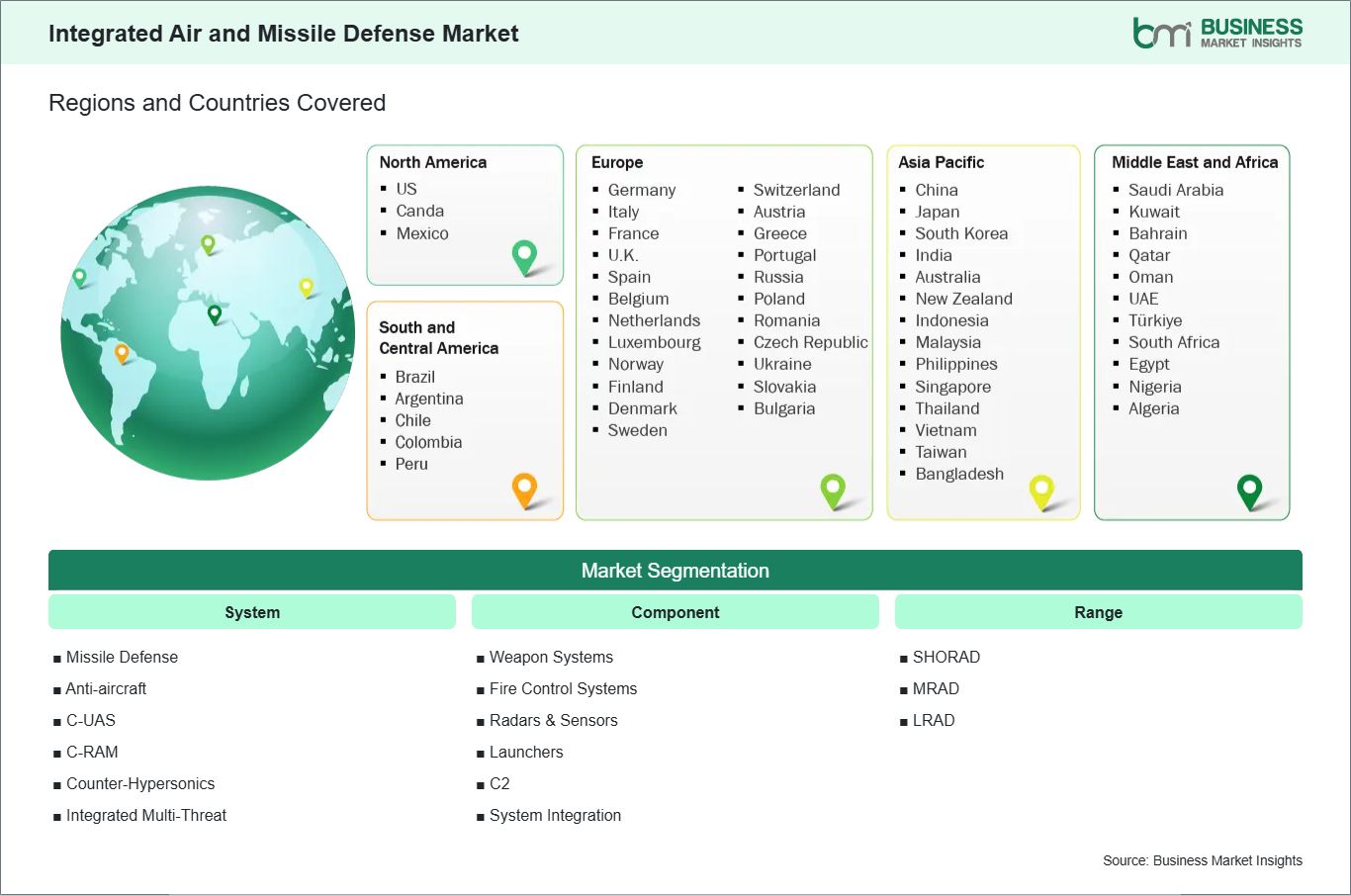
The market is segmented by system, component, range, and end user, reflecting layered defense planning across operational domains.
By System
- Missile Defense: Prioritized for layered interception against ballistic and cruise threat envelopes.
- Anti-aircraft: Maintains airspace protection against fixed-wing and rotary-wing intrusions.
- C-UAS: Expands to counter small, low-signature, and swarming unmanned systems.
- C-RAM: Supports force protection around bases and forward operating locations.
- Counter-Hypersonics:Gains attention as defense planners address compressed engagement timelines.
- Integrated Multi-Threat Segment: Unifies multiple effectors under coordinated battle management architectures.
By Component
- Weapon Systems: Central to engagement credibility across diverse aerial threat profiles.
- Fire Control Systems: Improve targeting precision and engagement sequencing efficiency.
- Radars & Sensors: Provide early warning, tracking continuity, and threat discrimination.
- Launchers: Enable mobile deployment and responsive interceptor positioning.
- C2: Connects detection, decision, and engagement across distributed assets.
- System Integration: Ensures interoperability between legacy systems and new architectures.
By Range
- SHORAD: Essential for point defense against low-altitude and short-notice threats.
- MRAD: Balances area coverage with deployment flexibility for layered missions.
- LRAD: Supports strategic defense against high-value and extended-range threats.
Market Forces
Integrated Air and Missile Defense Market Drivers and Opportunities
Escalating Multi-Threat Airspace Complexity
Air defense planning has become more demanding as forces confront overlapping threats from drones, cruise missiles, rockets, and maneuvering projectiles. Traditional point systems cannot consistently manage this threat mix without networked sensors and coordinated fire control. That operational gap is increasing procurement focus on integrated architectures that connect detection, decision, and interception into a unified response framework.
The impact extends beyond homeland defense into expeditionary protection, maritime security, and critical infrastructure shielding. Defense organizations require systems that can sustain engagement capacity under saturation conditions while preserving command visibility. This makes integrated air and missile defense relevant not only for strategic deterrence, but also for operational continuity across dispersed and contested theaters.
Open-Architecture Integration Across Legacy and Emerging Systems
A significant opportunity is emerging around open-architecture integration that links older defense assets with new sensors, battle management software, and interceptors. Governments are looking for flexible modernization paths that avoid complete system replacement. This trend favors integration platforms capable of combining different effectors and detection layers into a common operating picture for faster mission execution.
Future scope is broad because integrated frameworks can expand across land formations, naval fleets, and joint command environments with lower structural disruption. As procurement shifts toward software-defined coordination and interoperable nodes, suppliers that support modular upgrades may gain wider program access. This expansion can improve readiness, strengthen coalition compatibility, and extend mission coverage across evolving threat scenarios.
Size and Share Analysis
Integrated Air and Missile Defense Market Size and Share Analysis
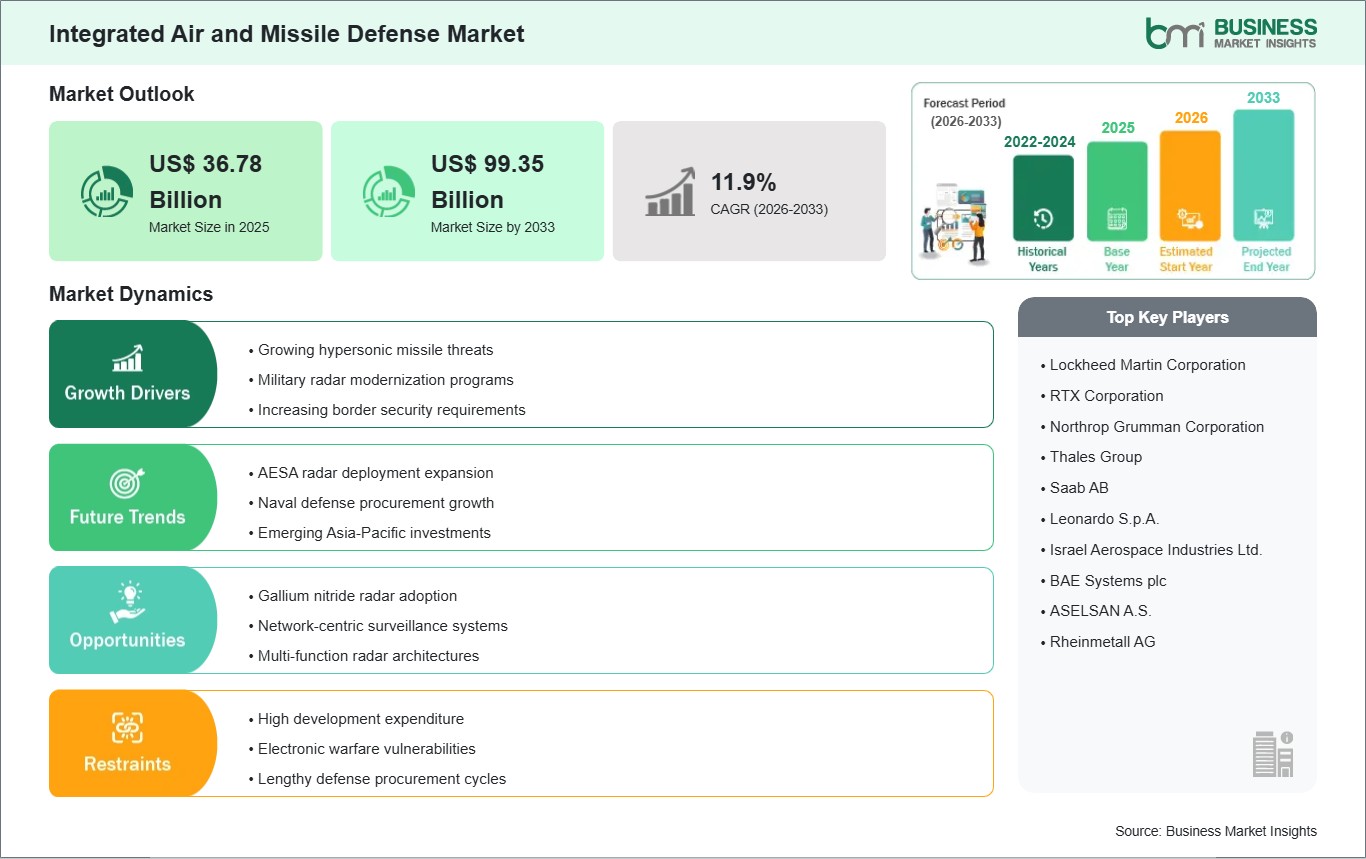
The Integrated Air and Missile Defense market size is projected to grow from US$ 36.78 Billion in 2025 to US$ 99.35 Billion by 2033, registering a CAGR of 11.9% during 2026 - 2033. This trajectory reflects sustained investment in layered defense architectures as armed forces seek broader threat coverage, improved engagement coordination, and stronger protection for strategic assets and deployed formations.
Among system categories, missile defense and integrated multi-threat configurations hold strategic prominence because procurement increasingly favors architectures that combine surveillance, command, and interception across several engagement layers. Within components, radars and sensors, fire control systems, and command networks remain central because performance depends on detection accuracy and coordinated battle management.
From an end-user perspective, army-led deployments account for a substantial share of operational demand due to land-based force protection and mobile air defense requirements. Application intensity also remains high in base defense, border surveillance, and maritime protection, where integrated engagement planning supports continuous readiness against dynamic aerial and missile threats.
Report Coverage
Integrated Air and Missile Defense Market Report Coverage and Deliverables
The "Integrated Air and Missile Defense Market Size and Forecast (2022–2033)" report provides a detailed analysis of the market covering below areas:
- Market size and forecast at global, regional, and country levels for all the key market segments covered under the scope
- Market trends, as well as market dynamics such as drivers, restraints, and key opportunities
- Market analysis covering key market trends, global and regional framework, major players, regulations, and recent market developments
- Industry landscape and competition analysis covering market concentration, heat map analysis, prominent players, and recent developments for the market
- Detailed company profiles, including SWOT analysis
Geographic Insights
Integrated Air and Missile Defense Market Geographic Insights
The Integrated Air and Missile Defense market shows diverse regional adoption patterns influenced by threat perceptions, defense modernization priorities, alliance commitments, and the maturity of command-and-control infrastructure. Global procurement programs increasingly emphasize layered architectures that can coordinate sensors, launchers, and battle management across service branches. This direction is strengthening demand for interoperable systems able to respond to drones, missiles, rockets, and aircraft within a single operational framework.
North America remains a principal center for capability development, field integration, and doctrinal advancement in this sector. Procurement focus is shaped by homeland defense, expeditionary protection, and the need to connect established missile defense assets with newer battle management networks. The regional landscape also benefits from a strong industrial base and established testing infrastructure, supporting sustained upgrades across land and maritime defense programs.
Asia Pacific is gaining strategic weight as governments strengthen defenses against expanding missile inventories, low-altitude incursions, and unmanned threats. Regional programs increasingly prioritize short-range and medium-range layers, networking capabilities, and faster decision support across distributed operating areas. Procurement strategies often combine domestic development with international collaboration, creating a dynamic environment for radar, command, and interceptor integration.
Europe continues to advance integrated defense through interoperability requirements, multi-country security coordination, and renewed emphasis on protecting critical infrastructure and forward positions. Emerging markets in the Middle East, Africa, and South and Central America are also examining layered defense models, although adoption paths differ according to budget structure, threat urgency, and local industrial capacity. These regions are creating selective opportunities for modular, scalable, and mission-specific deployments.
Industry Activity
Recent Developments
The Integrated Air and Missile Defense market is evaluated by gathering qualitative and quantitative data post primary and secondary research, which includes important corporate publications, association data, and databases. A few of the key developments in the Integrated Air and Missile Defense marketare.
- In March 2026, Thales Group has launched SkyDefender, an integrated air and missile defence dome that combines radar, command-and-control systems, AI, cybersecurity, and space-based sensors to protect against a wide range of threats, including drones, cruise missiles, ballistic missiles, and hypersonic weapons. The system uses a multi-layered defence architecture with short-, medium-, and long-range capabilities, supported by AI-driven threat analysis and an open architecture that can integrate with existing national and allied defence networks. SkyDefender is designed to provide comprehensive airspace protection and faster decision-making in response to increasingly sophisticated modern missile and aerial threats.
- In June 2026: RTX Corporation announced a $100 million investment in its Portsmouth, Rhode Island facility to expand radar testing and missile-interceptor production capacity. The project is expected to create about 150 high-tech jobs and support growing demand for advanced air and missile defense systems. The expansion will increase testing for the U.S. Army’s Lower Tier Air and Missile Defense Sensor (LTAMDS) radar and boost production of key components for Patriot GEM-T interceptors, helping accelerate deliveries to U.S. and allied customers. The move is part of RTX’s broader effort to strengthen defense manufacturing and meet rising global security requirements.
Trust & Transparency
Research Methodology
The market analysis combines proprietary research with secondary data from government agencies, company disclosures, regulatory filings, industry databases and expert interviews. Market estimates are validated through data triangulation, cross-market benchmarking and analyst
review.
View Full Research Methodology
Key Sources Referred:
World Bank – Global Trade IndicatorsWorld Trade Organization (WTO)(International Monetary Fund )IMFInternational Trade Administration (ITA)Company websiteCompany annual reportsCompany investor presentations