
Defense Electronics Market Outlook: Size, Share, Trends, Growth Analysis, Competitive Landscape & Forecast, 2026–2033

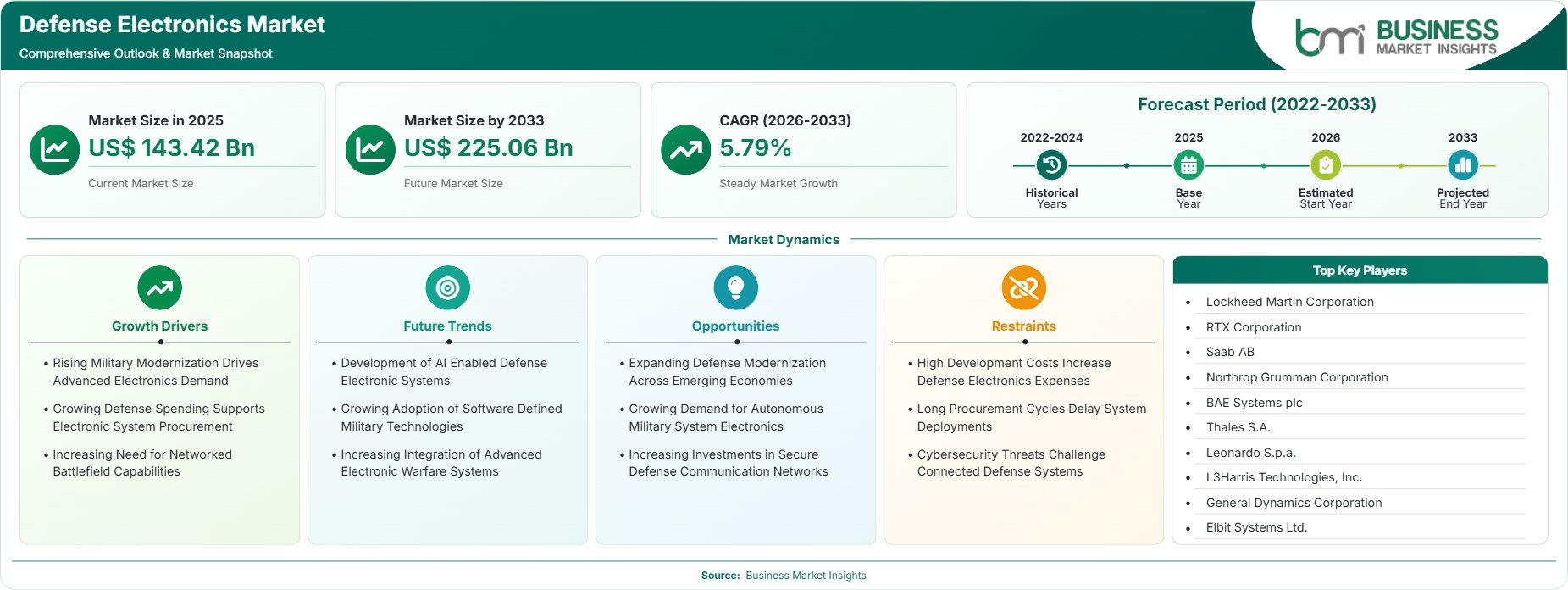
The Defense Electronics Market size was valued at US$ 143.42 Billion in 2025 and is projected to reach US$ 225.06 Billion by 2033, growing at a CAGR of 5.79% during 2026–2033, driven by military modernization, electronic warfare priorities, secure connectivity, advanced sensing, and opportunities across autonomous, networked, and multi-domain defense systems.

Report Coverage
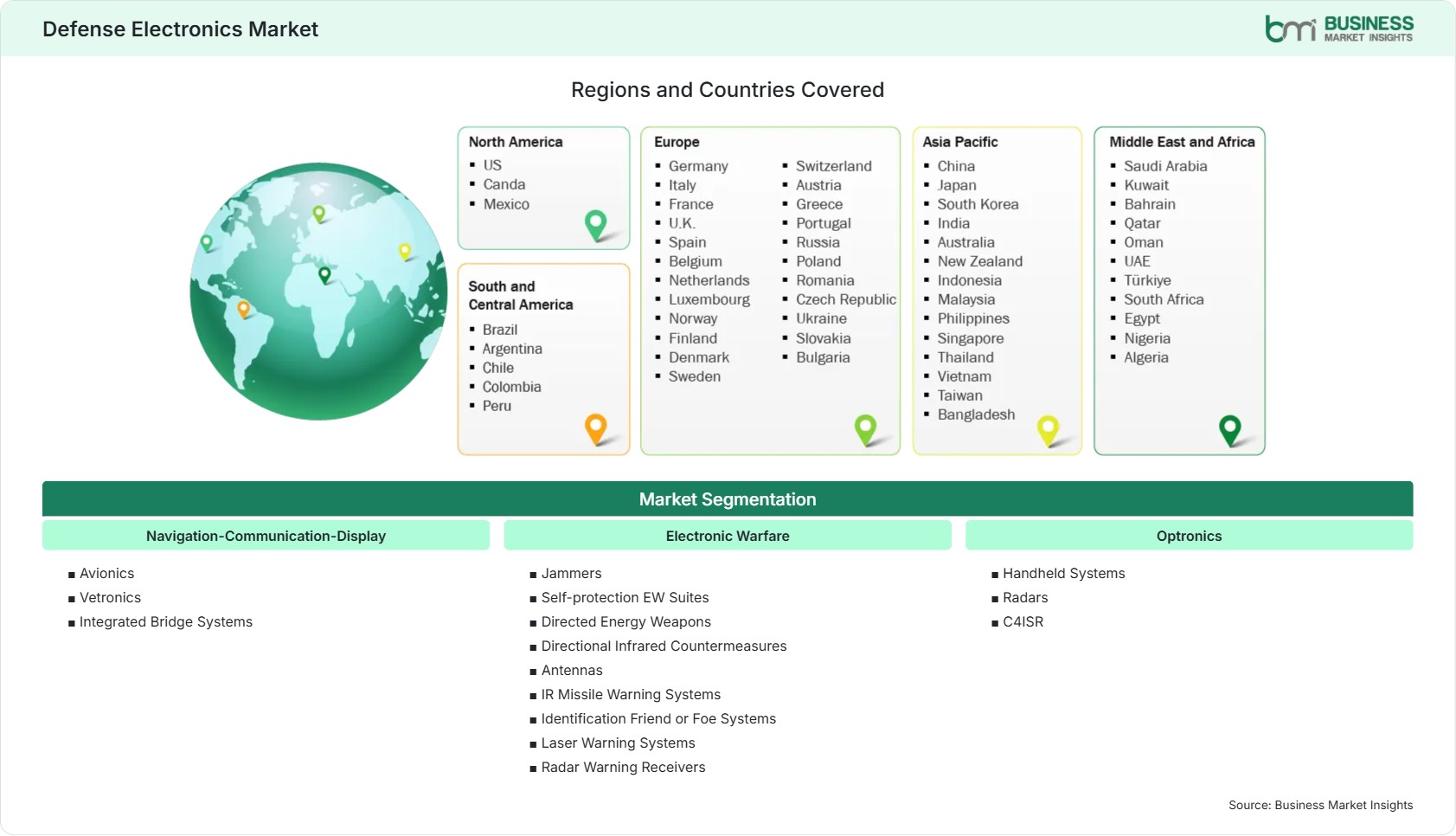
  • Navigation-Communication-Display: Avionics, Vetronics, Integrated Bridge Systems
  • Electronic Warfare: Jammers, Self-protection EW Suites, Directed Energy Weapons, Directional Infrared Countermeasures, Antennas, IR Missile Warning Systems, Identification Friend or Foe Systems, Laser Warning Systems, Radar Warning Receivers
  • Optronics: Handheld Systems, Radars, C4ISR
US$ 143.42 Bn Market size in 2025
US$ 225.06 Bn Market Size by 2033
5.79% CAGR, 2026 - 2033
2026-2033 Forecast Period

AI Overview

Defense Electronics Market Summary

  • North America Region: North America holds an estimated 36%–39% share in 2025 and is projected to grow at a 5.3%–5.8% CAGR during 2026–2033. Demand is supported by modernization programs, electronic warfare readiness, secure communications, sensor upgrades, autonomous platforms, and opportunities in integrated command systems, resilient networks, and advanced countermeasure technologies. The US market is expected to expand at a 5.4%–5.9% CAGR.
  • Fastest Growing Region: Asia Pacific holds an estimated 26%–29% share in 2025 and is expected to expand at a 6.4%–7.1% CAGR through 2033. Defense modernization, regional security priorities, indigenous manufacturing, naval expansion, aerospace investment, and demand for surveillance, communications, electronic warfare, and networked command capabilities are creating broad procurement opportunities.
  • Leading Segment: Navigation, Communication, and Display holds an estimated 43%–47% share in 2025 and is projected to grow at a 5.7%–6.2% CAGR, supported by modernization of aircraft, armored vehicles, naval platforms, and command environments, alongside rising requirements for interoperable, secure, and information-rich mission systems.
  • High Growth Segment: Electronic Warfare holds an estimated 32%–36% share in 2025 and is expected to advance at a 6.5%–7.2% CAGR, driven by contested electromagnetic environments, countermeasure requirements, spectrum dominance, platform survivability, and growing investment in adaptive jamming, warning, protection, and electronic intelligence capabilities.
  • Key Market Opportunity: Open-architecture electronics, software-defined systems, autonomous platforms, secure communications, multi-sensor fusion, and domestic production capabilities offer opportunities for suppliers able to support rapid technology upgrades and long program lifecycles.
  • Major Market Players: Lockheed Martin Corporation, RTX Corporation, Saab AB, Northrop Grumman Corporation, BAE Systems plc, Thales S.A., Leonardo S.p.A., L3Harris Technologies, Inc., General Dynamics Corporation, and Elbit Systems Ltd.
Strategic Insights

Defense Electronics Market: Strategic Insights

Defense Electronics Market Strategic Framework
FREE PDF
Request your free sample
Request free sample
Stakeholder View

Key Takeaways

  • The value chain is becoming more software-intensive, linking semiconductor suppliers, sensor specialists, system integrators, platform manufacturers, cybersecurity providers, and sustainment partners throughout long defense program cycles.
  • Electronic warfare, secure communications, distributed sensing, and mission computing offer the strongest upside because these capabilities are becoming essential across air, land, naval, space, and unmanned platforms.
  • Product development is moving toward modular architectures, software-defined functions, artificial intelligence-assisted processing, and systems capable of receiving upgrades throughout their operational life.
  • Asia Pacific presents a strong investment case as governments expand indigenous defense production, modernize military inventories, strengthen surveillance networks, and invest in maritime, aerospace, and electronic capabilities.
  • Consolidation and strategic investment are increasingly focused on specialized technologies that strengthen access to advanced sensors, communications, electronic warfare, autonomous systems, and mission software capabilities.
  • Future competitiveness will depend on cybersecurity, supply-chain resilience, export compliance, interoperability, component availability, and the ability to deliver upgrades without disrupting platform availability.
Geographic Outlook

Defense Electronics Market Regional Highlights

North America Defense Electronics Market

North America accounted for 36%–39% share in 2025 and is projected to expand at a 5.3%–5.8% CAGR through 2033. The Defense Electronics Market share is supported by large modernization programs, advanced aerospace capabilities, electronic warfare priorities, and continued investment in integrated command systems.

  • Military modernization programs are driving demand for upgraded mission systems, secure communications, sensors, electronic protection technologies, and computing architectures capable of supporting complex multi-domain operations.
  • Electronic warfare requirements are increasing investment in systems designed to detect, identify, disrupt, deceive, and defend against increasingly sophisticated electromagnetic threats.
  • Aerospace and naval modernization continue to generate demand for advanced avionics, radar, electronic surveillance, mission computers, and integrated platform management technologies.
  • Open architecture approaches are gaining importance as defense organizations seek faster upgrades, greater interoperability, reduced integration risk, and improved flexibility across long-lived military platforms.

US Defense Electronics Market

The US represented approximately 32%–35% of global share in 2025 and is expected to grow at a 5.4%–5.9% CAGR through 2033. Defense Electronics Market growth is supported by modernization across aircraft, naval systems, land platforms, missile defense, space assets, and command networks.

  • Demand for networked military capabilities is increasing requirements for secure communications and systems that allow faster information exchange across geographically dispersed forces.
  • Electronic warfare remains strategically important as military operations increasingly depend on the ability to operate, communicate, and maintain awareness within contested electromagnetic environments.
  • Modernization of aircraft and unmanned platforms supports continued investment in avionics, mission computers, sensors, electronic protection, and high-performance data processing capabilities.

Europe Defense Electronics Market

Europe held an estimated 24%–27% share in 2025 and is forecast to grow at a 5.8%–6.4% CAGR through 2033. France, the United Kingdom, and Germany remain leading markets, while Poland and other Central European countries offer stronger expansion opportunities. The Defense Electronics Market share is supported by higher modernization priorities, collaborative procurement, and investment in air defense, land systems, naval capabilities, and secure communications.

  • France supports advanced demand across aerospace, naval systems, secure communications, electronic warfare, and integrated mission technologies linked to domestic defense modernization.
  • The United Kingdom continues to prioritize next-generation sensing, electronic protection, secure networks, and technologies supporting future air and multi-domain operational capabilities.
  • Germany provides substantial modernization opportunities across land systems, air defense, communications, command infrastructure, and electronic technologies supporting improved military readiness.

Asia Pacific Defense Electronics Market

Asia Pacific accounted for 26%–29% share in 2025 and is expected to grow at a 6.4%–7.1% CAGR through 2033. China, India, Japan, and South Korea are major markets, with India and Southeast Asia providing significant expansion potential. Defense Electronics Market growth reflects indigenous production programs, maritime security priorities, aerospace investment, and modernization of communications and surveillance infrastructure.

  • China continues to support broad investment in military modernization, creating demand across sensors, communications, electronic systems, naval technologies, and aerospace mission capabilities.
  • India offers substantial opportunities as indigenous production policies and modernization requirements increase demand for locally developed and manufactured defense electronics.
  • Japan and South Korea support advanced procurement across naval, aerospace, surveillance, missile defense, and secure communications technologies.

Rest of World Defense Electronics Market

Rest of World represented approximately 9%–12% share in 2025 and is projected to advance at a 5.9%–6.7% CAGR through 2033. The Middle East and Africa are driven by defense procurement, air defense requirements, and modernization programs, with Saudi Arabia and the UAE providing significant technology opportunities.

  • Brazil remains an important regional market because modernization priorities span aerospace, land systems, communications, surveillance, and broader domestic defense industrial capabilities.
  • Middle Eastern procurement increasingly emphasizes integrated air defense, electronic surveillance, secure communications, and technologies supporting protection of strategic infrastructure.
  • Saudi Arabia offers significant opportunities through continued defense modernization and growing interest in localized production and technology-transfer arrangements.
  • The UAE supports demand for advanced defense technologies through investment in autonomous systems, secure communications, surveillance capabilities, and integrated military platforms.
Global Market Geography
FREE PDF
Request your free sample
Request free sample
Segment Analysis

Defense Electronics Market Segmentation

Navigation, Communication, and Display

Navigation, Communication, and Display leads the market, accounting for an estimated 43%–47% share in 2025 and projected to grow at a 5.7%–6.2% CAGR through 2033. Demand is tied to platform modernization and networked operations. Defense Electronics Market scope continues expanding as armed forces require reliable positioning, secure communications, integrated displays, and interoperable mission information across increasingly connected operational environments.

  • Avionics: Avionics support navigation, flight management, communications, mission processing, surveillance, and sensor integration, with modernization increasingly focused on software upgrades and interoperability.
  • Vetronics: Vetronics integrate vehicle electronics, communications, displays, sensors, navigation, and mission systems, improving situational awareness and supporting more connected land-force operations.
  • Integrated Bridge Systems: Integrated bridge systems combine navigation, communications, displays, sensors, and vessel management functions, supporting improved operational awareness and decision-making aboard naval platforms.

Electronic Warfare

Electronic Warfare represents an estimated 32%–36% share in 2025 and is projected to expand at a 6.5%–7.2% CAGR through 2033. Defense Electronics Market trends increasingly favor adaptive, software-driven systems capable of responding to rapidly changing threat environments while supporting platform survivability across multiple operational domains.

  • Jammers: Jammers are designed to disrupt hostile communications, radar, navigation, or other electromagnetic signals, supporting force protection and operational control in contested environments.
  • Self-protection EW Suites: Self-protection suites combine sensors, warning technologies, countermeasures, and electronic responses to improve the survivability of aircraft, vehicles, and naval platforms.
  • Directed Energy Weapons: Directed energy systems are being explored for defensive applications requiring rapid response, precision engagement, and potential alternatives to conventional interceptor-based protection.
  • Directional Infrared Countermeasures: Directional infrared countermeasures protect aircraft by detecting and disrupting heat-seeking missile threats through directed energy and integrated warning capabilities.
  • Antennas: Military antennas support communications, radar, electronic intelligence, navigation, and data transmission, with demand increasingly focused on compact, resilient, multi-band, and adaptable designs.
  • IR Missile Warning Systems: Infrared missile warning systems detect approaching threats and provide rapid alerts that enable aircraft and other platforms to initiate appropriate protective responses.
  • Identification Friend or Foe Systems: Identification Friend or Foe systems assist forces in distinguishing friendly, allied, neutral, and potentially hostile platforms within complex operational environments.
  • Laser Warning Systems: Laser warning systems detect laser-based targeting or range-finding activity, improving threat awareness and enabling platforms to initiate defensive or evasive measures.
  • Radar Warning Receivers: Radar warning receivers identify electromagnetic emissions associated with radar threats, providing situational awareness and supporting electronic countermeasure and survivability decisions.

Optronics

Optronics accounts for an estimated 20%–24% share in 2025 and is expected to grow at a 5.9%–6.6% CAGR through 2033. Defense Electronics Market share is strengthened by modernization programs that require improved imaging and intelligence capabilities across soldiers, vehicles, aircraft, naval assets, and command networks.

  • Handheld Systems: Handheld systems support portable observation, targeting, navigation, thermal imaging, and situational awareness, particularly for dismounted personnel operating in complex environments.
  • Radars: Defense radars support surveillance, detection, tracking, targeting, navigation, and air or maritime awareness, with modernization emphasizing improved processing and resistance to interference.
  • C4ISR: C4ISR integrates command, control, communications, computers, intelligence, surveillance, and reconnaissance, enabling faster information sharing and coordinated decisions across distributed military operations.
Market Forces

Defense Electronics Market Dynamics

Key Market Drivers

Military Modernization Is Expanding Demand for Advanced Electronics

The military is modernizing existing platforms and structures to enhance awareness, interconnectivity, survivability, and rapid response. Electronic systems are crucial in the context of modernization because of the dependence of current-generation aircraft, land vehicles, naval systems, and command infrastructure on sensors and computers. The Defense Electronics Market growth will thus be dependent on the modernization initiatives, where efficiency of operations rather than platform replacement will be of importance. The demand will be for solutions related to navigation, communications, display, protection, and surveillance. Companies capable of providing upgrades and interoperability throughout the life of military equipment will thus gain from these developments.

Contested Electromagnetic Environments Increase Electronic Warfare Demand

The growing need for forces to defend themselves against electromagnetic operations while being able to detect and react to such actions from an adversary is fueling interest in technologies relating to warning, jamming, electronic warfare, and electronic intelligence, as well as spectrum management. In this way, the Defense Electronics Market is seeing opportunities due to the understanding that having control over the electromagnetic spectrum has an impact on communication, navigation, sensing, and platform survivability. Future systems have to be able to adapt to changing threats much faster than is possible with traditional hard upgrade methods. The need for demand is such that flexible architecture and software-based functionalities, which are updatable and configurable in changing environments, shall be favored.

Networked Operations Drive Secure Communication and Data Requirements

The current defense operations now rely heavily on the fast exchange of information among people, sensors, vehicles, and command systems. It is, thus, a key requirement to have a secure communication network infrastructure in place. There is a growing need for technologies that can enhance bandwidth, survivability, encryption, and interoperability while working in challenging environments. The trends in the Defense Electronics Market are also driven by edge computing, which enables the system to perform analysis of vital information at the point of origination. The consequent shift leads to a higher demand for advanced processors, software, displays, communications equipment, etc.

Key Market Opportunities

Open Architecture Systems Create Long-Term Upgrade Opportunities

Open architecture provides room for minimizing dependency on fixed and proprietary technological infrastructures and integration of new functions in an easier manner. Modern military organizations appreciate systems that are able to incorporate changes in sensors, software, communications, and missions without the need for a total redesign of the platform. Such opportunities will become frequent in relation to modernization efforts and the involvement of technology suppliers with specialized offerings. The Defense Electronics Market Forecasts report is also positively influenced by the trend towards modularity in enduring military systems.

Autonomous and Unmanned Systems Expand Electronics Requirements

Unmanned and growingly autonomous systems need small electronics for sensing, navigating, communicating, mission processing, and controlling. Being used increasingly in the areas of surveillance, logistics, reconnaissance, maritime activity, and other military activities, these systems provide an opportunity for companies manufacturing light and power-efficient electronics. It is not only the individual systems but also the network of command and communications where the use of such electronics can be applied in the commercial sense. Opportunities may arise due to equipping unmanned fleets with better autonomy, sensing, protection, and communication technologies.

Domestic Electronics Production Supports New Industrial Partnerships

Governments are also increasingly attempting to gain more control over their strategically significant defense supply chains. This opens up possibilities for collaboration and partnerships involving manufacturing, technology transfer, joint development, and regional engineering. Production mandates create market entry chances for companies that are able to set up a localized production presence and work together with indigenous industries. Such possibilities apply to components, subsystems, testing, maintenance, and software development. Market success will depend more and more on developing trusted ecosystems of industry while retaining high-quality and secure access to critical technologies.

Market Restraints and Challenges

High Development and Integration Costs Limit Procurement Flexibility

Factor: Military electronics are highly sophisticated and necessitate specialized engineering, extensive testing, security of components, and integration with existing equipment. Impact: Increased costs of development and acquisition can delay purchases and reduce the size of the program. Integration problems could also lead to delays if the new systems have to interface with older communication, sensor, and software equipment. Qualification processes would increase the money demands from suppliers. Small technology firms would encounter many difficulties in joining major programs. Effective management of cost is necessary through the use of modular technology platforms, testing, and procurement.

Supply-Chain Dependence Creates Component Availability Risks

Factor: Defense electronics depend on specialized semiconductors, sensors, processors, and other components that may face production constraints or geopolitical restrictions. Impact: Limited availability can disrupt manufacturing schedules, increase procurement costs, and delay modernization programs. Long qualification requirements can make it difficult to replace approved components quickly. Dependence on international supply chains also raises concerns about security and continuity. Manufacturers are responding through supplier diversification, component redesign, inventory strategies, and domestic production initiatives. However, building resilient supply networks requires significant investment and long-term coordination between governments, prime contractors, technology suppliers, and component manufacturers.

Company Analysis

Competitive Landscape

The Defense Electronics Market analysis is characterized by competition among diversified defense primes, specialist electronics providers, sensor manufacturers, communications suppliers, and system integrators. Competitive strength is determined by technology depth, program experience, systems integration, secure manufacturing, international reach, and the ability to support modernization programs throughout lengthy procurement and sustainment cycles.

Company Name

Overview

Products and Services relevant to this market

Lockheed Martin Corporation

Global defense and aerospace company with broad capabilities across advanced military platforms, mission systems, sensors, and integrated defense technologies.

Avionics, radar, electronic warfare, communications, command systems, mission computing, sensors, missile defense electronics, and integrated technologies supporting air, land, sea, and space operations.

RTX Corporation

Major aerospace and defense technology company providing advanced sensors, communications, radar, electronic warfare, and mission-system capabilities.

Radar systems, electronic warfare technologies, communications, sensors, avionics, missile guidance electronics, cybersecurity solutions, and integrated mission technologies for military platforms.

Saab AB

Swedish defense and security company specializing in surveillance, sensors, electronic warfare, command systems, and advanced defense technologies.

Radar, electronic warfare, communications, surveillance, command-and-control systems, sensors, avionics, and integrated technologies supporting air, land, and maritime applications.

Northrop Grumman Corporation

Global aerospace and defense company with significant expertise in mission systems, sensors, electronic warfare, autonomous technologies, and advanced computing.

Radar, electronic warfare systems, mission computers, sensors, secure communications, navigation technologies, autonomous-system electronics, and integrated defense mission solutions.

BAE Systems plc

International defense company providing advanced technologies across electronic systems, combat platforms, aerospace, maritime, and intelligence applications.

Electronic warfare, avionics, mission systems, secure communications, sensors, combat electronics, intelligence technologies, and integrated solutions for military platforms.

Thales S.A.

Global technology company with extensive defense capabilities across communications, radar, sensors, cybersecurity, avionics, and mission systems.

Secure communications, radar, electronic warfare, avionics, C4ISR technologies, navigation systems, sensors, cybersecurity, and integrated command solutions for defense operations.

Leonardo S.p.A.

European aerospace and defense company offering electronics, sensors, helicopters, aircraft systems, cybersecurity, and integrated mission technologies.

Radar, electronic warfare, avionics, secure communications, sensors, mission systems, cyber technologies, and integrated electronics for airborne, naval, and land platforms.

L3Harris Technologies, Inc.

Defense technology company specializing in communications, sensors, electronic systems, intelligence solutions, and mission-critical technologies for military customers.

Tactical communications, electronic warfare, sensors, avionics, ISR technologies, secure networks, space electronics, mission systems, and integrated intelligence solutions.

General Dynamics Corporation

Diversified aerospace and defense company with operations across communications, mission systems, land platforms, naval technologies, and information systems.

Secure communications, command systems, vehicle electronics, mission computing, sensors, cyber technologies, naval electronics, and integrated information solutions for defense applications.

Elbit Systems Ltd.

Global defense technology company focused on electronic systems, sensors, unmanned technologies, communications, and integrated military solutions.

Electronic warfare, C4ISR, electro-optics, communications, avionics, unmanned-system electronics, vehicle systems, sensors, and integrated technologies supporting modern military operations.

Trust & Transparency

Research Methodology

The market analysis combines proprietary research with secondary data from government agencies, company disclosures, regulatory filings, industry databases and expert interviews. Market estimates are validated through data triangulation, cross-market benchmarking and analyst review.

View Full Research Methodology

Questions Answered

Frequently Asked Questions

How can a Defense Electronics Market Report support strategic planning?

The report can help stakeholders assess technology priorities, segmentation, regional procurement patterns, competitive positioning, modernization opportunities, supply-chain considerations, and areas requiring investment or partnership development.

How does open architecture affect defense technology procurement?

Open architecture can simplify technology upgrades by allowing compatible sensors, software, and subsystems to be integrated without extensive redesign, helping armed forces adapt systems to changing requirements.

Which platforms use defense electronics?

Defense electronics are used across aircraft, helicopters, armored vehicles, naval vessels, submarines, missiles, unmanned systems, satellites, command centers, and equipment used by dismounted military personnel.

Why is electronic warfare becoming increasingly important?

Modern military platforms depend heavily on radar, communications, navigation, and other electromagnetic systems. Electronic warfare technologies help forces detect threats, protect their systems, disrupt hostile capabilities, and maintain operational effectiveness.

What is driving demand for advanced defense electronics?

Demand is being supported by military modernization, electronic warfare requirements, secure communications, networked operations, autonomous platforms, improved situational awareness, and the need to upgrade long-serving defense assets.

Access the Full Defense Electronics Market Report

Get segment-level forecasts, regional estimates, competitive benchmarking, company profiles and downloadable Excel datasets.

Access the full Defense Electronics Market Report
350 pages PDF & Excel | 2026-08-31