
Electronic Intelligence Market Outlook: Size, Share, Trends, Growth Analysis, Competitive Landscape & Forecast, 2026-2033

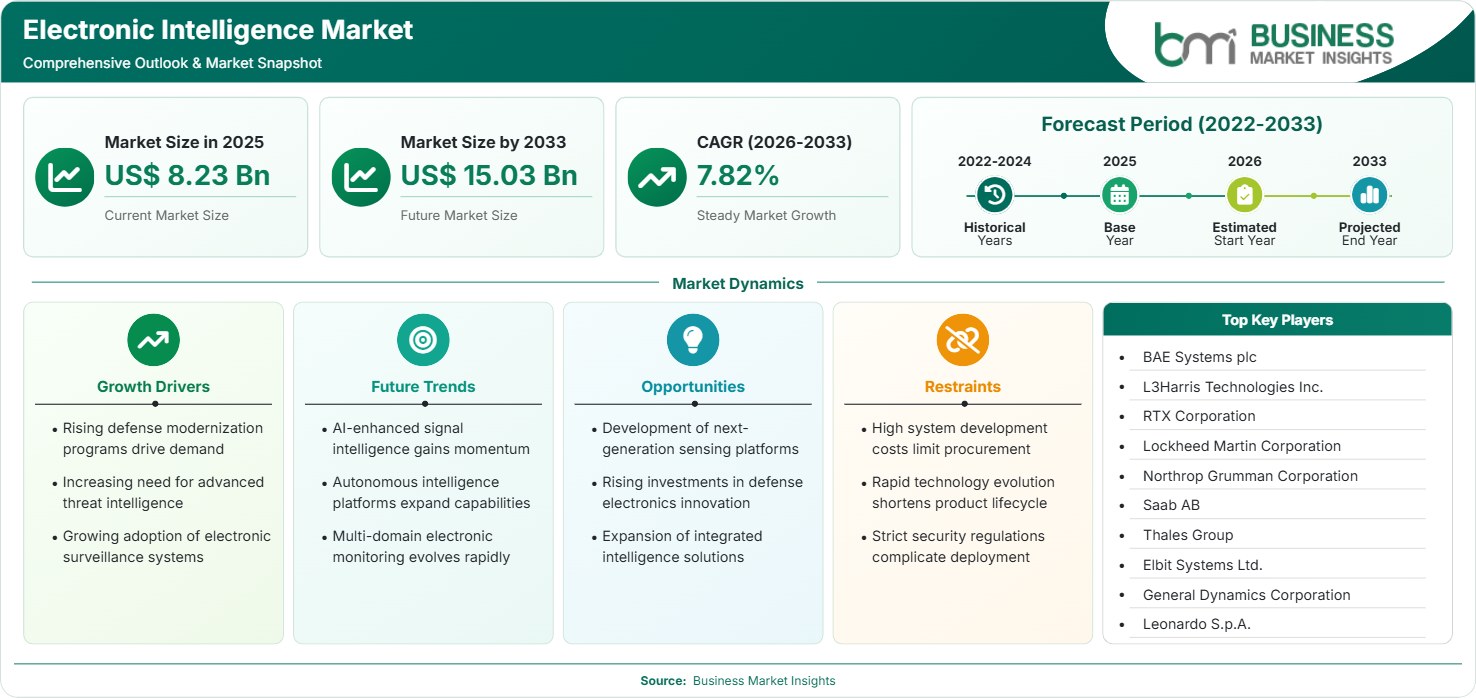
The Electronic Intelligence Market size was valued at US$ 8.23 billion in 2025 and is projected to reach US$ 15.03 billion by 2033, growing at a CAGR of 7.82% during 2026–2033. Rising defense modernization programs, increasing demand for advanced threat intelligence, growing deployment of electronic surveillance systems, and expanding investments in next-generation sensing technologies are creating significant opportunities for manufacturers and defense organizations worldwide.

Report Coverage
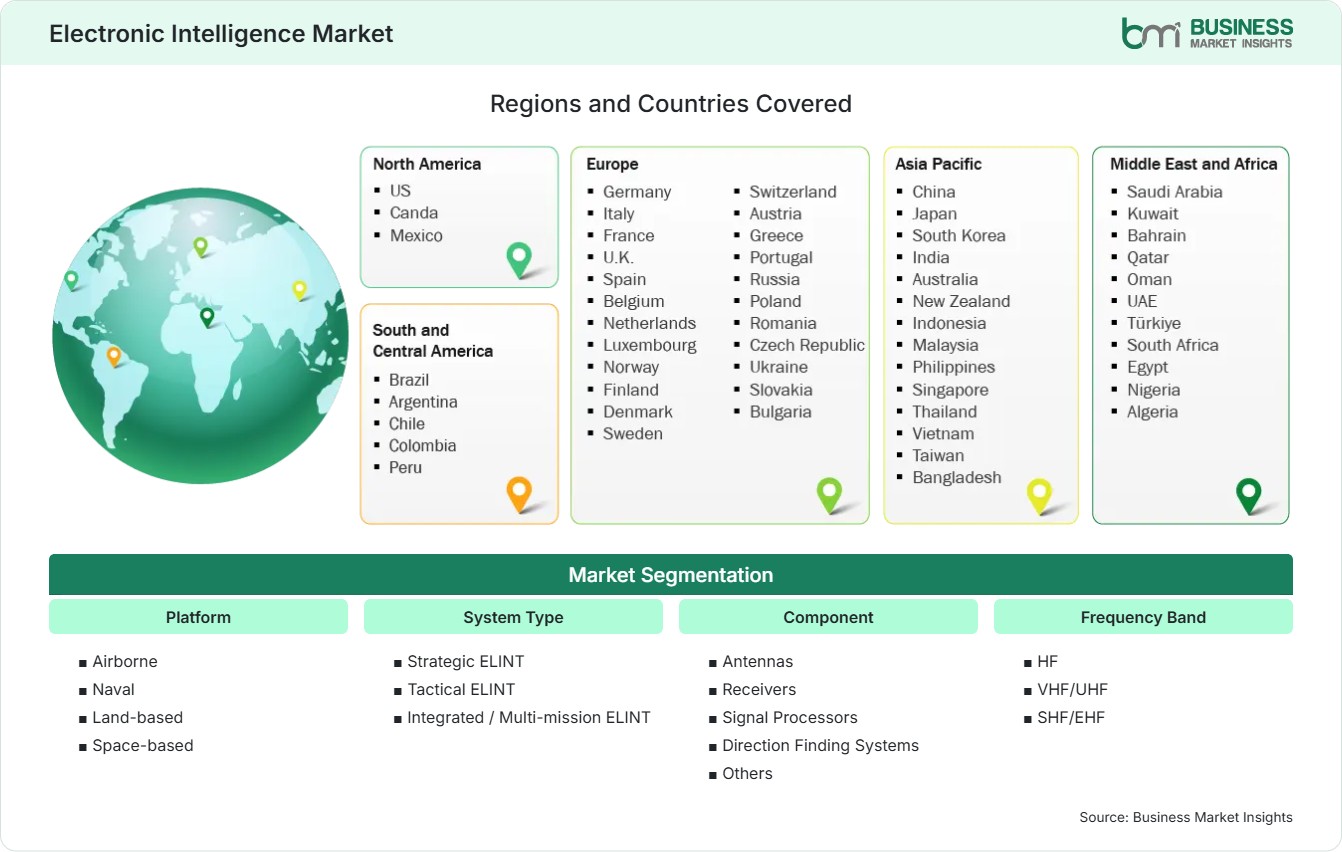
  • Platform: Airborne, Naval, Land-based, Space-based
  • System Type: Strategic ELINT, Tactical ELINT, Integrated / Multi-mission ELINT
  • Component: Antennas, Receivers, Signal Processors, Direction Finding Systems, Others
  • Frequency Band: HF, VHF/UHF, SHF/EHF
  • Application (Threat Detection & Early Warning, Surveillance & Reconnaissance, Targeting Support, Electronic Warfare Support, Border and Maritime Monitoring, Others), End User
US$ 8.23 Bn Market size in 2025
US$ 15.03 Bn Market Size by 2033
7.82% CAGR, 2026 - 2033
2026-2033 Forecast Period

AI Overview

Electronic Intelligence Market Summary

  • North America Region: North America holds 37%–40% market share in 2025 and is expected to grow at a CAGR of 7.4%–7.8% during 2026–2033. Strong defense budgets, continuous investments in electronic warfare capabilities, advanced aerospace technologies, and extensive intelligence modernization programs continue supporting regional leadership. The United States remains the primary contributor, supported by sustained defense procurement, advanced intelligence infrastructure, and an estimated CAGR of 7.5%–7.9% through 2033.
  • Fastest Growing Region: Asia Pacific accounts for 23%–26% electronic intelligence market share in 2025 and is projected to register a CAGR of 8.7%–9.2% during 2026–2033. Rising geopolitical tensions, expanding indigenous defense manufacturing, increasing military modernization programs, and growing investments in electronic surveillance technologies continue accelerating regional expansion.
  • Leading Segment: Airborne platform represents 34%–37% market share in 2025 and is forecast to expand at a CAGR of 7.8%–8.2% during 2026–2033. Increasing deployment of intelligence aircraft, unmanned aerial systems, and airborne surveillance missions continues supporting sustained segment leadership.
  • High Growth Segment: Integrated / Multi-mission ELINT accounts for 30%–33% market share in 2025 and is anticipated to grow at a CAGR of 8.5%–8.9% during 2026–2033. Rising demand for interoperable intelligence platforms, multi-domain operations, and integrated electronic warfare capabilities continues driving strong adoption.
  • Key Market Opportunity: Continuous advancements in artificial intelligence, software-defined sensing technologies, and multi-domain intelligence fusion platforms are creating new opportunities for defense organizations to improve situational awareness and operational decision-making.
  • Major Market Players: BAE Systems plc, L3Harris Technologies, Inc., RTX Corporation, Lockheed Martin Corporation, Northrop Grumman Corporation, Saab AB, Thales Group, Elbit Systems Ltd., General Dynamics Corporation, and Leonardo S.p.A.
Strategic Insights

Electronic Intelligence Market: Strategic Insights

Electronic Intelligence Market Strategic Framework
FREE PDF
Request your free sample
Request free sample
Stakeholder View

Key Takeaways

  • The market ecosystem continues evolving through strong collaboration among defense contractors, sensor manufacturers, software developers, communication technology providers, and government agencies to strengthen integrated intelligence capabilities across multi-domain military operations.
  • Integrated multi-mission electronic intelligence platforms represent one of the strongest long-term growth opportunities as defense organizations increasingly prioritize interoperable systems capable of supporting surveillance, reconnaissance, electronic warfare, and threat detection within a unified operational framework.
  • Product innovation is rapidly shifting toward artificial intelligence-enabled signal processing, cognitive electronic warfare, software-defined sensing technologies, autonomous intelligence platforms, and cloud-enabled mission management systems designed to improve operational efficiency and decision-making.
  • Asia Pacific continues emerging as a highly attractive investment destination owing to expanding defense budgets, indigenous military manufacturing initiatives, increasing geopolitical security requirements, and sustained investments in advanced surveillance and intelligence infrastructure.
  • Strategic partnerships, long-term defense contracts, technology licensing agreements, and cross-border industrial collaborations continue strengthening product portfolios while accelerating deployment of next-generation electronic intelligence capabilities across global defense organizations.
  • Increasing integration of cyber intelligence, space-based surveillance, autonomous platforms, and secure communications into electronic intelligence architectures is expected to enhance future operational capabilities while supporting resilient and data-driven defense decision-making across complex mission environments.
Geographic Outlook

Electronic Intelligence Market Regional Highlights

North America Electronic Intelligence Market

North America accounted for 37%–40% of the Electronic Intelligence Market Share in 2025 and is projected to expand at a CAGR of 7.4%–7.8% during 2026–2033. Defense modernization efforts along with the investment in electronic warfare capacity, aerospace manufacturing, and acquisition of intelligence equipment contribute to the development of the area. The cooperation of defense organizations and high-tech companies contributes to the innovation process, which will result in the implementation of new electronic intelligence platforms.

  • The United States and Canada continue investing in multi-domain intelligence capabilities, enabling integration of airborne, naval, land-based, and space-based surveillance assets into unified command structures.
  • Ongoing modernization of military communication networks supports deployment of advanced receivers, digital signal processors, and electronic surveillance technologies for improved situational awareness.
  • Defense contractors continue expanding investments in artificial intelligence, cognitive electronic warfare, and software-defined sensing technologies to strengthen intelligence gathering and electronic threat identification.
  • Increasing procurement of unmanned aerial systems equipped with advanced ELINT payloads supports persistent surveillance and real-time intelligence collection across strategic missions.
  • Strong domestic defense manufacturing capabilities and long-term government contracts continue reinforcing regional leadership in advanced electronic intelligence technologies.

US Electronic Intelligence Market

The United States represented 31%–34% of global revenue in 2025 and is forecast to register a CAGR of 7.5%–7.9% through 2026–2033. Continuous investments in defense innovation, advanced intelligence infrastructure, electronic warfare modernization, and next-generation sensing technologies maintain the country's dominant market position while encouraging development of integrated electronic intelligence capabilities.

  • Defense agencies continue expanding investments in electronic warfare modernization to improve spectrum dominance, threat identification, and secure military communications.
  • Major defense contractors strengthen domestic manufacturing while accelerating research in artificial intelligence-enabled intelligence processing and autonomous surveillance systems.
  • Growing investments in space-based intelligence platforms enhance national security by supporting continuous monitoring and strategic electronic signal collection.
  • Increasing collaboration between military organizations, research institutions, and technology companies accelerates commercialization of advanced intelligence solutions.

Europe Electronic Intelligence Market

Europe held 27%–30% electronic intelligence market share during 2025 and is anticipated to grow at a CAGR of 7.3%–7.7% through 2026–2033. Rising defense expenditure, expanding multinational security initiatives, and growing investments in electronic warfare technologies continue driving regional development. The United Kingdom leads regional demand with a CAGR of 7.4%–7.8%, while Poland is expected to record the fastest growth at 8.1%–8.5% owing to accelerated military modernization programs.

  • The United Kingdom continues investing in advanced intelligence aircraft, electronic warfare systems, and integrated surveillance technologies supporting national defense modernization.
  • Poland strengthens procurement of electronic intelligence systems through increasing investments in defense capabilities and strategic security infrastructure.
  • Collaborative European defense initiatives encourage development of interoperable intelligence platforms capable of supporting joint military operations.
  • Defense manufacturers continue focusing on software-defined electronic warfare systems, secure communications, and advanced signal intelligence capabilities.
  • Growing demand for border surveillance technologies strengthens procurement of integrated electronic intelligence solutions across multiple European nations.

Asia Pacific Electronic Intelligence Market

Asia Pacific accounted for 23%–26% of industry revenue in 2025 and is projected to record the highest CAGR of 8.7%–9.2% during 2026–2033. Expanding indigenous defense production, increasing geopolitical security concerns, and sustained investments in advanced surveillance infrastructure continue supporting regional expansion. China leads regional demand with a CAGR of 8.6%–9.0%, while India records the fastest growth at 9.2%–9.7%.

  • China continues strengthening domestic electronic warfare capabilities through significant investments in indigenous defense technologies, advanced sensors, and integrated intelligence systems.
  • India expands procurement of electronic intelligence platforms through defense modernization initiatives and increasing focus on self-reliant military manufacturing.
  • Japan and South Korea continue investing in next-generation surveillance systems supporting maritime security, missile defense, and regional intelligence operations.
  • Rising adoption of artificial intelligence-powered intelligence processing improves operational efficiency and accelerates electronic threat assessment capabilities.
  • Growing deployment of unmanned surveillance platforms strengthens long-term demand for advanced electronic intelligence technologies across regional defense organizations.

Rest of World Electronic Intelligence Market

The Rest of World accounted for 8%–10% electronic intelligence market share in 2025 and is expected to register a CAGR of 7.8%–8.3% during 2026–2033. South & Central America continue strengthening border security and surveillance capabilities through increasing defense modernization investments.

The Middle East & Africa are expanding procurement of electronic intelligence solutions to enhance military readiness, maritime security, and critical infrastructure protection. Brazil leads South & Central America with a CAGR of 7.9%–8.3%, while Saudi Arabia records the highest regional growth at 8.4%–8.8% through sustained defense modernization programs.

  • Brazil continues investing in advanced surveillance technologies supporting border monitoring, maritime security, and intelligence-driven defense operations.
  • Saudi Arabia strengthens procurement of integrated intelligence systems through long-term military modernization and national security initiatives.
  • Expanding regional defense collaborations encourage wider deployment of interoperable electronic intelligence platforms across multiple operational environments.
  • Growing investments in critical infrastructure protection continue increasing demand for advanced electronic surveillance and intelligence systems.
  • Rising adoption of multi-domain defense strategies creates new opportunities for integrated electronic intelligence technologies across emerging defense markets.
Global Market Geography
FREE PDF
Request your free sample
Request free sample
Segment Analysis

Electronic Intelligence Market Segmentation

Platform

The Platform segment accounted for 34%–37% of the overall market in 2025 and is projected to expand at a CAGR of 8.0%–8.4% during 2026–2033. Increasing deployment of multi-domain intelligence assets, continuous military modernization, and growing demand for persistent surveillance continue driving segment expansion. The Electronic Intelligence Market Forecasts indicate sustained investments in airborne and space-based intelligence platforms supporting modern defense operations.

  • Airborne: Remains the leading platform owing to extensive deployment in intelligence, surveillance, reconnaissance missions, electronic warfare operations, and long-range threat detection capabilities.
  • Naval: Experiences increasing adoption through maritime surveillance, fleet protection, anti-submarine operations, and coastal security applications requiring continuous electronic intelligence collection.
  • Land-based: Supports tactical battlefield intelligence through mobile surveillance units, fixed monitoring stations, and integrated electronic warfare operations across diverse operational environments.
  • Space-based: Gains momentum with growing deployment of intelligence satellites supporting global signal interception, strategic surveillance, and secure defense communication capabilities.

System Type

The System Type segment represented 30%–33% market share during 2025 and is expected to register a CAGR of 8.3%–8.7% during 2026–2033. Defense organizations increasingly prioritize interoperable intelligence systems capable of supporting strategic planning, tactical operations, and multi-domain command structures. The Electronic Intelligence Market Trends highlight rising integration of artificial intelligence and real-time data fusion across modern ELINT platforms.

  • Strategic ELINT: Focuses on long-range intelligence collection supporting national security planning, strategic threat monitoring, and electronic order of battle analysis.
  • Tactical ELINT: Enables real-time battlefield intelligence by detecting, identifying, and analyzing electronic emissions supporting operational military decision-making.
  • Integrated / Multi-mission ELINT: Combines surveillance, reconnaissance, targeting support, and electronic warfare capabilities within unified intelligence platforms for enhanced mission effectiveness.

Component

The Component segment generated 25%–28% of total revenue in 2025 and is forecast to grow at a CAGR of 7.8%–8.2% through 2026–2033. Continuous advancements in electronic hardware, digital processing technologies, and high-performance sensing capabilities continue improving intelligence collection accuracy while supporting modernization of electronic warfare systems.

  • Antennas: Enable efficient interception of electromagnetic signals across multiple operational frequencies while supporting accurate intelligence gathering and electronic surveillance.
  • Receivers: Perform high-speed signal acquisition and processing, enabling rapid identification and classification of electronic emissions across complex operational environments.
  • Signal Processors: Utilize advanced computing capabilities to analyze intercepted signals, improve threat recognition, and accelerate electronic intelligence decision-making processes.
  • Direction Finding Systems: Provide accurate geolocation of electronic emitters, supporting targeting operations, threat assessment, and electronic warfare mission planning.

Frequency Band

The Frequency Band segment accounted for 21%–24% market share during 2025 and is projected to expand at a CAGR of 7.9%–8.3% through 2026–2033. Growing complexity of modern communication networks and radar systems continues driving demand for comprehensive frequency monitoring capabilities across multiple operational environments.

  • HF: Supports long-range communications intelligence and strategic monitoring applications requiring extended operational coverage.
  • VHF/UHF: Widely utilized for military communications monitoring, tactical surveillance, and battlefield intelligence collection across land, naval, and airborne operations.
  • SHF/EHF: Increasingly adopted for advanced radar surveillance, satellite communications intelligence, and high-frequency electronic warfare applications.

Application

The Application segment generated 29%–32% of total revenue in 2025 and is forecast to grow at a CAGR of 8.1%–8.5% during 2026–2033. Expanding defense modernization initiatives and evolving operational requirements continue strengthening adoption of intelligence-driven mission support systems.

  • Threat Detection & Early Warning: Supports rapid identification of hostile electronic emissions enabling proactive military response and operational preparedness.
  • Surveillance & Reconnaissance: Provides continuous intelligence collection supporting strategic monitoring, mission planning, and national security operations.
  • Targeting Support: Improves precision engagement through accurate electronic emitter identification and location tracking during military operations.
  • Electronic Warfare Support: Enhances operational effectiveness by supplying real-time electronic intelligence for defensive and offensive electronic warfare missions.
  • Border and Maritime Monitoring: Strengthens surveillance across national borders and maritime territories through continuous electronic signal monitoring and threat identification.

End User

The End User segment accounted for 41%–44% of market revenue in 2025 and is anticipated to register a CAGR of 7.9%–8.3% during 2026–2033. Growing defense procurement, intelligence modernization, and homeland security investments continue driving demand for advanced electronic intelligence capabilities across government organizations and military agencies.

  • Defense Forces: Represent the primary end users through continuous investments in electronic warfare, intelligence gathering, and integrated surveillance capabilities.
  • Homeland Security Agencies: Increasingly deploy electronic intelligence systems for border protection, counterterrorism operations, and critical infrastructure security.
  • Intelligence Organizations: Utilize advanced ELINT platforms for strategic surveillance, electronic signal analysis, and national security intelligence operations.
Market Forces

Electronic Intelligence Market Dynamics

Key Market Drivers

Rising defense modernization programs drive demand

Governments worldwide continue prioritizing defense modernization to strengthen national security and improve operational readiness across air, land, naval, and space domains. The Stockholm International Peace Research Institute (SIPRI) reports that military expenditure across the globe has been reaching record levels, aiding in the procurement of sophisticated ISR and EW systems. Military organizations have been opting for newer digitally integrated ELINT systems, which have the ability to intercept and analyze signals in real-time. These investments continue supporting Electronic Intelligence Market Growth by encouraging deployment of next-generation intelligence platforms with improved situational awareness and mission effectiveness.

Increasing need for advanced threat intelligence

The growing complexity of modern warfare and the rapid evolution of electronic threats are increasing demand for sophisticated threat intelligence capabilities. The military services need to have sophisticated ELINT capabilities that can detect, recognize, classify, and geolocate threatening electronic emanations in different environments. AI, machine learning, and cognitive signal processing are improving analysis precision and decreasing reaction times. Improvements in electronic threat databases and intelligence processing increase the strength of decision making for defense operations.

Growing adoption of electronic surveillance systems

Surveillance defense agencies are enhancing their use of electronic surveillance equipment in order to enhance border security, maritime surveillance, critical infrastructure protection, and battlefield intelligence gathering. This is due to the fact that advanced surveillance vehicles fitted with high-performance receivers, software-defined radio, and digital signal processors make it possible to carry out real-time surveillance in complicated electromagnetic environment.

Key Market Opportunities

Development of next-generation sensing platforms

Advances in high technology sensing, artificial intelligence for signals processing, and software-driven electronic platforms are presenting numerous business opportunities. The defense companies are designing highly flexible sensing systems that can operate in the air, water, on land, and in space with increased precision and operational flexibility. Advancements in miniaturizing sensors and semiconductor performance have made it possible to deploy compact intelligence systems in different defense applications. The Electronic Intelligence Market Forecasts indicate sustained investment in next-generation sensing technologies supporting future battlefield modernization.

Rising investments in defense electronics innovation

Governments and defense organizations continue increasing investments in advanced defense electronics to strengthen electronic warfare, secure communications, and intelligence gathering capabilities. Funding supports research into high-speed processors, advanced receivers, cognitive electronic warfare systems, and resilient communication technologies. Strategic collaborations between defense manufacturers, semiconductor companies, and research institutions accelerate commercialization of innovative electronic intelligence solutions while expanding long-term business opportunities.

Expansion of integrated intelligence solutions

Military organizations increasingly prefer integrated intelligence platforms capable of combining ELINT, SIGINT, radar intelligence, communications intelligence, and cyber intelligence within unified command structures. Multi-domain integration improves situational awareness, enhances operational coordination, and enables faster strategic decision-making. Continuous development of open-system architectures further supports interoperability across military assets while encouraging procurement of comprehensive intelligence ecosystems.

Market Restraints and Challenges

High system development costs limit procurement

Factor: Electronic intelligence systems require sophisticated sensors, high-performance processors, secure communication modules, specialized software, and extensive testing to meet stringent military performance standards. Impact: Elevated development and acquisition costs restrict procurement among defense organizations with limited modernization budgets, particularly in developing economies. Manufacturers also face significant financial risks associated with long product development cycles and highly customized military requirements.

Rapid technology evolution shortens product lifecycle

Factor: Continuous advancements in electronic warfare technologies, communication systems, radar capabilities, and signal processing require frequent product upgrades to maintain operational effectiveness. Impact: Defense organizations experience increasing lifecycle management costs while manufacturers must continuously invest in research and development to remain technologically competitive. Frequent technology refresh requirements also create integration challenges for legacy intelligence platforms operating within existing defense infrastructures.

Company Analysis

Competitive Landscape

The competitive landscape is characterized by continuous technological innovation, strategic defense partnerships, and long-term government procurement programs. Leading companies continue investing in artificial intelligence, cognitive electronic warfare, advanced sensing technologies, and integrated intelligence solutions to strengthen product portfolios and maintain competitive positioning. Ongoing research collaborations and defense modernization initiatives continue supporting comprehensive Electronic Intelligence Market Analysis across global military and homeland security applications.

Company Name

Overview

Products and Services Relevant to this Market

BAE Systems plc

Global defense company specializing in advanced electronic warfare, intelligence, and mission systems.

Electronic intelligence systems, electronic warfare solutions, surveillance technologies, mission management systems, and defense electronics.

L3Harris Technologies, Inc.

Defense technology company delivering advanced intelligence, surveillance, and secure communication solutions.

ELINT systems, ISR platforms, communication systems, signal intelligence solutions, and electronic warfare technologies.

RTX Corporation

Aerospace and defense company providing integrated sensing, intelligence, and electronic warfare capabilities.

Radar systems, electronic intelligence solutions, surveillance sensors, mission electronics, and defense technologies.

Lockheed Martin Corporation

Global defense contractor developing advanced intelligence and multi-domain mission solutions.

Electronic warfare systems, intelligence platforms, surveillance technologies, integrated mission systems, and defense electronics.

Northrop Grumman Corporation

Aerospace and defense company focused on next-generation intelligence and surveillance technologies.

ELINT platforms, airborne intelligence systems, electronic warfare capabilities, sensors, and mission support solutions.

Saab AB

Defense and security company specializing in electronic warfare, surveillance, and integrated defense systems.

Electronic surveillance systems, intelligence solutions, radar technologies, mission systems, and defense electronics.

Thales Group

Global technology company delivering secure communications, intelligence, and electronic defense solutions.

ELINT technologies, surveillance systems, communication networks, electronic warfare platforms, and integrated defense systems.

Elbit Systems Ltd.

Defense electronics company providing intelligence, surveillance, and battlefield management technologies.

Electronic intelligence systems, tactical surveillance, electronic warfare solutions, sensors, and mission management platforms.

General Dynamics Corporation

Aerospace and defense company delivering secure communications and advanced intelligence capabilities.

Intelligence systems, mission electronics, communication technologies, surveillance solutions, and defense integration services.

Leonardo S.p.A.

International aerospace and defense company specializing in electronic warfare and integrated intelligence technologies.

Electronic intelligence systems, surveillance sensors, mission avionics, electronic warfare technologies, and defense electronics.

Trust & Transparency

Research Methodology

The market analysis combines proprietary research with secondary data from government agencies, company disclosures, regulatory filings, industry databases and expert interviews. Market estimates are validated through data triangulation, cross-market benchmarking and analyst review.

View Full Research Methodology

Questions Answered

Frequently Asked Questions

What does the Electronic Intelligence Market Report include?

The Report provides comprehensive insights into market size, segmentation, competitive landscape, regional performance, technological developments, growth drivers, opportunities, restraints, recent developments, and future industry outlook.

What opportunities are expected to influence future market expansion?

Artificial intelligence-enabled sensing platforms, integrated intelligence ecosystems, software-defined architectures, and increasing investments in defense electronics are expected to generate significant long-term growth opportunities.

Which platform dominates the market?

The airborne platform holds the largest market share because of its extensive use in intelligence, surveillance, reconnaissance missions, electronic warfare operations, and long-range electronic signal monitoring.

Which region leads the Market?

North America remains the leading regional market owing to substantial defense expenditure, advanced aerospace capabilities, continuous investments in intelligence modernization, and the presence of major defense technology companies.

What factors are driving the Electronic Intelligence Market?

The market is driven by defense modernization programs, increasing geopolitical tensions, rising demand for advanced threat intelligence, expanding electronic warfare capabilities, and growing investments in integrated surveillance and intelligence systems.

Access the Full Electronic Intelligence Market Report

Get segment-level forecasts, regional estimates, competitive benchmarking, company profiles and downloadable Excel datasets.

Access the full Electronic Intelligence Market Report
350 pages PDF & Excel | 2026-08-05