
Cognitive Electronic Warfare Market Outlook: Size, Share, Trends, Growth Analysis, Competitive Landscape & Forecast, 2026-2033

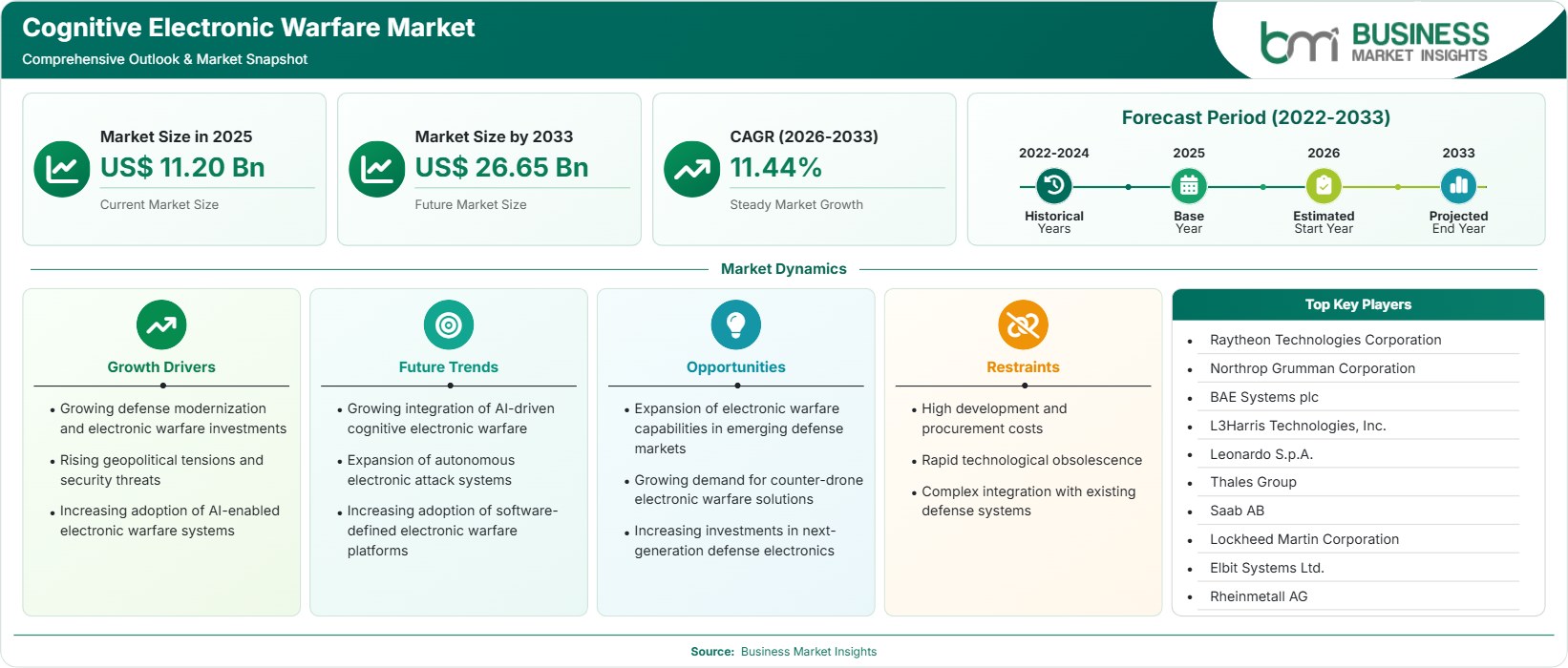
The Cognitive Electronic Warfare Market size was valued at US$ 11.20 Billion in 2025 and is projected to reach US$ 26.65 Billion by 2033, growing at a CAGR of 11.44% during 2026–2033. Market expansion is driven by accelerating defense modernization programs, increasing deployment of AI-enabled electronic warfare platforms, and growing requirements for adaptive spectrum dominance capabilities.

Report Coverage
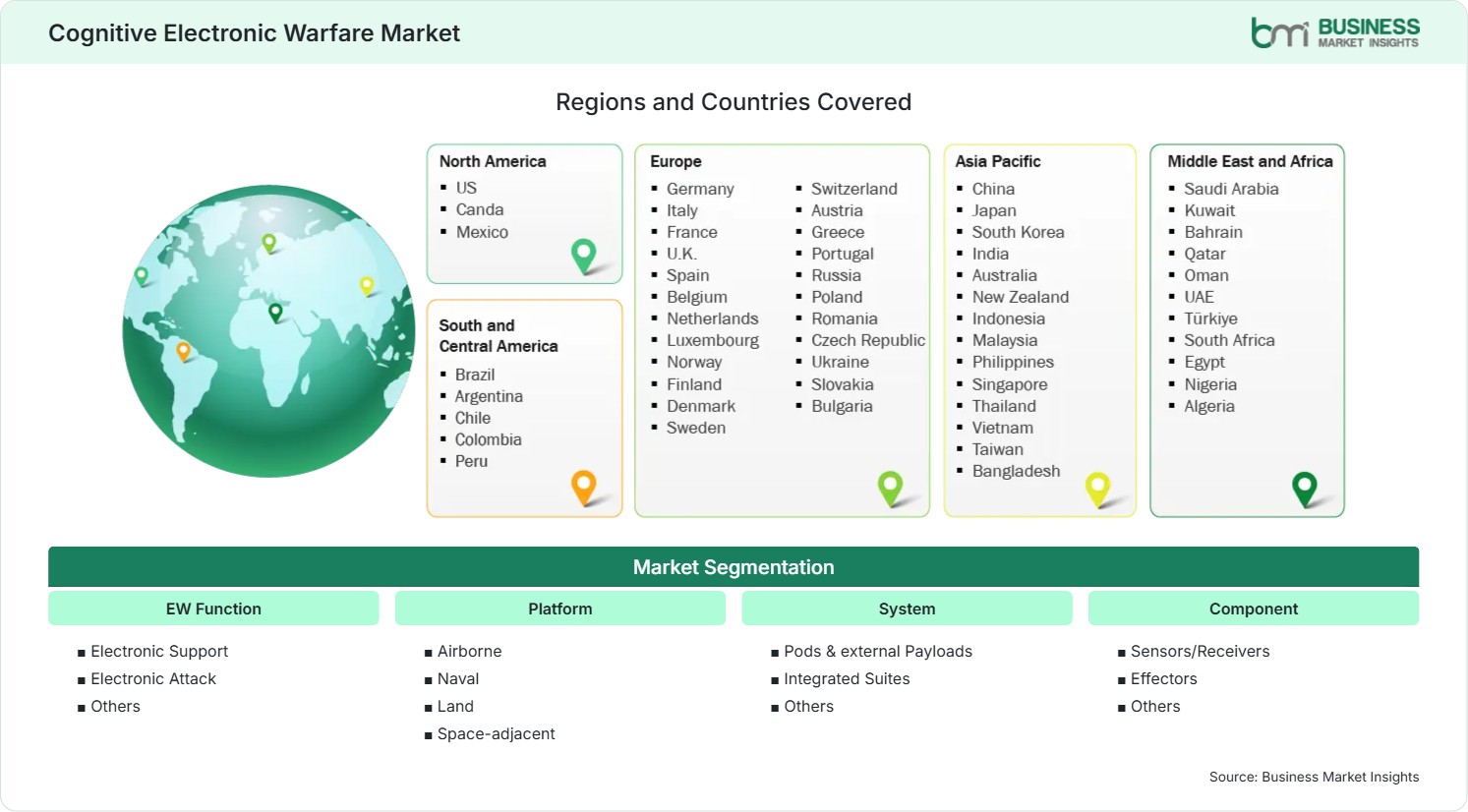
  • EW Function: Electronic Support, Electronic Attack, Others
  • Platform: Airborne, Naval, Land, Space-adjacent
  • System: Pods & external Payloads, Integrated Suites, Others
  • Component: Sensors/Receivers, Effectors, Others
  • Frequency: HF/VHF/UHF, L/S/C/X/Ku/Ka bands, Others
US$ 11.20 Bn Market size in 2025
US$ 26.65 Bn Market Size by 2033
11.44% CAGR, 2026 - 2033
2026-2033 Forecast Period

01 AI Overview

Cognitive Electronic Warfare Market Summary

  • North America: Holds a 37%–40% share in 2025 and is expected to grow at 10.8%–11.3% CAGR through 2033, driven by defense spending, AI-enabled warfare, electronic protection, spectrum superiority, and cognitive warfare investments. The U.S. dominates the region, growing at 10.9%–11.5% CAGR.
  • Fastest Growing Region: Asia Pacific accounts for 24%–27% share in 2025 and is anticipated to register a 12.6%–13.2% CAGR through 2026–2033. Rising regional security concerns, military digitization programs, investments in indigenous electronic warfare systems, increasing unmanned platform deployment, and expanding defense budgets are strengthening adoption.
  • Leading Segment: Electronic Support represents 42%–46% share in 2025 and is expected to grow at a 11.0%–11.6% CAGR during 2026–2033. Growing demand for signal intelligence, threat detection, electromagnetic surveillance, and real-time situational awareness capabilities continues supporting deployment across defense forces.
  • High Growth Segment: Airborne accounts for 34%–38% share in 2025 and is forecast to expand at a 12.1%–12.8% CAGR through 2026–2033. Increased procurement of advanced fighter aircraft, airborne early warning platforms, electronic attack aircraft, and unmanned aerial systems is driving segment demand.
  • Key Market Opportunity: Expanding integration of artificial intelligence, machine learning algorithms, autonomous threat assessment systems, and adaptive spectrum management capabilities is creating new revenue opportunities for defense contractors developing next-generation warfare solutions.
  • Major Market Players: RTX Corporation, Northrop Grumman Corporation, BAE Systems plc, L3Harris Technologies, Inc., Leonardo S.p.A., Thales Group, Saab AB, Lockheed Martin Corporation, Elbit Systems Ltd., Rheinmetall AG.
02 Strategic Insights

Cognitive Electronic Warfare Market: Strategic Insights

Cognitive Electronic Warfare Market Strategic Framework
FREE PDF
Request your free sample
Request free sample
03 Stakeholder View

Key Takeaways

  • The ecosystem is increasingly characterized by collaboration between defense primes, AI software providers, sensor manufacturers, and military agencies to deliver adaptive spectrum dominance solutions capable of operating across highly contested electromagnetic environments.
  • Airborne platforms offer the strongest near-term growth potential as governments accelerate procurement of next-generation fighter aircraft, electronic attack systems, airborne early warning platforms, and unmanned aerial vehicles with integrated cognitive capabilities.
  • Innovation is shifting from rule-based electronic warfare toward machine learning-enabled threat recognition, autonomous signal processing, dynamic spectrum management, and predictive response mechanisms that enhance battlefield effectiveness.
  • Asia Pacific presents a compelling investment opportunity due to rising defense expenditures, indigenous military modernization programs, regional security dynamics, and increasing deployment of advanced electronic warfare architectures.
  • Defense contractors are prioritizing investments in open-architecture systems, software-defined electronic warfare technologies, and modular upgrade pathways to reduce lifecycle costs and maintain operational relevance.
  • The growing convergence of cyber operations, electronic warfare, and artificial intelligence is creating demand for integrated electromagnetic battlespace management solutions capable of delivering real-time mission adaptability.
04 Geographic Outlook

Cognitive Electronic Warfare Market Regional Highlights

North America Cognitive Electronic Warfare Market

North America accounted for approximately 37%–40% of the Cognitive Electronic Warfare Market share in 2025 and is anticipated to expand at a 10.8%–11.3% CAGR through 2033. The region benefits from substantial defense budgets, advanced military technology development programs, and widespread adoption of AI-driven electromagnetic warfare capabilities.

  • The United States is increasing investment in cognitive spectrum operations to strengthen threat detection, intelligence, and autonomous response capabilities.
  • Defense modernization is focusing on software-defined and AI-enabled electronic warfare systems that can adapt to changing electromagnetic threats.
  • Military agencies are expanding partnerships with technology companies to accelerate the development and deployment of advanced electronic warfare solutions.
  • The growing use of unmanned systems and network-centric warfare is increasing demand for adaptive electronic protection technologies.
  • Investments in multi-domain command structures are driving demand for electronic warfare systems that improve situational awareness and operational flexibility.

US Cognitive Electronic Warfare Market

The United States represents approximately 72%–76% share within North America and is projected to grow at a 10.9%–11.5% CAGR during 2026–2033. Demand is driven by modernization of airborne, naval, and land-based electronic warfare assets designed to address increasingly sophisticated adversarial capabilities in cognitive electronic warfare market.

  • Advanced airborne electronic warfare programs remain key demand generators due to strategic emphasis on electromagnetic superiority in future conflicts.
  • AI-enabled electronic support and threat classification technologies are receiving increased funding across defense modernization initiatives.
  • Defense contractors continue developing open-system architectures that simplify upgrades and integration with existing military platforms.
  • Growing focus on joint force operations is encouraging deployment of interoperable cognitive electronic warfare solutions across military domains.

Europe Cognitive Electronic Warfare Market

Europe captured approximately 27%–30% share in 2025 and is expected to register a 10.9%–11.6% CAGR during the forecast period. Increasing regional security concerns and defense capability enhancement programs are driving procurement of advanced electromagnetic warfare technologies. The United Kingdom, France, and Germany remain leading adopters, supported by strong defense industrial bases and modernization investments.

  • The United Kingdom leads adoption through modernization of air and naval defense assets incorporating advanced electronic warfare capabilities.
  • Germany is among the fastest-growing national markets, supported by increasing defense expenditure and investments in next-generation warfare technologies.
  • NATO operational requirements continue encouraging deployment of interoperable electromagnetic warfare platforms across member states.
  • European defense initiatives are promoting indigenous development of advanced sensors, signal intelligence systems, and electronic countermeasures.
  • Increased focus on multi-domain operations is accelerating demand for integrated cognitive electronic warfare architectures.

Asia Pacific Cognitive Electronic Warfare Market

Asia Pacific held a 24%–27% share in 2025 and is expected to grow at 12.6%–13.2% CAGR through 2033, driven by rising defense spending, electronic warfare modernization, indigenous defense production, unmanned systems, and demand for spectrum dominance in Cognitive Electronic Warfare Market trends.

  • Japan continues strengthening electronic warfare investments through advanced airborne and maritime defense modernization initiatives.
  • India is emerging as a high-growth market supported by indigenous defense electronics development and military modernization programs.
  • Increasing deployment of unmanned systems is generating demand for adaptive electronic attack and protection capabilities.
  • Investments in defense research institutions are accelerating innovation in AI-enabled electromagnetic warfare technologies.
  • Regional military forces are emphasizing spectrum superiority capabilities to address complex and evolving threat environments.

Rest of World Cognitive Electronic Warfare Market

The Rest of World region represented approximately 6%–8% share in 2025 and is forecast to expand at a 11.0%–11.8% CAGR through 2033. Middle Eastern countries are investing in advanced defense technologies to strengthen national security capabilities, while selected South and Central American nations are enhancing electronic surveillance and protection infrastructure in cognitive electronic warfare market.

  • Saudi Arabia continues investing in advanced defense modernization programs that incorporate sophisticated electromagnetic warfare capabilities.
  • Brazil is increasing focus on defense electronics programs that support surveillance, intelligence, and operational readiness requirements.
  • Growing border security challenges are driving demand for adaptive electronic monitoring and threat detection systems.
  • International defense partnerships are facilitating access to advanced cognitive electronic warfare technologies and expertise.
  • Emerging military modernization strategies continue supporting long-term adoption of next-generation electronic warfare solutions.
Global Market Geography
FREE PDF
Request your free sample
Request free sample
05 Segment Analysis

Cognitive Electronic Warfare Market Segmentation

EW Function

The EW Function segment represents the operational core of the Cognitive Electronic Warfare Market and is expected to maintain a significant share throughout the forecast period. Growing emphasis on electromagnetic spectrum superiority, real-time threat assessment, and adaptive response mechanisms is supporting adoption. The segment is projected to expand at a CAGR of 11.2%–11.8% through 2033, supported by increasing deployment of intelligent electronic warfare architectures.

  • Electronic Support: Dominates operational deployment owing to increasing requirements for signal interception, threat identification, situational awareness, and spectrum monitoring across contested military environments.
  • Electronic Attack: Adoption is increasing as defense forces prioritize jamming, deception, suppression of enemy defenses, and disruption of adversarial communication and radar networks.

Platform

The platform segment is driven by the increasing integration of cognitive capabilities into military assets operating across multiple domains. Airborne solutions currently account for the largest Cognitive Electronic Warfare Market share, while modernization of naval, land, and space-adjacent assets continues accelerating. The segment is expected to grow at a 11.5%–12.1% CAGR due to increasing procurement programs and multi-domain warfare strategies.

  • Airborne: The leading platform category driven by fighter aircraft upgrades, airborne early warning systems, intelligence missions, and advanced electronic attack capabilities.
  • Naval: Naval forces are increasingly deploying cognitive electronic warfare technologies to improve threat detection, maritime surveillance, and electromagnetic protection capabilities.
  • Land: Modern land forces are adopting intelligent electronic warfare systems to counter evolving threats, strengthen battlefield awareness, and support network-centric operations.
  • Space-adjacent: Growing military utilization of near-space and satellite-linked assets is encouraging deployment of advanced spectrum monitoring and threat assessment technologies.

System

System-level demand is driven by military requirements for scalable, interoperable, and rapidly upgradeable electronic warfare architectures. Integrated suites account for a major cognitive electronic warfare market presence due to their ability to provide comprehensive threat management and operational flexibility. Continued defense investments are expected to support a 11.3%–11.9% CAGR through the forecast period while enhancing operational effectiveness across military platforms.

  • Pods & External Payloads: These systems offer platform flexibility, rapid integration, and mission customization, making them attractive for airborne and specialized operational deployments.
  • Integrated Suites: Widely adopted due to comprehensive functionality encompassing detection, analysis, electronic attack, and electronic protection within a unified architecture.

Component

The component segment remains critical as armed forces invest in advanced hardware capable of supporting cognitive processing requirements. Sensors and receivers currently contribute the largest revenue share owing to growing demand for accurate signal detection and classification capabilities in cognitive electronic warfare market. The segment is forecast to grow at a 11.0%–11.7% CAGR, supported by ongoing advancements in electronic intelligence technologies.

  • Sensors/Receivers: High adoption levels are supported by increasing needs for electromagnetic surveillance, threat recognition, real-time spectrum analysis, and signal intelligence missions.
  • Effectors: Demand is expanding as military organizations deploy advanced jamming and countermeasure technologies designed to disrupt adversarial electronic systems effectively.

Frequency

Frequency-based deployment trends are evolving as military operations require effective performance across increasingly congested electromagnetic environments. The segment is expected to witness steady growth at a 11.4%–12.0% CAGR, supported by broader operational requirements and ongoing digital defense transformation initiatives.

  • HF/VHF/UHF: These frequencies remain important for long-range communication interception, tactical operations support, and electromagnetic surveillance activities across diverse environments.
  • L/S/C/X/Ku/Ka Bands: Increasing deployment across modern radar, intelligence, targeting, and communication systems continues supporting strong investment in these advanced frequency bands.

End User

The End User segment is led by Defense Organizations, accounting for approximately 52%–56% share in 2025 and projected to expand at a 11.4%–12.0% CAGR through 2033. Increasing investments in spectrum superiority, electronic warfare modernization programs, and next-generation defense technologies continue supporting segment growth.

  • Defense Organization: Represents the largest end-user segment due to direct procurement of cognitive electronic warfare systems, electronic attack solutions, spectrum monitoring platforms, and advanced battlefield awareness technologies to enhance operational effectiveness.
  • R&D Agencies: Demand is increasing as government laboratories, defense research institutions, and specialized agencies invest in artificial intelligence, machine learning, adaptive threat detection, and next-generation electronic warfare technology development.
  • Prime Contractors/OEM Integration: Adoption continues expanding as defense contractors and platform manufacturers integrate cognitive electronic warfare capabilities into aircraft, naval vessels, armored vehicles, unmanned systems, and multi-domain defense architectures.
06 Market Forces

Cognitive Electronic Warfare Market Dynamics

Key Market Drivers

Growing Defense Modernization and Electronic Warfare Investments

Defense organizations worldwide are accelerating modernization initiatives to enhance electromagnetic spectrum superiority and battlefield effectiveness. Governments are allocating substantial resources toward upgrading legacy systems with intelligent electronic warfare architectures capable of autonomous decision-making and adaptive threat response. Increasing investments in next-generation aircraft, naval combat platforms, missile defense systems, and integrated command networks are creating strong demand for advanced cognitive capabilities. Military forces are prioritizing solutions that improve operational awareness, reduce response times, and strengthen survivability in contested environments. These investments continue supporting widespread deployment of innovative electronic warfare platforms across multiple domains.

Rising Geopolitical Tensions and Security Threats

Increasing geopolitical uncertainty and regional security challenges are encouraging armed forces to strengthen electronic warfare readiness. Modern conflicts increasingly involve contested electromagnetic environments where communication denial, radar disruption, and signal intelligence capabilities play critical operational roles. Governments are therefore investing in advanced spectrum management and electronic protection solutions to maintain mission effectiveness. The growing complexity of threat environments is generating demand for systems capable of continuously learning, adapting, and responding to dynamic operational conditions. This cognitive electronic warfare market trends is supporting long-term procurement opportunities across global defense markets.

Increasing Adoption of AI-Enabled Electronic Warfare Systems

Artificial intelligence is transforming electronic warfare by enabling automated signal detection, threat classification, spectrum analysis, and adaptive response generation. Advanced algorithms significantly improve operational efficiency by reducing analytical burdens on military personnel while enhancing speed and accuracy. The growing availability of high-performance computing technologies is supporting integration of machine learning capabilities into defense platforms. As armed forces seek improved operational agility and decision superiority, AI-enabled cognitive systems are becoming a critical component of future electromagnetic warfare strategies. Increasing adoption is expected to remain a major catalyst for market expansion.

Key Market Opportunities

Expansion of Electronic Warfare Capabilities in Emerging Defense Markets

Modernization of electronic warfare is becoming a key focus in emerging defense markets to ensure state security and the readiness of the armed forces. The countries of Asia, the Middle East, and Latin America are investing in state-of-the-art spectrum monitoring, signals intelligence, and electronic protection systems to counter modern military challenges. The increase of indigenous defense manufacturing and technology transfer processes contributes greatly to capability development. Cognitive electronic warfare systems offer a promising opportunity for military forces to develop cost-efficient, interoperable solutions.

Growing Demand for Counter-Drone Electronic Warfare Solutions

The growing proliferation of unmanned aerial systems is creating strong demand for advanced counter-drone technologies capable of detecting, identifying, tracking, and neutralizing hostile platforms. Cognitive electronic warfare solutions enable rapid signal analysis and adaptive response mechanisms, making them highly effective against increasingly sophisticated drone threats. Defense agencies are actively investing in systems that combine artificial intelligence, electronic attack capabilities, and real-time decision support. Rising concerns regarding border security, critical infrastructure protection, and battlefield survivability continue to expand procurement opportunities for manufacturers developing innovative counter-unmanned system solutions with enhanced operational effectiveness.

Increasing Investments in Next-Generation Defense Electronics

Military modernization strategies increasingly emphasize advanced sensors, artificial intelligence processors, software-defined architectures, and intelligent communications technologies. These investments are driving the development of highly adaptive electronic warfare ecosystems capable of managing complex electromagnetic environments. Governments are supporting research initiatives aimed at improving autonomy, processing speed, and system interoperability. The integration of cognitive technologies into future combat platforms is expected to generate long-term opportunities across airborne, naval, land, and space-adjacent operations. Market participants with expertise in advanced defense electronics are well positioned to benefit from expanding procurement and modernization programs.

Market Restraints and Challenges

High Development and Procurement Costs

Factor: Cognitive electronic warfare systems require sophisticated software algorithms, advanced sensors, high-performance processors, and extensive testing procedures to achieve operational effectiveness in demanding military environments. Impact: Elevated development and acquisition costs can limit adoption among budget-constrained defense organizations and extend procurement cycles. Integration complexity, certification requirements, and ongoing upgrade needs further increase lifecycle expenditures. Smaller defense agencies may face challenges in implementing comprehensive cognitive electronic warfare capabilities, creating barriers to widespread deployment despite significant operational advantages.

Rapid Technological Obsolescence

Factor: The electromagnetic warfare landscape evolves rapidly as adversaries continuously develop new radar systems, communication technologies, signal processing techniques, and countermeasure capabilities. Impact: Frequent technology changes shorten product lifecycles and require continuous investment in research, software updates, and capability enhancement programs. Defense organizations must regularly modernize deployed solutions to maintain effectiveness against emerging threats. This dynamic environment increases operational and financial pressures on manufacturers while creating challenges related to long-term planning, interoperability, and sustainment of advanced electronic warfare platforms.

07 Company Analysis

Competitive Landscape

The competitive environment is shaped by continuous innovation in artificial intelligence, electronic attack technologies, spectrum management, and multi-domain military capabilities. The Cognitive Electronic Warfare Market analysis highlights increasing investments in adaptive electromagnetic warfare solutions, open-architecture systems, and next-generation defense electronics.

Company Name

Overview

Products and Services Relevant to this Market

RTX Corporation

Major defense technology provider with extensive expertise in advanced radar, intelligence, and electronic warfare systems supporting global military customers.

Cognitive electronic warfare systems, advanced sensors, radar technologies, electronic attack solutions, and spectrum dominance capabilities.

Northrop Grumman Corporation

Leading defense contractor focused on electronic warfare innovation, autonomous systems integration, and advanced military technology development.

Electronic warfare suites, mission systems, signal intelligence solutions, spectrum management technologies, and defense electronics.

BAE Systems plc

Global defense company specializing in advanced electronic combat systems and electromagnetic spectrum operations.

Electronic attack technologies, intelligence solutions, electronic support systems, and integrated warfare architectures.

L3Harris Technologies, Inc.

Provider of mission-critical defense systems with strong capabilities in communications and electronic warfare technologies.

Tactical electronic warfare systems, signal intelligence platforms, sensors, and electromagnetic protection solutions.

Leonardo S.p.A.

International aerospace and defense company supporting advanced electronic surveillance and defense modernization programs.

Electronic warfare suites, airborne mission systems, intelligence solutions, and advanced defense electronics.

Thales Group

Technology leader delivering integrated defense systems designed for complex electromagnetic operating environments.

Electronic warfare sensors, command technologies, situational awareness systems, and intelligence solutions.

Saab AB

Defense and security company focused on advanced military technologies and next-generation spectrum operations.

Electronic support measures, self-protection systems, radar technologies, and intelligent defense solutions.

Lockheed Martin Corporation

Major defense contractor integrating advanced electronic warfare capabilities across multiple military platforms.

Integrated electronic warfare technologies, mission systems, airborne defense solutions, and AI-enabled capabilities.

Elbit Systems Ltd.

Defense electronics specialist offering advanced intelligence and electromagnetic warfare technologies.

Electronic attack systems, intelligence sensors, spectrum monitoring solutions, and integrated warfare systems.

Rheinmetall AG

Defense technology company expanding capabilities in electronic warfare and modern battlefield solutions.

Electronic protection technologies, tactical defense electronics, mission systems, and military modernization solutions.


10 Trust & Transparency

Research Methodology

The market analysis combines proprietary research with secondary data from government agencies, company disclosures, regulatory filings, industry databases and expert interviews. Market estimates are validated through data triangulation, cross-market benchmarking and analyst review.

View Full Research Methodology

11 Questions Answered

Frequently Asked Questions

What are the major applications of cognitive electronic warfare systems?

Major applications include electronic support, electronic attack, intelligence gathering, threat detection, signal interception, electronic protection, spectrum monitoring, counter-drone operations, and multi-domain military mission support.

Which region dominates the cognitive electronic warfare market report?

North America maintains the largest market presence due to substantial defense budgets, advanced defense technology ecosystems, continuous modernization initiatives, and strong investments in electromagnetic spectrum superiority programs.

Why is artificial intelligence important in electronic warfare?

Artificial intelligence improves signal classification, threat identification, autonomous decision-making, and adaptive response generation, enabling military forces to react more effectively in highly contested and rapidly evolving spectrum environments.

Which platform segment is expected to grow the fastest in cognitive electronic warfare market?

Airborne platforms are projected to record the strongest growth due to increasing procurement of advanced fighter aircraft, surveillance aircraft, electronic attack systems, and unmanned aerial platforms equipped with intelligent warfare solutions.

What is cognitive electronic warfare?

Cognitive electronic warfare refers to the use of artificial intelligence, machine learning, and adaptive algorithms to automatically detect, analyze, and respond to electromagnetic threats in real time, enhancing operational effectiveness and decision superiority.

Access the Full Cognitive Electronic Warfare Market Report

Get segment-level forecasts, regional estimates, competitive benchmarking, company profiles and downloadable Excel datasets.

Access the full Cognitive Electronic Warfare Market Report
350 pages PDF & Excel | 2026-08-20