
Cyber Warfare Market Outlook: Size, Share, Trends, Growth Analysis, Competitive Landscape & Forecast, 2026-2033

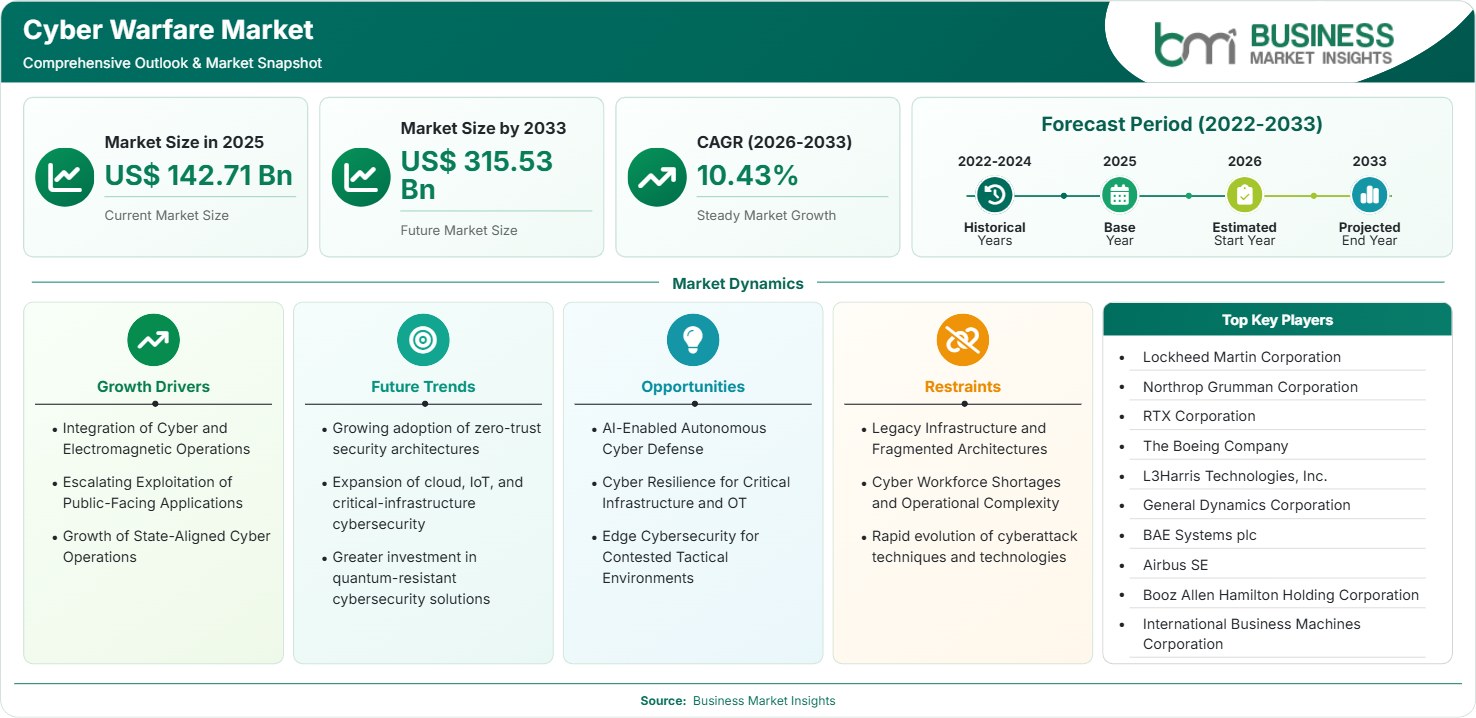
The Cyber Warfare Market size was valued at US$ 142.71 Billion in 2025 and is projected to reach US$ 315.53 Billion by 2033, growing at a CAGR of 10.43% during 2026–2033, driven by state-sponsored threats, critical-infrastructure protection, AI-enabled defense, zero-trust adoption, and demand for resilient command systems.

Report Coverage
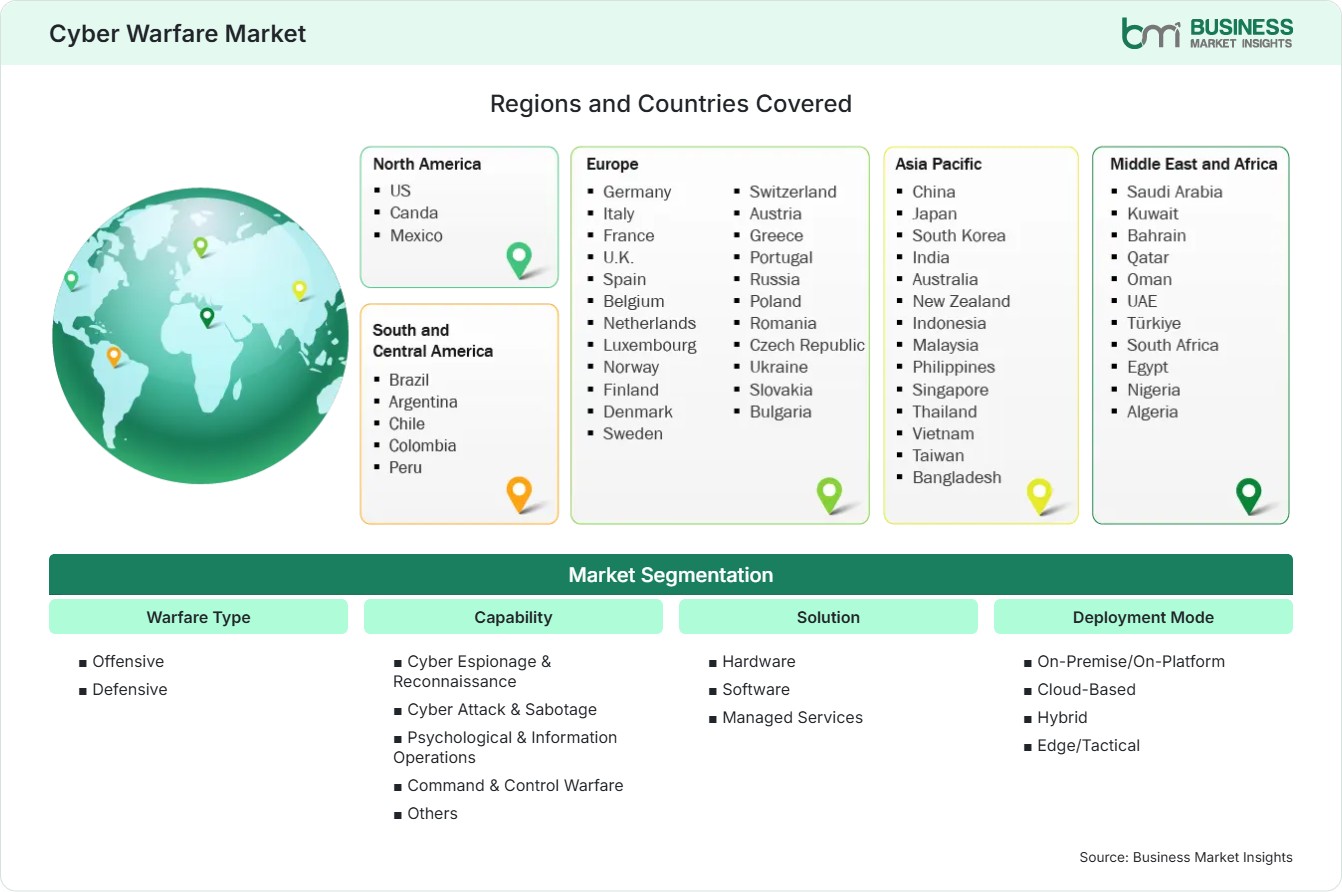
  • Warfare Type: Offensive, Defensive
  • Capability: Cyber Espionage & Reconnaissance, Cyber Attack & Sabotage, Psychological & Information Operations, Command & Control Warfare, Others
  • Solution: Hardware, Software, Managed Services
  • Deployment Mode: On-Premise/On-Platform, Cloud-Based, Hybrid, Edge/Tactical
  • Operational Level: Strategic, Operational, Tactical
US$ 142.71 Bn Market size in 2025
US$ 315.53 Bn Market Size by 2033
10.43% CAGR, 2026 - 2033
2026-2033 Forecast Period

AI Overview

Cyber Warfare Market Summary

  • North America Region: North America holds market share of 38%–42% in 2025, growing with a CAGR of 9.8%–10.6% during 2026–2033, influenced by defense modernization, federal cyber programs, zero-trust adoption, intelligence integration, and escalating state-sponsored threats. The US market remains the principal regional contributor, supported by defense procurement, cyber command modernization, critical infrastructure protection, and rapid adoption of AI-enabled security capabilities, with a modeled CAGR of 9.9%–10.7% during 2026–2033.
  • Fastest Growing Region: Asia Pacific holds market share of 20%–24% in 2025, expanding at a CAGR of 11.2%–12.4% during 2026–2033, supported by military digitization, sovereign cyber capabilities, satellite connectivity, critical-infrastructure protection, and expanding cyber command investments across China, India, Japan, South Korea, and Australia.
  • Leading Segment: Defensive Cyber Warfare holds a leading share of 55%–59% in 2025, advancing at a CAGR of 9.9%–10.7% during 2026–2033, driven by zero-trust architectures, threat intelligence, cyber resilience, network protection, secure communications, and increasingly integrated defense operations.
  • High Growth Segment: Edge/Tactical deployment holds an estimated share of 13%–17% in 2025, with a CAGR of 12.0%–13.2% during 2026–2033, propelled by disconnected operations, battlefield connectivity, autonomous platforms, tactical data processing, secure communications, and rapid cyber decision-making requirements.
  • Key Market Opportunity: AI-enabled cyber defense, autonomous threat hunting, cyber-range training, secure tactical edge computing, quantum-resistant cryptography, and integrated cyber-electromagnetic operations create investment opportunities across defense modernization programs and critical infrastructure.
  • Major Market Players: Lockheed Martin Corporation, Northrop Grumman Corporation, RTX Corporation, The Boeing Company, L3Harris Technologies, Inc., General Dynamics Corporation, BAE Systems plc, Airbus SE, Booz Allen Hamilton Holding Corporation, and International Business Machines Corporation.
Strategic Insights

Cyber Warfare Market: Strategic Insights

Cyber Warfare Market Strategic Framework
FREE PDF
Request your free sample
Request free sample
Stakeholder View

Key Takeaways

  • The ecosystem is moving toward integrated cyber, electronic warfare, intelligence, communications, and information operations, increasing the value of interoperable platforms rather than isolated security products.
  • Tactical and edge environments offer high upside because military forces increasingly require secure processing, detection, communications, and decision support when cloud connectivity is intermittent or contested.
  • AI is becoming a core technology layer for threat detection, vulnerability discovery, automated response, intelligence fusion, and cyber-range simulation, while adversaries simultaneously use AI to accelerate intrusion development.
  • Asia Pacific presents a compelling investment case as defense digitization, sovereign technology programs, satellite connectivity, and critical infrastructure modernization expand demand for domestic cyber capabilities.
  • Procurement is increasingly favoring companies capable of delivering lifecycle services, cyber-hardening, secure communications, managed defense, and mission assurance alongside conventional defense platforms.
  • Public-private collaboration is becoming strategically important because governments require specialized commercial capabilities for cloud security, identity protection, AI-enabled analytics, and protection of increasingly interconnected infrastructure.
Geographic Outlook

Cyber Warfare Market Regional Highlights

North America Cyber Warfare Market

North America accounts for an estimated 38%–42% in Cyber Warfare Market share in 2025 and is modeled to expand at 9.8%–10.6% CAGR during 2026–2033. The region benefits from mature defense procurement, extensive intelligence infrastructure, established cyber commands, and advanced defense contractors. US federal modernization remains the primary demand engine, while Canada contributes through critical infrastructure and defense digitization. Regional growth is reinforced by convergence between cyber, electronic warfare, communications, and intelligence.

  • Federal defense modernization continues to prioritize secure communications, cyber resilience, identity protection, and mission systems capable of operating across contested digital environments.
  • Demand is shifting toward integrated platforms combining cyber analytics, electronic warfare, intelligence, and command capabilities instead of standalone cybersecurity tools.
  • Defense contractors are increasingly embedding cyber-hardening and secure software practices into weapons, aircraft, naval systems, satellites, and tactical communications.
  • Zero-trust architectures and continuous monitoring are becoming procurement requirements for government networks and mission-critical environments.

US Cyber Warfare Market

The US represents approximately 72%–76% of North American share in 2025, with a modeled CAGR of 9.9%–10.7% during 2026–2033. Spending is supported by Department of Defense modernization, cyber mission forces, intelligence requirements, and protection of government and defense-industrial networks. Procurement increasingly links cyber capabilities with electronic warfare, command systems, and tactical communications. Federal and state programs are also expanding demand for zero-trust services and managed cyber operations in Cyber Warfare Market.

  • US procurement favors mission-ready cyber capabilities integrated into broader defense architectures, creating opportunities for vendors with systems engineering and lifecycle support expertise.
  • The defense industrial base remains a major demand center because supply-chain compromise, identity abuse, and exposed applications can affect multiple connected programs.
  • AI-assisted cyber operations are gaining attention as both defensive and offensive technologies evolve, increasing requirements for secure models, automated analytics, and human oversight.

Europe Cyber Warfare Market

Europe holds approximately 25%–29% share in 2025 and is modeled to grow at 9.7%–10.8% CAGR during 2026–2033. The region is shaped by geopolitical tensions, NIS2 implementation, national cyber strategies, and protection of critical infrastructure. Germany, the United Kingdom, France, and the Netherlands remain leading markets, while Poland and the Nordic countries represent high-growth defense opportunities in Cyber Warfare Market.

  • The United Kingdom is a leading market because defense modernization increasingly incorporates cyber, intelligence, secure communications, and digital mission systems.
  • France is strengthening sovereign defense AI and cybersecurity capabilities; Airbus received a framework contract worth up to €50 million for AI integration into French defense information, communication, weapons, and cybersecurity systems.
  • Germany benefits from industrial digitization and protection requirements across manufacturing, energy, transportation, and public-sector networks.
  • Poland and Nordic countries present high-growth opportunities because defense modernization is increasingly linked with cyber resilience and secure military communications.

Asia Pacific Cyber Warfare Market

Asia Pacific represents an estimated 20%–24% share in 2025 and is modeled to grow at 11.2%–12.4% CAGR during 2026–2033, making it the fastest-growing regional market. China, Japan, India, South Korea, and Australia are major demand centers, while Southeast Asian economies are expanding cyber resilience programs. Military digitization, satellite systems, autonomous platforms, smart infrastructure, and strategic competition are broadening attack surfaces. Indigenous technology development and sovereign data requirements further support investment in local cyber capabilities in Cyber Warfare Market.

  • China remains a major strategic technology market, with cyber, space, electronic warfare, and information operations increasingly integrated into broader military modernization.
  • India offers strong growth potential through defense digitization, indigenous communications, secure command networks, and modernization of government and critical infrastructure.
  • Japan and South Korea continue strengthening cyber resilience around advanced manufacturing, telecommunications, defense systems, and national infrastructure.
  • Australia is expanding cyber and information-warfare capabilities through defense modernization and closer integration among intelligence, communications, and allied operations.

Rest of World Cyber Warfare Market

Rest of World represents approximately 8%–12% share in 2025 and is modeled to grow at 9.0%–10.4% CAGR during 2026–2033. South and Central America are prioritizing financial, government, energy, and telecommunications resilience. Brazil and Mexico remain leading markets, while Colombia and Chile offer expanding opportunities in Cyber Warfare Market. The Middle East and Africa are shaped by national digital transformation, defense modernization, critical infrastructure protection, and sovereign cyber initiatives.

Gulf countries, particularly Saudi Arabia and the United Arab Emirates, are high-growth markets because digital government, cloud adoption, smart cities, energy infrastructure, and defense modernization increase requirements for cyber resilience. South Africa remains an important African market, while Israel contributes advanced cyber expertise and defense technology.

  • Brazil is positioned as a regional anchor because large financial, government, energy, and telecommunications ecosystems require stronger cyber resilience and incident-response capabilities.
  • Gulf governments are investing in sovereign digital infrastructure, secure cloud environments, AI, and defense technology, creating opportunities for integrated cyber and managed services.
  • Mexico benefits from expanding digital services and industrial connectivity, although fragmented security maturity creates demand for managed security and modernization services.
  • Saudi Arabia and the UAE provide high-growth opportunities where national transformation programs connect cybersecurity with defense, smart infrastructure, cloud, and AI investments.
Global Market Geography
FREE PDF
Request your free sample
Request free sample
Segment Analysis

Cyber Warfare Market Segmentation

Warfare Type

Warfare Type is led by Defensive Cyber Warfare, representing an estimated 55%–59% share in 2025, with a modeled CAGR of 9.9%–10.7% during 2026–2033. Cyber Warfare Market trends favor defensive capabilities because governments prioritize resilience, continuity, detection, and mission assurance across increasingly connected military and civilian systems.

  • Offensive: Supports intelligence, disruption, deception, and mission-specific cyber operations.
  • Defensive: Focuses on prevention, detection, response, recovery, and cyber-hardening of critical systems.

Capability

Capability segmentation is driven by Cyber Attack & Sabotage and Cyber Espionage & Reconnaissance, with the broader capability category estimated at 9.5%–10.8% CAGR during 2026–2033. Increasingly integrated intelligence, effects, command, and information functions are expanding procurement requirements.

  • Cyber Espionage & Reconnaissance: Supports intelligence gathering, adversary mapping, and situational awareness.
  • Cyber Attack & Sabotage: Focuses on controlled disruption, system testing, detection, and resilience.
  • Psychological & Information Operations: Covers digital influence, deception, monitoring, and information integrity.
  • Command & Control Warfare: Protects and disrupts command networks through secure communications and resilient systems.

Solution

Solution segmentation is expanding as organizations combine hardware, software, and managed services across mission environments. The segment is modeled at 9.6%–11.0% CAGR during 2026–2033 in Cyber Warfare Market forecasts, with software and managed services gaining strategic importance as cyber operations become continuous.

  • Hardware: Includes secure processors, network equipment, communication devices, sensors, and mission infrastructure.
  • Software: Covers threat intelligence, analytics, endpoint protection, cyber ranges, orchestration, and mission applications.
  • Managed Services: Provides monitoring, incident response, threat hunting, vulnerability management, and security operations.

Deployment Mode

Deployment Mode is increasingly diversified across on-premise, cloud, hybrid, and edge environments in Cyber Warfare Market. The segment is modeled to grow at 10.4%–12.0% CAGR during 2026–2033, with tactical edge deployment showing the strongest momentum as forces require resilient capabilities.

  • On-Premise/On-Platform: Supports sensitive mission systems requiring direct control, data sovereignty, and isolated environments.
  • Cloud-Based: Provides scalable analytics, threat intelligence, and faster software deployment across secure networks.
  • Hybrid: Combines local control with cloud analytics, balancing security, resilience, and scalability.
  • Edge/Tactical: Enables local processing for deployed forces, supporting low-latency operations and disconnected environments.

Operational Level

Operational Level segmentation is supported by strategic and operational cyber requirements, while tactical capabilities show higher adoption momentum. The segment is modeled at 10.0%–11.5% CAGR during 2026–2033, reflecting growing integration between national missions and battlefield systems in Cyber Warfare Market.

  • Strategic: Supports national security, intelligence, deterrence, critical infrastructure, and long-term cyber planning.
  • Operational: Links strategic goals with campaign planning, intelligence, communications, and mission systems.
  • Tactical: Supports deployed forces with threat detection, secure communications, cyber awareness, and rapid response.

Target Environment

Target Environment segmentation is expanding across government IT, enterprise systems, industrial control systems, and connected mission infrastructure. The segment is modeled at 10.1%–11.6% CAGR during 2026–2033, driven by converging IT and operational technology risks.

  • Enterprise/Government IT: Protects identities, networks, applications, databases, and digital services. Demand is rising for zero-trust, monitoring, and managed security.
  • Industrial Control Systems: Protects energy, manufacturing, transport, and utilities. IT-OT connectivity is increasing demand for monitoring, segmentation, and cyber resilience.
Market Forces

Cyber Warfare Market Dynamics

Key Market Drivers

Integration of Cyber and Electromagnetic Operations

The convergence of cyber, electronic warfare, intelligence, and information operations is becoming an important driver of defense procurement. Organizations increasingly seek integrated mission capabilities that connect secure communications, intelligence data, electromagnetic-spectrum awareness, and cyber operations. This shift is moving procurement beyond standalone cybersecurity products toward interoperable systems that can support joint and multi-domain missions. As a result, demand is growing for secure processors, advanced analytics, command systems, specialized software, systems engineering, and lifecycle modernization that enable effective coordination across operational environments.

Escalating Exploitation of Public-Facing Applications

Public-facing applications are becoming important entry points for cyberattacks as organizations rely more heavily on connected platforms, cloud services, and complex software environments. Weak authentication, misconfigurations, and unpatched vulnerabilities can expose sensitive systems to attackers. Governments and defense organizations are therefore increasing focus on continuous vulnerability assessment, application security, identity controls, threat intelligence, and automated remediation. The growing connection between commercial and mission networks also increases the need for network segmentation, zero-trust architecture, and continuous monitoring to limit potential attack paths.

Growth of State-Aligned Cyber Operations

Geopolitical competition is increasing the strategic importance of cyber espionage, disruption, influence, and reconnaissance. Governments are strengthening their capabilities to monitor persistent threats, improve attribution, protect critical systems, and maintain resilient command and communication networks. Rising geopolitical uncertainty and interconnected infrastructure are making cyber defense an ongoing national security priority. As a result, procurement is expanding beyond traditional security tools toward integrated threat intelligence, mission assurance, cyber ranges, secure communications, and defensive cyber operations that can support long-term national security objectives.

Key Market Opportunities

AI-Enabled Autonomous Cyber Defense

AI presents several new possibilities for automating tasks such as threat hunting, anomaly detection, vulnerability prioritization, intelligence analysis, and incident handling within cyberspace. Vendors may be differentiated by offering secure AI solutions that assist humans in decision-making while reducing the burden on security teams. Organizations defending themselves against cyber threats may leverage machine power to link activities across the network, identity, endpoints, and intelligence. The demand for such solutions is especially high in cases of wide attack surfaces and shortage of cybersecurity specialists.

Cyber Resilience for Critical Infrastructure and OT

Industrial control systems, energy networks, transportation, telecommunications, and public services are becoming key areas for cyber resilience as connected infrastructure faces growing security risks. Vendors can support these sectors through OT monitoring, network segmentation, secure remote access, vulnerability assessments, cyber-physical testing, and incident response. Demand is also increasing as legacy operational technology connects with enterprise and cloud systems. Long asset lifecycles create continued opportunities for security upgrades, maintenance, managed services, and regular assessments across critical infrastructure environments.

Edge Cybersecurity for Contested Tactical Environments

There is a unique opportunity in tactical edge environments where deploying troops cannot always rely on a constant cloud connection or centralized security operations. Secure edge computing could offer threat detection, identity verification, data filtering, mission analysis, and autonomous response in the event of impaired communication. Vendors could offer hardened hardware, secure environment for computations, AI-based analytics, reliable communication system, and software-defined cybersecurity solutions as part of one package. There is demand for this capability across autonomous vehicles, satellites, naval systems, aircraft, and mobile command centers. As the military becomes increasingly dependent on connected platforms, cybersecurity defenses will need to move closer to the platforms.

Market Restraints and Challenges

Legacy Infrastructure and Fragmented Architectures

Factor: Many defense and critical infrastructure environments depend on legacy systems with long replacement cycles, proprietary interfaces, limited computational capacity, or incomplete security telemetry.

Impact: modernization can require extensive integration, testing, certification, and operational downtime, slowing deployment of advanced cyber capabilities. Fragmented architectures also complicate centralized visibility and automated response because organizations must connect systems developed under different technical standards. In military environments, certification requirements can further extend deployment schedules. The challenge creates demand for incremental cyber-hardening, virtual segmentation, secure gateways, and specialized monitoring, but these approaches can increase lifecycle complexity.

Cyber Workforce Shortages and Operational Complexity

Factor: Advanced cyber operations require specialists in threat intelligence, secure software, cloud architecture, incident response, operational technology, AI, and military mission systems, while qualified personnel remain difficult to recruit and retain.

Impact: organizations may struggle to operate sophisticated tools continuously, reducing the value of technology investments and increasing dependence on external providers. The problem becomes more acute as adversaries automate reconnaissance and exploit development. Managed security services can address staffing gaps, but government and defense organizations must manage clearance, sovereignty, supply-chain, and trust requirements. Training through cyber ranges and simulation can improve readiness, yet capability development takes time.

Company Analysis

Competitive Landscape

The cyber warfare market analysis has a competitive structure that includes traditional defense contractors, specialized cyber and mission-technology providers, systems integrators, and large enterprise technology companies. Competition is shaped by the ability to deliver secure communications, cyber-hardening, intelligence capabilities, AI-enabled analytics, zero-trust solutions, and tactical computing.

Company Name

Overview

Products and Services relevant to this market

Lockheed Martin Corporation

Major US defense prime integrating cyber, electronic warfare, intelligence, and information operations.

Cyber effects, threat intelligence, mission systems, secure platforms, cyber-hardening, and defense engineering.

Northrop Grumman Corporation

US aerospace and defense company supporting national security through digital and intelligence capabilities.

Cyber mission solutions, command and control, secure communications, intelligence systems, and cyber-resilient architectures.

RTX Corporation

Diversified aerospace and defense company supporting advanced defense systems and secure technologies.

Cyber-enabled defense systems, secure communications, intelligence technologies, electronic warfare, and cybersecurity engineering.

The Boeing Company

Global aerospace and defense company developing connected aircraft, space, and mission systems.

Secure platforms, networked systems, communications, aircraft cybersecurity, space systems, and digital engineering.

L3Harris Technologies, Inc.

Defense technology provider focused on communications, space, electronic warfare, and command systems.

Secure communications, cyber solutions, command and control, electronic warfare, tactical networking, and mission systems.

General Dynamics Corporation

Defense and technology group with government IT, cyber services, and secure infrastructure capabilities.

Cybersecurity services, zero-trust solutions, security operations, secure networks, mission IT, and cyber engineering.

BAE Systems plc

Global defense and security company serving governments, armed forces, and critical infrastructure.

Cybersecurity, DevSecOps, threat intelligence, cyber operations, secure IT, and mission infrastructure.

Airbus SE

Global aerospace and defense company expanding digital, AI, space, and cybersecurity capabilities.

Defense cybersecurity, secure communications, AI-enabled systems, satellite security, and information systems.

Booz Allen Hamilton Holding Corporation

US technology and consulting provider supporting federal cyber strategy and modernization programs.

Cyber strategy, threat intelligence, zero trust, cyber operations, AI analytics, and mission assurance.

International Business Machines Corporation

Global technology company providing cybersecurity, AI, and security operations capabilities.

Security analytics, AI-enabled detection, threat intelligence, identity security, cloud security, and managed services.

Trust & Transparency

Research Methodology

The market analysis combines proprietary research with secondary data from government agencies, company disclosures, regulatory filings, industry databases and expert interviews. Market estimates are validated through data triangulation, cross-market benchmarking and analyst review.

View Full Research Methodology

Questions Answered

Frequently Asked Questions

What is the strategic value of a Cyber Warfare Market Report?

A Report can help organizations evaluate competitive positioning, deployment priorities, regional opportunities, technology adoption, and procurement direction.

How do zero-trust architectures support national security?

Zero trust reduces reliance on implicit network trust by continuously validating users, devices, applications, and access conditions.

Which industries outside defense are relevant to cyber warfare technologies?

Energy, telecommunications, transportation, manufacturing, finance, healthcare, and government services are increasingly relevant because cyber disruption can affect physical operations, economic activity, and public safety.

Why are tactical cyber capabilities becoming more important in Cyber Warfare Market growth?

Tactical forces increasingly depend on connected aircraft, vehicles, ships, satellites, autonomous systems, and distributed command posts.

How does AI change cyber warfare capabilities?

AI accelerates both defense and attack cycles. Defenders can automate threat hunting, correlate large telemetry sets, prioritize vulnerabilities, and support faster response, while adversaries can improve reconnaissance and exploit discovery.

Access the Full Cyber Warfare Market Report

Get segment-level forecasts, regional estimates, competitive benchmarking, company profiles and downloadable Excel datasets.

Access the full Cyber Warfare Market Report
350 pages PDF & Excel | 2026-08-31