
Anti-Submarine Warfare Market Outlook: Size, Share, Trends, Growth Analysis, Competitive Landscape & Forecast, 2026-2033

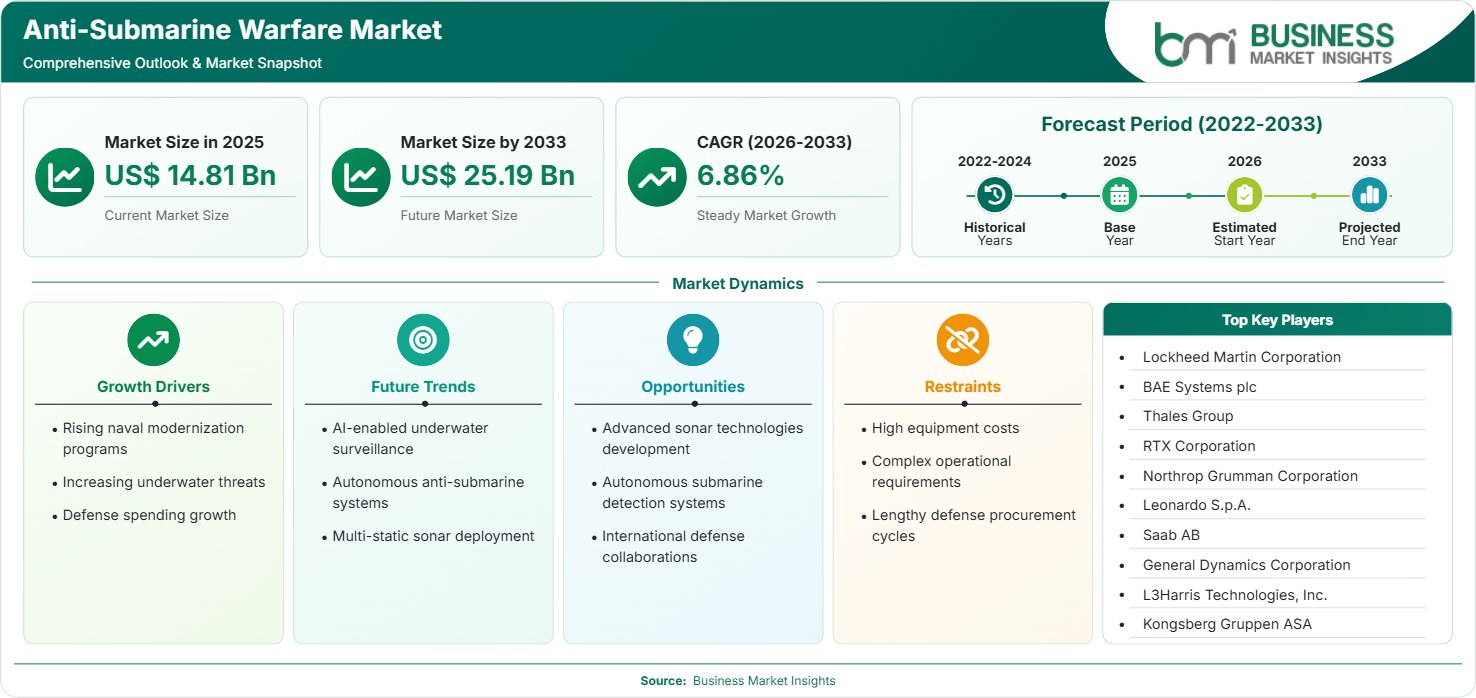
The Anti-Submarine Warfare Market size was valued at US$ 14.81 billion in 2025 and is projected to reach US$ 25.19 billion by 2033, growing at a CAGR of 6.86% during 2026–2033, driven by naval modernization initiatives, rising underwater security challenges, increasing defense expenditure, advanced sonar technology development, autonomous detection systems, and international maritime defense collaborations

Report Coverage
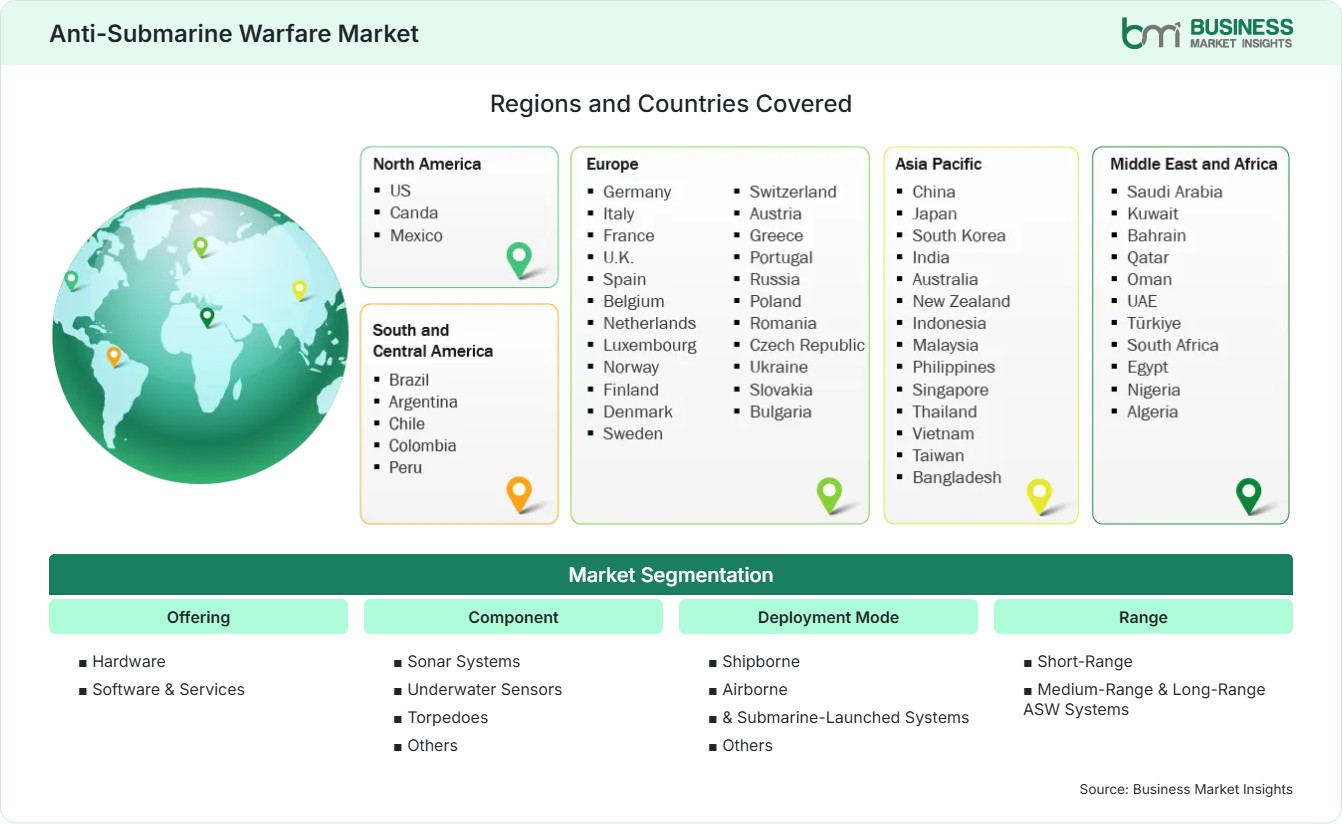
  • Offering: Hardware, Software & Services
  • Component: Sonar Systems, Underwater Sensors, Torpedoes, Others
  • Deployment Mode: Shipborne, Airborne, & Submarine-Launched Systems, Others
  • Range: Short-Range, Medium-Range & Long-Range ASW Systems
  • Installation Type: Line Fit & OEMs, Upgrades & Retrofitting
US$ 14.81 Bn Market size in 2025
US$ 25.19 Bn Market Size by 2033
6.86% CAGR, 2026 - 2033
2026-2033 Forecast Period

AI Overview

Anti-Submarine Warfare Market Summary

  • North America Region: North America holds approximately 38%–42% of the market share in 2025 and is projected to grow at a 6.2%–6.8% CAGR during 2026–2033. Regional leadership is supported by extensive naval modernization programs, advanced submarine fleets, high defense budgets, and investments in next-generation sonar, underwater sensors, and autonomous maritime systems. The United States remains the largest contributor due to continuous investment in undersea warfare capabilities, fleet modernization, and advanced detection technologies, growing at approximately 6.3%–6.9% CAGR during the Anti-Submarine Warfare Market Forecasts.
  • Fastest Growing Region: Asia Pacific represents approximately 25%–29 market share in 2025 and is expected to register a 7.5%–8.2% CAGR during 2026–2033. Growth is supported by increasing maritime security concerns, submarine fleet expansion, territorial disputes, defense modernization programs, and investments in advanced underwater surveillance capabilities across China, India, Japan, South Korea, and Australia.
  • Leading Segment: Hardware represents approximately 55%–60% market share in 2025 and is expected to grow at a 6.5%–7.0% CAGR during 2026–2033. Demand is supported by procurement of sonar systems, underwater sensors, torpedoes, maritime patrol equipment, and advanced naval platforms.
  • High Growth Segment: Autonomous submarine detection systems represent a rapidly expanding opportunity area with increasing adoption of unmanned underwater vehicles, artificial intelligence-enabled monitoring systems, and network-centric maritime surveillance solutions.
  • Key Market Opportunity: Development of advanced sonar technologies, autonomous underwater detection platforms, artificial intelligence-based threat identification systems, and multinational defense partnerships are creating opportunities for defense technology providers.
  • Major Market Players: Lockheed Martin, BAE Systems, Thales Group, Raytheon Technologies, Northrop Grumman, Leonardo S.p.A., Saab, General Dynamics, L3Harris Technologies, and Kongsberg Gruppen
Strategic Insights

Anti-Submarine Warfare Market: Strategic Insights

Anti-Submarine Warfare Market Strategic Framework
FREE PDF
Request your free sample
Request free sample
Stakeholder View

Key Takeaways

  • The anti-submarine warfare ecosystem is shifting toward integrated maritime defense networks that combine sonar systems, underwater sensors, communication platforms, command systems, and unmanned technologies.
  • Advanced sonar technologies and autonomous detection platforms represent major growth opportunities as naval forces seek improved underwater surveillance capabilities.
  • Technology innovation is focused on improving detection accuracy, reducing operational limitations, and enhancing real-time decision-making. Companies are developing advanced passive and active sonar systems, machine learning-based signal processing, and network-centric warfare capabilities to support complex maritime missions.
  • Asia Pacific presents a strong regional opportunity due to increasing naval modernization programs, submarine fleet expansion, maritime security concerns, and rising defense investments. Countries including India, Japan, Australia, and South Korea are strengthening underwater defense capabilities through indigenous programs and international partnerships.
  • The competitive environment is characterized by strategic defense contracts, technology collaborations, and portfolio expansion among major defense contractors.
  • Rising operational complexity and high technology requirements are encouraging defense agencies to adopt integrated solutions rather than standalone equipment. Providers offering complete ASW ecosystems combining hardware, software, analytics, and lifecycle support are gaining strategic importance.
Geographic Outlook

Anti-Submarine Warfare Market Regional Highlights

North America Anti-Submarine Warfare Market

North America accounted for approximately 38%–42% market share in 2025 and is projected to grow at a 6.2%–6.8% CAGR during 2026–2033. The region maintains market leadership due to extensive naval modernization programs, advanced defense technology capabilities, large submarine fleets, and significant government investment in maritime security. The United States represents the dominant contributor, supported by continuous procurement of sonar systems, maritime patrol aircraft, autonomous platforms, and integrated undersea warfare solutions. Canada is also strengthening maritime surveillance capabilities through naval modernization initiatives aligning with Anti-Submarine Warfare Market trends.

  • The United States leads regional demand through large-scale defense budgets, submarine fleet modernization, and investments in advanced underwater detection technologies.
  • Defense agencies are prioritizing artificial intelligence-enabled sonar processing, autonomous systems, and network-centric maritime surveillance capabilities.
  • Continuous upgrades of naval surface ships, submarines, and maritime aircraft are supporting demand for advanced ASW equipment.
  • Strategic focus on protecting critical underwater infrastructure is increasing investment in persistent maritime monitoring solutions.

US Anti-Submarine Warfare Market

The United States represented approximately 34%–37% of the global Anti-Submarine Warfare Market share in 2025 and is expected to expand at a 6.3%–6.9% CAGR during 2026–2033. The country remains the largest defense technology market due to its advanced naval capabilities, submarine fleet requirements, and continuous investments in undersea warfare modernization. Demand is supported by procurement programs involving advanced sonar systems, underwater sensors, maritime patrol aircraft, unmanned systems, and integrated command platforms.

  • The US Navy continues investing in next-generation ASW capabilities to enhance submarine detection and maritime domain awareness.
  • Defense contractors are developing advanced acoustic technologies and autonomous systems to improve underwater threat identification.
  • Modernization programs are increasing demand for upgraded sonar systems and advanced underwater communication technologies.
  • Government investments in research and development are supporting innovation in AI-enabled maritime defense solutions.

Europe Anti-Submarine Warfare Market

Europe accounted for approximately 22%–26% market share in 2025 and is expected to register a 6.0%–6.6% CAGR during 2026–2033. Regional demand is supported by increasing maritime security concerns, submarine activity in strategic waters, defense modernization programs, and multinational cooperation initiatives. The United Kingdom, France, Germany, Italy, and Nordic countries are investing in naval capabilities, including advanced sonar systems, maritime patrol platforms, and underwater surveillance technologies.

  • The United Kingdom remains a key Anti-Submarine Warfare Market due to submarine fleet modernization and investments in maritime surveillance capabilities.
  • France is strengthening underwater defense capabilities through advanced naval platforms and indigenous defense technology development.
  • Germany and Nordic countries are expanding maritime security programs due to increasing focus on regional underwater threats.
  • European defense collaborations are supporting joint development programs for advanced naval systems.
  • Rising demand for unmanned maritime technologies is creating new opportunities for regional defense suppliers.

Asia Pacific Anti-Submarine Warfare Market

Asia Pacific represented approximately 25%–29% market share in 2025 and is projected to achieve the fastest growth with a 7.5%–8.2% CAGR during 2026–2033. Growth is driven by expanding naval capabilities, submarine fleet development, territorial maritime disputes, and increasing defense expenditure. China, India, Japan, South Korea, and Australia are investing in underwater surveillance systems, maritime patrol aircraft, autonomous platforms, and advanced sonar technologies to strengthen regional security capabilities.

  • China is expanding naval capabilities through investments in submarines, underwater sensors, and maritime surveillance infrastructure.
  • India is strengthening indigenous naval defense programs with investments in ASW systems, sensors, and maritime aircraft.
  • Japan and South Korea are upgrading submarine detection capabilities through advanced sonar and surveillance technologies.
  • Australia is increasing maritime security investments through submarine programs and allied defense cooperation.
  • Regional governments are prioritizing autonomous underwater systems for persistent monitoring and threat detection.

Rest of World Anti-Submarine Warfare Market

The Rest of World region accounted for approximately 8%–11% market share in 2025 and is projected to grow at a 6.5%–7.1% CAGR during 2026–2033. Latin America, the Middle East, and Africa are increasing investments in maritime security due to expanding naval requirements, coastal protection needs, and infrastructure security concerns. Countries including Brazil, Saudi Arabia, and South Africa are exploring advanced surveillance and naval modernization programs.

  • Brazil is improving maritime defense capabilities through naval modernization and protection of extensive coastal areas.
  • Middle Eastern countries are investing in maritime surveillance technologies to protect strategic waterways and offshore infrastructure.
  • South Africa is enhancing maritime security capabilities through improved naval monitoring and defense cooperation.
  • Developing economies are seeking cost-effective ASW solutions through international partnerships and technology transfers.
  • Growing focus on underwater infrastructure protection is increasing demand for surveillance and detection systems.
Global Market Geography
FREE PDF
Request your free sample
Request free sample
Segment Analysis

Anti-Submarine Warfare Market Segmentation

Offering<h3>

The offering segment defines the procurement structure of anti-submarine warfare solutions, with Hardware accounting for approximately 55%–60% market share in 2025 and projected to grow at a 6.5%–7.0% CAGR during 2026–2033. Increasing naval modernization programs, replacement of aging defense equipment, and demand for advanced sonar, sensors, and weapon systems are supporting hardware adoption. Software and services are gaining importance through integrated command systems, analytics, maintenance, and lifecycle support requirements.

  • Hardware: Hardware solutions represent the core of ASW capabilities through sonar systems, underwater sensors, torpedoes, and detection equipment. Growing naval fleet modernization programs are increasing procurement of advanced physical defense systems.
  • Software & Services: Software and services adoption is increasing through command-and-control platforms, data analytics, simulation systems, maintenance support, and operational training solutions that enhance ASW mission effectiveness and system integration.

<h3> Component

The component segment is led by Sonar Systems, supported by increasing demand for active and passive detection technologies. The segment is estimated to account for approximately 40%–45% market share in 2025 and is projected to grow at a 6.8%–7.3% CAGR during 2026–2033. Rising underwater threats, submarine proliferation, and maritime surveillance requirements are driving investments in advanced detection components.

  • Sonar Systems: Sonar systems remain essential for submarine detection, tracking, and classification. Advanced acoustic processing, active sonar, and passive detection technologies are improving operational accuracy across naval platforms.
  • Underwater Sensors: Underwater sensors are gaining adoption for persistent maritime monitoring, seabed surveillance, and threat identification. Improved sensor networks are supporting enhanced situational awareness in complex underwater environments.
  • Torpedoes: Torpedo systems continue evolving with improved guidance, range, and targeting capabilities. Naval forces are upgrading weapon systems to strengthen submarine response and underwater combat effectiveness.

Deployment Mode

The deployment mode segment is driven by Shipborne Systems, which hold approximately 45%–50% market share in 2025 and are expected to grow at a 6.5%–7.0% CAGR during 2026–2033. Naval vessels remain primary platforms for ASW operations due to their ability to deploy sonar systems, sensors, and weapons. Airborne and submarine-launched systems are gaining importance through improved surveillance and rapid response capabilities.

  • Shipborne: Shipborne ASW systems provide extensive submarine detection and engagement capabilities through surface vessels equipped with sonar, sensors, and integrated combat systems.
  • Airborne: Airborne ASW platforms support rapid surveillance through maritime patrol aircraft and helicopters equipped with sensors, sonobuoys, and detection technologies.
  • Submarine-Launched Systems: Submarine-launched ASW capabilities enhance underwater operations by enabling covert detection and response missions in contested maritime environments.

Range

The range segment is influenced by increasing demand for long-duration maritime surveillance and extended operational capabilities. Long-Range ASW Systems represent approximately 40%–45% Anti-Submarine Warfare Market share in 2025 and are expected to grow at a 7.0%–7.5% CAGR during 2026–2033. Rising focus on strategic waterways, submarine tracking, and protection of naval assets is supporting demand for extended-range solutions.

  • Short-Range: Short-range ASW systems are used for localized submarine detection and coastal defense operations requiring rapid response capabilities.
  • Medium-Range: Medium-range systems support broader maritime surveillance missions and are widely deployed for regional naval security and fleet protection.
  • Long-Range: Long-range systems enable strategic submarine monitoring across large maritime areas and support advanced naval operations requiring extended detection capabilities.

Installation Type

The installation segment is supported by both new naval platform construction and modernization of existing fleets. Line Fit & OEMs account for approximately 60%–65% market share in 2025 due to increasing naval procurement programs and new vessel development. Upgrades and retrofitting are expanding as countries enhance existing fleets with advanced ASW technologies.

  • Line Fit & OEMs: OEM installations are increasing through new shipbuilding programs, submarine development initiatives, and integration of advanced ASW systems into modern naval platforms.
  • Upgrades & Retrofitting: Retrofitting activities are growing as defense organizations modernize existing fleets with improved sonar, sensors, communication systems, and detection technologies.

Technology

The technology segment is shaped by increasing adoption of advanced acoustic detection solutions. Passive Sonar Technology represents approximately 45%–50% Anti-Submarine Warfare market share in 2025 due to its stealth advantages and continuous monitoring capability. Active sonar systems are also expanding due to improved detection accuracy and operational requirements.

  • Active Sonar Technology: Active sonar systems provide enhanced submarine detection by transmitting acoustic signals and analyzing reflected responses for accurate target identification.
  • Passive Sonar Technology: Passive sonar technology supports covert surveillance by detecting underwater acoustic signals without transmitting signals, improving operational secrecy.

Platform

The platform segment is dominated by Naval Surface Ships, which account for approximately 35%–40% Anti-Submarine Warfare Market share in 2025 and are projected to grow at a 6.5%–7.0% CAGR through 2026–2033. Surface vessels remain essential ASW platforms due to their flexibility, sensor integration, and operational deployment capabilities. Unmanned platforms are emerging as high-growth areas.

  • Naval Surface Ships: Surface ships provide primary ASW capabilities through integrated sonar, sensors, weapons, and command systems supporting maritime defense operations.
  • Submarines: Submarines contribute to underwater warfare capabilities through stealth operations, detection systems, and strategic maritime missions.
  • Aircrafts: Aircraft platforms enhance ASW operations through wide-area surveillance, airborne sensors, and rapid deployment capabilities.
  • UAVs: UAV adoption is increasing through autonomous surveillance capabilities, improved monitoring efficiency, and reduced operational risks.
  • UUVs: Unmanned underwater vehicles are gaining importance for persistent underwater monitoring, reconnaissance, and autonomous detection missions.
Market Forces

Anti-Submarine Warfare Market Dynamics

Key Market Drivers

Rising naval modernization programs

Naval modernization initiatives remain one of the strongest growth drivers for the Anti-Submarine Warfare Market report as governments continue investing in advanced maritime defense capabilities. Countries are replacing aging fleets with technologically advanced naval surface ships, submarines, maritime patrol aircraft, and integrated ASW systems equipped with next-generation sonar, underwater sensors, and command platforms. Modern naval operations require enhanced underwater surveillance, network-centric warfare capabilities, and real-time threat assessment.

Increasing underwater threats

Growing submarine deployments, expanding underwater surveillance activities, and rising geopolitical tensions are increasing the need for advanced anti-submarine warfare capabilities. Modern submarines are becoming quieter and more technologically sophisticated, making detection increasingly challenging for naval forces. As a result, defense organizations are investing in advanced active and passive sonar systems, underwater sensor networks.

Defense spending growth

Increasing global defense expenditure is supporting procurement of advanced anti-submarine warfare platforms and technologies. Governments are allocating larger defense budgets toward naval fleet expansion, underwater surveillance infrastructure, autonomous systems, and integrated command-and-control capabilities. Growing investment supports acquisition of advanced sonar systems, torpedoes, unmanned underwater vehicles, maritime patrol aircraft, and network-enabled warfare solutions.

Key Market Opportunities

Advanced sonar technologies development

Continuous innovation in sonar technology presents significant opportunities for defense manufacturers. Improvements in acoustic signal processing, artificial intelligence, digital sonar architecture, and multi-static sonar systems are enhancing submarine detection accuracy while reducing false alarms. Naval organizations are increasingly looking for solutions that are able to function well in complex underwater environment with increased efficiency and extended operational range. Those firms which will develop new sonar technology will be able to gain advantage from increasing modernization efforts and growing demand for improved maritime surveillance systems.

Autonomous submarine detection systems

Autonomous detection technologies are creating new opportunities within the anti-submarine warfare sector. Autonomous underwater vehicles, autonomous surface vehicles, and intelligent monitoring systems that use artificial intelligence can conduct surveillance without risk. The use of machine learning and autonomous navigation in underwater operations has made the process more effective and reliable.

International defense collaborations

Increasing international defense cooperation is expanding opportunities for technology transfer, joint development programs, and multinational procurement initiatives. Governments are partnering with their allies as well as defense contractors for increasing maritime security via shared surveillance systems, naval operations, and interoperable ASW systems. These collaborations not only increase operational capability but also lead towards standardizing the sophisticated defense technologies.

Market Restraints and Challenges

High equipment costs

Factor: Anti-submarine warfare systems require sophisticated sonar technologies, underwater sensors, weapons, autonomous platforms, and integrated command systems that involve substantial development, manufacturing, and maintenance costs.

Impact: High acquisition and lifecycle costs may limit procurement by countries with constrained defense budgets, resulting in delayed modernization programs and slower adoption of advanced ASW technologies. Manufacturers must balance technological advancement with affordability to expand Anti-Submarine Warfare Market opportunities.

Complex operational requirements

Factor: Effective anti-submarine warfare operations require highly trained personnel, coordinated multi-platform deployments, advanced data processing capabilities, and seamless integration across naval assets operating in challenging underwater environments.

Impact: Operational complexity increases training requirements, deployment costs, and system integration challenges. Defense organizations must invest continuously in workforce development, simulation technologies, and interoperable command systems to maximize operational effectiveness while reducing mission risks.

Company Analysis

Competitive Landscape

The Anti-Submarine Warfare Market analysis highlights a competitive environment characterized by global leaders focusing on innovation, product differentiation, and strategic partnerships to strengthen market presence.

Company Name

Overview

Products and Services relevant to this market

Lockheed Martin

Global aerospace and defense company providing advanced maritime defense systems and naval technologies.

Develops ASW systems, sonar technologies, mission systems, combat management solutions, and underwater warfare capabilities for naval platforms.

BAE Systems

International defense company specializing in naval platforms, electronic systems, and advanced warfare technologies.

Provides submarine detection systems, naval combat systems, sonar solutions, and integrated maritime defense technologies.

Thales Group

Global technology and defense company offering advanced underwater surveillance and naval solutions.

Supplies sonar systems, underwater sensors, maritime surveillance technologies, and ASW mission systems for naval forces.

Raytheon Technologies

Aerospace and defense company developing advanced sensing, surveillance, and defense technologies.

Provides sonar-related technologies, underwater detection systems, sensors, and integrated defense solutions supporting maritime operations.

Northrop Grumman

Defense technology company focused on autonomous systems, sensors, and mission solutions.

Develops unmanned maritime systems, advanced sensors, surveillance platforms, and network-enabled ASW technologies.

Leonardo S.p.A.

Italian aerospace and defense company supplying advanced naval electronics and security systems.

Offers underwater sensors, sonar technologies, maritime surveillance systems, and naval defense electronics.

Saab

Swedish defense company specializing in surveillance, naval systems, and advanced sensor technologies.

Provides underwater surveillance systems, sonar solutions, naval combat systems, and maritime security technologies.

General Dynamics

Global defense company with expertise in naval shipbuilding and submarine technologies.

Develops submarines, naval platforms, underwater systems, and integrated ASW capabilities for defense organizations.

L3Harris Technologies

Defense technology provider focused on communication, sensing, and mission systems.

Supplies underwater communication systems, sensors, electronic systems, and maritime surveillance solutions.

Kongsberg Gruppen

Norwegian technology company providing defense and maritime solutions.

Offers underwater systems, autonomous vehicles, sonar technologies, and maritime surveillance solutions for naval applications.

Industry Activity

Recent Developments

July 2026

Lockheed Martin signed a definitive agreement to acquire Ultra Maritime, a global defense company specializing in advanced anti-submarine warfare (ASW) capabilities, for $3.45 billion. The acquisition will fold Ultra Maritime's portfolio of sonar technologies, sonobuoys, torpedo defense systems, and autonomous maritime sensing platforms into Lockheed's Rotary and Mission Systems business.

July 2026

Thales struck a deal to acquire a 35.51% stake in drone technology company Exail for €134 per share, with plans to launch a mandatory tender offer for the remaining shares at an enterprise value of €3.9 billion ($4.45 billion).

July 2026

Huntington Ingalls Industries (HII) announced the U.S. Navy exercised an option year production contract for its Lionfish small unmanned undersea vehicle. The Lionfish vehicle is designed for a range of undersea warfare missions, including anti-submarine warfare, intelligence, surveillance, and reconnaissance operations.

February 2026

Indian Navy commissioned Anjadip, the third vessel of the eight-ship Anti-Submarine Warfare Shallow Water Craft (ASW-SWC) project, at Chennai Port. The indigenously built vessel is designed for detection, tracking, and neutralization of enemy submarines in coastal waters, equipped with a Hull Mounted Sonar, lightweight torpedoes, and ASW rockets.

Trust & Transparency

Research Methodology

The market analysis combines proprietary research with secondary data from government agencies, company disclosures, regulatory filings, industry databases and expert interviews. Market estimates are validated through data triangulation, cross-market benchmarking and analyst review.

View Full Research Methodology

Questions Answered

Frequently Asked Questions

What are the major challenges affecting Anti-Submarine Warfare Market expansion?

High equipment costs, complex operational requirements, advanced training needs, and integration challenges can limit adoption. Defense organizations must manage lifecycle expenses, personnel requirements, and technological complexity while implementing advanced anti-submarine warfare systems.

Which region offers strong growth opportunities for anti-submarine warfare solutions?

Asia Pacific presents significant opportunities due to expanding naval capabilities, submarine fleet development, maritime security concerns, and increasing defense investments. Countries such as China, India, Japan, South Korea, and Australia are strengthening underwater surveillance and maritime defense infrastructure.

Why are autonomous systems becoming important in ASW operations?

Autonomous systems enable continuous underwater monitoring, reduce operational risks, and improve surveillance coverage across large maritime areas.

Which technologies are shaping the future of anti-submarine warfare systems?

Artificial intelligence-enabled sonar processing, autonomous underwater vehicles, unmanned maritime platforms, sensor fusion, and advanced acoustic detection technologies are shaping future ASW capabilities.

What factors are driving the growth of the Anti-Submarine Warfare Market?

The market is driven by naval modernization programs, increasing underwater security threats, rising defense budgets, and demand for advanced maritime surveillance capabilities.

Access the Full Anti-Submarine Warfare Market Report

Get segment-level forecasts, regional estimates, competitive benchmarking, company profiles and downloadable Excel datasets.

Access the full Anti-Submarine Warfare Market Report
350 pages PDF & Excel | 2026-08-03