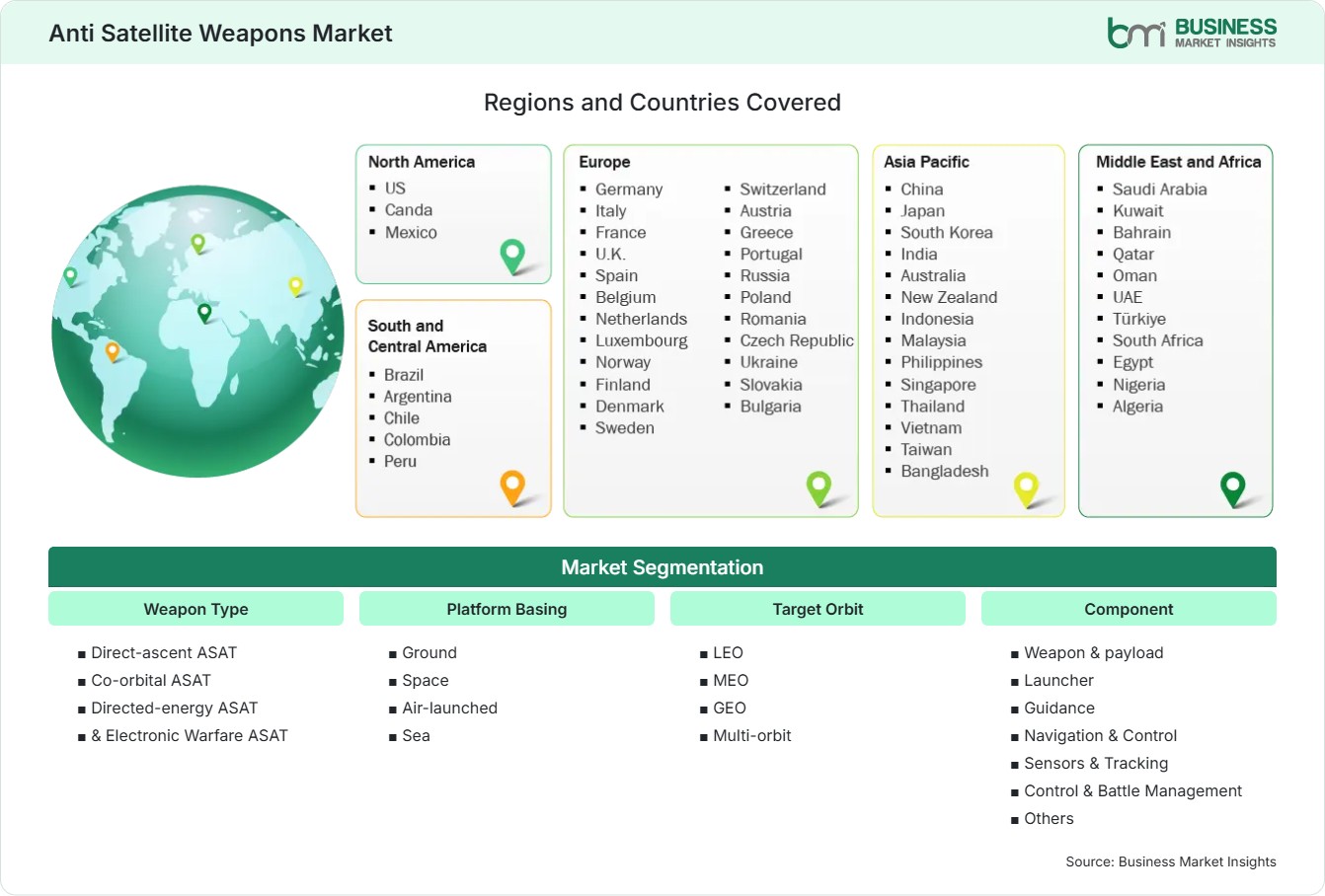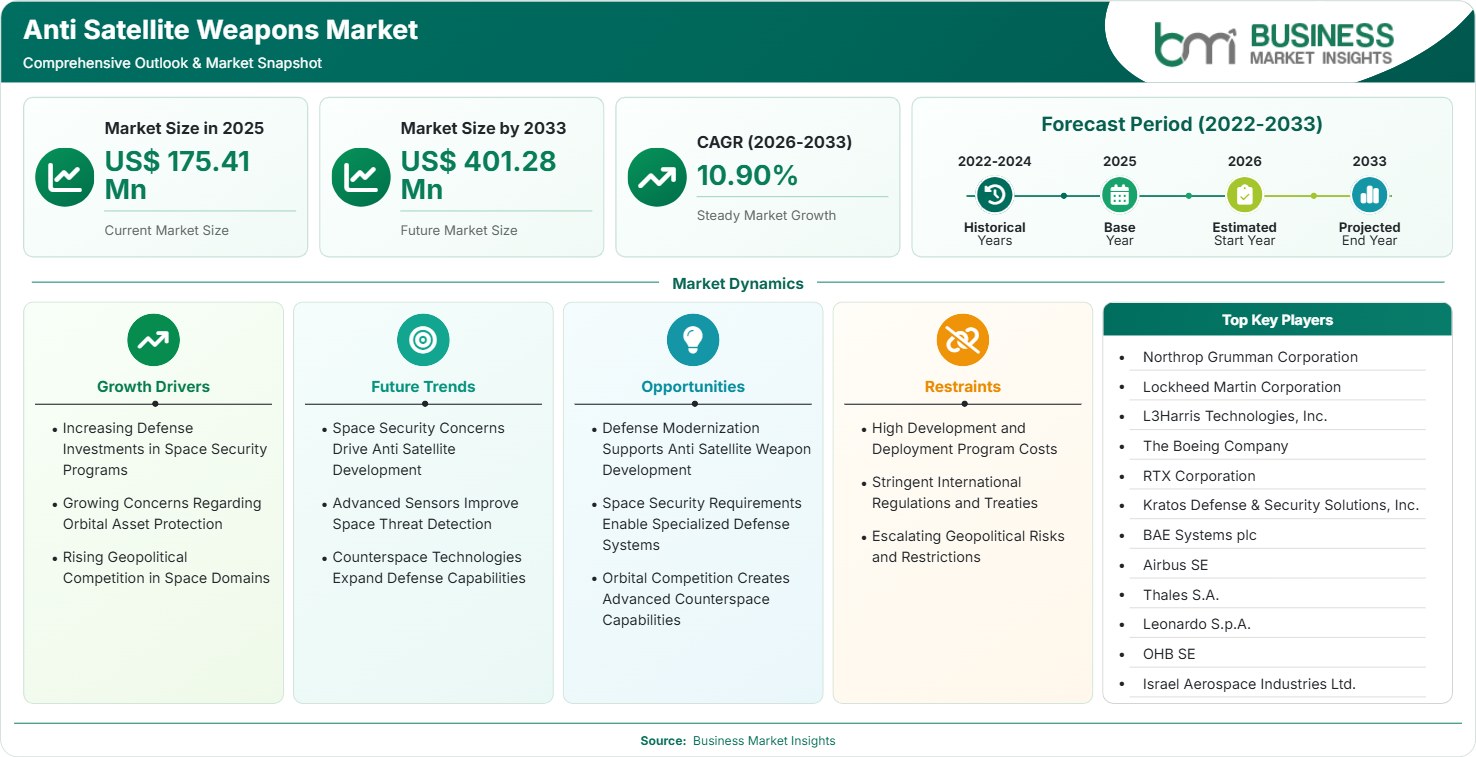
Anti Satellite Weapons Market Regional Highlights
North America Anti Satellite Weapons Market
North America accounts for a 35%–38% share in 2025 and is projected to expand at a 9%–11% CAGR through 2033. The Anti Satellite Weapons Market share reflects sustained US investment in resilient space architectures, missile warning, tracking, command systems, and electronic warfare. Canada contributes through surveillance and aerospace cooperation, while the US remains the regional procurement center.
- US procurement is centered on persistent tracking, resilient satellite architectures, and integrated command systems that improve detection, attribution, and response against increasingly complex space threats.
- North American suppliers are expanding sensor modernization and ground infrastructure. L3Harris reported a US Space Force contract supporting continued modernization of space-domain awareness systems in 2026.
- Directed-energy research benefits from established aerospace, missile-defense, optics, RF, and high-performance computing capabilities across the regional defense industrial base.
- Regulatory pressure against destructive testing is encouraging investment in reversible electronic, cyber, and directed-energy effects alongside resilient satellite architectures.
US Anti Satellite Weapons Market
The United States Anti Satellite Weapons Market constitutes approximately 78%-82% of North American activity in 2025, with a forecast of growth with a 9%-11% CAGR up until 2033. Procurement needs to focus on space domain awareness, missile warning, protected communication, tracking, and resilient constellations. The United States remains the leading integrator of technology in the region, involving government labs, Space Force agencies, prime contractors, sensor providers, and the space industry.
- The US Space Force is increasing investment in tracking systems and ground infrastructure. L3Harris received a $150 million MOSSAIC contract in April 2026 for surveillance-system modernization.
- Lockheed Martin secured a potential contract exceeding $1 billion for 18 Tracking Layer vehicles, reinforcing proliferated low Earth orbit missile-warning architecture.
- Northrop Grumman continues developing deep-space surveillance infrastructure, including DARC capabilities intended to strengthen persistent awareness of distant objects.
Europe Anti Satellite Weapons Market
The Anti Satellite Weapons market in Europe will account for 20%-23% of the market share in 2025 and is estimated to grow at an 8%-10% CAGR from 2025 to 2033. France, Germany, the UK, Italy, and Spain are key contributors to regional capability advancements, and Germany and France have good potential for high growth. The need for strategic autonomy is driving the demand for surveillance and communication satellites.
- France and Germany remain leading technology centers, supported by national space agencies, defense ministries, and industrial primes developing secure communications and space surveillance capabilities.
- Airbus is expanding sovereign space-intelligence cooperation with German specialists, reflecting growing European demand for independent end-to-end surveillance infrastructure.
- Spain offers high-growth potential through secure satellite communications and Earth-observation programs supporting defense and intelligence applications.
- BAE Systems is strengthening European and allied missile-warning capabilities through spacecraft, infrared payloads, and ground command infrastructure.
Asia Pacific Anti Satellite Weapons Market
The Asia Pacific Anti Satellite Weapons market has a 28%–31% share in 2025 and is estimated to register the highest 12%–14% CAGR till 2033. Capability hubs in Asia Pacific include China, India, Japan, South Korea, and Australia, while India and South Korea exhibit considerable potential for future growth. Intra-regional competition is fueling spending on space surveillance, missiles, electronic warfare, satellite robustness, and command capabilities.
- China maintains extensive space, missile, electronic warfare, and satellite capabilities, making it a major influence on regional counterspace investment and strategic planning.
- India is strengthening indigenous space situational awareness, launch, satellite, and defense technologies, creating opportunities across sensors, tracking, command systems, and electronic warfare.
- Japan is expanding space-security capabilities and integrating orbital surveillance with broader national defense planning, supporting demand for resilient and interoperable architectures.
- Australia is investing in surveillance and allied space-security cooperation, improving the regional ecosystem for sensors, secure communications, and space-domain awareness.
Rest of World Anti Satellite Weapons Market
The Anti Satellite Weapons market in the Rest of World represents a 12%–15% share in 2025 and is projected to grow at a 7%–9% CAGR through 2033. South and Central America remain smaller but increasingly interested in sovereign space monitoring, secure communications, and national-security applications. Brazil is the leading regional technology center, while Chile and Colombia offer emerging opportunities.
Middle East and Africa contribute through defense modernization, satellite communications, intelligence, and electronic warfare. Israel remains the leading technology center, while Saudi Arabia and the United Arab Emirates offer high-growth potential. Investment priorities emphasize secure communications, ISR, RF monitoring, and autonomous command systems.
- Brazil is strengthening domestic space capabilities and can support regional demand for tracking, satellite communications, and sovereign space situational awareness.
- Israel combines advanced aerospace, missile, sensor, and electronic warfare expertise, supporting sophisticated national-security space applications and export-oriented technology development.
- Gulf states are investing in sovereign space and defense infrastructure, creating opportunities for secure communications, surveillance, and command-and-control systems.
- African programs remain selective, with demand concentrated around satellite communications, Earth observation, border monitoring, and dual-use space infrastructure.