
Smart Weapons Market Outlook: Size, Share, Trends, Growth Analysis, Competitive Landscape & Forecast, 2026-2033

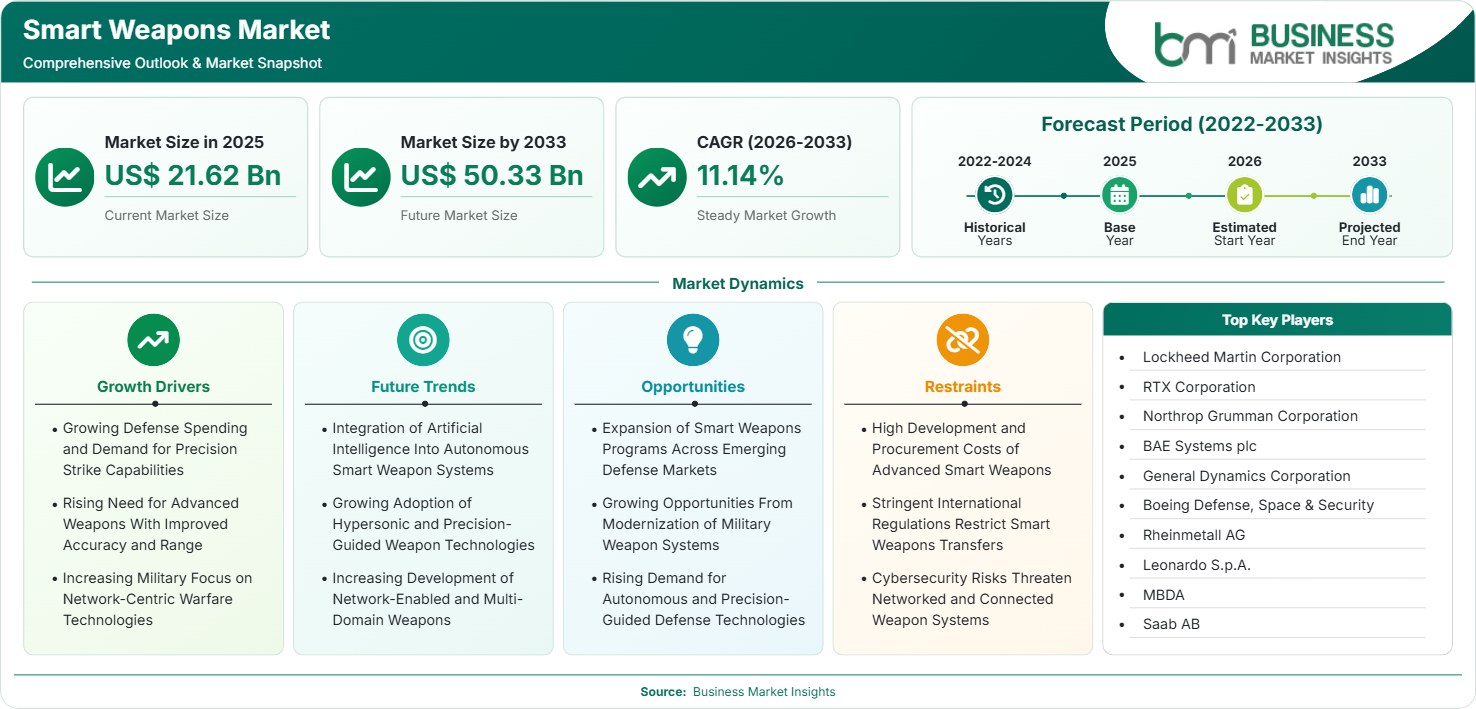
The Smart Weapons Market size was valued at US$ 21.62 Billion in 2025 and is projected to reach US$ 50.33 Billion by 2033, growing at a CAGR of 11.14% during 2026–2033, driven by rising defense spending, precision strike requirements, military modernization, network-centric warfare, and growing demand for advanced guidance technologies.

Report Coverage
  • Product: Missiles, Munitions, Guided Projectiles, Guided Rockets, Directed Energy Weapons
  • Platform: Air, Land, Naval
  • Technology: Laser Guidance, Infrared Guidance, Radar Guidance, Satellite Guidance, Others
US$ 21.62 Bn Market size in 2025
US$ 50.33 Bn Market Size by 2033
11.14% CAGR, 2026 - 2033
2026-2033 Forecast Period

AI Overview

Smart Weapons Market Summary

  • North America Region: North America held a 38%–42% of smart weapons market share in 2025 and is projected to grow at a 9.5%–11.5% CAGR during 2026–2033, supported by defense modernization, precision strike programs, advanced missile development, autonomous systems, and network-centric military operations. The US market is projected to grow at a 9.8%–11.8% CAGR through 2033, supported by procurement of precision-guided munitions, long-range strike systems, hypersonic technologies, and advanced targeting capabilities.
  • Fastest Growing Region: Asia Pacific represented a 23%–27% share in 2025 and is projected to expand at a 13.0%–15.5% CAGR through 2033, driven by military modernization, territorial security requirements, rising defense budgets, indigenous weapons development, and growing procurement of precision-guided missiles, munitions, and autonomous defense systems.
  • Leading Segment: Product, Missiles represented a 38%–42% share in 2025 and is projected to grow at a 10.5%–12.5% CAGR through 2033, supported by demand for precision strike capabilities, long-range engagement, advanced guidance, multi-domain operations, and modernization of missile inventories.
  • High Growth Segment: Technology, Satellite Guidance represented a 16%–20% share in 2025 and is projected to grow at a 12.5%–14.5% CAGR through 2033, driven by precision targeting, all-weather navigation, networked military operations, improved strike accuracy, and integration with advanced command systems.
  • Key Market Opportunity: Military modernization programs, autonomous precision systems, advanced guidance technologies, and emerging defense investments are creating opportunities for manufacturers to develop interoperable, network-enabled, and increasingly autonomous smart weapon platforms.
  • Major Market Players: Lockheed Martin Corporation, RTX Corporation, Northrop Grumman Corporation, BAE Systems plc, General Dynamics Corporation, Boeing Defense, Space & Security, Rheinmetall AG, Leonardo S.p.A., MBDA, and Saab AB.
Strategic Insights

Smart Weapons Market: Strategic Insights

Smart Weapons Market Strategic Framework
FREE PDF
Request your free sample
Request free sample
Stakeholder View

Key Takeaways

  • Ecosystem interconnectivity involving prime contractors, manufacturers of missiles, developers of missile guidance systems, sensors, propulsion technologies, electronic components, software, and militaries is increasingly emerging, with interoperability becoming an important criterion for purchasing.
  • Missiles and precision-guided weapons represent a promising market niche due to the emphasis put by the military on range extension, accuracy, speed, and minimized collateral damage.
  • Innovation is moving toward AI-enabled targeting, autonomous navigation, multi-mode seekers, hypersonic propulsion, directed energy, electronic warfare resilience, and network connectivity that allow weapons to operate within integrated battlefield architectures.
  • Asia Pacific presents a compelling investment opportunity as governments modernize military inventories, strengthen indigenous defense manufacturing, and expand procurement of precision strike capabilities amid evolving regional security requirements.
  • Defense companies are increasingly pursuing partnerships, joint ventures, technology agreements, and domestic production initiatives to strengthen supply chains, accelerate weapons development, and secure long-term government procurement contracts.
  • Companies capable of combining advanced guidance, secure communications, autonomous functions, and modular architectures can improve system adaptability while addressing military requirements for interoperable multi-domain operations.
Geographic Outlook

Smart Weapons Market Regional Highlights

North America Smart Weapons Market

North America held a 38%–42% share in 2025 and North America smart weapons market forecast to grow at a 9.5%–11.5% CAGR through 2033. The region benefits from substantial defense investment, established aerospace capabilities, advanced missile programs, and extensive precision strike requirements. The US dominates regional demand through large-scale procurement and modernization initiatives. Canada contributes through defense modernization and interoperability requirements.

  • The US remains the dominant regional market as military modernization programs prioritize precision-guided munitions, long-range strike systems, advanced missiles, and network-enabled weapons across multiple operational domains.
  • Defense procurement increasingly emphasizes extended-range precision fires and survivability, encouraging manufacturers to develop weapons capable of operating against sophisticated air-defense and electronic warfare environments.
  • Advanced guidance technologies are receiving greater attention as military forces seek improved accuracy, autonomous navigation, multi-mode sensing, and resilient targeting capabilities in contested environments.
  • Canada provides opportunities through modernization of defense capabilities, interoperability requirements, and participation in allied procurement and security initiatives involving advanced weapons and supporting technologies.

US Smart Weapons Market

The US smart weapons market represented approximately 91%–95% of North American demand in 2025 and is projected to grow at a 9.8%–11.8% CAGR through 2033. Defense modernization remains the principal demand driver, with procurement priorities spanning precision-guided munitions, long-range missiles, hypersonic weapons, autonomous systems, and advanced targeting technologies.

  • US procurement priorities increasingly emphasize long-range precision fires, hypersonic systems, advanced missiles, and autonomous capabilities designed to strengthen deterrence and operational effectiveness.
  • Integration between sensors, command systems, intelligence platforms, and precision weapons is accelerating as military forces develop network-centric approaches to multi-domain operations.
  • Defense manufacturers are expanding investments in advanced propulsion, seekers, artificial intelligence, electronic warfare resilience, and production capacity to address evolving military requirements.

Europe Smart Weapons Market

Europe smart weapons market accounted for a 25%–29% share in 2025 and is projected to grow at a 10.0%–12.5% CAGR through 2033. The United Kingdom, France, Germany, Italy, and Sweden represent important markets supported by defense modernization and collaborative weapons programs. Germany is projected to grow at a 11.0%–13.0% CAGR, while Poland offers high-growth potential through rapid military modernization.

  • Germany is becoming an important growth market as military modernization increases demand for advanced missiles, precision munitions, air-defense systems, and interoperable weapons capabilities.
  • France and the United Kingdom maintain strong positions through domestic defense industries and continued development of sophisticated missile, guided weapon, and precision strike technologies.
  • Poland provides significant growth potential as defense modernization and increased procurement requirements encourage investment in long-range precision fires, missile systems, and advanced munitions.
  • European collaborative programs are supporting development of advanced missile systems while strengthening industrial cooperation, technology sharing, and regional defense supply-chain capabilities.

Asia Pacific Smart Weapons Market

Asia Pacific smart weapons market held a 23%–27% share in 2025 and is projected to achieve a 13.0%–15.5% CAGR through 2033, making it the fastest-growing region. China, India, Japan, South Korea, and Australia represent major markets, while India is projected to grow at a 14.0%–16.5% CAGR. Regional demand is supported by military modernization, territorial security requirements, indigenous weapons development, and increasing investment in precision-guided systems, long-range missiles, autonomous platforms, and advanced defense electronics.

  • China represents a major regional market supported by extensive missile development, precision strike capabilities, autonomous technologies, and continued modernization of military systems.
  • India provides a high-growth opportunity as indigenous defense manufacturing, missile development, precision-guided weapons, and military modernization programs expand domestic procurement and technology capabilities.
  • Japan and South Korea are strengthening advanced weapons capabilities through investments in precision strike, missile defense, autonomous technologies, and integrated command-and-control systems.
  • Australia is increasing defense capabilities through modernization programs, long-range strike requirements, advanced missile procurement, and stronger integration with allied defense networks.
  • Southeast Asian countries provide additional opportunities as governments modernize military inventories and seek precision-guided systems, surveillance capabilities, and advanced weapons suited to diverse operational environments.

Rest of World Smart Weapons Market

South and Central America smart weapons market accounted for a 5%–7% share in 2025 and is projected to grow at a 7.5%–10.0% CAGR through 2033. Brazil, Colombia, and Chile represent leading markets, supported by defense modernization, border security, and selective procurement of precision systems. The Middle East and Africa represented a 7%–9% share in 2025 and is projected to grow at a 11.0%–14.0% CAGR through 2033.

  • Brazil remains a leading South American market as defense modernization, strategic autonomy initiatives, and development of indigenous military technologies support demand for advanced weapons capabilities.
  • Chile and Colombia provide selective opportunities through defense modernization programs focused on maintaining operational readiness, upgrading existing platforms, and strengthening precision and surveillance capabilities.
  • Saudi Arabia and the United Arab Emirates continue investing in sophisticated defense systems, creating opportunities for precision weapons, advanced missiles, autonomous technologies, and integrated targeting solutions.
  • Israel remains a technology-intensive market with strong demand for precision systems, advanced guidance, missile defense, autonomous technologies, and networked military capabilities.
  • Türkiye provides growth opportunities through expanding domestic defense manufacturing, indigenous missile development, autonomous platforms, and efforts to reduce dependence on foreign weapons technologies.
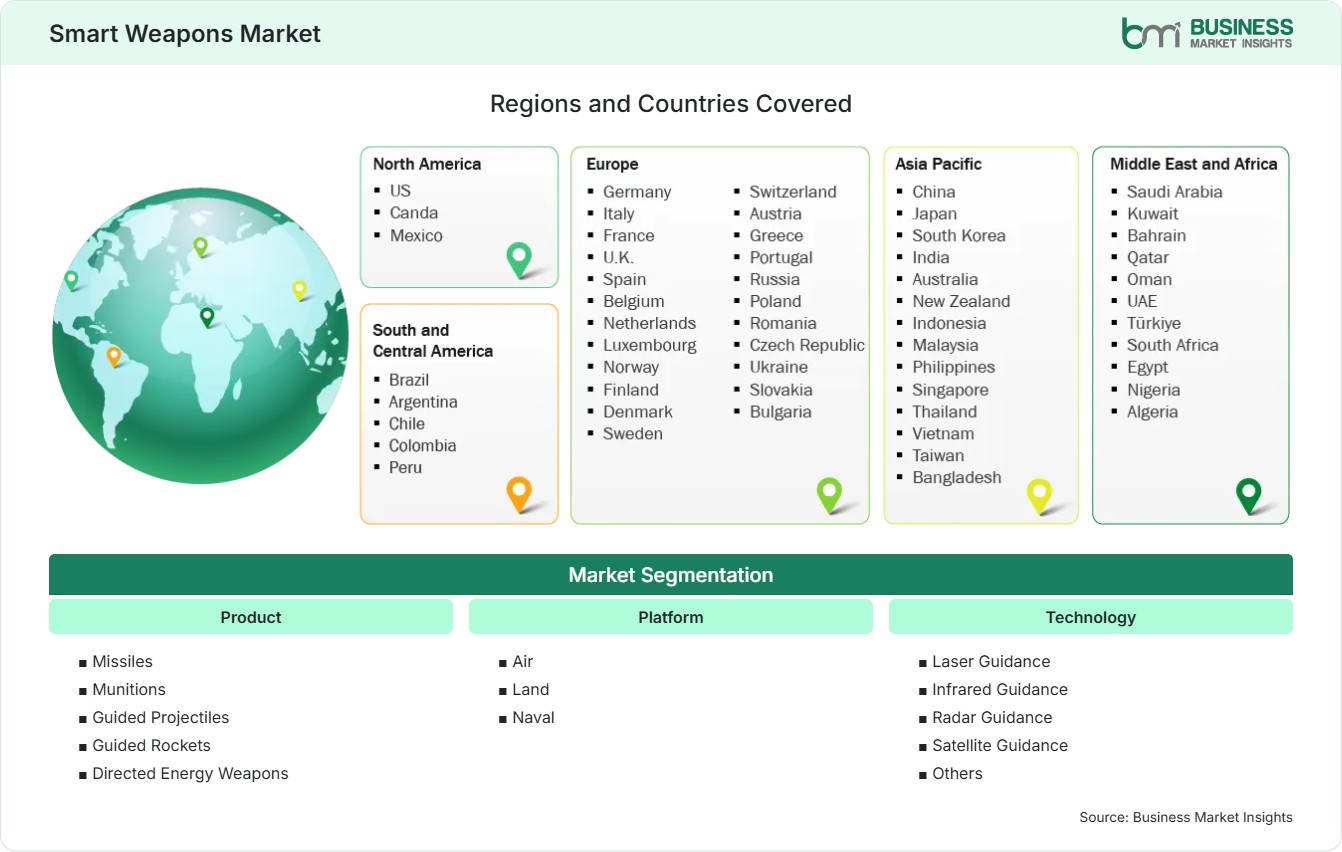
Global Market Geography
FREE PDF
Request your free sample
Request free sample
Segment Analysis

Smart Weapons Market Segmentation

Product

Missiles represented a 38%–42% of global smart weapons market share in 2025 and are projected to grow at a 10.5%–12.5% CAGR during 2026–2033. Demand is supported by long-range precision strike requirements, deterrence strategies, air-defense modernization, and multi-domain operations. Munitions, guided projectiles, guided rockets, and directed energy systems are also advancing through investments in accuracy, range, autonomy, and survivability.

  • Missiles: Missiles support precision strike, deterrence, air defense, and long-range engagement requirements, with development increasingly focused on advanced seekers, extended range, maneuverability, and network integration.
  • Munitions: Smart munitions improve targeting accuracy and operational effectiveness through precision guidance, enabling military forces to engage designated targets while optimizing ammunition utilization.
  • Guided Projectiles: Guided projectiles enhance artillery precision through advanced navigation and targeting technologies, supporting long-range fires and improved accuracy across complex battlefield environments.
  • Guided Rockets: Guided rockets combine extended range with improved precision, supporting land-based strike missions and enabling forces to engage targets with greater accuracy than conventional unguided systems.
  • Directed Energy Weapons: Directed energy weapons offer emerging capabilities for countering drones, missiles, and other threats, with development focused on power generation, beam control, range, and operational scalability.

Platform

Air platforms represented a 45%–49% share in 2025 and are projected to grow at a 10.0%–12.0% CAGR during 2026–2033. Aircraft-based smart weapons benefit from precision strike requirements, standoff engagement, and integration with advanced sensors. Land and naval platforms are also expanding capabilities through precision fires, missile systems, and networked targeting technologies.

  • Air: Air-launched smart weapons support precision strike and standoff engagement, integrating advanced guidance, aircraft sensors, and command networks to improve accuracy and operational flexibility.
  • Land: Land platforms employ guided missiles, projectiles, and rockets for precision fires, air defense, and tactical engagement, with modernization focused on range and targeting accuracy.
  • Naval: Naval platforms increasingly use precision missiles and guided weapons for maritime security, anti-ship operations, air defense, and long-range strike missions across contested environments.

Technology

Laser Guidance represented a 24%–28% share in 2025 and is projected to grow at a 10.0%–12.0% CAGR during 2026–2033. Laser guidance remains valuable for precision engagement, while satellite, radar, and infrared systems support operations requiring greater range, all-weather performance, autonomous targeting, and resilience against changing battlefield conditions.

  • Laser Guidance: Laser guidance provides high precision for designated targets and is widely used in guided munitions where accurate engagement and controlled targeting are critical operational requirements.
  • Infrared Guidance: Infrared guidance enables weapons to identify thermal signatures and engage heat-emitting targets, supporting air-to-air, air-to-ground, and specialized precision strike applications.
  • Radar Guidance: Radar guidance supports target detection and engagement across varied conditions, offering capabilities for long-range missiles, air defense, and complex operational environments.
  • Satellite Guidance: Satellite guidance improves positioning and navigation accuracy, supporting precision strikes and enabling weapons to engage designated coordinates across extended ranges and diverse operational conditions.
  • Others: Other technologies include multimode guidance, electro-optical systems, inertial navigation, and emerging autonomous approaches that improve targeting flexibility and operational resilience.
Market Forces

Smart Weapons Market Dynamics

Key Market Drivers

Rising Defense Spending and Demand for Precision Strike Capabilities

As defense spending increases, military organizations are prompted to upgrade their inventory as well as enhance their precision strike capability. There has been an increasing smart weapons market trend towards developing weapons which are accurate, have a greater engagement range, and are more effective against complicated targets. The use of precision-guided technology may lead to lesser amounts of ammunition being needed while at the same time enhancing military operations. Greater investments made in missile systems, guided weaponry, and advanced target acquisition systems have enhanced the purchasing possibilities for defense companies.

Rising Need for Advanced Weapons with Improved Accuracy and Range

There is an increasing demand for weapons in modern-day military warfare which should be able to strike the targets with greater accuracy at a much farther distance under challenging environmental conditions. The use of guidance systems, increased propulsion, advanced seekers, and precise navigation systems allows weapons to have increased ranges and accuracy. This becomes necessary especially when the traditional systems have to fight against layered defense system or challenging geographic conditions. There is an ongoing development in terms of missiles with long ranges and high accuracy, guided rockets, and advanced projectiles.

Increasing Military Focus on Network-Centric Warfare Technologies

Modern military organizations tend to integrate weapons with sensors, intelligence systems, command and control systems, UAVs, and other sources of battle field information in real-time. This kind of network-centric warfare makes it possible for commanders to find out the target, coordinate their assets, and make better decisions regarding engagement in various domains. Smart weapons become an important element of architecture due to the ability of weapons to exchange information using the modern guidance and communication technologies.

Key Market Opportunities

Expansion of Smart Weapons Programs Across Emerging Defense Markets

The opening up of new emerging defense markets has been caused due to increased investments in military modernization by governments and the need for advanced precision technologies. Countries in Asia Pacific, Middle East, and some of the Latin American markets have embarked on purchasing of missiles, precision-guided weapons, air defense technologies and automation technologies. There have also been initiatives to localize manufacturing which have promoted collaborations between foreign defense companies and local manufacturers. The foreign defense companies can be beneficiaries through technology transfer, localization, maintenance and integrated weapons solutions. There is a higher demand for such technologies from countries that wish to achieve strategic autonomy from imported defense technologies. Modular platforms and flexible manufacturing technologies would help in meeting the diverse needs of various countries.

Growing Opportunities from Modernization of Military Weapon Systems

Aging military inventories are creating opportunities for manufacturers to provide replacement systems and upgrade existing weapons with advanced guidance, sensors, communication capabilities, and digital interfaces. Modernization can extend the operational life of platforms while improving precision and interoperability without requiring complete system replacement. Manufacturers can also develop retrofit packages that improve targeting accuracy, navigation, and mission flexibility. The opportunity is particularly relevant in markets balancing operational requirements with constrained procurement budgets.

Rising Demand for Autonomous and Precision-Guided Defense Technologies

The rise of autonomous technologies has opened up new possibilities of developing intelligent weapons that could function using advanced sensory and navigational technology onboard. Military agencies are considering the use of autonomous and semi-autonomous technologies for enhancing their reaction time and keeping soldiers safe in dangerous conditions. Advanced technologies such as seeker technology, artificial intelligence, machine learning, and sensor fusion can help in detecting and tracking targets with greater accuracy. There will be an increased investment in sophisticated software, electronic devices, sensors, and communications systems in order to develop flexible precision weapons.

Market Restraints and Challenges

High Development and Procurement Costs of Advanced Smart Weapons

Factor: Modern smart weaponry involves complex guidance systems, sensor technology, electronics, propulsion mechanisms, specialized material handling, and rigorous testing, thus making it very capital-intensive to develop and produce. Impact: High costs related to research and development, production, acquisition, and other activities can strain defense budgets and affect acquisition programs as well as adoption by nations that have smaller budgets for defense.

Stringent International Regulations Restrict Smart Weapons Transfers

Factor: International rules for arms control, export licensing, end-user rules, technology transfer rules, and geopolitics could result in stringent regulation on the international sales of high-end smart weapons and technology. Impact: The difficulty in regulations will be limiting market entry, delays in approval process, postponement of international orders, and will limit the capacity of manufacturers to enter some defense markets. Guidance systems, targeting systems, propulsion, and autonomous technologies could undergo more scrutiny due to strategic reasons.

Company Analysis

Competitive Landscape

Smart Weapons Market Analysis has been influenced by competition among global defense firms, who possess strengths in the form of missiles, precision-guided weapons, guidance systems, aerospace systems, sensors, propulsion systems, and defense electronics. Top firms have been building their market position through government orders, foreign collaborations, co-development efforts, and cutting-edge technology investments.

Company Name

Overview

Products and Services relevant to this market

Lockheed Martin Corporation

Major aerospace and defense company with extensive capabilities across missile systems, precision weapons, and advanced military technologies.

Precision-guided missiles, tactical weapons, hypersonic systems, missile defense, advanced targeting, and integrated defense solutions.

RTX Corporation

Global aerospace and defense company developing advanced missile systems, sensors, propulsion, and precision strike technologies.

Missiles, guided weapons, seekers, radar systems, air defense, precision munitions, and advanced propulsion technologies.

Northrop Grumman Corporation

Defense technology company specializing in advanced weapons, autonomous systems, aerospace platforms, and integrated military capabilities.

Precision weapons, advanced munitions, autonomous technologies, targeting systems, missile defense, and defense electronics.

BAE Systems plc

Global defense company providing precision weapons, guided munitions, advanced electronics, and military systems.

Precision-guided weapons, artillery systems, munitions, electronic warfare, targeting technologies, and defense systems.

General Dynamics Corporation

Defense contractor with capabilities spanning land systems, aerospace, naval platforms, and advanced military technologies.

Guided weapons, precision munitions, tactical systems, missile technologies, and integrated defense platforms.

Boeing Defense, Space & Security

Aerospace and defense business developing advanced aircraft, missiles, precision weapons, and networked military systems.

Precision-guided munitions, missiles, autonomous systems, air-launched weapons, and integrated defense technologies.

Rheinmetall AG

European defense technology company supplying weapons, ammunition, military vehicles, and advanced defense solutions.

Precision ammunition, guided munitions, air defense, weapon systems, advanced sensors, and military technologies.

Leonardo S.p.A.

Aerospace and defense company providing advanced electronics, helicopters, aircraft, sensors, and weapon-related technologies.

Precision-guided systems, defense electronics, sensors, targeting technologies, and integrated military solutions.

MBDA

Multinational missile systems company specializing in advanced missile and precision weapon technologies for defense forces.

Air-defense missiles, cruise missiles, anti-ship missiles, air-to-air systems, precision strike, and guided weapons.

Saab AB

Swedish defense and aerospace company developing advanced weapons, sensors, surveillance, and military systems.

Guided weapons, missiles, precision strike systems, sensors, targeting technologies, and integrated defense solutions.

Trust & Transparency

Research Methodology

The market analysis combines proprietary research with secondary data from government agencies, company disclosures, regulatory filings, industry databases and expert interviews. Market estimates are validated through data triangulation, cross-market benchmarking and analyst review.

View Full Research Methodology

Questions Answered

Frequently Asked Questions

What is the main challenge facing smart weapons adoption?

High development and procurement costs remain a major challenge, while export controls and international regulations can restrict technology transfers and limit access to advanced weapon systems.

How is network-centric warfare influencing smart weapons?

Weapons are increasingly integrated with sensors, intelligence platforms, command networks, and unmanned systems, enabling faster targeting, improved situational awareness, and coordinated multi-domain operations.

Why is Asia Pacific the fastest-growing region?

Military modernization, territorial security requirements, rising defense investment, indigenous weapons development, and procurement of precision-guided systems are supporting rapid regional expansion.

Which product segment leads the market?

Missiles represent the leading product segment due to demand for precision strike, deterrence, long-range engagement, air defense, and modernization of military missile inventories.

What is driving demand for smart weapons market report?

Demand is driven by defense modernization, precision strike requirements, long-range engagement needs, military network integration, and increasing investment in advanced guidance and autonomous technologies.

Access the Full Smart Weapons Market Report

Get segment-level forecasts, regional estimates, competitive benchmarking, company profiles and downloadable Excel datasets.

Access the full Smart Weapons Market Report
350 pages PDF & Excel | 2026-08-06
Similar Research

Related Market Reports