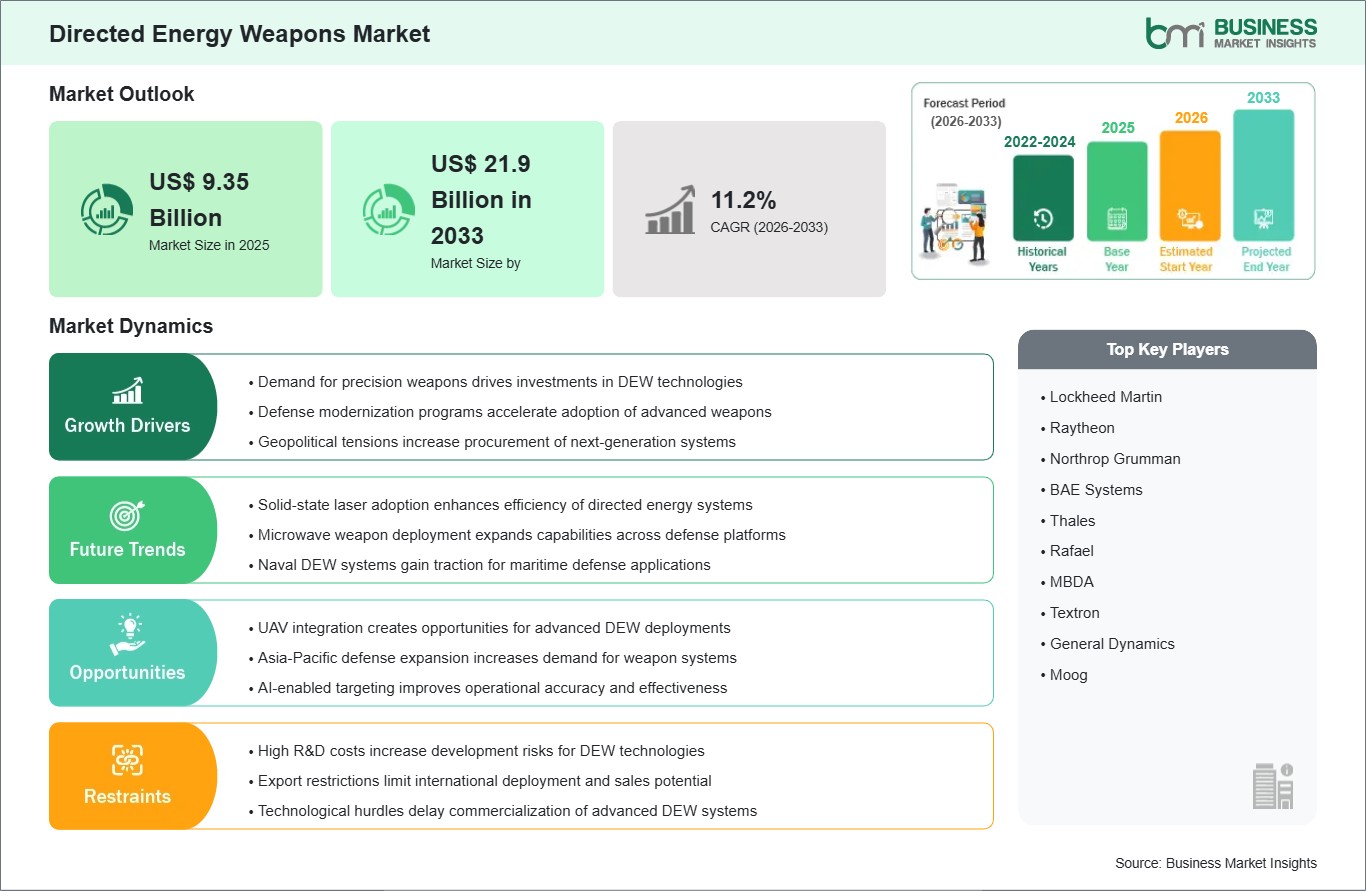
The directed energy weapons market size is expected to reach US$ 21.9 billion by 2033 from US$ 9.35 billion in 2025. The market is estimated to record a CAGR of 11.2% from 2026 to 2033.
Directed energy weapons's market is positioned at the forefront of next-generation defense modernization, driven by the growing demand for rapid-response, high-precision, and scalable military capabilities. Directed energy systems-including high-energy lasers, high-power microwave systems, and particle beam concepts-are designed to incapacitate or destroy targets using concentrated energy rather than conventional munitions. Their ability to engage threats at the speed of light, with minimal ammunition logistics and reduced collateral damage, is reshaping strategic defense thinking across major military powers.
A key driver of this market is the increasing complexity of modern threat environments, particularly the rise of unmanned aerial systems, swarm drones, and advanced missile technologies. Traditional defense mechanisms often struggle to counter large volumes of low-cost, fast-moving threats, whereas directed energy systems offer cost-effective per-engagement solutions and near-instantaneous response capabilities. This has led to accelerated investment in laser-based air defense platforms, ship-mounted microwave systems, and mobile ground-based DEW units for layered defense architectures.
Technological advancements are also playing a critical role in market development. Improvements in power generation, thermal management, beam precision, and energy storage systems are enhancing the operational reliability and scalability of directed energy platforms. Militaries are actively exploring integration across land, naval, airborne, and space domains, where DEWs can complement existing kinetic systems and provide flexible engagement options. Their ability to reduce dependency on physical ammunition supply chains is further strengthening their strategic appeal.
Despite strong defense interest, the market faces significant challenges, including high development costs, system miniaturization difficulties, and performance limitations under adverse atmospheric conditions such as fog, dust, and humidity. Additionally, operational doctrine integration and regulatory considerations surrounding deployment continue to evolve. Nevertheless, ongoing defense R&D initiatives and increasing geopolitical tensions are expected to sustain long-term momentum for directed energy weapons as a transformative force in future warfare systems.

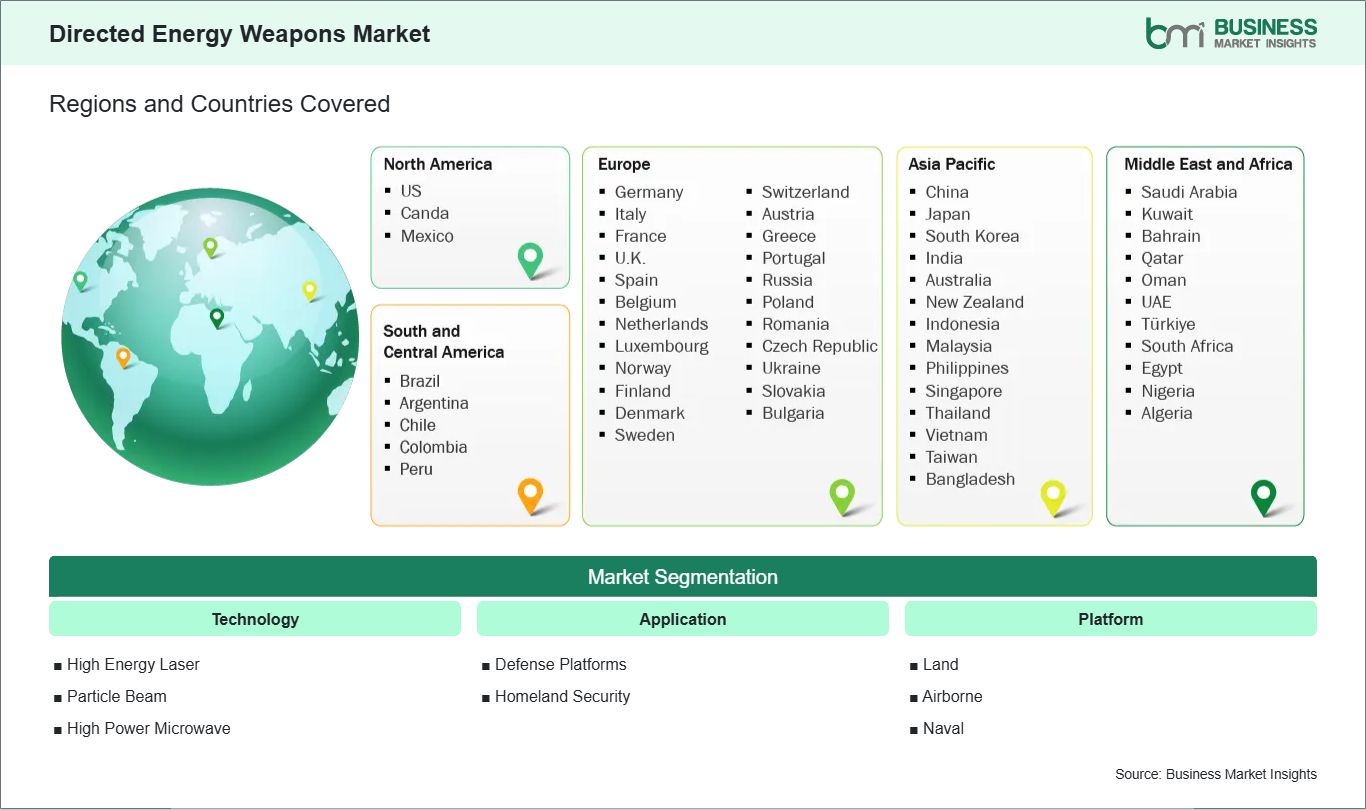
The directed energy weapons (DEW) market is segmented based on technology, application, and platform, driven by rising geopolitical tensions, modernization of defense systems, and the growing demand for precision, low-cost-per-engagement, and high-speed threat neutralization capabilities.
The directed energy weapons (DEW) market is expanding as modern defense strategies increasingly prioritize precision, speed, and reduced collateral damage. Military forces worldwide are increasingly moving towards sophisticated systems that can engage targets accurately while using minimal amounts of conventional ammunition. The reason behind this move lies in the necessity to confront modern aerial and missile threats, such as drones and hypersonic projectiles.
Directed energy systems such as high-energy lasers and high-power microwave weapons offer near-instantaneous engagement capabilities, making them highly suitable for precision interception scenarios. The capacity of providing focused energy at the speed of light helps with improved response capabilities in the case of multi-target environments. Because of this capability, lasers are considered ideal for use in air defense and missile interception.
Another key factor supporting demand is the growing emphasis on cost-effective engagement per shot. As compared to traditional weapons, which require an ongoing supply of ammunition, DEWs depend on electrical energy, making them cost-effective in terms of their use. In addition to being more accurate, these weapons allow for increased precision, which is why there is increasing interest from defense sectors in energy-based weapons.
The key opportunity that exists in the market of directed energy weapons is in the incorporation of these weapons on UAVs. As the role of unmanned aerial vehicles increases in the field of warfare through roles such as reconnaissance, surveillance, and combat engagements, the use of directed energy weapon systems on board can create new opportunities for the vehicle itself.
UAV-mounted directed energy systems can provide extended operational reach while maintaining a low risk profile for personnel. High-powered lasers and microwaves that can be incorporated onto drones themselves can be employed against drones, targets, or enemy systems via electronic jamming. The ability of UAVs to maneuver enables these weapons to be deployed in forward positions or battle zones, where other platforms would face difficulties operating.
Additionally, advancements in power storage, miniaturization, and thermal management are making it increasingly feasible to mount directed energy systems on aerial platforms. With growing autonomy of UAVs, the combination of AI-powered targeting and directed energy weaponry is set to bring about important enhancements in combat efficiency. In addition, such a synergy represents an essential sphere of development that will bring benefits to the future military equipment.
The directed energy weapons market is projected to grow from US$ 9.35 billion in 2025 to US$ 21.9 billion by 2033, registering a CAGR of 11.2% from 2026 to 2033.
By technology, High Energy Laser (HEL) systems dominate the market due to their precision targeting, rapid engagement capability, and relatively lower per-shot cost compared to other directed energy solutions. Continuous advancements in laser power scaling, beam control, and thermal management are accelerating their adoption across modern defense programs.
By application, Defense Platforms dominate the market as militaries worldwide increasingly invest in directed energy weapons for missile defense, counter-drone operations, and electronic warfare. Growing geopolitical tensions and the need for advanced non-kinetic weapon systems are driving large-scale procurement for battlefield and strategic defense use.
By platform, the naval segment dominates the market owing to its strong suitability for high-power systems, stable power availability, and growing need for ship self-defense against drones, missiles, and asymmetric threats. Naval forces are among the earliest adopters of operational directed energy systems, further strengthening this segment's leadership.
| Report Attribute | Details |
|---|---|
| Market size in 2025 | US$ 9.35 Billion |
| Market Size by | US$ 21.9 Billion in 2033 |
| Global CAGR (2026 - 2033) | 11.2% |
| Historical Data | 2022-2024 |
| Forecast period | 2026-2033 |
| Segments Covered | By Technology
|
|
Regions and Countries Covered
| |
| North America | US, Canada, Mexico |
| Europe | Germany, Italy, France, U.K., Spain, Belgium, Netherlands, Luxembourg, Norway, Finland, Denmark, Sweden, Switzerland, Austria, Greece, Portugal, Russia, Poland, Romania, Czech Republic, Ukraine, Slovakia, Bulgaria |
| Asia-Pacific | China, Japan, South Korea, India, Australia, New Zealand, Indonesia, Malaysia, Philippines, Singapore, Thailand, Vietnam, Taiwan, Bangladesh |
| South and Central America | Brazil, Argentina, Chile, Colombia, Peru |
| Middle East and Africa | Saudi Arabia, United Arab Emirates, Kuwait, Bahrain, Qatar, Oman, Turkiye, South Africa, Egypt, Nigeria, Algeria |
| Market leaders and key company profiles |
|
The "Directed Energy Weapons Market Size and Forecast (2022-2033)" report provides a detailed analysis of the market covering below areas:
In terms of the geographical distribution of the Directed Energy Weapons (DEW) Market, there is a highly concentrated pattern of adoption driven by defense modernization programs, rising geopolitical tensions, and increasing investments in next-generation military technologies.
North America is a dominant market for directed energy weapons, supported by strong defense budgets, advanced R&D capabilities, and the presence of leading defense contractors. The US has been spending a great deal of money on laser-based weapons, ship-mounted directed energy systems, and C-UAS systems for military purposes in both airborne, ground, and naval forces. Constant financial support from defense organizations for prototype production, field testing, and deploying of scalable DEW systems has fueled the growth of the market. The region's focus on next-generation warfare capabilities and integration of DEW systems into existing defense platforms further strengthens its leadership position.
Asia Pacific is witnessing rapid growth in the directed energy weapons market due to increasing defense spending, territorial security concerns, and the modernization of military capabilities. China, India, Japan, and South Korea have been spending heavily on the development of futuristic weapons systems that include directed energy systems for air defense and drones. The emphasis in the region towards indigenous military manufacturing, along with the development of defense systems, is a key factor motivating the R&D efforts related to directed energy weapons systems. Rising border tensions and maritime security challenges are further contributing to the adoption of advanced defensive and offensive energy-based weapon systems.
Both regions play a critical role in the expansion of the directed energy weapons market, driven by accelerating defense modernization efforts, increasing demand for precision engagement systems, and growing investments in high-energy laser and microwave technologies for next-generation military applications.

The directed energy weapons market is evaluated by gathering qualitative and quantitative data post primary and secondary research, which includes important corporate publications, association data, and databases. Recent developments and news in the market include:
The Directed Energy Weapons Market is valued at US$ 9.35 Billion in 2025, it is projected to reach US$ 21.9 Billion in 2033 by .
As per our report Directed Energy Weapons Market, the market size is valued at US$ 9.35 Billion in 2025, projecting it to reach US$ 21.9 Billion in 2033 by . This translates to a CAGR of approximately 11.2% during the forecast period.
The Directed Energy Weapons Market report typically cover these key segments-
The historic period, base year, and forecast period can vary slightly depending on the specific market research report. However, for the Directed Energy Weapons Market report:
The Directed Energy Weapons Market is populated by several key players, each contributing to its growth and innovation. Some of the major players include:
The Directed Energy Weapons Market report is valuable for diverse stakeholders, including:
Essentially, anyone involved in or considering involvement in the Directed Energy Weapons Market value chain can benefit from the information contained in a comprehensive market report.
Please tell us your area of interest
(Market Segments/ Regions and Countries/ Companies)